Knowing how to tell if a rack end is bad can be difficult because steering looseness, knocking, and unstable handling have several possible causes. If you assume the rack end has failed based on one symptom, you may replace the wrong part. A proper inspection can trace the movement and confirm what needs attention.
A bad rack end may cause steering looseness, clunking, wandering, or unusual tire wear, but none of these symptoms confirms failure by itself. The strongest evidence is excessive play that a qualified technician traces directly to the rack end’s ball-and-socket joint after safely inspecting the complete steering and suspension system.
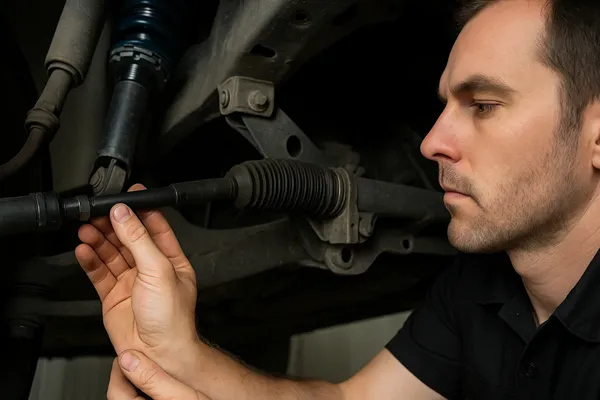
You can notice changes in steering feel and sound, but you cannot always identify their source from the driver’s seat. Understanding how the part works, which symptoms matter, and what else can imitate rack-end wear will help you decide when to arrange an inspection.
What Does a Rack End Do?
A steering problem feels urgent because the steering system controls where your vehicle goes. However, it is hard to judge a component without understanding its role. The rack end connects steering-rack movement to the outer tie-rod end, allowing your wheels to turn while the suspension moves.
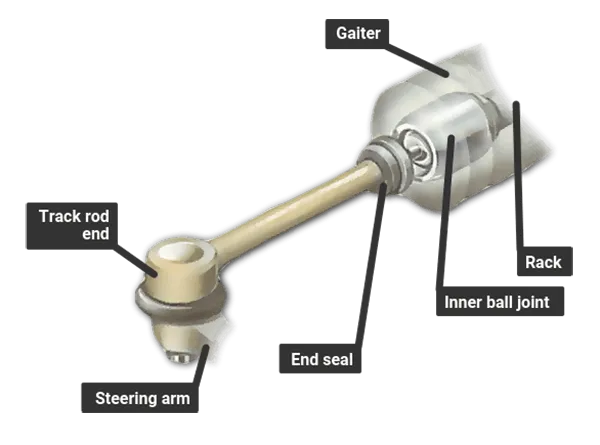
A rack end transfers movement from the steering rack toward the steering knuckle through the outer tie-rod end. Its flexible ball-and-socket joint allows controlled angular movement. If internal wear creates excessive clearance, steering input may no longer reach the wheel as precisely as intended.
Why is it also called an inner tie rod?
Depending on your region or parts catalog, you may see the rack end described as an inner tie rod, inner tie-rod end, or axial joint. Terminology and design can vary by vehicle, so you should confirm the exact application through the vehicle identification details and a reliable catalog.
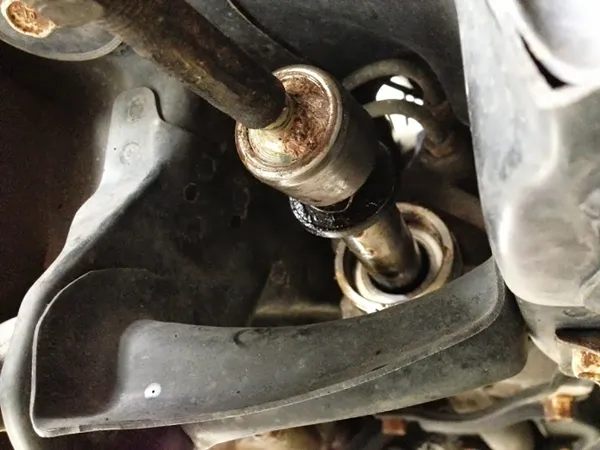
The part normally sits between the steering rack and the outer tie-rod end. A protective steering-rack boot usually covers its inner joint. That boot helps keep dirt, water, and road contamination away from the rack and joint area.
How does wear create looseness?
The joint contains a ball-and-socket arrangement designed to move through a controlled range while resisting unwanted free play. Over time, wear or contamination may increase the clearance inside that joint. This can create a delay between your steering input and the wheel’s response.1
From our perspective as a steering and suspension parts manufacturer, this relationship between internal clearance and external movement is the key point. A worn joint can produce movement, but the symptom must still be traced to that exact location. A sound heard near the rack does not prove that the rack end itself is responsible.
Possible contributors to rack-end deterioration can include:
- Damage to the protective boot
- Water, dust, or road debris entering the joint area
- Impact from potholes, curbs, or rough roads
- Wear in the joint’s internal contact surfaces
- Incorrect installation or an unsuitable replacement part
- Problems in nearby components that increase steering-system loads
The design is relatively simple, but diagnosis is not. Movement passes through several connected parts. Play that seems to come from the inner tie rod may actually start at the outer tie-rod end, steering rack, wheel bearing, or another suspension joint.
What Symptoms May Suggest a Rack End Is Bad?
You may first notice a knock, vague steering, or a vehicle that seems less settled than usual. These changes should not be ignored. However, they should be treated as reasons to investigate, not as proof that you need to order a new rack end.
Possible symptoms of a bad rack end include excessive steering free play, knocking or clunking during steering movement, unstable directional control, and abnormal tire wear.2 Because other steering and suspension faults can produce the same symptoms, the rack end must be inspected before replacement is recommended.
Steering feels loose or delayed
You may feel that you need to move the steering wheel farther than usual before the vehicle responds. The vehicle may also require frequent corrections to remain on course.
This can happen when clearance inside a rack-end joint absorbs part of the initial steering movement. However, loose steering can also come from the steering rack, outer tie-rod ends, ball joints, wheel bearings, mounting points, or other components. Tire condition and wheel alignment can also change how a vehicle tracks.3
For this reason, steering looseness is an important warning sign, but it is not a standalone diagnosis.
You hear knocking or clunking
A worn joint may make a knock when steering movement changes direction or when the suspension moves over uneven surfaces. Customers in aftermarket markets often associate this sound with tie-rod wear, but noise travels through metal parts and can be misleading.
Similar sounds may come from:
- Outer tie-rod ends
- Ball joints
- Stabilizer links
- Control-arm bushings
- Steering-rack mountings
- Strut or shock absorber mountings
- Loose fasteners or damaged brackets
You can note when the noise occurs, such as during low-speed steering or travel over bumps. That information may help a technician reproduce the condition. It still does not identify the failed component by itself.
Steering feels unstable or unpredictable
A vehicle that wanders, changes direction unexpectedly, or feels difficult to control needs prompt attention. Excess movement in a steering joint can affect directional accuracy, but so can tire damage, incorrect tire pressure, wheel-bearing wear, alignment problems, or other steering faults.
You should not keep driving simply to gather more clues if the steering feels meaningfully loose or unpredictable. The risk of leaving genuine steering play unaddressed is more important than identifying the part from road feel alone.
Tires show uneven wear
Loose steering components may contribute to changing wheel alignment and irregular tire wear.4 However, tire wear develops for many reasons, including pressure problems, worn suspension parts, alignment errors, and damaged wheels.
Tire wear can support an investigation, but it cannot confirm that a rack end is bad. A technician should evaluate both the tire pattern and the mechanical condition of the vehicle.
How Can You Tell If a Rack End Is Bad?
Guessing from noise can lead to an unnecessary purchase, while dismissing real looseness can leave a safety-related problem unresolved. You need evidence that separates normal joint movement from excessive play and identifies precisely where that play begins.
You can tell a rack end is bad when a qualified technician reproduces the reported movement and traces excessive free play to the inner tie-rod ball-and-socket joint. The inspection should also rule out the outer tie-rod end, steering rack, wheel bearing, ball joint, bushings, and nearby mounting points.
What can you observe safely?
You can give the technician useful information without attempting a complete diagnosis. Before arranging the inspection, consider documenting:
- When the symptom began
- Whether it is becoming worse
- Whether it occurs while steering, braking, or crossing bumps
- Whether you feel looseness, vibration, pulling, or delayed response
- Whether the tires show new or uneven wear
- Whether the vehicle recently hit a pothole or curb
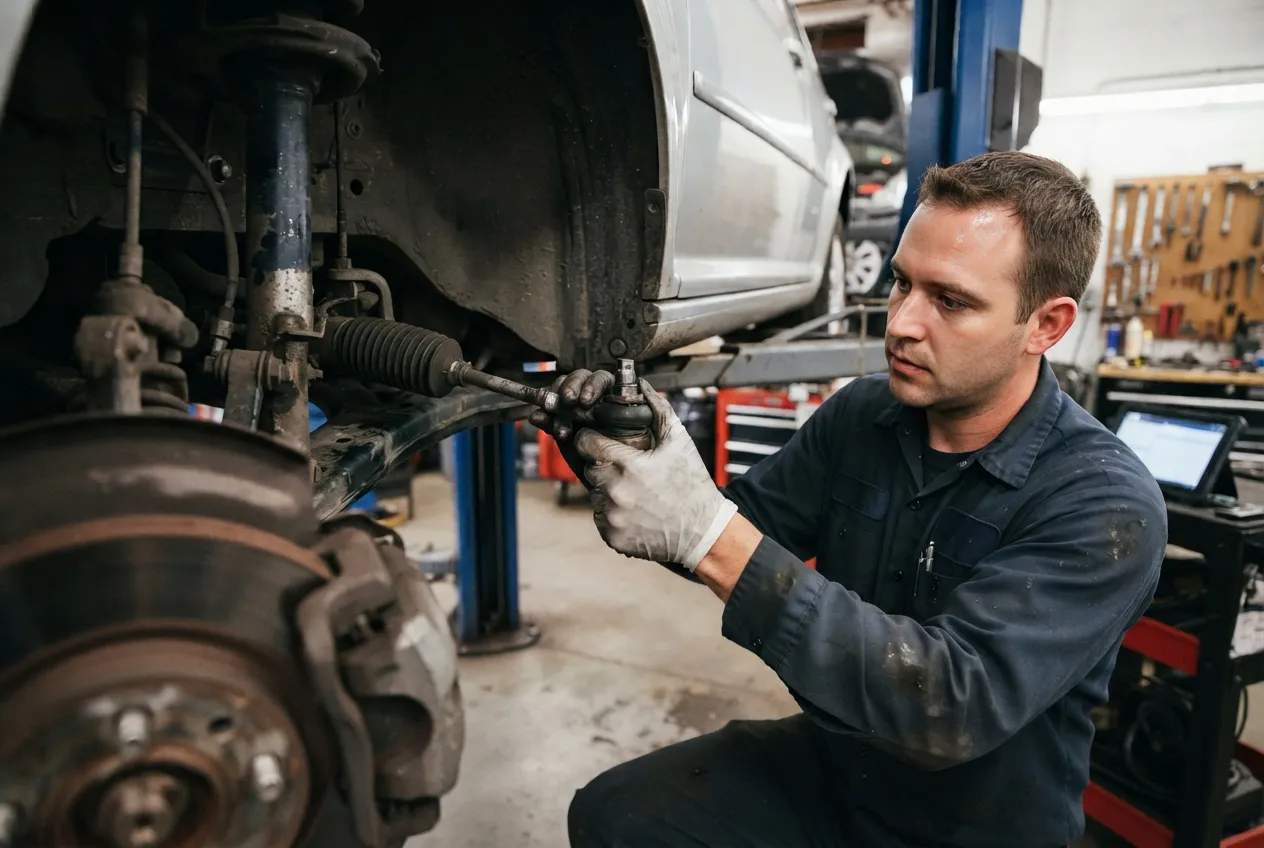
You should avoid crawling under a vehicle that is not professionally supported.5 You should also avoid asking another person to move the steering while you reach near exposed or moving components. A safe workshop has suitable lifting equipment and inspection procedures.
What should the technician check?
The exact process depends on the vehicle design and the manufacturer’s service information. In general, the technician should inspect the connected system rather than looking at the rack end in isolation.
A sound diagnosis usually includes:
- Reproducing the reported symptom when safe
- Checking the wheels and tires for obvious damage
- Inspecting steering and suspension joints for free play
- Comparing movement at the inner and outer tie-rod joints
- Examining the steering-rack boot and nearby mountings
- Checking wheel-bearing and ball-joint movement
- Determining whether the steering rack itself contributes to the play
- Consulting model-specific service specifications when required
The most persuasive finding is not simply that a wheel moves. It is that the technician can see or feel movement at the relevant joint while confirming that connected components are not causing it.
Why does exact fault location matter?
Replacing the wrong component costs money and may leave the original problem unchanged. It can also create false reassurance because the steering system has received a new part while the actual source of looseness remains.
At the same time, waiting too long when genuine play is present can allow steering control and tire wear to deteriorate. This is why the best decision is not “replace it just in case” or “keep driving until it gets worse.” The best decision is to obtain a prompt, differential inspection.
What Else Can Mimic a Bad Rack End?
Many steering and suspension parts operate within the same small area. When one develops clearance or loses stiffness, the sound and movement can travel through the assembly. Without checking each connection, you can easily mistake another fault for a bad rack end.
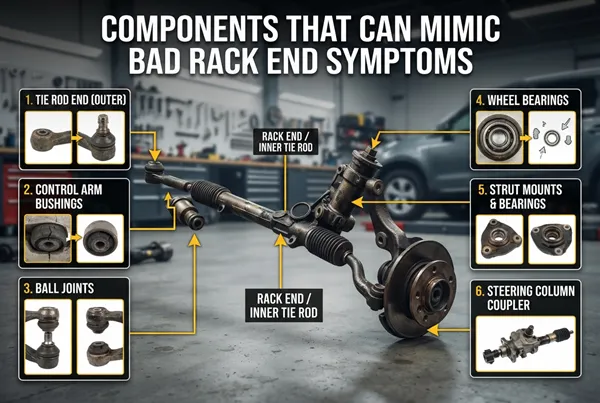
Parts that can mimic a bad rack end include the outer tie-rod end, ball joint, control-arm bushing, wheel bearing, stabilizer link, steering-rack mounting, and the steering rack itself. Tires, wheels, and alignment conditions can also produce wandering, vibration, pulling, or uneven wear.
Common sources of similar symptoms
| Possible source | Symptoms you may notice | What requires confirmation |
|---|---|---|
| Rack end or inner tie rod | Free play, knock, vague steering | Movement inside the inner joint |
| Outer tie-rod end | Looseness, clunking, uneven wear | Play at the outer joint |
| Ball joint | Knock, unstable handling, tire wear | Movement at the ball joint |
| Wheel bearing | Play, humming, vibration | Bearing movement or roughness |
| Control-arm bushing | Knock, wandering, braking movement | Cracking, separation, or excess deflection |
| Steering rack or mounting | Loose response, noise, leakage on some designs | Internal rack play or mounting movement |
| Tire or wheel problem | Pulling, vibration, poor tracking | Pressure, damage, balance, or wheel condition |
This overlap explains why a symptom checklist has limits. For example, a knock while turning may seem like strong evidence, but both inner and outer joints move when you steer. A technician must isolate them rather than infer the cause from sound location.
Should both rack ends always be replaced?
There is no universal rule that both sides must always be replaced together. The correct decision depends on the vehicle manufacturer’s guidance, the condition of both sides, product availability, and the technician’s findings.
If one side has confirmed play, it is reasonable to inspect the opposite side carefully. However, inspection should guide the decision rather than an automatic rule.
What matters when selecting a replacement?
You should select a replacement only after confirming the fault. Correct vehicle application and dimensional accuracy are essential because rack ends may differ in thread form, length, joint geometry, and connection design.
For distributors and vehicle owners alike, useful checks include:
- Verified vehicle and application data
- Accurate OE or cross-reference numbers
- Traceable product identification
- Consistent joint movement and dimensions
- Suitable protective boots and corrosion protection
- Clear warranty and supplier documentation
Quality-system certificates, such as ISO 9001 or IATF 16949 documents, can support supplier evaluation, but you should verify their validity and scope. A certificate does not replace application checks or inspection of the actual product.
After replacement, the workshop should follow the vehicle manufacturer’s service information. Steering geometry may need to be checked and adjusted. Model-specific torque values and procedures should always come from verified technical data.
Frequently Asked Questions
Can you drive with a bad rack end?
You should not continue driving if the steering is meaningfully loose, unpredictable, or worsening. These symptoms may indicate a steering-related fault even if the rack end has not yet been confirmed. Arrange a professional inspection promptly and ask the technician whether the vehicle is safe to move.
Does a bad rack end always make noise?
No. A worn rack end may develop excess play without producing an obvious noise. You may notice vague steering or unstable tracking instead. Conversely, a clunk does not automatically mean the rack end is bad because several adjacent parts can create similar sounds.
Can a bad rack end cause uneven tire wear?
A worn rack end can contribute to unstable wheel alignment and uneven tire wear, but tire wear alone cannot confirm the fault. Incorrect pressure, alignment errors, worn bushings, ball-joint problems, and damaged tires can create similar patterns. The vehicle needs a mechanical and tire inspection.
Is a rack end the same as a tie rod end?
A rack end is commonly called an inner tie rod, while “tie rod end” often refers to the outer joint near the steering knuckle. Parts terminology varies between markets and catalogs, so you should confirm the component’s position and vehicle application before purchasing it.
Should wheel alignment be checked after rack-end replacement?
Yes, steering geometry should generally be checked after replacing a rack end or disturbing tie-rod adjustment.6 The workshop should follow the vehicle manufacturer’s procedures and specifications. Correct alignment helps restore steering behavior and reduces the risk of avoidable tire wear.
Conclusion
The safest way to learn how to tell if a rack end is bad is to separate warning signs from proof. Looseness, clunking, wandering, and tire wear justify investigation, but they do not identify the failed part. Confirmation requires a qualified technician to trace excessive play to the inner joint and rule out nearby components. If your steering feels loose, unpredictable, or noticeably worse, arrange a prompt professional inspection. Once the fault is confirmed, choose a correctly matched, quality-documented replacement from a reliable steering-parts supplier.
"8+ Fixes: How to Tighten Steering Wheel Play (DIY)", https://bigblue.atlantisuniversity.edu/how-to-tighten-steering-wheel-play/. Engineering analyses of steering linkages treat joint clearance as a source of lost motion or increased compliance, which can reduce the precision with which steering input is transmitted to the road wheels. Evidence role: mechanism; source type: paper. Supports: Research or engineering literature should show that clearance in steering-linkage joints introduces lost motion or compliance between steering input and road-wheel movement.. Scope note: This establishes the general mechanical relationship but does not define the acceptable clearance for a particular vehicle. ↩
"19VAC30-70-470. Steering. - Virginia Law", https://law.lis.virginia.gov/admincode/title19/agency30/chapter70/section470/. Vehicle-inspection standards identify excessive looseness or wear in tie-rod and steering-linkage joints as a steering defect associated with free play and reduced directional control. Evidence role: general_support; source type: government. Supports: Government vehicle-inspection guidance should identify looseness, wear, or damage in tie-rod and steering-linkage joints as relevant to excessive play and impaired steering condition.. Scope note: Inspection standards support the association with steering defects but may not list every symptom, such as noise or a specific tire-wear pattern. ↩
"TIRE PRESSURE MONITORING SYSTEM FMVSS No. 138", https://www.nhtsa.gov/sites/nhtsa.gov/files/fmvss/tirepressure-fmvss-138.pdf. Vehicle-dynamics literature shows that tire condition and inflation, together with alignment parameters such as toe and camber, influence straight-line stability, steering response, and a vehicle’s tendency to pull or wander. Evidence role: mechanism; source type: research. Supports: Vehicle-dynamics research should explain how tire condition, inflation, and alignment parameters such as toe influence straight-line stability, pulling, and steering behavior.. Scope note: These factors can explain tracking symptoms but do not exclude simultaneous wear in the steering linkage. ↩
"8+ Signs: How to Tell if a Tie Rod is Bad (DIY Guide)", https://bigblue.atlantisuniversity.edu/how-to-tell-if-a-tie-rod-is-bad/. Tire and suspension research identifies wheel-alignment variation, particularly changes in toe, as a contributor to irregular tread wear; looseness in steering linkage can allow the road wheel’s alignment to vary under operating loads. Evidence role: mechanism; source type: research. Supports: Research should establish that changes in toe or other wheel-alignment conditions affect tire-wear distribution and that linkage looseness can allow alignment to vary under load.. Scope note: Irregular tire wear is multifactorial and cannot identify which steering or suspension component, if any, is loose. ↩
"Citation 1276530.015/01001 | Occupational Safety and ...", https://www.osha.gov/ords/imis/generalsearch.citation_detail?id. Occupational-safety authorities identify improperly supported raised vehicles as a crushing hazard and require secure lifting and support arrangements before work is performed underneath. Evidence role: expert_consensus; source type: government. Supports: Occupational-safety guidance should state that raised vehicles must be securely supported before anyone works underneath them.. ↩
"MKIII Golf/Jetta Inner and Outer Tie rod DIY.", https://faculty.ccp.edu/faculty/dreed/campingart/jettatech/tierods/tierods.htm. Steering-geometry references identify tie-rod effective length as an adjustment governing wheel toe, so replacement or disturbance of a tie rod can change alignment and justify a subsequent geometry check. Evidence role: mechanism; source type: education. Supports: A technical source should explain that tie-rod effective length sets or influences toe and that disturbing or replacing the tie rod can therefore require an alignment check.. Scope note: The required alignment procedure and specifications are vehicle-specific, and preserving the prior adjustment does not itself verify that alignment is correct. ↩