
Types of sway bar links can look simple in a catalog, but similar shapes often hide important structural and fitment differences. If you classify them by appearance alone, you risk incorrect applications, returns, and unstable quality. A better approach starts with connection design, followed by fitment, manufacturing, and batch-control verification.
The main types of sway bar links include ball-joint, bushing, hybrid, and adjustable configurations. However, these categories are not globally standardized.1 You should identify the actual connection structure, then verify the OE reference, vehicle application, mounting dimensions, orientation, articulation range, and other configuration details before treating two products as interchangeable.
A category name helps you organize a product range, but it cannot confirm whether a part fits or performs as required. You still need to examine drawings, samples, inspection records, and production controls. The following framework can help you compare products and suppliers without relying on catalog labels alone.
What Are the Main Types of Sway Bar Links?
When catalogs use different names for similar products, product range planning becomes confusing. The same design may be called a sway bar link, stabilizer link, anti-roll bar link, or link rod.2 If you focus only on the name, you can group incompatible parts together.
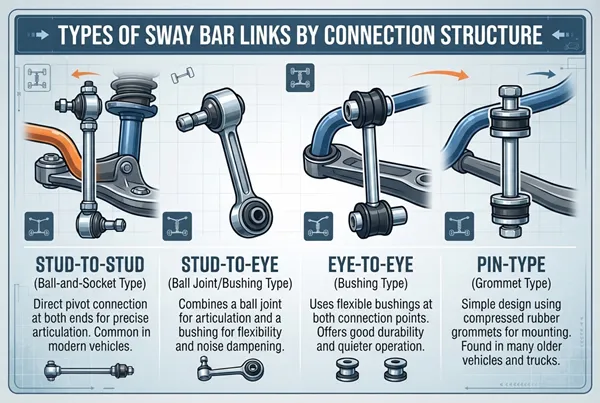
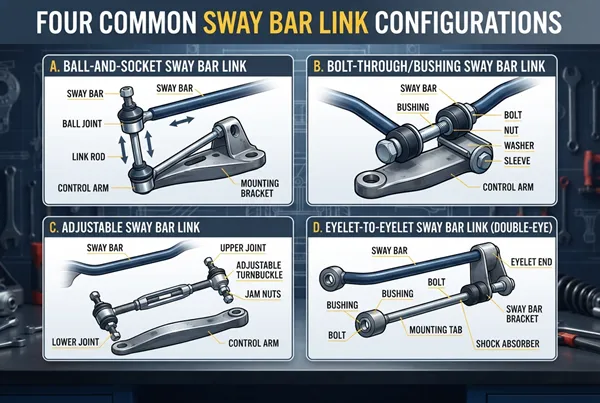
The main types of sway bar links can be classified by their observable connection designs: ball-joint links, bushing links, hybrid links, and adjustable links. This is a practical purchasing framework rather than a universal engineering standard. Each part must still be confirmed against its specific OE reference, mounting arrangement, dimensions, and vehicle application.
Ball-Joint Sway Bar Links
A ball-joint design normally has one or two articulated joints.3 Depending on the application, the studs may face the same direction, opposite directions, or sit at different angles. The center body can be straight, curved, forged, machined, welded, or assembled from several components.
The visible shape does not tell you everything. You should also check:
- Stud diameter and thread specification
- Distance between mounting centers
- Stud orientation
- Joint articulation range
- Body shape and clearance areas
- Boot construction and seating
- Nut type and included hardware
- Left-hand or right-hand application
- Grease specification or lubrication arrangement, where relevant
From my inspection experience, two ball-joint links can look almost identical when placed on a table. However, small differences in stud angle, center distance, or body offset can prevent correct installation or limit joint movement in the installed position.
Bushing-Type Sway Bar Links
Bushing links use rubber, polyurethane, or another specified elastomer at one or both connection points. Some designs use a bolt, sleeve, washers, and several bushings. Others use an eye-style end with a pressed or assembled bushing.
You should verify more than the overall length. Important details can include:
- Sleeve inner and outer diameters
- Bushing dimensions and profile
- Washer shape and thickness
- Bolt length, grade, and thread
- Assembly sequence
- Compression condition after installation
- Elastomer material specification
- Surface treatment of metal components
Bushing hardness alone does not prove service life or suitability. The correct material and construction depend on the vehicle application and the original design requirements.
Hybrid Sway Bar Links
A hybrid link combines different connections. A common example has a ball joint at one end and a bushing or eye connection at the other. This configuration requires separate checks for each end.
Hybrid products can create catalog errors because buyers sometimes compare only the body length. You should confirm which connection belongs at which mounting point, as well as the installed orientation.
Adjustable Sway Bar Links
Adjustable links use threaded components, lock nuts, or similar mechanisms to change the effective length. They may be supplied for modified or specialized applications, but adjustability does not automatically mean better quality, greater strength, or longer service life.
You should ask for the intended adjustment range, locking method, material specification, installation instructions, and application evidence. Application-specific suitability should be reviewed by a qualified vehicle or suspension professional.
| Configuration | Observable feature | Main purchasing risk |
|---|---|---|
| Ball-joint | One or two articulated studs | Incorrect angle, orientation, or movement range |
| Bushing | Elastomer bushings, sleeves, and bolts | Wrong bushing dimensions or assembly sequence |
| Hybrid | Different connection at each end | Reversed orientation or incomplete specifications |
| Adjustable | Threaded length adjustment | Incorrect adjustment, locking, or application selection |
How Should You Verify the Fitment of Different Types of Sway Bar Links?
Approximate dimensions can make two links appear interchangeable. That assumption is risky because a small change in mounting geometry can affect installation. If you rely on photographs or total length alone, you may approve the wrong reference and discover the mismatch only after shipment.
To verify types of sway bar links, compare the vehicle application and OE reference first. Then check mounting-center distance, stud or sleeve dimensions, thread details, body offset, connection orientation, and articulation range. You should use approved drawings or validated samples rather than treating visual similarity as proof of interchangeability.
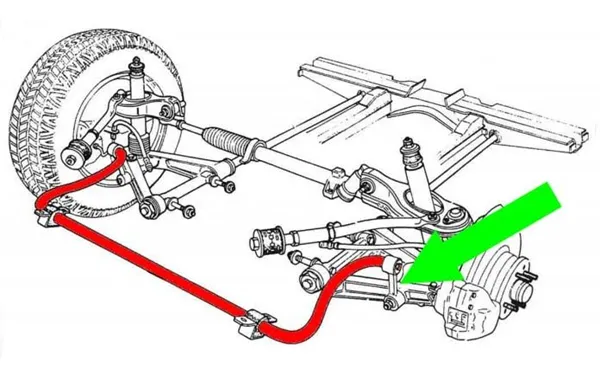
Start With the Application, Not the Shape
Your first check should connect the product to a specific application record. That record may include:
- Vehicle make and model
- Production year or model range
- Chassis or platform code
- Axle position
- Left, right, front, or rear location
- OE reference and accepted cross-references
- Relevant suspension configuration
- Market-specific variations
OE numbers are useful, but you should not treat every online cross-reference as verified. Catalog databases can contain copied or outdated information. When several references are grouped together, ask how the supplier validated the interchange.
Build a Fitment Checklist
A controlled comparison is more reliable than a visual check. Your checklist should cover the features that affect mounting and movement.
| Fitment item | What you should verify |
|---|---|
| Center distance | Measurement between defined mounting centers |
| Stud details | Diameter, thread pitch, usable thread length, and direction |
| Bushing details | Inner diameter, outer diameter, width, and sleeve size |
| Orientation | Relative direction of studs, eyes, or mounting faces |
| Body geometry | Straightness, bends, offsets, and clearance features |
| Articulation | Required joint angle and freedom of movement |
| Hardware | Nuts, washers, sleeves, bolts, and locking features |
| Position | Correct axle side and left/right application |
You should define how every dimension is measured. “Overall length” can mean different things when one person measures tip to tip and another measures between joint centers.
I have seen apparently matching samples reveal clear differences once they were placed in a fixture and checked from defined datums. This is why photographs are useful for screening, but not for final approval.
Control Changes During Cross-Referencing
After you approve a reference, preserve the approval basis. Keep the drawing revision, sample identification, measurement report, packaging label, and application data linked to the product code.
If a supplier proposes a consolidated design for several references, request documented evidence for each application. A shared shape or close dimension is not enough. Any uncertainty about vehicle geometry or suspension function should be reviewed by a qualified technical professional before commercial release.
How Does Manufacturing Quality Affect Types of Sway Bar Links?
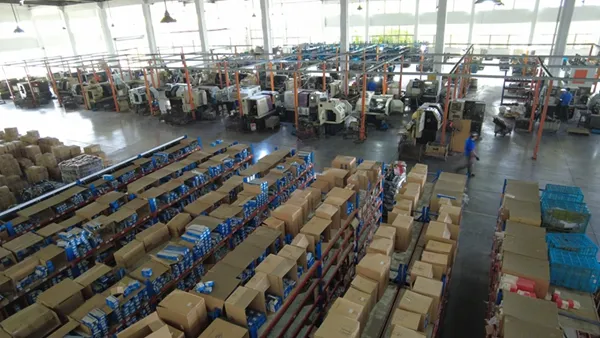
A product can belong to the correct category and still have inconsistent quality. Poor control during material handling, forging, welding, machining, surface treatment, or assembly may not be obvious in a catalog image. This creates risk when an approved sample does not represent later production.
Product type alone does not determine quality. You should evaluate material records, dimensional consistency, forged or machined features, weld control, joint movement, boot assembly, fastener condition, surface treatment, and inspection results. The supplier should also show that these controls are repeated across batches rather than prepared only for one sample.
Examine the Manufacturing Route
Different types of sway bar links may follow different production routes. One product may use a forged body, while another may combine a rod with welded housings. Neither route is automatically superior. What matters is whether the process is suitable for the approved specification and remains controlled.
You can ask the supplier to explain:
- How raw material batches are identified
- Which components are forged, cast, machined, or welded
- How machining fixtures control key dimensions
- Which welding parameters and inspections apply
- How joints, boots, grease, and retaining parts are assembled
- How surface treatment is specified and monitored
- How nonconforming products are isolated
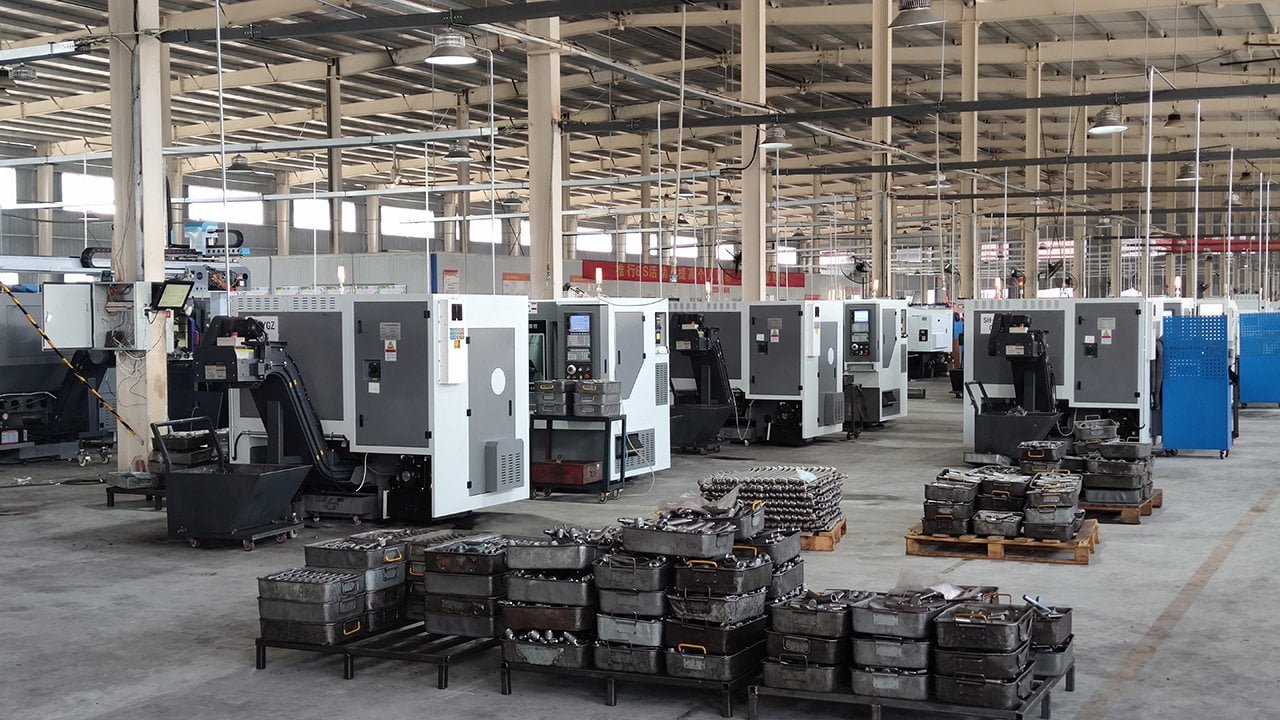
At GDST Auto Parts, for example, I have observed these stages across material handling, forging, welding, machining, assembly, and final inspection. That experience has taught me that small assembly details deserve the same attention as the visible metal body. A poorly seated boot, abnormal joint movement, or incorrect fastener can turn an otherwise acceptable-looking link into a purchasing problem.
Review Inspection Evidence
Your inspection plan should match the approved design. Depending on the product and application, relevant checks may include:
- Material inspection reports and chemical-composition verification
- Key dimensional measurements
- Thread gauges and mounting-diameter checks
- Articulation-angle inspection
- Joint movement or torque-related checks
- Pull-out or compression testing
- Hardness testing
- Fatigue testing4
- Ozone resistance testing for rubber components5
- Salt spray testing for specified surface treatments6
- Packaging, labeling, and quantity inspection
You should define test methods, sample sizes, acceptance limits, and equipment requirements in advance. A report that says only “passed” has limited value if it does not identify the specification, test method, batch, and result.
Certifications such as IATF 16949 and ISO 9001 can support your supplier review, but they should be treated as documents to verify. You should check the issuing body, certificate scope, site address, validity period, and relevance to the products being purchased.
How Can You Source Types of Sway Bar Links With Consistent Batch Quality?
A polished sample can make a supplier look capable, but one acceptable piece does not prove repeatable production. If your evaluation ends with price and sample appearance, later batches may vary in dimensions, assembly condition, labeling, or packaging.
You should source types of sway bar links through a controlled approval process. Confirm the supplier’s application data, drawing control, material traceability, production capability, inspection plan, change-management procedure, and batch records. Then compare production shipments with the approved specification instead of relying on the original sample alone.
Use a Staged Approval Process
A practical supplier evaluation can follow six stages:
- Catalog review: Check vehicle coverage, OE references, product structure, and required position.
- Technical confirmation: Approve drawings, materials, dimensions, hardware, and packaging requirements.
- Sample inspection: Measure critical features and examine movement, assembly, and finish.
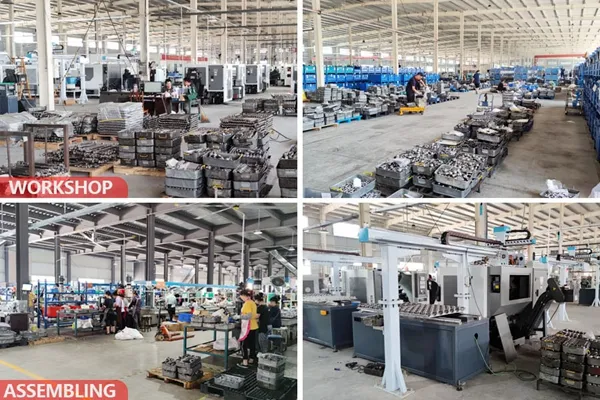
- Process review: Assess production equipment, fixtures, work instructions, and quality controls.
- Pilot order: Compare multiple pieces from a controlled production batch.
- Ongoing monitoring: Review incoming results, claims, corrective actions, and delivery performance.
This process helps you distinguish sample-making ability from mass-production capability.
Look Beyond the Lowest Unit Price
A low quotation can exclude details that another supplier includes. Before comparing prices, confirm whether each offer covers the same:
- Material specification
- Connection structure
- Included nuts, bolts, washers, or sleeves
- Surface treatment
- Grease and boot requirements
- Testing and inspection scope
- Labeling and packaging
- Product traceability
- Tooling or development costs
- Order quantity and delivery terms
A thicker rod should not automatically receive a higher quality rating. A higher price does not prove better control either. You need evidence tied to the approved application and specification.
Check Capacity and Change Control
You should ask whether the production equipment and inspection resources can support your expected order volume. GDST operates 20 production lines and supports OEM/ODM orders, but any buyer should still verify capacity against the specific product mix, forecast, tooling, and delivery schedule.
You should also establish a written change-control rule. The supplier should not change materials, sub-suppliers, tooling, joint components, surface treatment, or packaging without review and approval. This rule is especially important when you manage many part numbers that look similar.
Your real sourcing target is not one correct sample. It is the repeatable production of the correct construction, fitment, inspection standard, and packaging across every approved batch.
Frequently Asked Questions
Are sway bar links and stabilizer links the same?
These terms often describe the same general product family. “Anti-roll bar link” is another common name. However, catalog terminology varies by country and supplier. You should verify the actual connection design, OE reference, installation position, and application instead of relying on the product name alone.
Can two sway bar links with the same length be interchangeable?
No. Equal or approximate length does not confirm interchangeability. The links may differ in stud orientation, thread size, bushing dimensions, body offset, articulation range, mounting hardware, or vehicle position. You should compare validated application data and controlled drawings before approving a cross-reference.
Are adjustable sway bar links better than fixed links?
Not automatically. Adjustable links serve particular applications, but their suitability depends on the vehicle, adjustment range, locking design, material specification, and installation method. You should not assume that adjustability provides greater strength or service life. Seek qualified technical evaluation for modified suspension applications.
Which quality documents should you request from a supplier?
You can request approved drawings, material records, dimensional reports, process-control documents, test reports, inspection plans, batch traceability records, and valid quality-system certificates. The exact package should reflect your product requirements. You should confirm that every report identifies the specification, method, date, and relevant batch.
How should you approve a new sway bar link supplier?
You should review application accuracy, samples, manufacturing processes, inspection capability, production capacity, traceability, and change control. A pilot order can show whether the supplier repeats the approved quality across multiple pieces. You should also monitor incoming defects, claims, corrective actions, communication, and delivery consistency.
Conclusion
The types of sway bar links are best understood through their connection structures: ball-joint, bushing, hybrid, and adjustable configurations. These labels provide a starting point, not proof of fitment or quality. You should verify each application through OE references, controlled dimensions, mounting geometry, articulation, materials, manufacturing processes, and batch records. When you evaluate a supplier, focus on repeatability rather than one attractive sample or low quotation. If you are building or reviewing a sway bar link range, request a structured application and quality review before approving production.
"ISO 7135:2009(en), Earth-moving machinery", https://www.iso.org/obp/ui/en/#!iso:std:42842:en. Available automotive standards and engineering references address stabilizer-link dimensions, materials, or performance requirements but do not establish ball-joint, bushing, hybrid, and adjustable links as a universal four-part classification. Evidence role: historical_context; source type: institution. Supports: Standards catalogues or engineering references should show that formal standards address component requirements or testing without defining the article's four-part commercial taxonomy.. Scope note: The absence of this taxonomy from the standards reviewed is contextual evidence rather than proof that no national or industry-specific classification exists anywhere. ↩
"Anti-roll bar", https://en.wikipedia.org/wiki/Anti-roll_bar. Automotive references use “anti-roll bar” and “stabilizer bar” for the same general suspension device and use several regional terms for the link connecting it to the suspension. Evidence role: definition; source type: encyclopedia. Supports: A neutral automotive reference should establish that sway bar, stabilizer bar, and anti-roll bar are alternative names and identify the associated connecting link.. Scope note: Terminology sources can document common usage but may not establish that every supplier uses all four names identically. ↩
"Characterization and Failure Analysis of an Automotive ...", https://www.academia.edu/86760381/Characterization_and_Failure_Analysis_of_an_Automotive_Ball_Joint. A suspension ball joint functions as an articulated spherical connection, allowing angular movement between linked components while transmitting mechanical loads. Evidence role: mechanism; source type: education. Supports: An engineering source should explain that automotive ball joints provide rotational or angular articulation while transmitting load.. ↩
"Endurance Testing and FE Analysis of Four Wheeler Automobile ...", https://www.academia.edu/96635480/Endurance_Testing_and_FE_Analysis_of_Four_Wheeler_Automobile_Stabilizer_Bar. Automotive suspension links are exposed to repeated load cycles, making fatigue analysis or testing relevant to evaluating durability under representative service loads. Evidence role: mechanism; source type: paper. Supports: Research should document cyclic loading and fatigue analysis or testing for stabilizer links or comparable automotive suspension linkages.. Scope note: A general fatigue study does not define the correct load spectrum, fixture, or acceptance limit for every sway bar link design. ↩
"Long Term Performance of Rubber in Seismic and", https://nvlpubs.nist.gov/nistpubs/Legacy/IR/nistir4613.pdf. Standardized ozone-resistance methods expose strained vulcanized or thermoplastic rubber to controlled ozone concentrations because ozone can initiate surface cracking in susceptible elastomers. Evidence role: mechanism; source type: institution. Supports: A recognized standards body should document ozone cracking of rubber and the controlled exposure methods used to assess resistance.. Scope note: Ozone-test results address a specified environmental degradation mode and do not by themselves establish complete component service life. ↩
"Letter Circular 530: salt spray test", https://nvlpubs.nist.gov/nistpubs/Legacy/LC/nbslettercircular530.pdf. ISO 9227 and comparable standards define controlled salt-spray exposures used to assess corrosion behavior and reveal discontinuities in metallic coatings or surface treatments. Evidence role: definition; source type: institution. Supports: An ISO or ASTM source should define neutral salt-spray testing and its use for evaluating corrosion resistance or detecting coating defects under specified laboratory conditions.. Scope note: Salt-spray exposure is a comparative laboratory test and does not directly reproduce or predict service life in every real-world environment. ↩