Extending strut mount life is not about driving habits or one good sample. You launch a line, the samples pass, and then early failures cluster in a market you believed was settled. That pattern points to batch consistency rather than a single defective part.
To extend strut mount life, you have to control what repeats. Ask for one steel source with per-batch material reports, a fully bonded rubber-to-metal interface, and dimensions held around OE tolerances. Strut mount life is decided by batch-to-batch consistency, not by one passing test result.
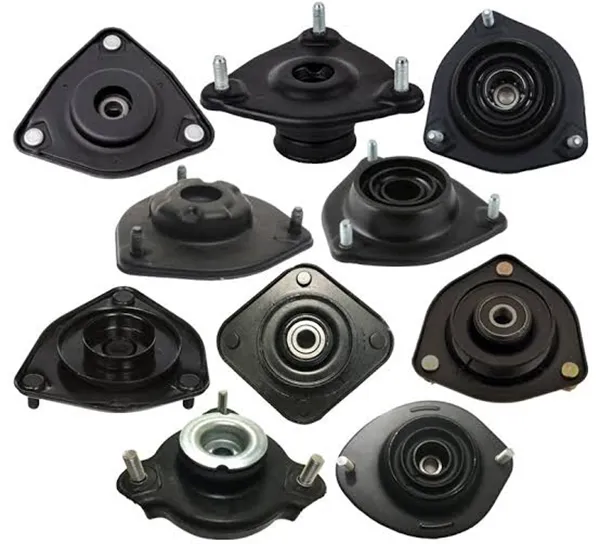
The sections below explain why a passing test proves less than most buyers assume, which three variables decide life inside the part, and the exact questions you can put to any supplier before you commit.
Why Does a Passing Test Prove So Little About Strut Mount Life?
A supplier sends samples with a test report, everything looks acceptable, and you place the order. A few months later a market complaint arrives. Nothing in that report was false. It simply described a sample rather than a batch, and strut mount life depends on the batch.
A test result describes one sample at one moment in time. Strut mount life depends on whether every batch repeats the same material source, the same bonding process, and the same dimensional control. The useful question is not "does it pass?" but "can it repeat?"
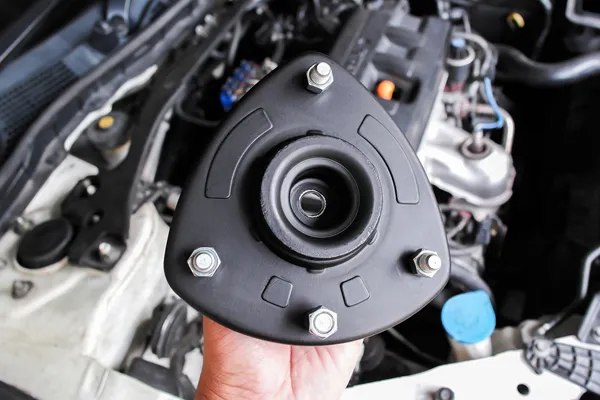
A test result is a snapshot, not a promise
Test reports are useful documents. They confirm that a design can meet a requirement when it is made properly. They do not confirm that the next production run will be made the same way. Between batch one and batch twelve, several things can drift: steel supplier, heat lot, vulcanization time and temperature, mold wear, and operator practice on the press.
Four things that have to repeat
- Steel source and batch identity. A different mill or a different heat lot can shift hardness and fatigue behaviour, even when the grade name stays the same.
- Bond quality. The rubber-to-metal interface is a chemical bond, not a coating. It depends on surface preparation, bonding agent control, and cure parameters.
- Tooling condition. Molds wear. A tolerance that felt comfortable in the first run can drift outside the OE window over thousands of cycles.
- Process settings and operator discipline. The same machine can produce different results on a different shift, especially when settings are adjusted informally.
Reframe your question
| What buyers usually ask | What the question hides | What to ask instead |
|---|---|---|
| Does it pass the test? | Whether the sample represents production | Can you repeat this result across batches? |
| Is the price competitive? | The cost of a concentrated failure event | What is the consistency risk behind the price? |
| Are you certified? | How the system is applied daily | Which batch records can I review? |
When you move from "does it pass" to "can it repeat," your supplier conversations change. You stop collecting certificates and start collecting evidence.
A note on scope
Driving conditions and installation torque also influence service life, but those sit outside the procurement question discussed here.
What Actually Decides Strut Mount Life Inside the Part?
Buyers often rank strut mounts by appearance and price. Both are easy to compare on a screen. The variables that decide strut mount life sit inside the part, behind the rubber, in the metal and the bond.
Three variables decide most of it: the quality of the metal forming, the rubber-to-metal bonded interface, and dimensional control around OE specifications. Appearance and price tell you very little about any of the three.
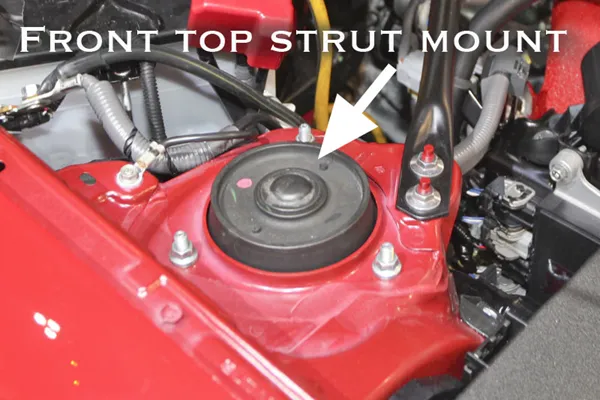
The metal before the rubber
A strut mount is not a rubber consumable with a metal insert. It is a metal component that happens to carry a flexible element. Casting or forging quality, weld integrity, and machining accuracy decide how the part carries load.
In our own production, steel comes from named mills such as Baosteel, Shagang, and Yuanli, and every batch arrives with a material inspection report. Our QC department also runs random chemical composition tests. Those documents exist because the metal decides the starting point. Buyers who only compare the rubber never see this layer.
The bonded interface
The rubber-to-metal bond is where many returned parts point. A bond that is incomplete or unevenly cured can survive a short test and separate later under repeated load and road input. Bond quality depends on surface preparation, bonding agent control, and cure parameters, and it is easy to lose when a line speeds up.
Test programs such as pull-out and compression force testing, ozone resistance testing, and fatigue testing exist to probe that interface. Their value lies in the failure mode they target, not in the certificate they generate.
Dimensional control around OE specifications
Fitment is a life issue, not only a convenience issue. Molds should be developed to OE specifications, with dimensional tolerances held inside a tight range — in our factory, within ±0.2 mm. When a mount sits slightly off, the load path changes and the bonded interface works harder than it was designed to.
What you can and cannot see
- You can see: surface finish, packaging quality, label accuracy, and general workmanship.
- You cannot see: steel lot identity, cure uniformity, bond coverage, or tooling wear.
- You can request instead: material reports, tooling specification sheets, tolerance ranges, and batch records.
| Variable | How it shows up later | Evidence to request |
|---|---|---|
| Metal forming quality | Cracking, distortion, loose fit | Batch material reports, process description |
| Bonded interface | Separation, noise, premature wear | Bonding controls, fatigue and pull-out testing |
| Dimensional control | Poor fitment, uneven load | OE-based tooling spec, stated tolerance range |
How Do You Screen a Supplier for Consistent Strut Mount Life?
Most supplier questionnaires ask whether a factory is certified and how many production lines it runs. Those answers are easy to give and hard to verify. They also say nothing about whether batch twelve will match batch one, which is where strut mount life is decided.
Use four questions instead. Each one asks for a document or a defined process rather than an adjective, and each one works with any supplier in any market.
Question one: where does your steel come from, and can I see a batch report?
A confident answer names the mills, describes how steel is selected, and offers a per-batch material inspection report. A weak answer says "good quality steel" and changes the subject.
Question two: whose tooling, and what tolerance range do you hold?
You want to know whether molds are developed to OE specifications or reverse-engineered from a sample, and what tolerance the factory actually holds in production. A stated range such as ±0.2 mm is checkable. "Standard tolerance" is not.
Question three: how do you control the rubber-to-metal bond?
Listen for surface preparation, bonding agent handling, cure time and temperature monitoring, and how the line detects an incomplete bond. If the answer covers only the rubber compound, the supplier is describing half the part.
Question four: what does your test program prove, and against which failure mode?
Every test should map to a failure mode. Pull-out and compression testing speaks to the bond and the housing. Fatigue testing speaks to repeated load. Salt spray and ozone resistance testing speak to the environment. Torque and angle testing speak to assembly behaviour. A supplier who cannot explain the link is running tests for paperwork.
How to read the answers
| Signal | Weak answer | Strong answer |
|---|---|---|
| Specificity | "High quality" | Named mill, stated range, defined process |
| Evidence | Verbal assurance | Document offered without prompting |
| Failure logic | Test names listed | Test linked to a failure mode |
| Consistency | Claims about samples | Description of batch-to-batch control |
If an answer cannot be checked, treat it as unverified until it is. This is not suspicion; it is how you build a defensible supplier file.
Why Is the Real Cost of Short Strut Mount Life a Batch Event?
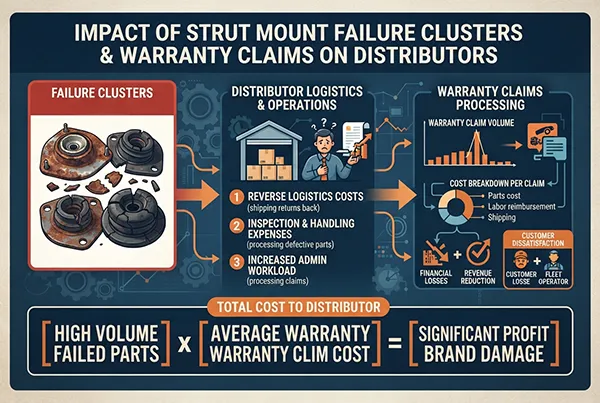
The unit price of a strut mount is small. The cost of a batch event is not. When failures arrive together in one market shortly after launch, claims, returns, labour, and reputation damage land in the same period.
Short strut mount life rarely fails one vehicle at a time. It fails in groups, because those units came from the same material lot and the same process window. That is why consistency risk belongs in your evaluation before unit price does.
Where the cost actually lands
- Claims handling. Every return consumes staff time, not just part cost.
- Freight and reverse logistics. Returned goods move twice and often cannot be resold.
- Dealer and installer labour. Repeat repair costs damage trust faster than the part price does.
- Brand credibility. A distributor who absorbs two bad batches starts quoting your competitor.
None of these costs appear in a unit price comparison. All of them appear after a batch event.
Why switching suppliers feels like guesswork
If you have no screening method, replacing a supplier means running the same lottery again with a different name on the carton. That is why so many buyers repeat the same problem with a new vendor and conclude the category is simply difficult.
A screening question set changes the game. It gives you a comparison basis that does not depend on price alone, and it produces a written record you can revisit if performance changes.
What returned parts tell a manufacturer
Across returned parts from customers in multiple markets, we repeatedly see the same broad patterns: incomplete or uneven bonding at the rubber-to-metal interface, and dimensional drift that shows up as poor fitment. These are process patterns, not vehicle-specific cases. They are also the reason we keep batch records, tooling specifications, and test-to-failure-mode documentation available for customer review.
How to justify consistency internally
Build your recommendation on documents, not adjectives. A simple scoring sheet works:
| Criteria | Weight | What you score |
|---|---|---|
| Material traceability | High | Batch reports, mill identity, random composition checks |
| Tooling and tolerance | High | OE-based tooling, stated range, inspection method |
| Bond control | High | Surface prep, cure monitoring, bond testing |
| Test logic | Medium | Tests mapped to failure modes |
| Commercial terms | Medium | Price, lead time, packaging flexibility |
When you present this to your product team or your downstream customers, the discussion shifts from "who is cheapest" to "who can repeat."
Frequently Asked Questions
Does driving style affect strut mount life?
Driving conditions matter, but they are not a variable you control at procurement. Two mounts from the same factory can behave differently in the same market because of batch variation. Focus your screening on the variable you can actually check.
Can you judge strut mount quality by appearance and price?
No. Appearance shows surface finish and packaging, and price shows commercial positioning. Neither reveals steel source, bond quality, or dimensional control, which are the variables that decide strut mount life.
What documents should you request from a strut mount supplier?
Request per-batch material inspection reports, a tooling specification sheet tied to OE dimensions, the tolerance range held in production, bonding process controls, and a test list with the failure mode each test targets. Treat certifications as documents to verify rather than guarantees.
How long should a strut mount last?
There is no single answer, because service life depends on the application, load, and road conditions. The manufacturing question is more useful: can the supplier repeat the same bond quality and dimensions from batch to batch?
Is IATF16949 certification enough on its own?
Certification shows that a quality management system exists and has been audited against a recognised standard. It does not describe how closely that system is followed on a given shift. Ask for batch records and tooling data alongside it.
Conclusion
Extending strut mount life is a selection and consistency problem, not a driving-tip problem. A passing test describes a moment; a repeatable batch describes a life. Ask any supplier about steel source and batch reports, tooling origin and tolerance range, bonded-interface control, and test-to-failure-mode logic. When you compare suppliers on those four answers instead of price alone, you reduce claims, protect your brand, and give your team a decision they can defend.
If you are evaluating a strut mount line for launch or replacement, send us your target applications and OE references. GDST Auto Parts can share batch material reports, tooling specifications with tolerances held within ±0.2 mm, and the test program behind each part — so your decision rests on evidence, not on hope.