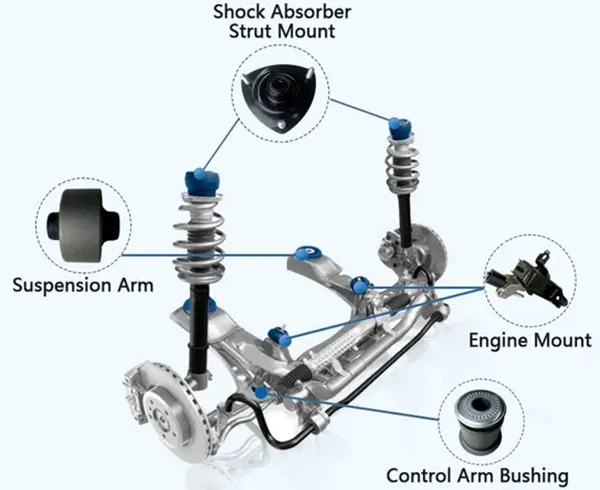
A strut mount looks like a simple rubber pad on your quotation, so it is easy to treat as a low-risk purchase. That assumption is expensive. The mount holds the strut in place, lets it rotate when you steer, and filters vibration — three jobs in one part. Understanding how it works changes how you buy it.
A strut mount works as a load-bearing assembly with three stacked functions. It locates the top of the strut to the vehicle body so suspension geometry stays stable, it holds a thrust bearing so the strut can rotate when you steer, and it isolates road and engine vibration from the cabin. All three functions must work together.
The rest of this article breaks the part down layer by layer. You will see what each layer does, where lower-cost mounts fail early, and what to put into a supplier specification before you place an order.
What Does a Strut Mount Actually Do?
You already know the mount sits at the top of the strut. What you may not have mapped out is that the part does three jobs at once, and each one fails in a different way. That is why one symptom does not always point to one cause.
A strut mount connects the top of the strut to the vehicle body and performs three tasks at the same time. It holds the strut in position so alignment stays stable, it carries a bearing so the strut turns with the steering, and it isolates vibration so the cabin stays quiet.
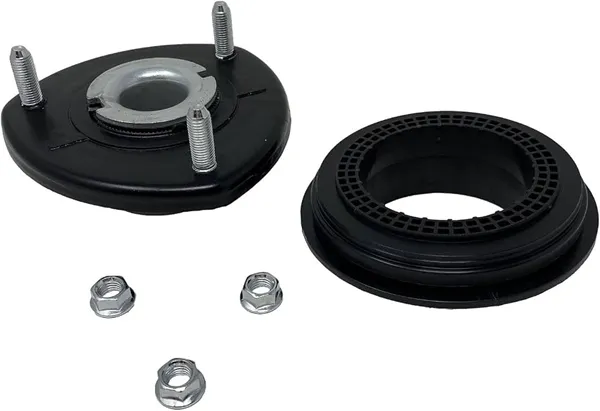
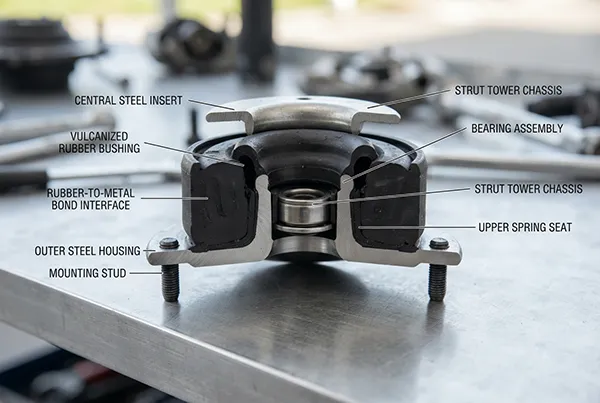
On a bench, a strut mount looks simple: a metal plate, a block of rubber, and a bearing inside. The important point is that each piece is doing a different job, and the jobs are stacked on top of each other. Remove one from your mental model, and the other two become hard to read.
The location layer
The metal plate bolts to the body, and the bonded rubber grips the strut rod. Together they hold the top of the strut in a fixed position. If that position drifts, camber and caster drift with it, and the vehicle starts to pull or wear tires unevenly. This layer is about geometry, not comfort.
The bearing layer
A thrust bearing sits inside the assembly so the strut can rotate around its own axis when you turn the wheel. Without it, the spring would twist and fight the steering. Most people forget this layer exists, because you cannot see it from the outside.
The isolation layer
The rubber compound and its shape decide how much road noise and engine vibration reach the body. Soft rubber isolates more but moves more. Stiff rubber holds geometry tighter but transmits more noise. That trade-off is tuned for each vehicle, not chosen at random.
| Layer | Main job | Typical failure symptom |
|---|---|---|
| Location | Holds strut position and geometry | Clunk, alignment drift |
| Bearing | Lets strut rotate with steering | Stiff or noisy steering |
| Isolation | Filters vibration and noise | Extra noise, harshness |
This layered structure is familiar to us. We build chassis rubber-metal assemblies such as ball joints, tie rod ends and stabilizer links, where a metal shell, a rubber element and a bearing surface must work as one unit. Strut mounts are not our core line, but the assembly logic and the manufacturing discipline are the same.
Why Does the Rubber-to-metal Bond Matter More than Hardness?
Buyers often ask for a hardness number, like 60 Shore A, and treat that as the whole quality spec. Hardness is easy to measure and easy to quote, so it ends up being the entire conversation. The bond underneath the rubber usually decides how long the part actually lasts.
The rubber-to-metal bond is what keeps the mount together under load. Hardness only describes how stiff the rubber feels. A mount with the right hardness but a weak bond can separate early, because the pull-out force and the bonding interface, not the rubber surface, carry the strut load.
The bond interface carries the load
During vulcanization, the rubber is chemically attached to the metal surface. If the metal preparation, the bonding agent, or the cure cycle is off, the rubber may look perfect on the outside and still tear away from the plate under real load. This is the failure mode buyers see first, because the part often fails within the first months after installation rather than years later.
Compound and aging decide the long term
Rubber changes with time, heat, ozone, salt and road chemicals. Compound formulation and protective additives decide how slowly that happens. This is why test categories matter more than a single hardness value:
- Pull-out and compression force testing
- Fatigue cycling under repeated load
- Salt spray testing for corrosion resistance
- Ozone resistance testing for cracking
- High and low temperature testing
These are the test categories we run on our own chassis rubber-metal assemblies. We are describing them here as industry background, not as strut mount bench data.
Pre-load angle is easy to miss
The rubber inside a strut mount is often bonded at a set angle, called pre-load. That angle keeps the rubber in a neutral position when the vehicle is standing on the ground. If it is wrong, the rubber is already stressed before the car moves, and it ages faster. Dimensions cannot show this. Only the drawing and the validation process can.
What to ask for instead of hardness
| Weak question | Stronger question |
|---|---|
| "What hardness is it?" | "How do you control the bond interface?" |
| "Is it OE quality?" | "Which tests do you run, and can I see reports?" |
| "Is it the same size?" | "Is the pre-load angle matched to this application?" |
How do You Tell Which Layer Failed?
A customer hears a clunk over bumps, replaces the strut mount, and the noise returns. Or they replace the whole strut, and the noise still returns. Two parts can look guilty for the same symptom, and that overlap is where warranty claims start.
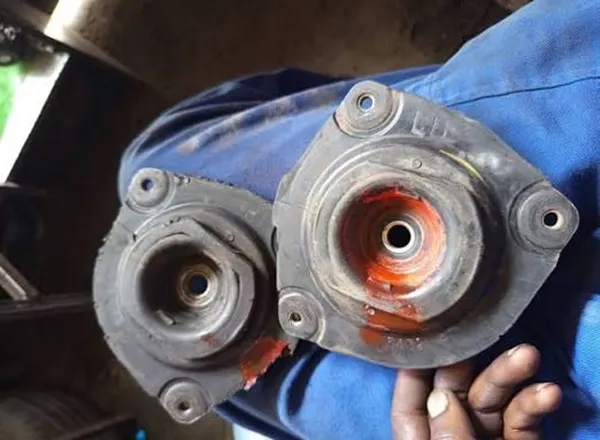
You can separate the layers by symptom. A failed location layer shows up as clunking, wander, or alignment drift. A failed bearing layer shows up as stiff or noisy steering when you turn the wheel. A failed isolation layer shows up as extra vibration and road noise at normal driving speed.
Why the overlap happens
A worn strut and a worn mount share symptoms because they act on the same corner of the vehicle. Both can cause noise over bumps. Both can make steering feel vague. Both can create a small looseness that is hard to find by hand.
How to narrow it down
- Ask where the noise happens: turning, straight-line bumps, or both.
- Check for steering stiffness, which points to the bearing layer.
- Look for alignment drift, which points to the location layer.
- Look for vibration at steady speed, which points to the isolation layer.
- Confirm with a lift inspection before ordering parts.
The commercial cost
When the wrong part is replaced, the symptom returns and the claim lands on you, not on the driver. A returned mount that was never the problem still costs you labor time, shipping, and credibility with your own customer. For a distributor, that is a margin problem, not just a technical one. Diagnosis language is support material here — the real value is helping your market buy the right part the first time.
Why Does a Matching Strut Mount Still Fail?
Two mounts can share bolt spacing, stud length, and overall height, and still behave differently on the same car. Buyers who purchase on dimensions alone often find this out through warranty claims rather than through spec sheets.
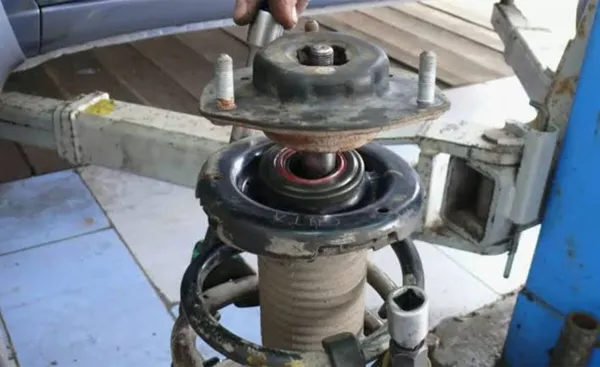
Appearance compatibility is not installation compatibility. Two mounts can match in bolt pattern and dimensions but differ in rubber formulation, bearing design, and pre-load angle. Those differences change noise, steering feel, and service life under the same load case.
Where the differences hide
- Rubber formulation. Different compounds age at different rates under heat and ozone.
- Bearing design. Sealing and grease retention decide how long steering stays smooth.
- Pre-load angle. A small angle difference changes rubber stress from day one.
- Load case. A light passenger car and a loaded SUV stress the same mount differently.
Why vehicle coverage matters
A mount listed for a wide range of models may be a compromise, or it may be correct for one application and marginal for another. When you build a catalog, application data — not just a photo and a dimension — is what protects you. This is also why OE reference numbers matter more than appearance.
How manufacturing discipline reduces the risk
Mold development to OE specifications and tight dimensional control support fitment, but fitment alone is not the goal. We control dimensional tolerances within ±0.2 mm on our own rubber-metal parts, because a mount that fits but behaves differently still generates claims. A sample on a real vehicle, checked against the original part, tells you more than any catalog image.
What Should You Check in a Supplier?
Once you know the part has three layers, your supplier questions become easier to write. You stop asking whether the rubber is good, and start asking which layer the supplier actually controls, and how they prove it.
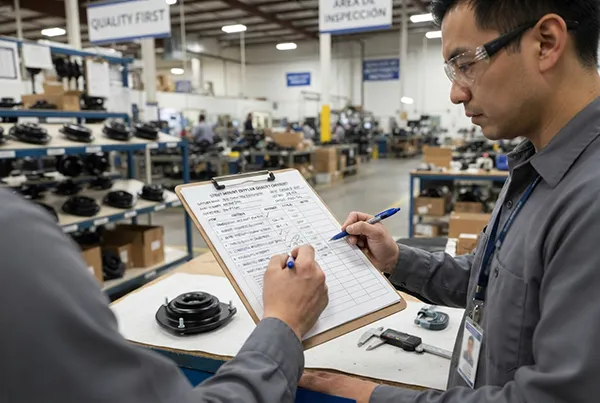
Ask how the supplier controls the bond, the bearing, the rubber compound, and the pre-load angle, then ask which tests prove it. Request samples for validation on a real application. Certifications such as IATF16949 and ISO9001 are documents worth verifying directly, not automatic guarantees.
Build the spec sheet around the layers
| Layer | What to require |
|---|---|
| Location | OE reference, drawing, dimensional tolerance |
| Bearing | Bearing type, sealing, rotation test |
| Isolation | Compound details, aging and ozone tests |
| Assembly | Pull-out force, fatigue cycles, pre-load angle |
Ask about material and traceability
For metal parts, ask where the steel comes from and whether each batch arrives with an inspection report. We buy steel from leading Chinese mills such as Baosteel, Shagang and Yuanli, and we run random chemical composition checks in-house. For rubber, ask about compound control and vulcanization process monitoring.
Validate with samples, not with promises
A sample on a real vehicle, compared against the part you are replacing, is the cheapest test you can run. It costs you time at the start and saves claim cycles later. If a supplier cannot explain which layer is tested and how, that gap is your answer.
Frequently Asked Questions
Is a strut mount the same as a strut bearing?
No. The strut mount is the full assembly that connects the strut to the body. The bearing is one layer inside it, allowing the strut to rotate with steering. Some mounts have a separate bearing, and some have it integrated. Always confirm which design your application uses.
How long should a strut mount last?
There is no fixed number, because service life depends on rubber compound, bond quality, road conditions and load. A well-made mount with a sound bond and correct pre-load angle typically outlasts a cheap one by a wide margin. Industry sources often link early failures to bond separation rather than rubber wear.
Can you replace only the strut mount?
Sometimes, yes. On many vehicles the mount can be replaced on its own, while on others it is serviced with the strut or as part of a kit. This is an application-specific decision, so confirm with a qualified technician before recommending it to your market.
Does harder rubber make a strut mount last longer?
Not necessarily. Harder rubber feels stiffer and may hold geometry better, but it transmits more noise. Service life depends more on the bond interface, compound aging resistance and pre-load angle than on hardness alone. Hardness is one input, not the whole spec.
What should I send a supplier for an accurate quote?
Send the OE reference number, a photo of the original part, vehicle make and model, and any drawings you have. Mention the load case and the market conditions. Suppliers who work on chassis rubber-metal assemblies can then confirm the layers they control and quote against a real specification.
Conclusion
A strut mount is not a rubber cushion. It is a load-bearing assembly doing three jobs: locating the strut, allowing steering rotation, and isolating vibration. When you evaluate it layer by layer, you stop buying on hardness and dimensions alone. You start asking about the bond, the bearing and the pre-load angle — the details that decide whether a shipment becomes repeat business or a warranty cycle.
If you want to review a strut mount specification or compare a sample against your current part, send us the OE number and a photo. We build chassis rubber-metal assemblies, and we are glad to look at the structure with you.