
Types of ball joints in vehicles can confuse even experienced buyers because the same part name may refer to different structures, functions, and fitment requirements. If you choose only by appearance or “upper vs lower,” you may face returns, warranty claims, or delayed shipments. The better solution is to match the ball joint by application, structure, specifications, and inspection needs.
Types of ball joints in vehicles are commonly classified by installation position, load-carrying role, and mounting method. However, these categories are not universal interchange rules. You should confirm the OE number, vehicle configuration, suspension design, mounting geometry, taper, articulation range, and inspection requirements before sourcing or approving any ball joint.
When I review ball joint samples or drawings for aftermarket projects, I rarely start with the name alone. I start with the vehicle application, OE reference, and critical dimensions. Then I look at the structure. That is where the real selection work begins.
What Are the Main Types of Ball Joints by Installation Position?
Installation position is the most familiar way to describe types of ball joints, but it is also the easiest place to oversimplify. You may see “upper ball joint” or “lower ball joint” in a catalog, yet that label alone does not prove fitment or function.
The main types of ball joints by installation position are upper ball joints and lower ball joints. Some suspension systems may use one or both depending on design.1 However, you should always confirm the exact vehicle configuration, suspension layout, OE number, and mounting details before treating any upper or lower ball joint as interchangeable.
Upper Ball Joints
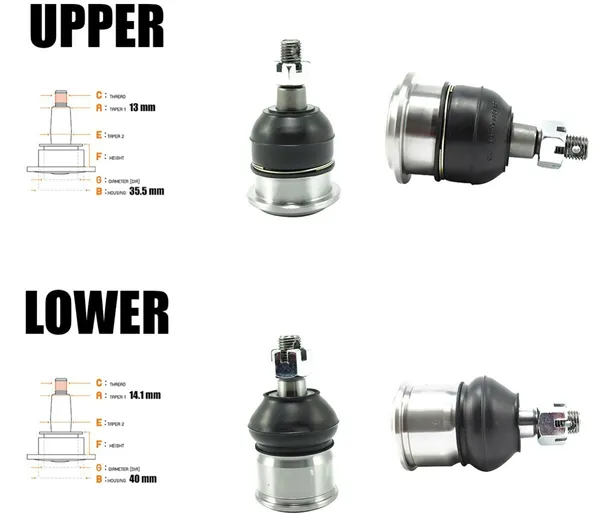
An upper ball joint is usually installed on the upper control arm or related suspension location. Its role depends on the suspension design. In some vehicles, it mainly guides movement. In other designs, it may also share load or alignment-related functions.2
You should not assume that every upper ball joint has the same structure. The following details may change by application:
- Stud length and taper
- Housing diameter
- Mounting hole pattern
- Thread size
- Articulation angle
- Grease fitting design, if used
- Dust boot shape and sealing structure
Lower Ball Joints
A lower ball joint is often installed on the lower control arm or steering knuckle area. In many suspension layouts, the lower position may carry significant load, but this is not a rule for every vehicle. You should check the suspension design before making that judgment.
For procurement, the lower ball joint often needs careful confirmation because small dimensional differences can create big installation problems. A part may look close, but the taper may not seat correctly. The flange may not align with the control arm. The stud may articulate at the wrong angle.
Why Position Alone Is Not Enough
I often see buyers start with a simple request like, “We need lower ball joints for this model.” That is a good starting point, but it is not enough for production approval.
A better first check includes:
- OE number or cross-reference number
- Vehicle make, model, year, and market version
- Suspension type
- Installation position
- Mounting structure
- Critical dimensions
- Required inspection items
| Selection Factor | Why It Matters |
|---|---|
| Upper or lower position | Identifies the general installation area |
| OE number | Reduces catalog confusion |
| Suspension design | Confirms function and structure |
| Taper and stud size | Affects knuckle fitment |
| Hole pattern | Affects mounting compatibility |
| Articulation angle | Affects movement range |
| Torque and strength inspection | Supports quality consistency |
From a manufacturing point of view, “upper” or “lower” is only one layer of identification. When GDST reviews a sample or drawing, the QC and development teams look at the full structure before confirming feasibility. This is especially important for aftermarket brands, importers, and wholesalers that sell across many markets.
How Do Types of Ball Joints Differ by Load-Carrying Role?
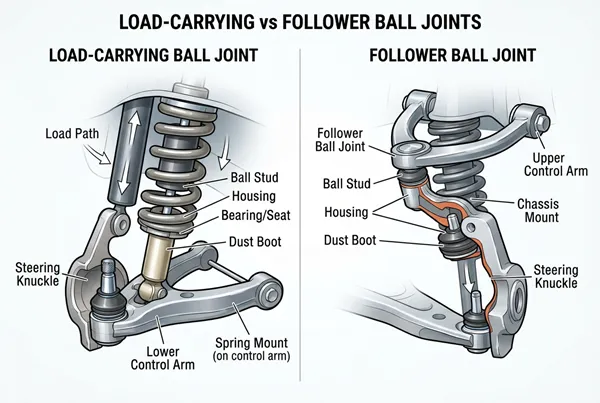
Types of ball joints can also be understood by their load-carrying role, but this depends heavily on suspension design. If you only use catalog names, you may miss the difference between a load-bearing part and a follower-type part.
By load-carrying role, ball joints are often discussed as load-carrying ball joints and follower ball joints. A load-carrying ball joint supports vehicle suspension load in certain designs, while a follower ball joint mainly guides movement.3 You should verify this role through the specific suspension system, not by position alone.
Load-Carrying Ball Joints
A load-carrying ball joint is designed for applications where the joint supports suspension load. This can affect material requirements, housing structure, stud design, and inspection focus. However, I avoid saying one type is “better” than another. The correct part is the one matched to the vehicle design and validated through proper specifications.
For sourcing, you should check:
- Ball stud geometry
- Housing strength requirements
- Bearing or socket design
- Boot sealing quality
- Pull-out or compression force inspection
- Torque behavior
- Articulation movement
In manufacturing, these details affect process control. A forged or machined part needs stable dimensions. A socket assembly needs consistent movement. A dust boot must seal properly without limiting articulation. Each process matters.
Follower Ball Joints
A follower ball joint usually guides suspension movement instead of carrying the main vehicle load. That does not mean it is unimportant. If the taper, thread, or articulation angle is wrong, the part may still fail to install or operate correctly.
For aftermarket buyers, follower-type applications still require close fitment checks. A small difference in the stud angle or housing height can affect installation. A weak boot design may also increase after-sales complaints, depending on road conditions and usage.
Why Load Role Affects Procurement Risk
When you source ball joints for your brand, the load role changes how you should review quality documents and inspection plans. You do not need to become a suspension engineer, but you should ask the supplier to explain how the part is controlled during production.
A practical review may include:
- Dimensional inspection report
- Material inspection report
- Torque test record
- Angle inspection
- Hardness inspection
- Pull-out or compression force test, where applicable
- Final inspection checklist
At GDST, we treat these as manufacturing control points rather than marketing claims. Our team checks dimensions, articulation angles, torque, and strength-related items according to product requirements and customer specifications. For application-specific safety or engineering decisions, you should always rely on qualified technical evaluation and verified standards.
The key point is simple: types of ball joints are not just names. They represent different design duties. If the duty is misunderstood, the buyer risk increases.
What Types of Ball Joints Are Used by Mounting Method?
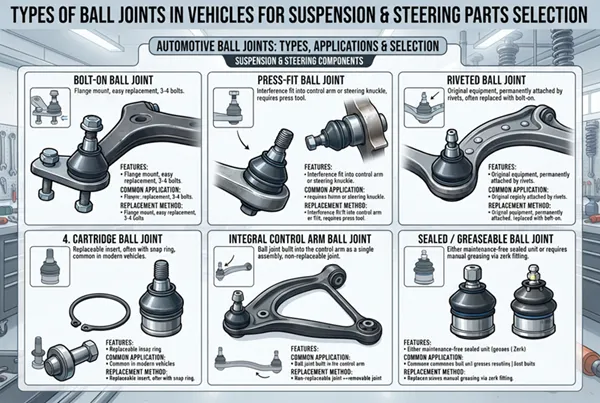
Mounting method is one of the most important ways to classify types of ball joints because it directly affects installation. A part with the same vehicle description may still differ by press-in, bolt-on, riveted, or integrated structure.
The common types of ball joints by mounting method include press-in ball joints, bolt-on ball joints, riveted ball joints, and integrated control arm ball joints. These mounting styles are not automatically interchangeable. You should verify mounting dimensions, hole layout, housing form, and installation requirements before procurement.
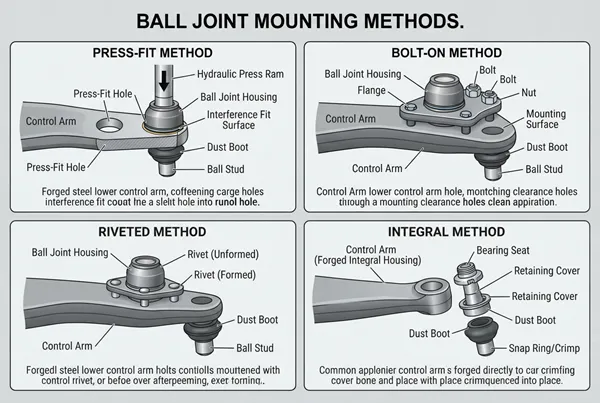
Press-In Ball Joints
A press-in ball joint is installed into a control arm or housing by interference fit.4 This style requires accurate outer diameter, housing shape, and press-fit tolerance. If the dimension is too loose, the part may not hold properly. If it is too tight, installation may damage the control arm or the part.
For this type, I usually pay attention to:
- Outer diameter
- Knurling or housing surface form
- Shoulder height
- Snap ring groove, if used
- Press direction
- Boot clearance after installation
Bolt-On Ball Joints
A bolt-on ball joint uses bolts to attach to the control arm or suspension component. Buyers often like this style because installation appears straightforward. Still, the hole spacing, flange thickness, and mounting surface must match exactly.
Key checks include:
- Bolt hole center distance
- Hole diameter
- Flange shape
- Mounting face flatness
- Stud taper
- Overall height
Riveted Ball Joints
Some original applications may use riveted joints. In aftermarket replacement, these may be supplied with bolts after the old rivets are removed.5 You should confirm whether the replacement structure is appropriate for the target market and repair practice.
This is where catalog notes become important. If your customers are installers or distributors, unclear instructions may create complaints even when the product itself is made correctly.
Integrated Ball Joints
Some ball joints are integrated into a control arm assembly. In this case, the buyer may source the full control arm rather than the ball joint alone.6 This changes procurement evaluation because you now need to inspect welding, bushings, arm geometry, surface treatment, and packaging as well.
| Mounting Method | Main Fitment Risk | Key Inspection Focus |
|---|---|---|
| Press-in | Wrong outer diameter or fit | Housing size, groove, press area |
| Bolt-on | Hole pattern mismatch | Hole spacing, flange shape |
| Riveted replacement | Installation confusion | Hardware, notes, mounting form |
| Integrated assembly | Full assembly mismatch | Arm geometry, bushing, ball joint position |
No mounting method is automatically higher quality. Quality depends on correct design, materials, production consistency, sealing, surface treatment, and inspection. As a manufacturer, I see the mounting method as a fitment and process-control question first.
How Should You Select Types of Ball Joints for Aftermarket Sourcing?
Selecting types of ball joints for aftermarket sourcing should follow a clear workflow. If you skip application checks and jump directly to price, you may save time at the quotation stage but lose money through returns and complaints later.
You should select ball joints by following this order: application information → structural type → critical specifications → inspection requirements. Start with OE number and vehicle configuration, then confirm position, load role, mounting method, dimensions, taper, articulation range, packaging needs, and quality control documents.
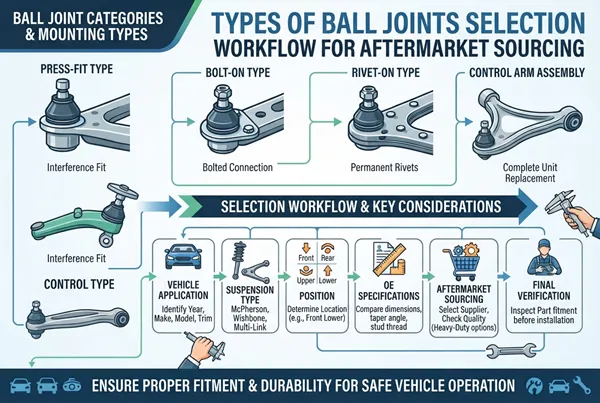
Step 1: Confirm Application Information
You should begin with the most complete application information possible. The OE number is very important, but it should not stand alone. Different markets may use different configurations, and catalog data can sometimes be incomplete.
Prepare the following details:
- Vehicle make and model
- Year range
- Engine or chassis details, if relevant
- Drive type, if relevant
- OE number or reference number
- Target market
- Required packaging or brand information
If you have a sample, send clear photos and measurements. If you have a drawing, confirm the latest version. In GDST’s development process, sample and drawing review is a normal step before mass production decisions.
Step 2: Confirm Structural Type
After the application is clear, you can confirm whether the part is upper or lower, load-carrying or follower, and press-in or bolt-on. This is where many sourcing mistakes happen.
A similar-looking part may differ in:
- Taper angle
- Thread size
- Stud length
- Housing height
- Mounting hole pattern
- Boot clearance
- Articulation range
- Grease nipple position
These differences may look small on a desk. They can become serious on a vehicle.
Step 3: Confirm Critical Specifications
Critical specifications should be agreed before order confirmation. You do not need to list every production detail in your purchase order, but you should clarify the points that affect fitment and quality consistency.
Common specifications include:
| Specification | Buyer Question |
|---|---|
| Main dimensions | Does it match sample, drawing, or OE requirement? |
| Stud taper | Will it seat correctly in the knuckle? |
| Articulation angle | Can it move within the required range? |
| Torque | Is movement controlled and consistent? |
| Surface treatment | Is it suitable for your market expectations? |
| Boot material and sealing | Does it support expected use conditions? |
| Packaging | Does it protect the product and support your brand? |
Step 4: Confirm Inspection Requirements
Inspection is where the sourcing decision becomes more serious. You should ask what the supplier checks during and after production. Certifications such as IATF16949 and ISO9001 are useful quality management references, but buyers should verify the documents and confirm how the factory applies process control.
At GDST, our production covers processes such as forging, casting, welding, CNC machining, assembly, and surface treatment depending on the product. Our QC team monitors production and performs final inspection before shipment, including product checks, quantity verification, packaging condition, shipping marks, labels, and pallet inspection.
For your own procurement process, the safest workflow is:
Application information → structural type → critical specifications → inspection requirements
This workflow helps you reduce fitment risk, protect your brand reputation, and build a more stable supplier relationship.
Frequently Asked Questions
Are upper and lower ball joints interchangeable?
Upper and lower ball joints are not automatically interchangeable. They may differ in load role, mounting structure, taper, size, angle, and housing design. You should confirm the OE number, vehicle configuration, suspension design, and critical dimensions before approving any substitution.
Are press-in ball joints better than bolt-on ball joints?
Press-in ball joints are not inherently better than bolt-on ball joints. Each mounting method is designed for a specific application. Quality depends on material control, dimensional accuracy, sealing, assembly consistency, and inspection, not only the mounting style.
What information should I send to a ball joint manufacturer?
You should send the OE number, vehicle application, target market, required quantity, sample photos, drawings if available, packaging needs, and any inspection requirements. Clear information helps the manufacturer confirm structure, dimensions, production feasibility, and quotation accuracy.
Why do similar-looking ball joints fail to fit?
Similar-looking ball joints may fail to fit because of small differences in taper, stud length, thread size, mounting hole pattern, housing height, or articulation angle. Visual similarity does not prove interchangeability. You should verify samples, drawings, or critical dimensions before bulk sourcing.
What inspections matter for ball joint sourcing?
Important inspections may include dimensional checks, material reports, hardness testing, torque testing, angle testing, pull-out or compression force testing, surface inspection, boot inspection, and final packaging inspection. The exact inspection plan should match the application and buyer requirements.
Conclusion
Types of ball joints in vehicles should be treated as an application-matching decision, not a simple catalog label. You need to connect vehicle information with installation position, load role, mounting method, critical dimensions, and inspection requirements. If you are sourcing ball joints for an aftermarket brand, importer, wholesaler, or distributor, GDST Auto Parts can support OEM/ODM development, sample review, customized packaging, and stable production. Contact us to discuss your next ball joint sourcing project.
"2017 Bearcats Baja SAE - Front Suspension - Scholar@UC", https://scholar.uc.edu/downloads/bc388257f. Automotive suspension references show that the number and location of ball joints vary with suspension architecture; for example, double-wishbone layouts commonly use upper and lower locating joints, whereas many MacPherson-strut layouts use a lower joint with the strut providing the upper connection. Evidence role: general_support; source type: education. Supports: Automotive engineering material should show that ball-joint number and position depend on suspension architecture, such as double-wishbone and MacPherson-strut designs.. Scope note: These layout examples establish the general design distinction but do not determine the configuration of a specific vehicle. ↩
"What Are Ball Joints?", https://www.uti.edu/blog/automotive/ball-joints. Suspension-engineering literature indicates that a ball joint's kinematic and load-transfer functions are determined by the geometry and load path of the complete suspension, so an upper joint may act primarily as a locating pivot or may also transmit substantial forces. Evidence role: mechanism; source type: paper. Supports: Suspension-engineering literature should explain how control-arm geometry and spring placement determine the loads and kinematic role assigned to an upper joint.. Scope note: This principle does not establish the exact load carried by an upper joint in any particular vehicle. ↩
"Ball Joints", https://brakes.siu.edu/balljoints.htm. Official vehicle-inspection materials define a loaded ball joint as one subjected to the suspension spring's load and distinguish it from a follower or unloaded joint that primarily locates and permits suspension movement. Evidence role: definition; source type: government. Supports: An official inspection manual or technical guide should define loaded and follower ball joints and distinguish their roles.. Scope note: The precise labels used for these categories are not fully standardized across all manufacturers and jurisdictions. ↩
"Interrupted shaft fits", https://dr.lib.iastate.edu/bitstreams/ba5a6b1b-a9f1-4abd-84b6-ae0e3c3ab647/download. Mechanical-design references define an interference fit as a joint formed when the inserted part is slightly larger than the mating opening, generating contact pressure that resists relative movement; this is the retention principle used by press-in components. Evidence role: definition; source type: education. Supports: An engineering source should define an interference fit as an assembly in which the inserted component is dimensionally larger than the receiving bore, producing contact pressure and retention.. Scope note: The general interference-fit principle does not specify the required tolerances or retention force for an individual ball-joint application. ↩
"Safety Recall B47 - Upper Ball Joints", https://static.nhtsa.gov/odi/rcl/2004/RCRIT-04V596-3958.pdf. Published service procedures for some vehicle applications instruct technicians to remove or drill out the original ball-joint rivets and secure the replacement joint with specified bolts and nuts. Evidence role: case_reference; source type: government. Supports: A publicly archived manufacturer service bulletin or repair procedure should document at least one application in which original ball-joint rivets are removed and replacement hardware is bolted in place.. Scope note: This is an application-specific repair method and should not be generalized to every riveted ball joint. ↩
"front axle control arm ball joint boot damage 2026-05-22", https://static.nhtsa.gov/odi/tsbs/2026/MC-11033032-0001.pdf. Manufacturer service documentation for some vehicle platforms identifies the ball joint as integral to the control arm and directs replacement of the control-arm assembly rather than separate replacement of the joint. Evidence role: case_reference; source type: government. Supports: Publicly available service documentation should provide examples of ball joints supplied or serviced only as part of a complete control-arm assembly.. Scope note: Serviceability varies by vehicle, and the existence of an aftermarket standalone part does not by itself establish manufacturer approval for separate replacement. ↩