
When you evaluate a strut mount, you may see a small component that appears simple and easy to replace. However, a poor match can create noise, vibration, fitment problems, and avoidable warranty claims. I have found that buyers make better decisions when they understand the mount’s actual role, its design differences, and the evidence a supplier can provide.
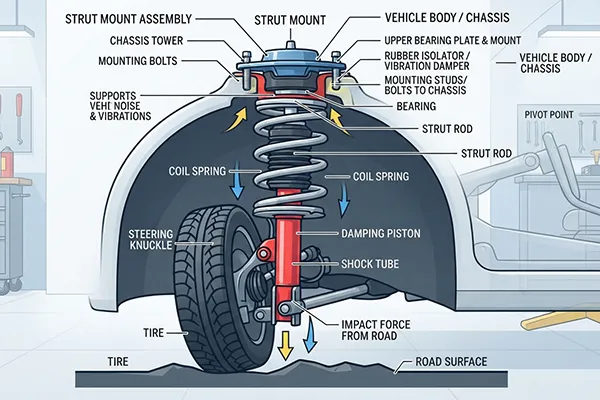
A strut mount connects the strut assembly to the vehicle body while helping support suspension loads and isolate noise and vibration. On applications with an integrated bearing, it also allows the strut to rotate during steering.1 The exact function depends on the vehicle design, so buyers should verify fitment, mounting geometry, bearing configuration, materials, and quality-control records before selecting a replacement part.
The role of a strut mount becomes clearer when you view it as an interface rather than a simple rubber cushion. It connects several systems that must work together. In the sections below, I will explain how the component affects suspension operation, how to assess possible quality concerns, and how procurement teams can compare suppliers more carefully.
How Does a Strut Mount Support the Suspension?
A vehicle suspension must carry loads while allowing controlled movement. The strut mount sits between the upper part of the strut assembly and the vehicle body, so it helps transfer suspension forces into the chassis. At the same time, its construction can help reduce the transmission of road noise and vibration into the passenger compartment.
A strut mount supports the upper end of the strut, helps position the assembly, and reduces the transfer of impact, noise, and vibration to the vehicle body. On some vehicles, the mount includes a bearing that permits the strut to rotate as the wheels turn. Other designs use a separate bearing or a different steering arrangement.
Understanding the interface
I usually explain the component as a connection point with several responsibilities:
- Load support: The mount helps carry forces created when the vehicle passes over bumps, potholes, and uneven surfaces.
- Body attachment: It secures the upper end of the strut assembly to the vehicle body.
- Vibration isolation: Rubber or elastomer elements can reduce the transfer of certain road impacts and vibration.2
- Position control: The mount helps keep the strut assembly located in the intended position.
- Steering movement: On suitable applications, an integrated bearing allows the strut to rotate during steering.
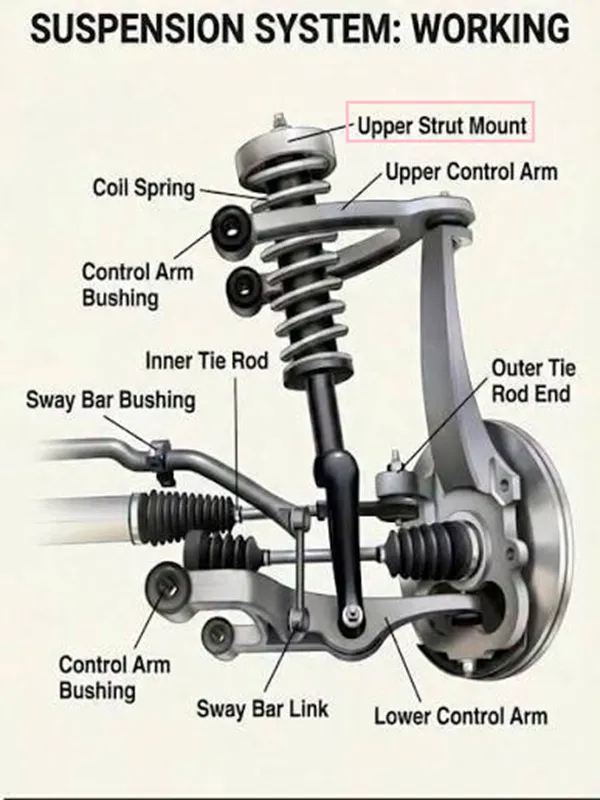
The exact arrangement varies by vehicle. Some McPherson strut systems place a bearing in the upper mount. Other vehicles use a separate upper bearing, a different mount construction, or a suspension layout where the strut does not rotate in the same way. For this reason, I do not recommend treating all strut mounts as interchangeable products.
Why the rubber element matters
Many mounts include a rubber or elastomer section bonded or assembled with metal components. This material must provide enough flexibility for isolation while retaining adequate support under load. If the material is too soft, the assembly may not control movement as intended. If it is too hard, the vehicle may transmit more harshness and vibration.3
The right balance depends on the vehicle application. A passenger car, SUV, off-road vehicle, and light truck may place different demands on the upper suspension mounting system. A buyer should therefore avoid selecting a mount only because its outside shape looks similar to another part.
What happens during normal operation?
During driving, the mount can experience a combination of:4
- Vertical suspension loads.
- Repeated compression and rebound movement.
- Steering-related rotation, where the design requires it.
- Temperature changes.
- Exposure to moisture, road salt, ozone, and contaminants.
- Assembly forces from the complete strut system.
These forces do not act independently. The spring, strut, bearing, mount, and body attachment all work as a system. A mount that looks acceptable on a workbench may still be unsuitable if its internal design, rubber characteristics, or bearing configuration does not match the vehicle.
I have seen buyers focus first on the rubber diameter or bolt spacing. Those measurements are useful, but they are only part of the evaluation. The complete mounting geometry, stud position, bearing arrangement, orientation, and compression behavior also matter.
Procurement reminder: A matching outline does not prove that a replacement strut mount will perform correctly on the vehicle.
Can a Strut Mount Affect Noise, Vibration, and Steering?
A worn or poorly matched strut mount may contribute to suspension noise, vibration, harshness, or steering concerns. However, these symptoms do not prove that the mount is the failed component. Buyers and technicians should consider the complete suspension assembly before drawing a conclusion.
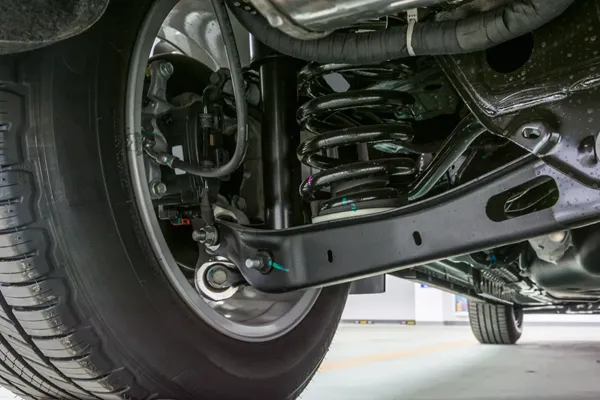
A strut mount can influence noise, vibration, ride harshness, and steering feel because it connects the strut to the vehicle body. However, similar symptoms can also come from the strut, spring, bearing, fasteners, installation method, control arms, or other suspension components. A qualified inspection is necessary for application-specific diagnosis.
Separating possible symptoms from confirmed causes
In conversations with aftermarket buyers, I often hear questions such as:
- “Will a new mount remove a knocking noise?”
- “Does a stiff mount mean that the rubber quality is better?”
- “Can a mount cause heavy steering?”
- “Will every bearing-style mount improve steering smoothness?”
These questions are understandable, but they cannot be answered correctly without the vehicle application and inspection information.
A knocking sound may involve a mount, but it may also come from a loose fastener, worn stabilizer link, damaged spring seat, ball joint, tie rod end, or internal strut problem. A steering concern may involve the upper bearing, but it may also result from alignment, tire condition, steering linkage, spring seating, or incorrect installation.
I use careful language because overdiagnosis creates procurement problems. If a distributor promises that replacing one component will solve every noise complaint, the distributor may create unrealistic expectations for installers and vehicle owners.
The bearing question
Not every strut mount contains an integrated bearing. This distinction is important.
| Design feature | Possible function | Buyer verification point |
|---|---|---|
| Rubber-metal mount without integrated bearing | Supports and isolates the assembly | Confirm whether the vehicle uses a separate bearing |
| Mount with integrated bearing | Supports the upper assembly and permits designed rotation | Verify bearing type, position, and OE reference |
| Separate upper bearing and mount | Divides support and rotation functions | Confirm the complete repair kit configuration |
| Application-specific mount | Matches a particular suspension geometry | Check orientation, mounting holes, studs, and assembly compatibility |
A bearing that is missing, incorrectly positioned, or unsuitable for the application can affect assembly movement. However, I would not assume that every steering problem comes from the bearing. The complete system still requires inspection.
Installation is part of the result
Even a correctly manufactured mount can perform poorly if it is installed incorrectly. The installer must follow the vehicle manufacturer’s procedure, use suitable tools, observe tightening requirements, and confirm that the spring and strut are seated correctly.
Common installation-related risks include:
- Incorrect orientation of the mount.
- Reusing damaged or unsuitable fasteners.
- Misalignment of the spring seat.
- Incorrect tightening method.
- Failure to compare the replacement part with the removed part.
- Installing a mount that belongs to a similar but different application.
For this reason, I recommend that product documentation clearly identifies the application and assembly arrangement. A product label should not rely only on a broad vehicle description. It should include usable references, application details, and orientation information where needed.
How procurement teams should discuss symptoms
When a customer reports noise or steering difficulty, you can improve the conversation by asking:
- What vehicle, model year, engine, and axle position are involved?
- Was the complete strut assembly recently removed or replaced?
- What other suspension parts were changed?
- Was the mount installed according to the correct procedure?
- Does the application use an integrated or separate bearing?
- Has a qualified technician inspected the vehicle?
This approach avoids blaming the strut mount without evidence. It also helps the supplier identify whether the issue may be fitment-related, installation-related, or connected to another component.
How Should You Select a Strut Mount Supplier?
Choosing a strut mount supplier requires more than comparing price and appearance. You should evaluate application data, manufacturing consistency, material control, inspection methods, testing records, and the supplier’s ability to repeat the same specification across future batches.
You should select a strut mount supplier that can verify vehicle compatibility, control mounting dimensions, document material and production quality, and provide repeatable batch results. A professional supplier should also explain bearing configuration, OE references, packaging identification, inspection procedures, and the limits of its technical claims.
Start with application compatibility
The first question is not “What is the lowest price?” It is “Does this part match the complete application?”
I recommend checking the following information before approving a product:
- Vehicle make, model, year, engine, and axle position.
- OE reference number and equivalent catalog references.
- Mounting-hole pattern and stud arrangement.
- Overall height, outside diameter, and critical locating dimensions.
- Orientation marks or offset geometry.
- Integrated bearing or separate bearing configuration.
- Compatibility with the spring, strut, and upper seat.
- Left-hand and right-hand application differences, if applicable.
- Packaging and labeling requirements for the target market.
Dimensional similarity is helpful, but it does not establish interchangeability.5 Two mounts may share bolt spacing while using different internal rubber characteristics, bearing arrangements, or load paths.
Look beyond visual inspection
A visual inspection can identify obvious defects, but it cannot prove every important quality characteristic. I would ask the supplier what records are available for:
- Raw material inspection.
- Rubber or elastomer compound control.
- Metal component dimensions.
- Bonding or assembly consistency.
- Bearing operation, where applicable.
- Surface treatment and corrosion resistance.
- Final inspection and batch traceability.
- Packaging and label verification.
In our manufacturing context, we treat dimensional control as a basic requirement rather than the entire quality program. Molds and tooling should follow the approved design, while production teams should monitor critical dimensions and assembly conditions. The exact tolerance must be confirmed against the product drawing and application requirements instead of being assumed across every part number.
Testing should match the risk
A supplier may mention testing, but buyers should ask what the test evaluates and whether the method is relevant to the application. Depending on the product design, useful quality-control activities may include:
- Hardness testing.
- Dimensional inspection.
- Torque or rotation testing for bearing-equipped designs.
- Compression or load testing.
- Fatigue testing.
- Ozone resistance testing.
- Salt spray testing for suitable metal or surface-treated components.
- High- and low-temperature testing.
- Visual and assembly inspection.
A test result has meaning only when you know the sample, method, acceptance criteria, and production batch.6 I do not recommend using an isolated laboratory result as a guarantee of service life. Vehicle operating conditions, installation quality, road conditions, and application loads can all affect actual performance.
Compare suppliers using evidence
Price is not automatically a sign of poor quality, and a higher price is not automatically proof of better quality. I prefer to compare suppliers through evidence.
| Evaluation area | Questions to ask |
|---|---|
| Fitment data | Can the supplier provide OE references, application coverage, and technical drawings where needed? |
| Material control | Are raw materials documented and checked by batch? |
| Production | Can the supplier explain molding, forging, machining, assembly, or surface-treatment processes? |
| Quality inspection | Are critical dimensions and finished products inspected consistently? |
| Testing | Are tests relevant to the product design and documented with clear criteria? |
| Traceability | Can the supplier identify production batches and shipment records? |
| Customization | Can the supplier support private labels, packaging, samples, and drawings? |
| Standards | Can the supplier provide current certification documents for buyer verification? |
| Supply stability | Can the supplier maintain repeatable specifications during future orders? |
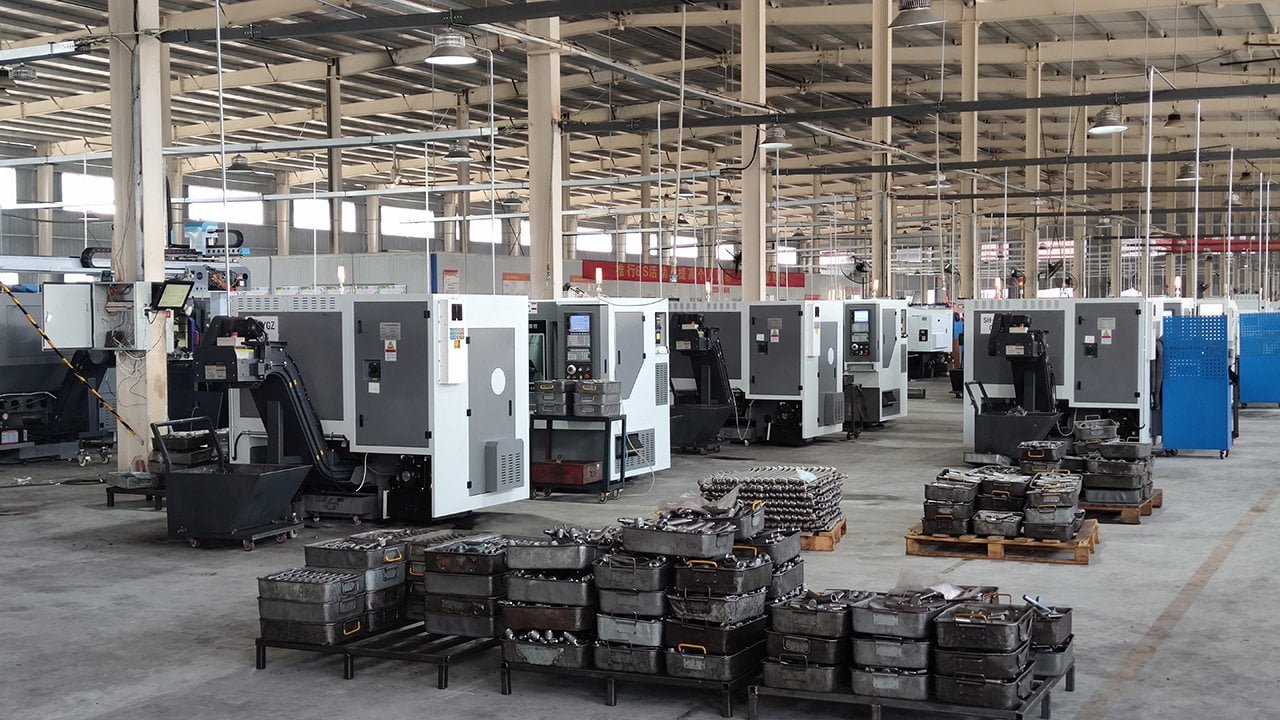
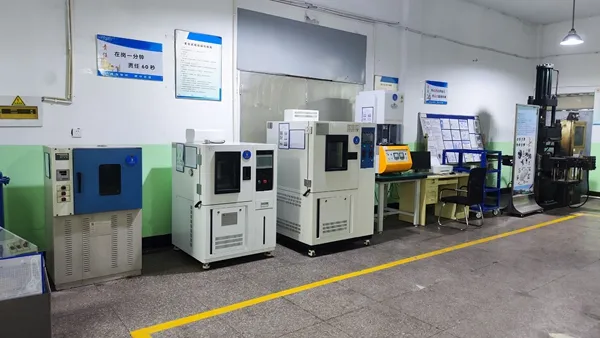
At GDST Auto Parts, our production environment includes multiple manufacturing processes, including casting, forging, welding, CNC machining, assembly, and surface treatment. I mention this because supplier capability should be judged by the actual process required for the part, not only by a general factory description.
Certification documents still require verification
A supplier may state that its quality management system follows IATF16949 or ISO9001 requirements. That information can be useful, but I recommend that buyers verify current certificates, issuing bodies, scope, validity, and site details. Certification supports confidence in a management system; it does not replace product-specific fitment checks or inspection records.
Use a sample approval process
For private-label or high-volume procurement, I find a sample approval process especially useful. Before mass production, you can compare the sample with the approved drawing, OE reference, or supplied vehicle component. You can record:
- Critical dimensions.
- Mounting orientation.
- Bearing configuration.
- Rubber and metal appearance.
- Markings and packaging.
- Inspection results.
- Approved revision level.
This record gives both buyer and supplier a common reference. It can reduce later confusion when a product is reordered months after the original approval.
Frequently Asked Questions
What is the main role of a strut mount?
A strut mount connects the upper strut assembly to the vehicle body. It helps support suspension loads, control the position of the strut, and isolate some noise and vibration. On certain designs, it also includes a bearing that allows the strut to rotate during steering.
Do all strut mounts include a bearing?
No. Some strut mounts include an integrated bearing, while others use a separate bearing or do not require the same type of rotational function. You should confirm the vehicle’s original design, OE reference, and complete strut assembly configuration before selecting a replacement.
Can a bad strut mount cause a knocking noise?
A damaged or poorly fitted mount may contribute to knocking, vibration, or harshness. However, these symptoms can also come from the strut, spring, fasteners, stabilizer link, steering parts, or installation errors. A qualified technician should inspect the complete suspension system before confirming the cause.
Are strut mounts interchangeable if the dimensions are similar?
Not necessarily. Matching dimensions do not prove compatibility. You should also verify mounting geometry, orientation, rubber characteristics, bearing configuration, OE references, and compatibility with the complete strut assembly.
What quality documents should I request from a supplier?
You can request product drawings, material inspection records, dimensional inspection reports, relevant test records, batch traceability information, and current quality-management certificates. You should verify that the documents apply to the actual product and production site.
Conclusion
The role of a strut mount extends beyond holding a strut in place. It can support suspension loads, isolate vibration, control assembly position, and permit steering rotation when the design includes the correct bearing. I recommend that you evaluate fitment, construction, testing, traceability, and supplier consistency together. If you are comparing strut mount suppliers for an aftermarket brand, importer, or wholesale program, contact GDST Auto Parts with your OE references, drawings, samples, and packaging requirements so we can discuss a qualified OEM/ODM solution.
"MacPherson strut - Wikipedia", https://en.wikipedia.org/wiki/MacPherson_strut. Suspension-system analyses describe the upper bearing in a MacPherson strut assembly as accommodating the rotational movement required during steering. Evidence role: mechanism; source type: research. Supports: Suspension engineering literature should explain that an upper bearing can accommodate rotation of the strut and spring assembly as the steering knuckle turns.. Scope note: This mechanism applies to designs in which steering rotation is carried through the strut; other suspension layouts may use a separate bearing or a different steering arrangement. ↩
"Dynamic stiffness determination of a modified engine mount", https://www.academia.edu/61065374/Dynamic_stiffness_determination_of_a_modified_engine_mount. Studies of elastomeric automotive mounts report that their stiffness and damping characteristics can attenuate vibration transmission between suspension components and the vehicle body. Evidence role: mechanism; source type: paper. Supports: Research on elastomeric vehicle mounts should support the relationship between elastomer stiffness or damping and reduced vibration transmissibility over relevant frequency ranges.. Scope note: Isolation is frequency- and load-dependent; an elastomeric mount does not eliminate all impacts or vibration. ↩
"Impact and Assessment of Suspension Stiffness on Vibration ...", https://pmc.ncbi.nlm.nih.gov/articles/PMC9965621/. Automotive suspension research indicates that elastomer stiffness and damping influence both component displacement control and the transmission of vibration and road harshness. Evidence role: mechanism; source type: research. Supports: Vehicle NVH and suspension research should establish that mount compliance affects displacement control and that increased stiffness can alter vibration and harshness transmission.. Scope note: The observed balance depends on the complete suspension design, excitation frequency, preload, temperature, and vehicle tuning. ↩
"Investigation of fatigue life and active vibration control via ...", https://pmc.ncbi.nlm.nih.gov/articles/PMC12528500/. Automotive durability studies identify cyclic mechanical loading, temperature variation, moisture, road salt, ozone, contaminants, and assembly loads as relevant service exposures for elastomeric suspension components. Evidence role: general_support; source type: paper. Supports: Automotive durability literature should document the combined mechanical and environmental conditions relevant to rubber-metal suspension mounts.. Scope note: Actual exposure severity varies with climate, road conditions, vehicle use, component location, and protective design. ↩
"Weakly-Supervised Component Suggestions for 3D ...", https://arxiv.org/html/1708.01841v2. Engineering compatibility principles indicate that dimensional resemblance alone does not establish interchangeability when load paths, material properties, kinematics, or interface functions differ. Evidence role: general_support; source type: research. Supports: Engineering literature should support the principle that functional interchangeability requires compatibility of geometry, loads, interfaces, material behavior, and operating conditions, not merely similar dimensions.. Scope note: The cited principle is general; definitive interchangeability still requires vehicle-specific design data or validated application records. ↩
"NIST Policy on Metrological Traceability", https://www.nist.gov/calibrations/traceability. Metrology guidance states that meaningful conformity evidence depends on defined measurement methods, representative sampling, acceptance criteria, and traceability to the relevant production or reference condition. Evidence role: expert_consensus; source type: government. Supports: Metrology and quality-assurance guidance should support the need to define test methods, samples, acceptance criteria, and traceability when interpreting test results.. Scope note: The specific sampling plan and acceptance criteria must be established for the product, test purpose, and applicable standard. ↩