A shock absorber controls unwanted suspension movement after your vehicle encounters a bump, dip, or uneven surface. Without properly matched damping, the spring can continue moving, which may reduce comfort and control. By understanding the working principle, you can evaluate fitment, damping behavior, and supplier evidence more confidently.
A shock absorber works by forcing hydraulic fluid through carefully controlled internal passages as the suspension compresses and rebounds. This process creates resistance and converts suspension movement into heat. The spring supports the vehicle’s weight and stores impact energy, while the shock absorber controls how quickly that stored energy is released.
That basic explanation matters because physical fit is only the beginning of product evaluation. When I inspect finished units or review dynamometer results, I look beyond mounting points. You also need to consider compression force, rebound force, application mapping, sealing quality, and production consistency.
What Does a Shock Absorber Actually Do?
A vehicle spring can compress when the wheel hits a bump, but it does not automatically stop moving after the impact. If that stored energy remains uncontrolled, the body and wheel may continue oscillating. A correctly calibrated damper slows this repeated motion without making the suspension unnecessarily harsh.
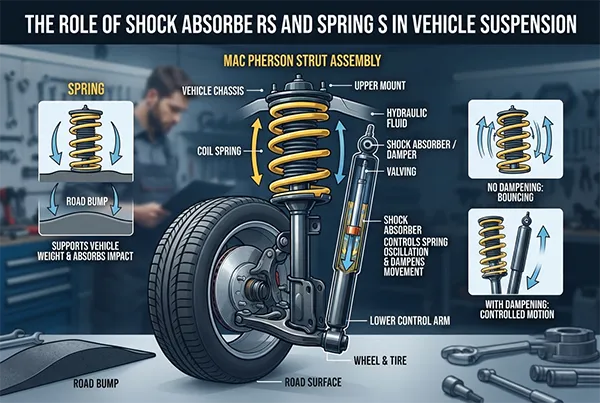
A shock absorber controls the speed of suspension compression and rebound. It does not primarily carry the vehicle’s weight. The spring carries the load, while the damper creates hydraulic resistance that limits repeated spring movement, helping the tire follow the road and keeping body movement more stable.
The Spring And Damper Perform Different Jobs
The easiest way to understand the system is to separate the two components:
- The spring carries the vehicle load.
- The spring compresses and stores energy when the wheel moves upward.
- The spring releases that stored energy as it returns toward its normal position.
- The damper controls how quickly compression and rebound occur.
- The tire, spring, damper, bushings, and suspension geometry work together as a system.
A shock absorber is sometimes described as “absorbing road impact.” That phrase can be misleading. The spring takes a major role in receiving and storing the energy created by wheel movement. The damper then controls that energy by resisting the spring’s motion.
You can picture a spring without a damper as a flexible object that keeps bouncing after you push it. Adding hydraulic damping does not remove the spring’s ability to move. Instead, it slows the movement in a controlled way.
Why Uncontrolled Movement Creates Problems
When damping is not suitable for the application, you may notice symptoms such as:
- Repeated bouncing after a road disturbance
- Excessive body movement during braking or acceleration
- A floating or unsettled ride
- Harsh reactions over small surface irregularities
- Poor wheel control on rough roads
- Unusual noise caused by internal or mounting-related problems
These symptoms do not always prove that the damper itself is defective.1 Tires, springs, top mounts, control-arm bushings, wheel alignment, and installation errors can produce similar complaints. That is why you should avoid diagnosing suspension behavior from one symptom alone.
In finished-product inspections, I have seen why dimensional approval and performance approval must remain separate. A part can pass a basic dimensional check and still require damping verification before anyone should approve it for a specific application.
A Simple Division of Responsibilities
| Suspension component | Main function | What you should verify |
|---|---|---|
| Spring | Carries load and stores impact energy | Spring type, rate, free length, load application |
| Shock absorber | Controls compression and rebound speed | Damping curves, force consistency, stroke, application |
| Mounts and bushings | Connect components and isolate some vibration | Dimensions, material condition, installation orientation |
| Tire | Maintains contact with the road | Size, pressure, load rating, wear |
| Suspension links | Guide wheel movement | Geometry, joint condition, dimensional fit |
This distinction gives you a better starting point for purchasing. You are not simply buying a metal cylinder that fits between two mounting points. You are sourcing a calibrated suspension-control component.
How Does a Shock Absorber Create Hydraulic Resistance?
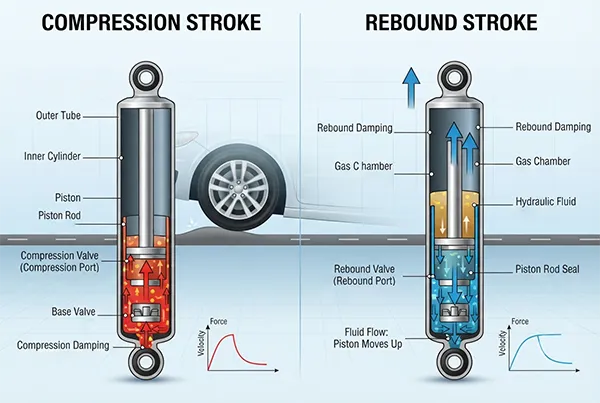
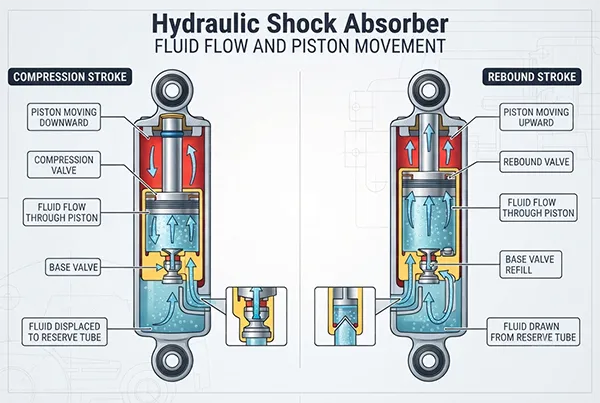
The internal piston moves when the wheel and vehicle body move relative to each other. That piston pushes hydraulic fluid through valves and restricted passages. The restrictions control fluid flow, and the resulting resistance slows the movement of the suspension during both compression and rebound.
A shock absorber creates damping force by restricting the movement of hydraulic fluid. During compression, the piston rod enters the body as the suspension shortens. During rebound, it moves outward as the suspension extends. Internal valves regulate fluid flow differently in each direction to produce the required damping behavior.2
What Happens During Compression?
Compression occurs when the distance between the damper’s mounting points becomes shorter. This usually happens when the wheel moves upward relative to the vehicle body.
Inside the unit, the piston and rod movement displaces fluid. The fluid must travel through controlled passages. The valve design limits that flow and creates resistance.
Compression damping influences how the suspension responds when it is being compressed. However, higher compression force is not automatically better. Excessive resistance can contribute to a harsh response because the suspension may not move freely enough over certain road surfaces.
What Happens During Rebound?
Rebound occurs when the spring expands and the damper extends. The spring is releasing energy that it stored during compression.
The damper restricts this extension through a separate flow path or valve response. Rebound control helps prevent the spring from returning too quickly and continuing to oscillate.
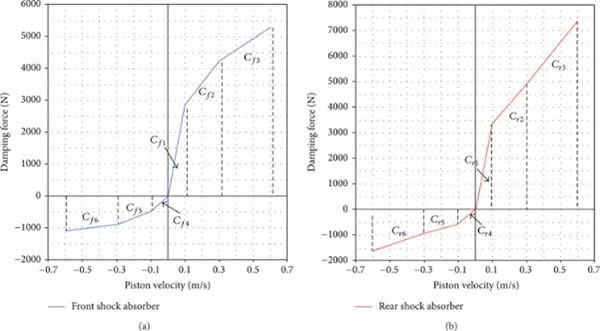
Compression and rebound usually require different damping behavior. For that reason, a single description such as “soft” or “hard” cannot fully describe damper performance.
| Stroke direction | Suspension movement | Damper’s role | Purchasing concern |
|---|---|---|---|
| Compression | Damper shortens | Controls inward movement | Avoid unsuitable harshness or insufficient control |
| Rebound | Damper extends | Controls spring return | Avoid repeated bouncing or restricted wheel recovery |
| Direction change | Piston reverses movement | Maintains a controlled transition | Check for noise, delay, or inconsistent response |
Where Does the Movement Energy Go?
The resistance inside the damper converts mechanical movement into heat in the hydraulic fluid and surrounding components. The damper body then releases that heat to the environment.
This conversion happens repeatedly while the vehicle travels. Fluid condition, valve design, internal clearances, and sealing quality therefore matter. They affect whether the unit can maintain predictable behavior under its intended conditions.
Gas pressure may also be used in some designs to help manage fluid aeration and maintain more consistent operation.3 However, the presence of gas does not mean that the damper becomes the main load-supporting component. The spring still carries the primary vehicle load in a conventional suspension arrangement.
Why Oil Seals Matter
The oil seal helps retain hydraulic fluid while allowing the piston rod to move. It also has to work with the rod surface and guide system. Poor sealing can allow external leakage, while unsuitable surface condition or assembly damage can shorten seal performance.
In my manufacturing and QC work, I pay close attention to:
- The oil-seal specification and material
- The piston-rod surface condition
- Seal-seat dimensions
- Assembly cleanliness
- Lubrication during assembly
- Rod alignment
- Evidence of external oil leakage
- Damage caused during handling or installation
Seal quality supports reliable damping, but it does not prove that the damping calibration matches a vehicle. You should treat leakage control and damping compatibility as two different evaluation tasks.
Is More Shock Absorber Damping Always Better?
A common purchasing mistake is to treat higher damping force as proof of higher quality. That assumption can result in a product that feels firm but does not suit the vehicle. Excessive damping and insufficient damping can both create undesirable ride or control characteristics.
More shock absorber damping is not automatically better. The correct damping behavior depends on vehicle mass, spring characteristics, suspension geometry, expected load, road conditions, tire choice, comfort targets, and handling requirements.4 You should evaluate compression and rebound results against application-specific acceptance criteria rather than selecting the highest force reading.
Why “Hard” Does not Mean “High Quality”
You cannot judge a damper accurately by pushing it by hand.5 A hand-compression check may identify an obvious problem, such as no resistance, severe sticking, or unusual noise. However, it cannot reproduce controlled operating speeds or provide a reliable force curve.
A unit that feels difficult to compress may have high force at one hand-generated speed. That result does not tell you how it behaves across other piston velocities. It also does not show whether the compression-to-rebound balance is suitable.
In practice, you need objective test evidence.
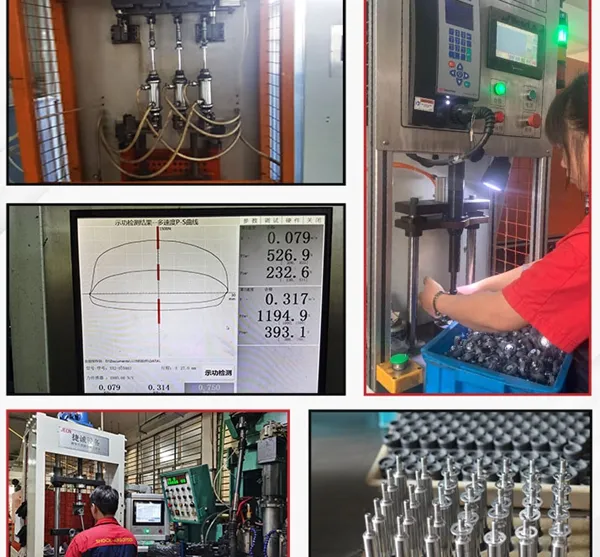
A damping dynamometer moves the damper through controlled strokes and speeds. The equipment records force during compression and rebound. The resulting data can help you assess:
- Force at specified test points
- Compression and rebound balance
- Curve shape
- Smoothness through the stroke cycle
- Repeatability between cycles
- Consistency between units
- Comparison with an approved reference or specification
The exact test method, speed points, temperature conditions, and acceptance limits should come from the relevant product specification or qualified engineering source. You should verify those details rather than applying one universal value to every application.
What Changes the Required Damping Behavior?
Several factors influence suitable calibration:
-
Vehicle weight and weight distribution
A heavier application may require different control than a lighter vehicle, but weight alone does not define the correct curve. -
Spring characteristics
The damper must work with the installed spring. A modified or heavy-duty spring can change the required damping response. -
Road conditions
Smooth highways, damaged urban roads, gravel surfaces, and off-road conditions place different demands on suspension movement. -
Expected load
A vehicle that often carries passengers or cargo may need a different application-specific setup from one that usually operates lightly loaded. -
Comfort and handling targets
A comfort-focused passenger car and a performance-oriented vehicle may use different damping strategies. -
Suspension geometry
The damper’s mounting position and motion ratio affect how wheel movement translates into damper movement.6
How Should You Compare Test Data?
You should not ask only for a graph. You should ask what the graph means and how the supplier decided whether the product passed.
A useful test package should identify:
- The exact part number
- The intended vehicle application
- The test equipment or method
- Compression and rebound directions
- The specified test conditions
- The approved force range or other acceptance criteria
- The tested sample identification
- The test date and result
- The reference specification or approved benchmark
A curve without application information or acceptance limits gives you incomplete evidence. It may show that a unit produced resistance, but it does not prove that the resistance was correct.
When I review production test results, I look for consistency as well as absolute readings. A single acceptable sample cannot establish the uniformity of an entire order. Your inspection plan should therefore define sampling, traceability, and actions for out-of-specification products.
For safety-critical or highly modified applications, you should involve a qualified suspension engineer or vehicle dynamics professional. A component supplier can provide manufacturing and test evidence, but application-specific engineering approval may require vehicle-level analysis.
Can Two Shock Absorbers With the Same Dimensions Be Interchangeable?
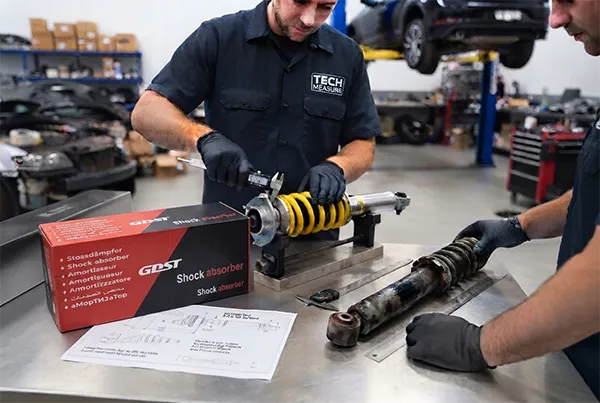
Two units may share similar length, body diameter, and mounting points, yet behave differently inside. If you approve a product only because it physically installs, you may create ride complaints or inconsistent handling. Visual similarity is useful for screening, but it cannot establish full compatibility.
Matching dimensions do not prove that two shock absorbers are interchangeable.7 You should confirm the exact vehicle, model year, engine or chassis variation where relevant, OE cross-reference, mounting details, stroke, and compression and rebound performance. Full approval requires both mechanical-fit evidence and application-specific damping evidence.
Start with Exact Application Mapping
Vehicle platforms often include several versions that look similar in a catalog. Differences may relate to body style, axle load, drivetrain, suspension package, market region, production date, or commercial-use configuration.
Your application record should include as much of the following information as relevant:
- Vehicle make and model
- Model year or production range
- Chassis or platform code
- Front or rear axle position
- Left, right, or non-handed position
- Body style
- Engine or drivetrain variant
- Standard, sport, heavy-duty, or raised suspension
- Relevant OE numbers
- Any superseded OE numbers
- Market-specific variations
An OE cross-reference is valuable, but you should verify the source. A copied catalog number may contain an error or may apply only to one regional specification.
Separate Dimensional Fit From Functional Fit
I use dimensional inspection to confirm whether the product matches approved drawings and specifications. Important checks can include:
- Extended and compressed length
- Working stroke
- Body and rod dimensions
- Mounting-hole position
- Bracket angle and orientation
- Bushing or sleeve dimensions
- Spring-seat location on strut designs
- Hose and sensor bracket position
- Thread size
- Clearance around nearby components
These checks help prevent installation problems such as misaligned brackets or incorrect mounting dimensions. However, they do not reveal the internal valve calibration.
A complete approval process should have at least two gates:
| Approval gate | Main question | Typical evidence |
|---|---|---|
| Application and fit | Will the part install correctly on the intended vehicle? | Vehicle mapping, OE references, drawings, dimensional report |
| Damping performance | Will it control movement as specified? | Compression and rebound test results, curves, acceptance criteria |
| Production quality | Can the supplier make it consistently? | Inspection records, control plans, traceability, process checks |
| Sealing and finish | Can the unit retain fluid and resist expected exposure? | Leakage controls, rod and seal checks, verified corrosion-test reports |
Do not Overlook Mounting Details
A bracket that is only slightly mispositioned may interfere with installation or place connected parts in the wrong location. The same concern applies to brake-hose brackets, stabilizer attachments, sensor-wire supports, and spring seats.
That is why I treat fixture control, drawing revision, and final dimensional inspection as practical purchasing issues. If a supplier does not control drawing versions, the factory may produce a dimensionally consistent part that follows an outdated requirement.
You should also control samples carefully. A sample may be hand-selected or adjusted before shipment. Production approval should connect the approved sample to the final drawing, bill of materials, damping standard, and inspection plan.
How Should You Verify a Shock Absorber Supplier?
Supplier verification becomes easier when you connect each factory claim to objective evidence. A large catalog or modern production line may be helpful, but neither proves that a specific part has suitable damping. You need product-level records, controlled manufacturing processes, and consistent inspection methods.
To verify a shock absorber supplier, ask for exact application mapping, approved drawings, compression and rebound test results, and documented acceptance criteria. You should also review oil-seal controls, piston-rod quality, welding processes, dimensional inspection, leakage prevention, traceability, and batch consistency through samples, reports, or a qualified factory audit.
Ask Product-specific Questions
Broad questions usually produce broad answers. “Is your quality good?” invites a yes. A better review uses questions that require records.
You can ask:
- Which exact vehicle variants does this part number cover?
- Which OE numbers support the application mapping?
- What drawing revision controls the dimensions?
- What compression and rebound criteria apply?
- Under which test conditions were the results recorded?
- How does the factory control oil-seal installation?
- How does the factory inspect the piston rod?
- Which dimensions receive final inspection?
- How are tested units linked to production batches?
- What happens when a damping result falls outside the approved range?
At GDST Auto Parts, we use in-house processes that include raw-material inspection, machining, welding, assembly, coating, final performance testing, and packaging. We also focus closely on welding and oil-seal assembly because failures in these areas can lead to structural concerns or fluid leakage. You should still verify the evidence for the exact product you plan to buy.
Review Certification Carefully
Management-system and automotive quality certifications can support supplier evaluation. GDST Auto Parts reports certification to standards including ISO 9001, ISO 14001, ISO 45001, and IATF 16949.8
However, you should treat every certificate as a document that requires verification. Check:
- The legal company name
- The factory address
- The certificate scope
- The issuing certification body
- The issue and expiration dates
- The certificate status
- Whether the manufacturing site is included
- Whether the relevant product activities fall within scope
A valid system certificate does not approve every part number. It indicates that a management system has been assessed within a defined scope. You still need product-specific fitment and damping evidence.
Build a Practical Approval File
Your supplier approval file can combine commercial, technical, and quality records:
| Record | Why it matters |
|---|---|
| Application list | Defines where each product may be used |
| OE cross-reference | Supports catalog accuracy |
| Approved drawing | Controls dimensions and mounting details |
| Damping specification | Defines compression and rebound requirements |
| Dynamometer report | Shows tested performance |
| Control plan | Explains production and inspection controls |
| Material or component records | Supports specification traceability |
| Packaging specification | Prevents labeling and handling mistakes |
| Certificate verification | Supports management-system review |
| Audit report | Confirms factory practices at the time of audit |
For larger or technically sensitive orders, you should consider a third-party factory audit and independent product testing. You should also define acceptance criteria before production begins. If expectations remain vague until final inspection, disagreements become much harder to resolve.
Frequently Asked Questions
Does a shock absorber carry the vehicle’s weight?
A shock absorber does not primarily carry vehicle weight in a conventional suspension system. The spring supports the load and stores energy when it compresses. The damper controls the speed at which the spring compresses and rebounds, reducing repeated oscillation after the wheel encounters a road disturbance.
Can you test a shock absorber by pushing it by hand?
A hand test may reveal obvious sticking, noise, or a complete lack of resistance, but it cannot confirm correct calibration. You need controlled dynamometer testing to measure compression and rebound force under defined conditions. The results should be compared with application-specific acceptance criteria.
Does a stiffer shock absorber improve handling?
A stiffer damper does not automatically improve handling. Excessive damping can reduce comfort and may prevent the wheel from responding properly to some road surfaces. The correct setup depends on the vehicle, spring, load, suspension geometry, tires, road conditions, and intended driving characteristics.
Is an OE number enough to confirm compatibility?
An OE number is an important reference, but you should verify its source and applicable vehicle variants. You should also confirm model year, axle position, dimensions, mounting details, stroke, and damping behavior. Catalog errors and regional vehicle differences can make an unverified cross-reference unreliable.
What test report should you request before purchasing?
You should request a report linked to the exact part number and application. It should identify compression and rebound results, test conditions, sample details, acceptance criteria, and the final pass or fail decision. A graph without limits or application information is not sufficient evidence of compatibility.
Conclusion
A shock absorber works by converting suspension movement into controlled hydraulic resistance during compression and rebound. The spring carries the load, while the damper manages spring motion. When you evaluate a product, you should look beyond appearance, stiffness, and mounting dimensions. You should verify application mapping, OE references, drawings, damping results, acceptance criteria, sealing controls, and production consistency.
If you need application-based sourcing, OEM/ODM customization, or documented damping and dimensional inspection support, contact GDST Auto Parts to discuss your required vehicle coverage, specifications, testing evidence, order quantity, and factory-audit needs.
"03 Suspension and Alignment.", https://regs.maryland.gov/us/md/exec/comar/11.14.05.03. Vehicle inspection and maintenance guidance treats bouncing, noise, harshness, and unstable handling as nonspecific symptoms that may arise from dampers or from other tire, mounting, alignment, spring, and suspension-component faults. Evidence role: expert_consensus; source type: government. Supports: The source should identify multiple possible causes of suspension symptoms, including dampers, springs, tires, joints, bushings, alignment, or mounting faults.. Scope note: Such guidance supports differential inspection rather than diagnosing the cause of any particular vehicle complaint. ↩
"Development of a Semi-active Suspension System for ...", https://vtechworks.lib.vt.edu/bitstream/handle/10919/72131/Tyagi_SR_T_2016.pdf?isAllowed=y&sequence=1. Technical studies of hydraulic dampers describe direction-sensitive valve systems in which compression and rebound flows follow different calibrated paths, allowing distinct force characteristics in the two stroke directions. Evidence role: mechanism; source type: paper. Supports: The source should describe separate or direction-sensitive fluid paths and the resulting differences between compression and rebound damping forces.. Scope note: The precise circuit arrangement varies among twin-tube, monotube, adjustable, and electronically controlled damper designs. ↩
"experimental diagnosis of cavitation for a hydraulic monotube ...", https://www.academia.edu/28661385/EXPERIMENTAL_DIAGNOSIS_OF_CAVITATION_FOR_A_HYDRAULIC_MONOTUBE_SHOCK_ABSORBER. Studies of gas-pressurized hydraulic dampers report that maintaining fluid pressure can reduce cavitation and aeration, helping preserve more repeatable damping forces under demanding operating conditions. Evidence role: mechanism; source type: paper. Supports: The source should explain how gas pressure separates or pressurizes the fluid volume and reduces the likelihood of cavitation, foaming, or aeration-related force variation.. Scope note: Gas pressure does not eliminate all temperature- or speed-dependent force variation, and its implementation differs between monotube and twin-tube designs. ↩
"(PDF) Study of Road Holding and Ride Comfort Analysis ...", https://www.academia.edu/65260064/Study_of_Road_Holding_and_Ride_Comfort_Analysis_with_the_Help_of_Quarter_Car_Model. Suspension-optimization research treats damping as an application-specific calibration problem, with ride comfort, suspension travel, body control, and dynamic tire load often imposing competing objectives. Evidence role: expert_consensus; source type: paper. Supports: The source should establish that damper tuning involves trade-offs among ride comfort, road holding, body control, vehicle mass, spring rate, and operating conditions.. Scope note: Simplified quarter-car or simulation studies demonstrate the general trade-off but do not define a correct production calibration for a particular vehicle. ↩
"Characterizing a Racing Damper's Frequency Dependent ...", https://vtechworks.lib.vt.edu/bitstream/handle/10919/42109/Shawn_Emmons_Thesis_ETD.pdf?sequence=1. Damper characterization is ordinarily performed on a dynamometer that controls stroke and velocity while recording compression and rebound force; an uncontrolled hand test cannot produce an equivalent force-velocity curve. Evidence role: general_support; source type: research. Supports: The source should describe dynamometer control of displacement or velocity and measurement of force over compression and rebound cycles.. Scope note: A hand test may still reveal gross faults such as seizure, severe sticking, noise, or an obvious absence of resistance. ↩
"Suspension", http://ruina.tam.cornell.edu/Courses/moonbuggy/2002/design_files/suspension_files/Suspension.html. Vehicle-suspension references define motion ratio as the kinematic relationship between wheel movement and spring or damper movement, making installation geometry a determinant of damper velocity and effective wheel-level damping. Evidence role: mechanism; source type: education. Supports: The source should define suspension motion ratio and explain its effect on damper displacement, velocity, and effective damping at the wheel.. Scope note: The ratio may vary through suspension travel and cannot always be represented accurately by a single constant value. ↩
"Shocks vs Struts: Understanding Key Suspension Differences", https://www.uti.edu/blog/automotive/struts-vs-shocks. Damper research shows that units sharing basic envelope and mounting dimensions may nevertheless have materially different force-velocity characteristics; dimensional fit therefore provides only contextual support for installation and does not establish functional interchangeability for a specific vehicle. Evidence role: general_support; source type: research. Supports: The source should demonstrate that dampers with compatible mounting dimensions can have different force-velocity characteristics and that those characteristics affect vehicle response.. Scope note: A general engineering source cannot determine whether any particular pair of part numbers is interchangeable; that conclusion requires application records and part-specific test data. ↩
"GDST Auto Parts | The Histories of GDST Auto Parts: -1995 ...", https://www.instagram.com/reel/C76Rf3jNyLc/. Accredited certification records should be used to confirm whether the named legal entity and manufacturing site hold current ISO 9001, ISO 14001, ISO 45001, and IATF 16949 certificates within the stated scopes; such records verify management-system certification only, not the suitability or quality of an individual shock-absorber part number. Evidence role: case_reference; source type: institution. Supports: The source should verify the certified legal entity, manufacturing location, applicable standards, certification scope, issuing body, and current validity dates.. Scope note: Certification status and scope can change, so the evidence must be checked against a current registry or issuing-body record rather than a supplier-provided logo or undated certificate copy. ↩