
Shock absorber vs coil spring confusion can quickly lead to the wrong diagnosis, quotation, or purchase. A vehicle may sag, bounce, lean, or make noise, but those symptoms do not identify one failed part by themselves. You first need to separate load support from motion control, then confirm the suspension design and inspect the vehicle.
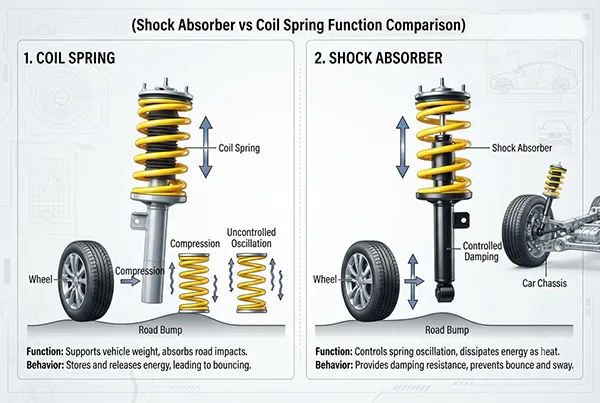
A coil spring supports the vehicle’s weight and helps maintain ride height, while a shock absorber controls spring movement, rebound, and oscillation. Neither component replaces the other. If a vehicle sags, bounces, or handles poorly, you should inspect the entire suspension rather than select a part from one symptom alone.
The practical question is not which part is better. You need to ask whether the concern involves ride-height support, uncontrolled suspension movement, or both. You must also determine whether the catalog calls for a standalone shock absorber, a strut, or a complete strut assembly.
What Is the Main Shock Absorber vs Coil Spring Difference?
The two parts often operate close to each other, so their roles are easy to confuse. That confusion becomes expensive when a quotation includes the wrong product type or a repair replaces the motion-control component without investigating a ride-height problem.
The main shock absorber vs coil spring difference is functional: the coil spring carries load and stores suspension energy, while the shock absorber dissipates that energy to control movement. The spring allows the wheel and body to move over road irregularities. The shock limits repeated bouncing, pitching, and rebound.
What Does a Coil Spring Do?
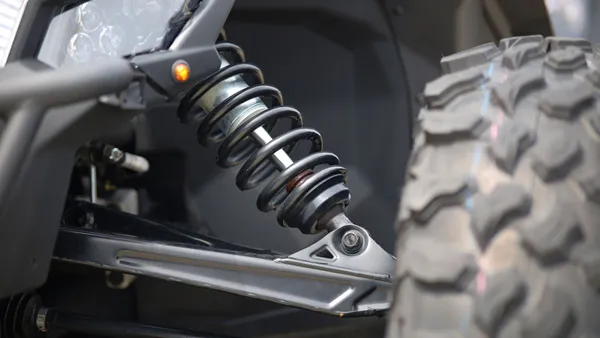
A coil spring compresses as the suspension carries the vehicle and responds to road input. It helps establish the designed relationship between the body, chassis, and wheels. Its exact behavior depends on several factors, including:
- Spring material and wire diameter
- Coil diameter and number of active coils
- Free length and installed height
- Linear or progressive spring design
- Vehicle axle load
- Suspension geometry
- Original equipment specifications
The spring temporarily stores energy when it compresses. It then releases that energy as it returns toward its normal position. Without sufficient damping, that stored energy can cause continued movement after the initial bump.
A spring also contributes to ride height, but you should not assume every ride-height concern proves that the spring has failed. Vehicle loading, spring seats, isolators, suspension geometry, damaged mounting points, mismatched components, and previous modifications can also affect measured height.
What Does a Shock Absorber Do?
A conventional shock absorber uses hydraulic resistance to control the relative movement between the body and suspension. Internal valves regulate fluid flow during compression and rebound strokes. This process converts part of the suspension’s movement into heat, which then dissipates through the unit.
A shock absorber primarily helps control:
- Repeated bouncing after a road input
- Rebound after spring compression
- Body pitch during acceleration or braking
- Body roll during directional changes
- Wheel movement over uneven surfaces
- Tire contact consistency under changing road conditions1
Most conventional shock absorbers do not serve as the main static load-support component. Gas pressure inside a gas-charged shock can create some extension force, but you should not treat that force as a replacement for the coil spring. Specialized load-assist products and air suspension systems require separate evaluation.
Shock Absorber vs Coil Spring Comparison
| Evaluation point | Coil spring | Shock absorber |
|---|---|---|
| Primary job | Supports load and contributes to ride height | Controls suspension movement |
| Energy behavior | Stores and releases energy | Dissipates movement through hydraulic resistance |
| Main design characteristic | Spring rate and installed geometry | Compression and rebound damping |
| Common product form | Separate spring or part of an assembly | Standalone shock or strut damper |
| Can replace the other part’s function? | No | No |
| Selection basis | Vehicle load, geometry, application, and OE reference | Vehicle application, mounting, dimensions, and damping requirements |
From production testing and quality-control work, I have found that the clearest conversations begin with one question: Are you trying to support the vehicle at the correct height, or control movement after the suspension is disturbed? That question does not diagnose the vehicle, but it prevents many early catalog and quotation errors.
How Do Shock Absorber vs Coil Spring Symptoms Differ?
A sagging corner may direct attention toward the spring or its mounting system. Continued bouncing may direct attention toward damping. However, suspension parts work as a system, and several unrelated faults can produce similar behavior. A symptom should start an inspection, not finish one.
Possible coil spring concerns often involve ride height, visible spring damage, or reduced load support. Possible shock absorber concerns often involve uncontrolled bouncing, pitching, or rebound. However, worn mounts, bushings, tires, ball joints, alignment problems, and other suspension faults can produce overlapping symptoms, so professional inspection remains necessary.
Start by Classifying the Complaint
Before you search a catalog or prepare a quotation, place the complaint into one of three broad categories:
- Ride-height or load-support concern
- Movement-control concern
- Noise, vibration, or handling concern with an unclear source
This classification helps you ask better questions. It does not prove which part is defective.
Possible Ride-height or Spring-related Observations
You may need to inspect the spring and surrounding components when you observe:
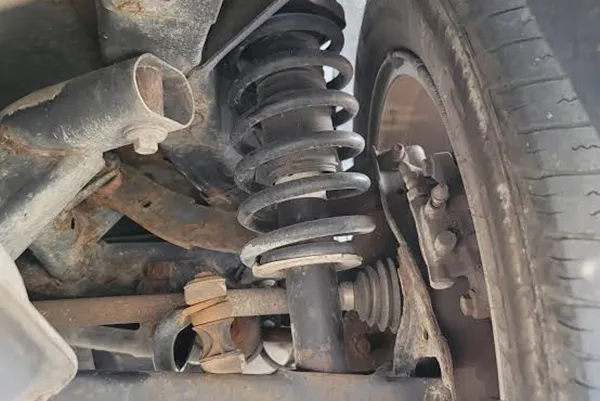
- One corner sitting lower than the comparable side
- A vehicle sitting outside its specified trim-height range
- A visible fracture or missing section of a coil
- Coil-to-coil or coil-to-body contact
- A displaced spring or damaged spring seat
- Frequent bottoming under an appropriate load
- Corrosion or physical damage in a critical spring area
You should measure ride height on a level surface using the vehicle manufacturer’s specified reference points.2 Tire pressure, cargo, fuel load, wheel size, vehicle modifications, and uneven ground can distort the comparison.
A lower corner does not automatically mean the spring alone is responsible. A damaged spring seat, collapsed isolator, structural damage, incorrect replacement part, or previous suspension modification may change the installed position.
Possible Shock Absorber-related Observations
You may need to inspect the shock absorber or strut when the vehicle shows:
- Continued oscillation after a bump
- Excessive body pitch or float
- Poor control over repeated road undulations
- Unusual rebound behavior
- Damaged shock mounts or bushings
- Physical damage to the shock body or piston rod
- Fluid leakage that exceeds the manufacturer’s acceptable condition
A light film on a damper body and an active hydraulic leak are not always classified in the same way.3 You should follow the component manufacturer’s inspection criteria rather than make a decision from appearance alone.
The traditional manual “bounce test” can reveal severe loss of control in some cases, but it cannot provide a complete diagnosis. Modern suspension designs, stiff springs, tire characteristics, and vehicle mass can make the result difficult to interpret.
Why Do Symptoms Overlap?
The spring and damper continuously influence each other. If a spring no longer supports the intended installed height, the shock absorber may operate in a different part of its stroke. If damping is inadequate, the spring may continue oscillating even though its load-support ability remains acceptable.
Other components can also imitate spring or shock absorber problems:
| Observation | Possible areas to inspect |
|---|---|
| Clunking over bumps | Mounts, bushings, links, fasteners, ball joints, spring seating, shock attachment points |
| Uneven tire wear | Alignment, tire pressure, joints, bushings, ride height, wheel condition |
| Vehicle pull | Tires, brakes, alignment, ride height, structural condition |
| Low ride height | Springs, seats, isolators, loading, incorrect parts, modifications |
| Excessive bounce | Dampers, mounts, tires, suspension joints, application mismatch |
| Steering instability | Tires, steering parts, alignment, wheel bearings, suspension components |
You should never approve a spring or shock absorber replacement from one symptom without confirming the vehicle application and inspecting related components.
When uncertainty remains, you should use a qualified technician who can follow the vehicle manufacturer’s inspection and service procedures. Application-specific decisions may require measurements, component removal, alignment checks, or specialist test equipment.
How Do a Shock Absorber, Strut, and Complete Strut Assembly Differ?
Product terminology causes as many order problems as technical diagnosis. A customer may request a “shock” while expecting a spring-inclusive assembly. If you quote a bare strut instead, the part may fit the vehicle but still fail to match the customer’s expected scope.
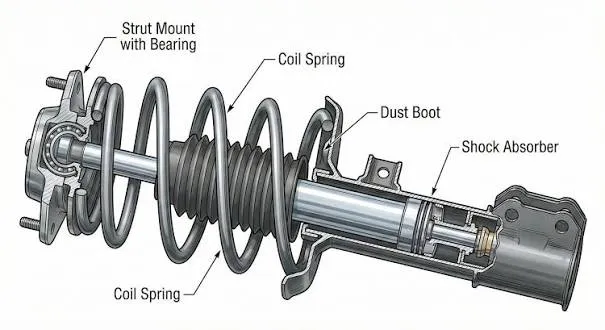
A shock absorber is generally a separate damping unit. A strut combines damping with a structural suspension role and may help locate the wheel. A complete strut assembly usually includes the strut, coil spring, upper mount, and related hardware. Catalog definitions vary, so you must verify the included components before ordering.
A Standalone Shock Absorber
A standalone shock absorber usually mounts separately from the coil spring. You can find this arrangement on many rear suspension systems, trucks, and other vehicle applications. The shock controls movement, while another component supports the load.
The exact mounting style may include:
- Eye-to-eye mounts
- Stem-to-eye arrangements
- Pin or stud mounts
- Bracketed lower mounts
- Application-specific bushings and sleeves
Two shocks that look similar may still differ in extended length, compressed length, mounting dimensions, stroke, internal valving, or bracket orientation. Visual similarity is not enough for fitment confirmation.
A Strut
A strut is more than a shock absorber with a different name. It normally forms a structural part of the suspension.4 Depending on the design, it may connect the steering knuckle to the body and contribute to wheel location.
A catalog listing for a bare strut or strut cartridge may not include:
- Coil spring
- Upper strut mount
- Bearing
- Spring seats
- Dust boot
- Bump stop
- Installation hardware
Replacing a strut can also disturb suspension geometry.5 You should follow the relevant service procedure and determine whether the vehicle needs an alignment check after installation.
A Complete or Loaded Strut Assembly
A complete strut assembly, sometimes called a loaded strut or quick strut in certain markets, generally combines several parts into one installation unit. The package may include:
- Strut damper
- Coil spring
- Upper mount
- Bearing, where applicable
- Upper and lower spring seats
- Dust cover
- Bump stop
- Related washers, nuts, or insulators
However, “complete” is not a universal bill of materials. One supplier may include every item above, while another may omit a bearing, fastener, or isolator. You must inspect the product drawing, packing list, photographs, and catalog notes.
Why the Product Hierarchy Matters
When you compare shock absorber vs coil spring products, you should define the requested level before discussing price:
| Requested product | Damper included? | Coil spring included? | Structural suspension role? |
|---|---|---|---|
| Standalone shock absorber | Yes | No | Usually no |
| Bare strut | Yes | No | Usually yes |
| Coil spring | No | Yes | Supports load |
| Complete strut assembly | Yes | Usually yes | Yes |
| Spring-and-shock kit | Depends on kit | Depends on kit | Application-dependent |
In anonymized discussions with parts buyers, I have seen terminology differences turn into avoidable after-sales disputes. The supplier may ship the exact bare strut shown in its catalog, while the buyer believes the quoted price includes the spring and mount. Both parties may have used the word “strut,” but they were describing different product scopes.
You can prevent that problem by writing the component level directly in the inquiry. For example:
“Please quote a complete front strut assembly, including the coil spring, upper mount, bearing, bump stop, and dust boot. Please identify any excluded hardware.”
That wording is much safer than asking only for a “front shock.”
How Should You Evaluate Shock Absorber vs Coil Spring Replacement Needs?
Replacing parts without a structured inspection can leave the original problem unresolved. It can also create repeat labor, additional alignment work, or a second purchase. You should confirm the symptom, vehicle identity, suspension layout, and required product scope before authorizing replacement.
To evaluate shock absorber vs coil spring replacement needs, first verify the vehicle and suspension design. Then separate ride-height concerns from movement-control concerns, inspect both components and their mounting points, and compare the findings with manufacturer criteria. You should use a qualified technician for safety-critical or application-specific decisions.
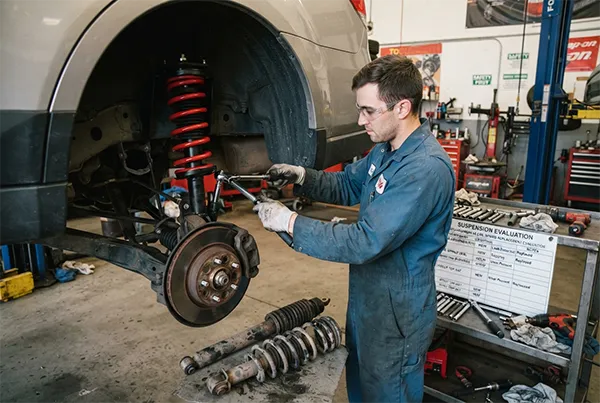
Use a Step-by-step Inspection Process
A practical evaluation can follow this order:
-
Record the exact complaint.
Ask when the concern occurs. Note whether it appears during braking, cornering, loading, low-speed bumps, or repeated road undulations. -
Confirm the vehicle identity.
Record the VIN where available, model year, engine, drivetrain, axle configuration, body style, and suspension option. -
Check for modifications.
Lift kits, lowering springs, non-standard wheels, increased loads, and previous suspension changes can alter both fitment and behavior. -
Measure ride height correctly.
Use the manufacturer’s reference points and loading conditions. Do not rely only on the visual gap between the tire and fender. -
Inspect the coil spring and its seats.
Look for fractures, displacement, severe corrosion, contact marks, incorrect seating, or damaged isolators. -
Inspect the damper and attachments.
Check the piston rod, body, bushings, mounts, fasteners, brackets, dust protection, and leakage condition. -
Inspect related systems.
Tires, control-arm bushings, stabilizer links, ball joints, bearings, steering parts, and alignment can affect the same complaint. -
Compare the findings with service criteria.
Use the vehicle or component manufacturer’s specifications where available.
You should also follow safe lifting and spring-handling procedures. A compressed coil spring stores substantial energy. Removal from a strut assembly requires suitable equipment and trained handling. If you do not have the correct compressor and procedure, you should not disassemble the assembly.
Should the Spring and Shock be Replaced Together?
You do not always need to replace a coil spring simply because you replace a shock absorber. You also do not automatically need a new damper because one spring requires replacement. The decision depends on inspection findings, service guidance, mileage and use conditions, axle balance, and the design of the suspension.
Many service procedures recommend replacing certain suspension components in axle pairs to preserve balanced behavior. However, you should verify the recommendation for the specific application instead of applying one rule to every vehicle.
You should consider these questions:
- Does the opposite-side component have similar wear or damage?
- Does the manufacturer specify replacement in pairs?
- Will the work require spring compression or major disassembly?
- Are the mounts, bearings, bump stops, and dust boots reusable?
- Does the new part match the original ride-height and damping requirements?
- Will the repair require an alignment inspection?
You should not assume that a “sport,” “heavy-duty,” or “comfort” component is automatically better. Spring rate and damping force must suit the vehicle, axle load, suspension geometry, tire setup, and intended use.
How Can Shock Absorber vs Coil Spring Ordering Errors Be Prevented?
An incorrect order can create more than a return. It can delay a repair, occupy workshop space, increase freight costs, and weaken customer trust. The safest approach is to treat component scope and vehicle fitment as separate checks.
You can prevent shock absorber vs coil spring ordering errors by confirming the vehicle application, OE reference, installation position, suspension type, and required product level. Your quotation should state whether it covers a coil spring, standalone shock, bare strut, or complete strut assembly and list every included component.

Build a Complete Fitment Record
You should gather more than the vehicle model name. A useful inquiry includes:
- VIN or chassis number, where appropriate
- Make, model, and model year
- Engine and drivetrain
- Body style
- Front or rear axle
- Left, right, or non-handed position
- Standard, sport, heavy-duty, or electronic suspension
- OE part number
- Existing part photographs
- Mounting and bracket details
- Requested product scope
Regional versions of the same model can use different suspension parts. Production dates can also divide fitment within a single model year. You should therefore verify catalog data against the OE number and physical configuration when possible.
Make the Quotation Unambiguous
A clear quotation should identify:
| Quotation field | What you should confirm |
|---|---|
| Product category | Shock absorber, strut, coil spring, or complete assembly |
| Installation position | Front/rear and left/right |
| Included components | Spring, mount, bearing, boot, bump stop, hardware |
| Reference numbers | OE and supplier cross-references |
| Suspension option | Standard, sport, raised, lowered, electronic, or load-rated |
| Unit definition | Piece, pair, set, or axle kit |
| Packaging quantity | Units per carton and cartons per order |
| Technical documents | Drawing, dimensions, and fitment list |
| Quality documents | Current certificates and relevant test reports for review |
If you buy for distribution, you should request samples or drawings for unfamiliar applications before a large order. You should also verify that quality-system certificates are current, issued by recognized bodies, and relevant to the manufacturing site. A certificate supports supplier evaluation, but it does not replace product validation or fitment checks.
Review the Data Before Shipment
Your purchase order should repeat the product level rather than relying on earlier messages. You can add a simple confirmation line such as:
“The ordered item is a bare front strut. It does not include the coil spring, upper mount, bearing, boot, or bump stop.”
For a complete assembly, you can attach a component checklist and approved image. This small step can reduce disputes caused by language differences, shortened descriptions, or catalog assumptions.
Your incoming inspection should then verify:
- Part number and label
- Installation position
- Bracket and mounting orientation
- Included accessory set
- Key dimensions
- Packaging identification
- Visible damage or corrosion
- Sample fitment, where your quality plan requires it
The most reliable shock absorber vs coil spring purchasing process combines accurate terminology, fitment verification, document review, and physical inspection. Price comparison should come after those points are aligned.
Frequently Asked Questions
Can a shock absorber support the vehicle if the coil spring is broken?
A conventional shock absorber should not be treated as a substitute for a damaged coil spring. The spring provides the main load and ride-height support in this suspension arrangement. A broken spring can create a safety risk, so the vehicle should receive qualified inspection before further use.
Can worn shock absorbers make a vehicle sit lower?
Conventional shock absorbers usually do not establish the vehicle’s static ride height. However, suspension design, gas pressure, load-assist features, mounting condition, and other components can affect what you observe. You should measure the vehicle using the specified reference points and inspect the complete suspension.
Does bouncing always mean that the shock absorber has failed?
No. Continued bouncing can suggest inadequate damping, but it does not confirm a failed shock absorber by itself. Tires, springs, mounts, bushings, loading, and suspension geometry can affect movement. A technician should inspect the system and compare the results with the manufacturer’s criteria.
Is a strut the same as a complete strut assembly?
No. A bare strut normally provides damping and serves a structural suspension role, but it may not include the coil spring or upper components. A complete strut assembly usually includes the spring, mount, and other parts. You should always verify the supplier’s exact bill of materials.
Should you replace shock absorbers and coil springs in pairs?
Pair replacement is often recommended to maintain balanced behavior across an axle, but the correct procedure depends on the vehicle, component condition, and manufacturer’s instructions. You should inspect both sides and follow application-specific service guidance rather than apply one rule to every suspension.
Conclusion
The shock absorber vs coil spring comparison is not about choosing which component is better. The coil spring supports load and contributes to ride height, while the shock absorber controls compression, rebound, and repeated movement. You should classify the complaint, inspect related parts, verify the suspension layout, and distinguish a shock from a bare strut or complete strut assembly. For safer quotations and fewer wrong orders, send your vehicle details, OE references, installation position, and required component scope to a qualified parts specialist before purchasing.
"Tire Force Estimation in Off-Road Vehicles Using ...", https://etd.auburn.edu/bitstream/handle/10415/2966/Hill_Thesis.pdf?sequence=3&isAllowed=y. Vehicle-dynamics research associates suspension damping with control of dynamic wheel loads and tire-road contact as a wheel traverses road irregularities. Evidence role: mechanism; source type: paper. Supports: Research should show that damping influences wheel-load variation and the tire's ability to follow uneven road surfaces.. Scope note: Damping is only one influence on tire contact; tire properties, road profile, suspension geometry, speed, and vehicle loading also affect the result. ↩
"Kenworth Ride Height Measurement", https://training.jacksonms.gov/libweb/2ASbfA/279060/KenworthRideHeightMeasurement.pdf. Official vehicle inspection and service procedures commonly specify that trim height be checked on a level surface using defined body or suspension reference points and stated loading conditions. Evidence role: general_support; source type: government. Supports: An official inspection manual or service procedure should require a level measuring surface and designated vehicle reference points for ride- or trim-height assessment.. Scope note: The exact preparation, dimensions, tolerances, and reference locations are application-specific and must be taken from the relevant vehicle procedure. ↩
"Ohio School Bus Standards and Inspection Manual", https://education.ohio.gov/getattachment/Topics/Finance-and-Funding/School-Transportation/State-Highway-Patrol/School-Bus-Inspection-Manual-2025.pdf.aspx?lang=en-US. Vehicle-inspection guidance distinguishes limited damper misting or seepage from a significant fluid leak, with defect classification depending on the extent of leakage and its effect on damper operation. Evidence role: definition; source type: government. Supports: A government vehicle-inspection manual should distinguish minor damper misting or seepage from leakage serious enough to constitute a defect.. Scope note: Inspection terminology and rejection thresholds differ among jurisdictions and do not replace the vehicle or component manufacturer's service criteria. ↩
"Shocks vs Struts: Understanding Key Suspension Differences", https://www.uti.edu/blog/automotive/struts-vs-shocks. Engineering references define the suspension strut as a structural suspension member incorporating a damper and contributing to wheel location or the transfer of suspension loads to the vehicle body. Evidence role: definition; source type: encyclopedia. Supports: A reference source should define a suspension strut as an integrated structural member that combines damping with wheel-location or load-path functions.. Scope note: The strut's exact structural and steering functions vary among suspension architectures. ↩
"A STUDY OF PARAMETERS INFLUENCING THE ...", https://ninercommons.charlotte.edu/record/746/files/Patel_uncc_0694N_11115.pdf. Automotive service references note that strut removal can disturb suspension mounting relationships and wheel-alignment angles, particularly where the strut-to-knuckle connection influences camber. Evidence role: mechanism; source type: education. Supports: An automotive-service or vehicle-dynamics source should explain how disturbing strut-to-knuckle or upper-mount locations can affect camber, toe, or related alignment angles.. Scope note: Not every strut replacement changes alignment measurably; the required checks and adjustments depend on the specific suspension design and service procedure. ↩