

A bad shock absorber may still allow your car to move, but movement does not prove that the car is safe. Weak or uneven damping can reduce tire contact and make steering, braking, and body movement less predictable. You need to judge the warning signs and arrange a professional inspection promptly.
You should not continue driving if a bad shock absorber causes continuous bouncing, severe leaning, unstable steering, noticeable diving or pulling under braking, or poor tire contact. Broken, loose, deformed, or tire-interfering suspension parts also require you to stop safely and arrange towing. Mild symptoms still need prompt professional inspection.
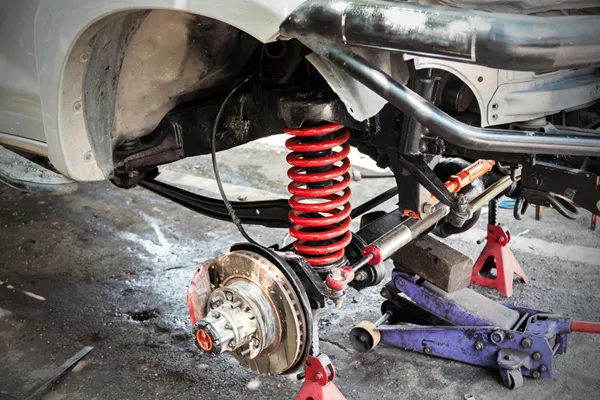
The difficult part is that noise, bouncing, and pulling do not confirm the cause by themselves. You need to separate urgent control problems from symptoms that may permit only a short, cautious trip to a nearby repair facility.
Is It Safe to Drive With a Bad Shock Absorber?
Your car may feel driveable even when its suspension cannot control movement properly. That creates a misleading sense of safety. A small leak or occasional noise may seem harmless, but the underlying problem could affect vehicle stability or involve a different suspension component.
A bad shock absorber is not safe to ignore because it may reduce body control, tire contact, steering stability, and predictable braking behavior. Whether you should stop immediately depends on the severity of the symptoms. No remote checklist can guarantee that a particular vehicle remains safe to drive.
Why does damping matter?
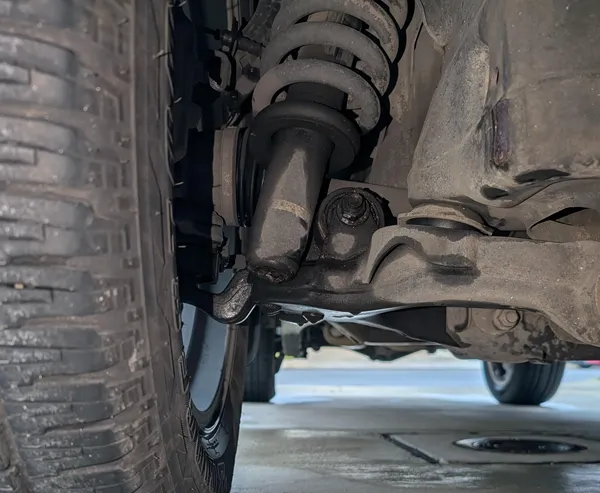
A spring supports the vehicle and allows a wheel to move over bumps. The shock absorber controls that movement by forcing fluid through internal valves.1 Without enough damping, the spring and body can continue moving after the initial bump.2
That uncontrolled movement can affect several parts of the driving experience:
- Tire contact: A wheel may become less stable over rough or uneven surfaces.
- Body control: The vehicle may bounce, pitch, squat, or lean more than expected.
- Steering response: Weight movement can make directional changes feel delayed or unsettled.
- Braking behavior: The front of the vehicle may dive excessively, and the car may feel less composed.
- Driver confidence: Repeated movement can make it harder to judge how the vehicle will respond.
From a manufacturing and bench-testing perspective, inadequate damping is not always visually obvious. During shock absorber dynamometer testing, you can identify weak or irregular damping force even though the unit still moves through its stroke. You can also find side-to-side force inconsistency between two units.3 These conditions can allow a vehicle to remain mobile while reducing balanced body control.
Bench testing does not diagnose your specific car. It shows why “the car still drives” is not a reliable safety standard. Your tires, springs, upper mounts, bushings, steering parts, wheel bearings, brakes, and alignment can also influence the symptoms.
Driveable and safe are not the same condition.
You should treat a suspected bad shock absorber as a vehicle-control concern rather than only a ride-comfort problem.
When Should You Stop Driving With a Bad Shock Absorber?
Some suspension symptoms require more than a slower drive to the garage. If the car cannot maintain stable tire contact or predictable direction, continuing the journey may increase the risk of losing control. Reducing speed does not remove that risk.
Stop in a safe location and arrange professional help if the vehicle bounces continuously, leans severely, becomes difficult to keep on course, dives or pulls noticeably under braking, or feels as if a tire is losing stable road contact. You should also stop for loose, broken, deformed, or tire-interfering parts.

High-risk warning signs
The following signs justify stopping as soon as you can do so safely:
-
Continuous bouncing
The vehicle keeps oscillating after a bump instead of settling promptly. -
Severe body lean
The car leans unusually during ordinary turns or lane changes. -
Difficulty holding a straight course
You must make repeated steering corrections, or the vehicle feels unstable without a clear road-related reason. -
Noticeable diving or pulling under braking
The front drops sharply, the vehicle changes direction, or braking feels unpredictable. -
Unstable tire contact
A wheel appears to hop, skip, or lose stable contact over normal road irregularities. -
Visible structural damage
A shock absorber, strut, mount, spring, bracket, or related part looks broken, loose, bent, or displaced. -
Tire interference
A suspension part or damaged body component touches or threatens to touch the tire. -
Sudden major change in handling
The car begins behaving differently after a pothole impact, collision, or other severe event.
What should you do when these signs appear?
You should avoid abrupt steering or hard braking while finding a safe place to stop. Turn on your hazard lights when appropriate, move away from active traffic if possible, and arrange roadside assistance or towing.
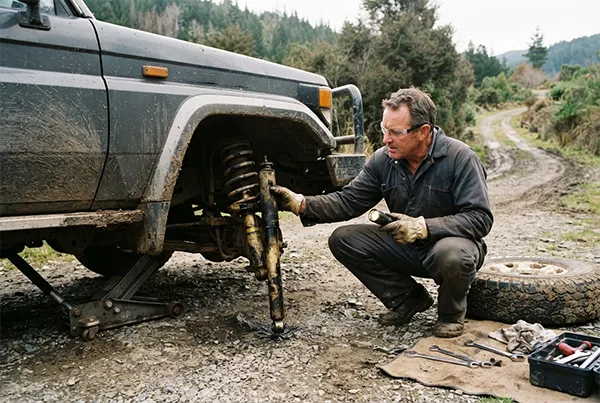
Do not crawl under a vehicle supported only by its factory jack.4 A damaged suspension may shift unexpectedly, and roadside conditions create additional hazards. A qualified technician should inspect the vehicle using proper lifting equipment.
A visible fluid coating may support suspicion of shock absorber leakage, but appearance alone does not reveal the full condition. Light residue, road grime, and active oil loss can look different, and another component may be responsible for the instability. If serious handling symptoms are present, you should base the stop decision on the vehicle’s behavior—not on whether you can clearly identify a leaking shock.
Can You Drive a Bad Shock Absorber to a Repair Shop?
You may notice a minor noise, light fluid residue, or slightly increased movement without obvious instability. That creates a difficult choice. You still cannot determine the remaining damping capacity or rule out damage simply by looking at the vehicle in your driveway.
A short, direct trip to a nearby repair facility may be reasonable only if no high-risk warning signs are present and the vehicle remains stable. You should avoid highway travel, hard braking, abrupt steering, rough roads, and unnecessary stops. This limited trip is not a guarantee of safety.
Use a conservative decision process
Before moving the vehicle, consider the following questions:
- Does the car sit at an unusual angle?
- Is any tire contacting another component?
- Can you see a broken spring, detached mount, bent bracket, or hanging part?
- Does the steering feel normal while the vehicle moves slowly in a safe area?
- Does the body settle rather than continue bouncing?
- Does braking feel straight and predictable?
- Is the repair facility nearby and reachable without fast roads?
- Can roadside assistance inspect or tow the car instead?
If you cannot answer these questions confidently, towing is the safer choice. You should also choose towing when conditions add risk, such as heavy traffic, poor weather, steep roads, or a route with limited places to stop.
What should you avoid?
If you decide to make a direct trip for inspection, do not treat that decision as permission for normal use. You should avoid:
- Highway speeds
- Heavy cargo or unnecessary passengers
- Sudden lane changes
- Hard acceleration or braking
- Potholes and rough roads where possible
- Continued commuting or everyday driving
- Delaying the inspection because the first trip seemed uneventful
There is no universal safe speed, distance, or number of days for driving with a bad shock absorber.5 Vehicle design, loading, road conditions, weather, tire condition, and the type of failure all affect risk. A slower speed may reduce some forces, but it cannot restore damping or secure a loose component.
Your goal should be reaching qualified inspection with the least exposure, not testing how long the vehicle can continue operating.
How Can You Confirm a Bad Shock Absorber?
Many drivers first suspect suspension trouble after hearing a clunk or noticing extra bouncing. Those observations are useful, but they are not a complete diagnosis. Several steering, brake, tire, and suspension faults can create similar sensations.
You cannot confirm a bad shock absorber from noise, pulling, bouncing, or braking changes alone. A technician should inspect the complete suspension, tires, steering, and brakes. Diagnosis may include a visual check, component play inspection, tire evaluation, road assessment, and appropriate performance testing.

Which faults can produce similar symptoms?
| Symptom | Possible shock-related cause | Other possible causes |
|---|---|---|
| Bouncing | Weak or inconsistent damping | Damaged spring, incorrect tire pressure, overloaded vehicle |
| Clunking | Loose mount or internal damage | Ball joint, bushing, stabilizer link, tie rod, spring seat |
| Pulling | Uneven side-to-side control | Alignment, tire damage, brake drag, steering fault |
| Fluid on shock body | Oil seal leakage | Road contamination or fluid from another source |
| Nose-diving | Reduced front damping | Brake imbalance, spring issue, tire condition |
| Uneven tire wear | Poor wheel control | Alignment, tire pressure, worn steering components |
| Vehicle leaning | Damaged damper or mount | Broken spring, load imbalance, structural damage |
What should a technician inspect?
A proper inspection should look beyond the shock absorber itself. Depending on the vehicle and symptoms, the technician may examine:
- Shock or strut bodies for active leakage and physical damage
- Upper and lower mounts
- Springs and spring seats
- Bushings, ball joints, and stabilizer links
- Steering joints and wheel bearings
- Tire pressure, damage, and tread wear
- Brake operation and possible brake drag
- Wheel alignment indicators
- Clearance between the tire and nearby components
- Left-to-right suspension condition
Workshop diagnosis may also consider how the vehicle settles after loading and how it behaves during a controlled road assessment. However, a simple “bounce test” in a driveway cannot measure actual damping force or reliably isolate every fault.6
In production quality control, a damping dynamometer provides a force-versus-velocity profile under controlled conditions. It can reveal inadequate or inconsistent force that an external inspection may miss. However, this equipment evaluates a removed unit or a production sample. It does not replace a complete on-vehicle diagnosis because mounts, springs, tires, and other parts influence real vehicle behavior.
If replacement becomes necessary, the technician should follow the vehicle manufacturer’s repair procedure. Replacement in axle pairs is commonly recommended for balanced behavior, but the correct decision depends on the vehicle design, component condition, and manufacturer guidance.7
Frequently Asked Questions
Does a leaking shock absorber always mean that it has failed?
Not necessarily. Light residue and road contamination can be mistaken for active leakage. However, visible oil running down the body, combined with unstable movement or reduced control, requires prompt inspection. A technician should confirm the source and evaluate the shock absorber’s condition.
Can one bad shock absorber make a car pull to one side?
Uneven damping may contribute to side-to-side instability, especially during bumps or braking. However, pulling can also result from tire pressure, alignment, brake drag, steering wear, or tire damage. You should not replace a shock absorber based on pulling alone.
Can a bad shock absorber cause clunking?
A damaged shock absorber may produce noise, but clunking often comes from mounts, bushings, ball joints, stabilizer links, springs, or loose hardware. The location and cause should be confirmed through an on-vehicle suspension inspection.
Will driving slowly make a damaged shock absorber safe?
No. Slower driving may reduce some vehicle forces, but it does not restore lost damping or secure a damaged component. If the car bounces continuously, becomes hard to steer, brakes unpredictably, or has visible structural damage, you should stop and arrange towing.
Should shock absorbers be replaced in pairs?
Pair replacement on the same axle is often recommended to maintain balanced damping. However, the correct procedure depends on the vehicle, suspension design, condition of the opposite unit, and manufacturer instructions. A qualified technician should make the application-specific decision.
Conclusion
You should never assume that a car is safe merely because it still moves with a bad shock absorber. Continuous bouncing, severe leaning, unstable steering, braking changes, poor tire contact, or damaged suspension parts are reasons to stop safely and arrange towing. If the vehicle remains stable and no high-risk signs are present, only a short, cautious trip to a nearby inspection facility may be reasonable. Arrange a qualified suspension inspection as soon as possible. For professional replacement-part evaluation, GDST Auto Parts can also provide distributors with manufacturing, quality-control, and shock absorber testing documentation.
"Numerical Study on the Damping Characteristics of a ...", https://www.academia.edu/101043375/Numerical_Study_on_the_Damping_Characteristics_of_a_Shock_Absorber_Valve_Utilizing_Different_Velocities_Through_CFD_Analysis. Conventional hydraulic automotive dampers generate resisting force as piston motion drives oil through calibrated valves or orifices, dissipating suspension-motion energy primarily as heat. Evidence role: mechanism; source type: education. Supports: An engineering source should explain how hydraulic resistance through valves converts suspension motion into damping force.. ↩
"E12: Speed Bump Lab", https://www.sccs.swarthmore.edu/users/06/dluong1/e12/Lab4/lab4.htm. In an underdamped spring–mass system, displacement decays through repeated oscillations after a disturbance; vehicle-suspension models apply this principle to body and wheel motion following a road input. Evidence role: mechanism; source type: education. Supports: A vibration or vehicle-dynamics source should establish that underdamped spring-mass systems oscillate longer after a disturbance.. Scope note: The simplified spring–mass model explains the mechanism but does not reproduce every nonlinear feature of a complete vehicle suspension. ↩
"Characterizing a Racing Damper's Frequency Dependent Behavior ...", https://vtechworks.lib.vt.edu/bitstream/handle/10919/42109/Shawn_Emmons_Thesis_ETD.pdf?sequence=1. Because dynamometer tests record force under repeatable motion inputs, results from corresponding dampers can be compared to quantify unit-to-unit or side-to-side differences in damping characteristics. Evidence role: general_support; source type: research. Supports: A laboratory or engineering source should document comparison of measured damping-force curves across multiple dampers or paired units.. Scope note: A measured difference does not alone establish that the variation exceeds the vehicle manufacturer's service limit or creates a specific on-road hazard. ↩
"Citation 1276530.015/01001 | Occupational Safety and ...", https://www.osha.gov/ords/imis/generalsearch.citation_detail?id=1276530.015&cit_id=01001. Government vehicle-maintenance safety guidance warns against working beneath a vehicle supported only by a jack and calls for appropriately rated, correctly positioned support equipment before anyone enters the space below. Evidence role: expert_consensus; source type: government. Supports: Government safety guidance should state that a jack is a lifting device rather than a secure support and that suitable stands or other rated support are required before going underneath.. ↩
"IMPACT OF TRUCK SUSPENSION AND ROAD ROUGHNESS ON ...", https://www.utep.edu/engineering/ctis/_Files/docs/Reports/2008-2012/3IntPave-Research-Report-FHWA-RD-07-1008-02.pdf. Studies of vehicle suspension dynamics show that responses to reduced damping vary with road excitation, speed, loading, tire properties, and vehicle configuration, so the literature does not provide a single universally safe operating distance or speed for an unidentified damper fault. Evidence role: general_support; source type: paper. Supports: Vehicle-dynamics research should show that damper-related effects vary with speed, road input, loading, tires, and the nature or severity of the defect.. Scope note: The absence of a universal threshold does not prove that any particular short trip is safe or unsafe. ↩
"Suspension Damage: What To Look For", https://www.uti.edu/blog/collision/suspension-damage. A manual bounce test provides only a qualitative observation of whole-vehicle settling and does not directly measure a damper's force–velocity characteristics; its result may also be influenced by springs, friction, mounts, tires, and suspension geometry. Evidence role: general_support; source type: paper. Supports: Research should compare subjective bounce testing with instrumented damper or suspension measurements and describe its diagnostic limitations.. Scope note: The test may reveal pronounced oscillation in some cases, but it cannot quantify remaining damping capacity or isolate every fault. ↩
"6+ When to Replace Shocks: Guide & Tips!", https://bigblue.atlantisuniversity.edu/how-often-to-replace-shocks/. Comparable damping characteristics on the left and right sides of an axle support symmetric vehicle response, which provides the technical basis for commonly replacing corresponding dampers in pairs; the required procedure nevertheless remains vehicle- and manufacturer-specific. Evidence role: general_support; source type: research. Supports: A vehicle-dynamics or maintenance source should support the importance of comparable left-right damping while recognizing application-specific repair procedures.. Scope note: General balance principles do not establish that pair replacement is mandatory for every vehicle, damper design, or warranty procedure. ↩