When a buyer sends us an inquiry with a photo of a part that "connects to the knuckle," it could be a tie rod end or a control arm — and the wrong choice leads to returns, delayed shipments, and frustrated customers. I've seen this confusion play out dozens of times across different markets. The two parts look similar, both contain ball joints, and both attach to the steering knuckle. But they belong to completely different suspension subsystems, serve different functions, and are not interchangeable. This article reframes the question from "what's the difference?" to "how do I verify which part I actually need before I order it?"
The fundamental difference between a tie rod end and a control arm is system function. Tie rod ends are part of the steering linkage that transmits directional input from the steering rack to the knuckle.1 Control arms connect the wheel assembly to the chassis and manage vertical suspension travel and fore-aft wheel positioning. They are not interchangeable, not visually confirmable without proper reference data, and should be identified through OE number and installation position — not by part name alone.
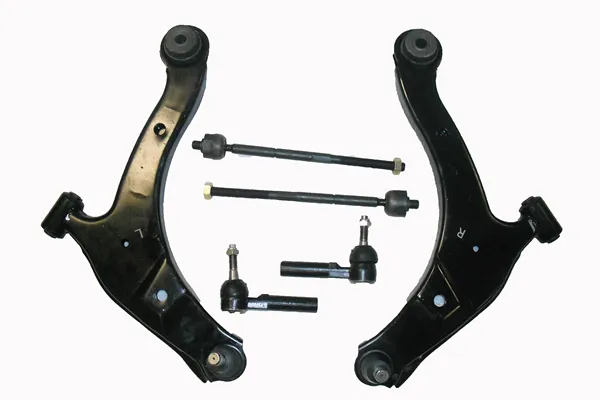
Most buyers who contact us think they know which part they need. But when we walk through the verification steps, we find that roughly one in five inquiries contains a mismatch between the part name the customer uses and the actual part that fits their application. The cost of that mismatch — in returned freight, restocking fees, and lost sales — is entirely avoidable. The sections below give you the decision framework we use internally to prevent it.
Which Suspension Subsystem Does Each Part Belong To?
Here is the source of most confusion. Both tie rod ends and control arms connect to the steering knuckle, so buyers lump them together as "steering and suspension parts." That category label is technically correct, but it hides a critical distinction.
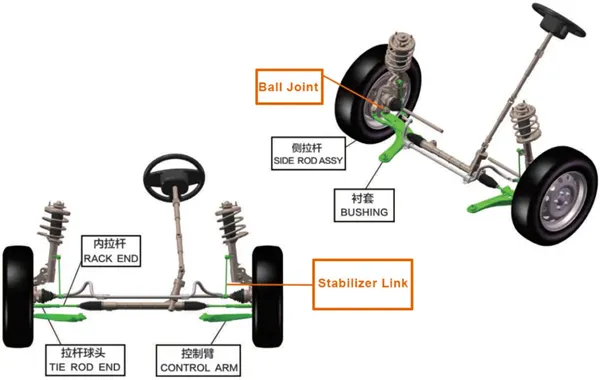
Tie rod ends belong exclusively to the steering linkage system. Control arms belong to the suspension system.2 The two subsystems have different mechanical demands, different load paths, and different replacement cycles.
Understanding the steering linkage
The steering linkage consists of the tie rod assembly (inner tie rod, outer tie rod, and tie rod ends), the center link on some vehicle designs, and the idler arm or pitman arm on traditional truck applications. The job of the tie rod end is to transmit the linear motion of the steering rack into rotational motion at the wheel. Every time the driver turns the steering wheel, the tie rod ends move.
The ball joint on a tie rod end is designed for steering articulation — it rotates through a specific arc as the wheel turns left and right. The movement is primarily rotational around a vertical axis. The load is primarily lateral (side-to-side).
Understanding the suspension control arm
The control arm (also called an A-arm or wishbone on some designs) connects the wheel hub assembly to the vehicle's frame or subframe. It pivots at the chassis side through bushings and at the wheel side through a ball joint. The control arm controls the wheel's vertical travel and maintains the correct wheel alignment geometry as the suspension compresses and rebounds.
The ball joint on a control arm is designed for suspension travel — it allows the knuckle to move up and down as the vehicle goes over bumps. The movement is primarily rotational around a horizontal axis. The load is primarily vertical (up-down).
Why this matters for procurement
When our team reviews a buyer's application request, the first question we ask is not "what part do you need?" It is "which system are you trying to service?" If the part transmits steering input, it is a tie rod end. If the part positions the wheel and manages suspension movement, it is a control arm. These are not interchangeable categories.
| Factor | Tie Rod End | Control Arm |
|---|---|---|
| System | Steering linkage | Suspension |
| Primary movement | Left-right (steering) | Up-down (suspension travel) |
| Primary load direction | Lateral | Vertical |
| Ball joint design | Steering articulation | Suspension travel |
| Attachment points | Steering rack to knuckle | Chassis frame to knuckle |
So when you check your application, start with system function. Ask yourself: does this part move when I turn the steering wheel, or does it move when the wheel goes over a bump? That one question eliminates most identification errors.
Why Does the Ball Joint Similarity Cause Procurement Errors?
This is the trap that catches most buyers. Both tie rod ends and control arms use ball joint connections.3 Both have a stud that inserts into the knuckle and is secured with a castle nut and cotter pin. Both are made of forged or cast steel. To someone looking at a photo online or a loose part in a warehouse, they can appear nearly identical.
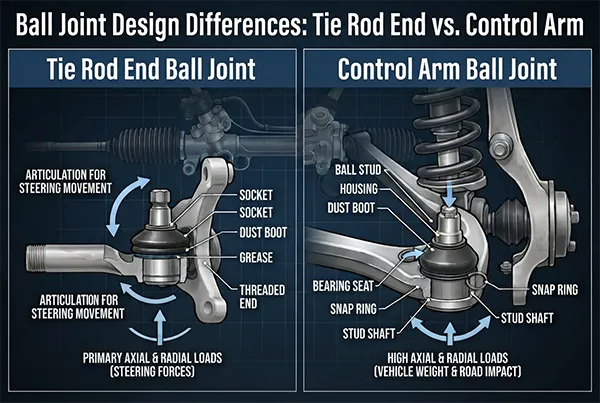
The ball joint on a tie rod end and the ball joint on a control arm serve different mechanical purposes and are designed with different stud angles, different taper dimensions, and different load ratings. They are not interchangeable despite looking similar.
The mechanical difference
The tie rod end ball joint has a stud that is typically oriented downward or sideways depending on the vehicle design. Its range of motion is optimized for steering angle — usually around 30 to 40 degrees of rotation in the horizontal plane. The stud is designed to handle lateral forces during turning.
The control arm ball joint has a stud that is typically oriented downward (on the lower control arm) or upward (on the upper control arm). Its range of motion is optimized for suspension travel — the stud needs to move through a full range of vertical motion as the wheel travels from full rebound to full compression. The stud is designed to handle vertical loads from vehicle weight and impact forces from road irregularities.4
The procurement risk
We have seen cases where buyers ordered a part based on appearance alone, only to find that the stud taper did not match the knuckle bore, the thread pitch was different, or the ball joint stud angle caused interference during installation.
The visual similarity creates a false sense of confidence. A tie rod end and a control arm ball joint might look interchangeable to the untrained eye, but the taper angle, thread size, stud length, and zerk fitting location are all application-specific.
So when you are sourcing parts, do not rely on visual comparison. The ball joint is not the part — it is a connection method. The system function and the OE number determine the correct part, not the presence of a ball joint stud.
How Should Buyers Verify Which Part They Actually Need?
This is the practical core of the article. If you are a brand owner, importer, or wholesaler sourcing suspension and steering parts, you need a repeatable verification process that does not depend on visual recognition or memory.
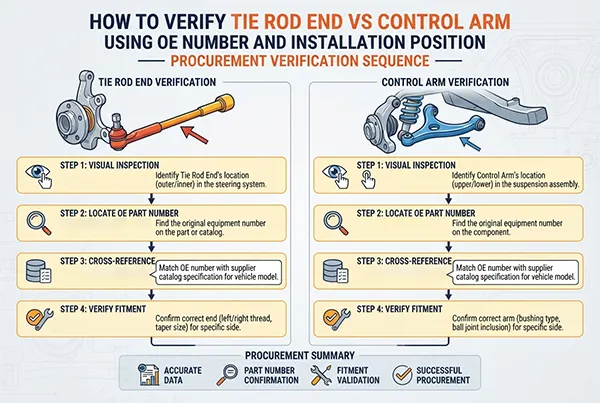
The correct verification sequence is: start with the OE number, then confirm the installation position, then match the dimensions. Never start with the part name.
Step 1: Use the OE number as the primary identifier
Every vehicle manufacturer assigns a unique OE number to each part.5 For tie rod ends, common OE numbers come from Toyota (e.g., 45046-39485), Honda (e.g., 53530-S0X-A01), or Nissan (e.g., 48520-0E025). For control arms, the OE numbers fall under different part families (e.g., Toyota 48068- or Honda 51350-).
When a buyer tells us "I need a tie rod end," we ask for the OE number. If the OE number corresponds to a control arm in our catalog, that tells us immediately that the customer may have misidentified the part.
Step 2: Confirm installation position
If no OE number is available, ask about the installation position. On the knuckle, the tie rod end attaches to the steering arm — a small protruding tab on the knuckle that moves when the steering rack pushes or pulls. The control arm attaches to the lower mounting point or upper mounting point of the knuckle, which is part of the main knuckle body.
A simple way to distinguish: if the connection point is on the side of the knuckle and moves when the steering wheel turns, it is a tie rod end. If the connection point is on the bottom or top of the knuckle and the part extends toward the vehicle's frame, it is a control arm.
Step 3: Match critical dimensions
For final confirmation, use three key dimensions:
- Stud diameter and taper — measured at the widest part of the taper
- Thread size and pitch — tie rod ends and control arms use different thread patterns
- Overall length — measured from mounting center to mounting center
We provide our buyers with dimensional specification sheets for exactly this purpose. When the OE number is not available and the installation position is unclear, dimensions eliminate the guesswork.
When to escalate
If the application is for a commercial vehicle fleet, a heavy-duty truck, or a critical safety system like steering, do not rely on self-verification. Send the OE number and a photo of the installation position to your supplier. A 10-minute verification saves weeks of returns and replacements.
What Happens When Catalog Cross-referencing Goes Wrong?
Catalog errors are invisible until they cause real losses. A single wrong mapping — entering a tie rod end OE number under a control arm listing, or incorrectly cross-referencing a tie rod end to a control arm application — creates a cascade of downstream problems.
Catalog errors compound across inventory, pricing, and customer orders. A mistaken cross-reference in your catalog can take months to detect and thousands of dollars to correct.
The inventory impact
When a catalog entry maps a tie rod end to a control arm application, the wrong part gets ordered into inventory. That part sits on the shelf until a customer orders it for the application it was mapped to. The customer receives a part that does not fit. The return process begins. The part goes back to the warehouse as "open box" or "damaged," often at a restocking loss of 15–25%.
We have seen this happen when a buyer used an online cross-reference tool that grouped "ball joint parts" under a single category. The result was a shipment of 100 tie rod ends that buyers ordered believing they were control arms for a popular Toyota model.
The pricing impact
The wrong part also gets the wrong price. Tie rod ends and control arms have different price points — control arms are typically more expensive because they contain more material, include bushings and ball joints, and require more manufacturing steps. If a tie rod end gets cataloged as a control arm application, it may be priced too high (making it unsaleable) or too low (losing margin).
The customer trust impact
The most expensive consequence is lost customer trust. When a distributor tells a repair shop "I have this part in stock" and sends the wrong component, the repair shop loses time, the vehicle stays on the lift, and the distributor looks unreliable. That relationship damage takes multiple correct orders to repair.
How suppliers can prevent this
At GDST, we maintain separate catalog structures for steering linkage parts and suspension parts. Tie rod ends, drag links, center links, and idler arms all go into the steering linkage category. Control arms, ball joints (suspension type), and bushing kits go into the suspension category. No part crosses categories unless the OE number explicitly matches a dual-application vehicle.
When you build your own catalog, enforce this system separation. Train your catalog team to verify the OE number against the vehicle's OEM parts diagram before assigning a part to a category. A few extra minutes per entry saves months of downstream correction.
Frequently Asked Questions
Can a tie rod end be used to replace a control arm ball joint?
No. The two ball joints are designed for different load directions, different articulation ranges, and different taper dimensions. Using a tie rod end in place of a control arm ball joint creates a safety risk because the stud is not rated for vertical suspension loads. Always use the part that matches the OE specification.
How do I know if my application uses a separate tie rod end or a complete tie rod assembly?
On most modern passenger vehicles with rack-and-pinion steering, the outer tie rod end is a separate replaceable part attached to the inner tie rod. On some heavy-duty trucks and older designs, the tie rod end may be integrated into a complete drag link or tie rod assembly. Check the OE part diagram to confirm.
What is the most reliable way to find the correct OE number for a tie rod end or control arm?
Use the vehicle's VIN to look up the OEM parts catalog. Most major manufacturers provide online parts catalogs that show the exact OE number for each component. If the VIN is not available, use the make, model, year, and engine size to narrow the search.
Do tie rod ends and control arms have different replacement intervals?
Yes. Tie rod ends typically wear faster because they move with every steering input and are exposed to road debris at the wheel level. Control arms generally last longer because the bushings and ball joints ride in sealed or greased environments. However, replacement intervals vary widely by vehicle usage and road conditions.
Can cross-referencing by vehicle application alone guarantee the right part?
No. Vehicle application cross-references are reliable only when the source database is maintained with OE-level accuracy. Many cross-reference tools group parts by vehicle category and do not distinguish between steering linkage and suspension components. Always verify the OE number and installation position before ordering.
Conclusion
Tie rod ends and control arms belong to different suspension subsystems, serve different mechanical functions, and require different verification methods. The ball joint similarity is a false signal — it suggests interchangeability where none exists. For buyers sourcing these parts globally, the right decision framework starts with system function, uses the OE number as the primary identifier, confirms installation position, and treats catalog cross-referencing as a supply chain risk to be managed, not a shortcut to be trusted. The cost of confusion is measurable in returns, lost margin, and damaged customer relationships. The cost of correct identification is a few extra minutes of verification. If you are evaluating a new suspension or steering part application and need help verifying the right fitment, our team reviews OE numbers and installation positions daily — send us your application details and we will confirm the correct part match.
"Steering linkage", https://en.wikipedia.org/wiki/Steering_linkage. A technical automotive source describes tie rods as steering linkage members that transmit motion from the steering gear or rack to the wheel-end steering arm/knuckle, supporting the article's functional distinction between tie rod ends and suspension arms. Evidence role: definition; source type: education. Supports: A neutral technical source should define a tie rod or tie rod end as part of the steering linkage that transfers steering motion to the wheel/knuckle.. Scope note: The source may describe the linkage generally rather than the exact aftermarket component naming used in the article. ↩
"What Is Steering Linkage? | UTI", https://www.uti.edu/blog/diesel/steering-linkage. Automotive instructional materials classify tie rods within the steering linkage and control arms within the suspension assembly, supporting the article's separation of the two components by system function. Evidence role: definition; source type: education. Supports: A source should distinguish tie rods as steering components and control arms as suspension components.. Scope note: Classification terminology may vary across sources, especially where catalogs group steering and suspension parts together commercially. ↩
"Control arm", https://en.wikipedia.org/wiki/Control_arm. General references on automotive ball joints describe their use in steering and suspension connections, providing context for why tie rod ends and control arms can share a visually similar ball-stud interface. Evidence role: definition; source type: encyclopedia. Supports: A source should explain that ball joints are used in automotive steering and suspension linkages, including tie rods and control arms.. Scope note: The source may not state that every tie rod end or every control arm uses the same style of ball joint. ↩
"What Are Ball Joints?", https://www.uti.edu/blog/automotive/ball-joints. Automotive suspension references describe ball joints at the control-arm-to-knuckle connection as load-bearing joints that transmit wheel and road loads into the suspension structure, supporting the article's statement about vertical and impact loading. Evidence role: mechanism; source type: education. Supports: A source should explain that suspension ball joints connect the control arm to the steering knuckle and transmit suspension loads, including vertical loads and road-impact forces.. Scope note: The exact magnitude and direction of loads vary with suspension design, driving conditions, and whether the joint is load-carrying or follower-type. ↩
"Original equipment manufacturer", https://en.wikipedia.org/wiki/Original_equipment_manufacturer. Automotive cataloging references define OE or OEM part numbers as manufacturer-assigned identifiers for components in vehicle parts catalogs, supporting the article's use of OE numbers as primary fitment references. Evidence role: definition; source type: institution. Supports: A source should define OE/OEM part numbers as manufacturer-assigned identifiers used in parts catalogs.. Scope note: A single part may have supersessions, regional variants, or multiple numbers over time, so 'unique' should be understood within a specific catalog context. ↩