
If you source shock absorbers for a living, you've probably asked this question more times than you can count. But here's the uncomfortable truth: the question itself may be wrong. You cannot extend something you don't understand. And the biggest misconception in the suspension industry is that shock absorber lifespan is a fixed number — a kilometer count you can look up in a catalog.
Instead, you need to ask a better question: how do I manage the four variables that actually determine how long a shock absorber works properly?
Shock absorber lifespan is not a mileage figure. It is the outcome of four controllable factors: manufacturing quality, correct vehicle matching and installation, operating conditions, and proactive condition monitoring. No single variable decides when a shock fails. You reduce premature failures by controlling each risk factor — not by hoping for a longer warranty period or picking the most expensive brand.
So let's go beyond the surface-level advice. What really determines when a shock fails? And what should you look for — in your products, your installation process, and your after-sales communication — to stop treating early failure as an inevitable cost of business?
What Actually Determines Shock Absorber Lifespan?
Everyone wants a number. 60,000 kilometers. 80,000 kilometers. 100,000 kilometers. But when you examine hundreds of returned units on a dynamometer bench, the data tells a different story.
Shock absorber lifespan is determined by the interaction between three factors: the manufacturing quality of the seal and damping system, the external conditions the shock operates under, and whether installation errors introduced premature stress. No single factor dominates — the weakest link in the chain determines total life.
The Manufacturing Baseline
Here's where my team's testing experience comes in. Over years of running damping force consistency checks and salt spray tests, we have observed a clear pattern: units that leave the factory with borderline seal fit or inconsistent piston rod surface finish tend to fail earlier — regardless of how gently the vehicle is driven.
The manufacturing variables that matter most:
- Multi-lip oil seal integrity. Not all seals are equal. Imported multi-lip seals with consistent lip pressure produce significantly lower early leakage rates in our testing compared to generic alternatives.
- Piston rod surface finish. A rod with micro-scratches or inconsistent chrome plating will gradually degrade the seal from the inside out. This is invisible to the naked eye but shows clearly under microscope analysis.
- Welding quality at bracket joints. Structural failure at weld points is the most common non-leak failure mode we see in returned units. Poor penetration or inconsistent weld beads create stress concentration points that crack under normal load cycling.1
- Damping force consistency across batches. If you receive a container where 10% of units are outside the specified damping force range, those 10% will feel "wrong" to the end user — and they will be returned before any genuine wear failure occurs.
The Operating Conditions Factor
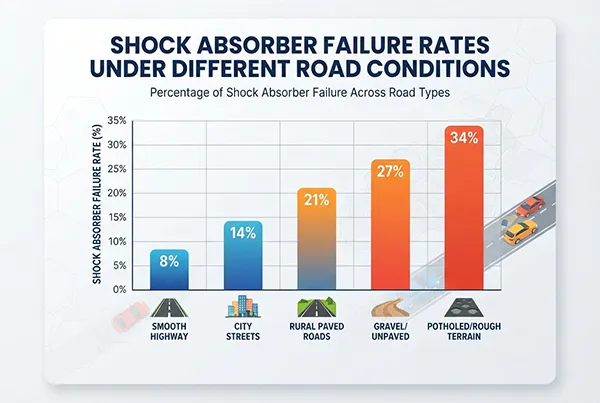
This is where things get realistic. The same shock absorber that lasts 80,000 km on smooth highways in a temperate climate may fail at 25,000 km on rough rural roads with heavy loads in a tropical region.2
Variables you cannot control but must account for:
| Condition | Impact on Lifespan | What You Can Do |
|---|---|---|
| Road surface quality | Poor roads accelerate seal wear and rod bending | Recommend appropriate product tier for market conditions |
| Vehicle load weight | Heavy loads increase internal pressure and heat | Choose heavy-duty series for commercial vehicle applications |
| Climate (temperature, humidity, salt exposure) | Extreme heat degrades oil viscosity; salt accelerates corrosion | Ensure salt spray protection level matches intended market |
| Driving style | Aggressive driving increases cycling frequency | Not a defect issue — communicate this clearly in warranty terms |
The Installation and External Damage Variable
This is the one that creates the most conflict between suppliers and buyers. In our returned sample analysis, we frequently observe units that failed due to external damage — torn dust boots, bent piston rods, improperly torqued mounting bolts — being submitted as "manufacturing defects."
Common installation errors that destroy shock life:
- Damaged dust boots during installation. A torn boot allows grit and moisture to reach the seal, causing premature wear within weeks.3
- Overtorqued or undertorqued mounting bolts. Incorrect torque creates abnormal stress on bushings and rod alignment.
- Worn-out strut mounts or bushings reused during replacement. These introduce lateral forces the shock was not designed to handle.
- Misaligned brackets from previous accident damage. The shock follows the bracket geometry — if the bracket is bent, the shock rod operates at an angle.
How Can You Tell If a Shock Absorber Is Truly Defective vs. Prematurely Worn?
This question matters more to your bottom line than any technical specification. Because every returned unit costs you money — shipping, inspection, replacement handling, and lost customer trust. And if you cannot distinguish between a genuine defect and a user-caused failure, you will either accept too many false claims or reject too many legitimate ones.
A genuine manufacturing defect typically appears within the first 5,000–15,000 km of use.4 Common patterns include consistent oil leakage from the seal area without external damage, abnormal noise that was present from installation, or damping inconsistency between left and right shocks of the same batch. External damage — bent rods, torn boots, dented tubes — is almost always user-caused.
The Three Categories of Returned Units
From our quality testing and return analysis, we categorize failures into three groups:
Category 1: Genuine manufacturing defects (approximately 15–25% of returns)5
- Oil leakage at the seal without any external damage to the dust boot or tube
- Damping force outside specification on the dynamometer test (both compression and rebound)
- Weld cracks at bracket joints with no impact marks on the surrounding area
- Inconsistent performance between matched pair
- Visible contamination inside the oil (foreign particles, metal shavings)
These are defects the factory should accept and replace without argument.
Category 2: External damage / installation errors (approximately 50–60% of returns)
- Bent piston rod with visible impact marks
- Torn or missing dust boot
- Dent on the tube body from road debris or tool impact
- Broken mounting eyelet with sheared-off appearance
- Bushing worn unevenly, indicating misalignment
These are not manufacturing defects. Clear communication with your customers about what constitutes a valid warranty claim is essential here.
Category 3: Damping attenuation without visible leakage (approximately 15–25% of returns)
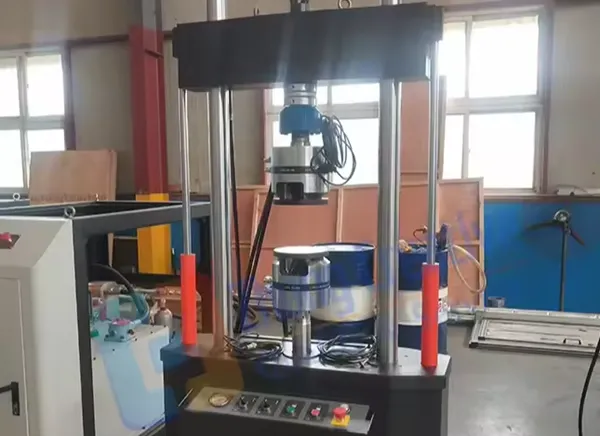
This is the tricky category. The unit looks perfect. No oil on the tube. The dust boot is intact. The rod moves smoothly. But the damping force has dropped by 30% or more from its original specification.
The vehicle owner reports: "The ride feels bouncy again. It's not leaking, but it doesn't feel right."
The Crucial Non-Leak Signals
This brings us to a point that many buyers overlook. Leak-free does not mean performance-guaranteed.
Damping attenuation — the gradual loss of internal resistance — can occur before any oil escapes the seal. The internal valve system wears. The oil degrades under thermal cycling. The gas charge (in gas-charged units) gradually depletes through microscopic seal permeation.
Signals of damping attenuation that are visible or testable:
- Extended rebound length. A properly functioning shock returns to its extended position at a controlled speed. A worn shock snaps back quickly.
- Inconsistent damping feel. The shock feels "loose" on small bumps but "harsh" on large ones — indicating gas loss or valve degradation.
- Vehicle body oscillation. When you push down on the vehicle's corner and release, it bounces more than 1.5 cycles before settling.
- Uneven tire wear patterns. Cupping or scalloped wear on tires, especially on the front axle, often precedes noticeable leakage.
The Telephone Test
If you want a quick field check that doesn't require a dynamometer: compress the shock fully and extend it fully by hand several times. A new or functional unit produces consistent resistance through the entire stroke, with noticeable damping force especially near the end of extension. A worn unit feels "thin" — less resistance, sometimes with a hissing sound instead of a controlled hydraulic feel.
Is this method precise? No. But combined with visual inspection for external damage, it is surprisingly effective at identifying the 50–60% of returns that are not genuine defects.
How Do Operating Conditions Accelerate Failure—and What Can You Do About It?
You cannot control how your customers use the product. But you can control how you communicate about usage conditions. And that communication directly affects whether a failure is blamed on the product or accepted as normal wear.
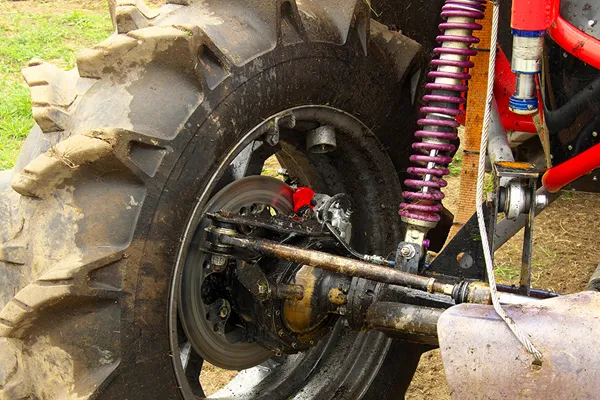
Severe operating conditions can reduce shock absorber life by 50–70% compared to normal conditions. These include continuous rough road driving, frequent heavy loads, extreme temperature exposure, and salt-spray environments. The shock itself may be flawless — but the conditions it operates under exceed what a standard product is designed for.
Matching Product Tier to Market Conditions
Not all shocks are built for all conditions. If you are supplying a market where roads are predominantly unpaved, where trucks routinely carry 120% of rated capacity, or where road salt is used for six months of the year — you need to select products designed for those conditions.
Three tiers you should be familiar with:
| Tier | Typical Application | Key Features | Expected Lifespan Relative to Standard |
|---|---|---|---|
| Standard oil/gas | Normal city and highway driving | Basic seal system, standard damping | Baseline |
| Heavy-duty | SUVs, light trucks, commercial vehicles | Reinforced rod, heavy-duty seals, larger oil capacity | 1.5x under heavy load |
| Performance / modified | Enthusiast vehicles, off-road use | High-temperature oil, gas-charged, advanced valving | 1.3x under normal use |
The mistake many buyers make is selecting one product family for the entire catalog and then accepting high return rates from a specific sub-market. The solution is not to "upgrade quality" across the board — it is to segment your product offering by market condition severity.
Climate-Specific Considerations
If you are shipping to coastal regions or cold-climate markets, salt spray resistance becomes a lifespan variable. Our salt spray testing shows that a standard coating may fail at 72 hours in a 5% NaCl fog, while an upgraded coating system can pass 200+ hours.
For markets with extreme summer heat (ambient temps above 40°C): the shock absorber oil must maintain stable viscosity across a wider temperature range. Standard oil may thin out, reducing damping force. High-performance all-weather fluid maintains its damping coefficient from -40°C to +120°C.
What Should You Inspect Before Blaming the Product for Early Failure?
When a customer sends you photos of a leaking shock at 15,000 km, your first instinct may be to accept the return and move on. But if you do that repeatedly without investigating the root cause, you are bleeding margin on avoidable warranty costs.
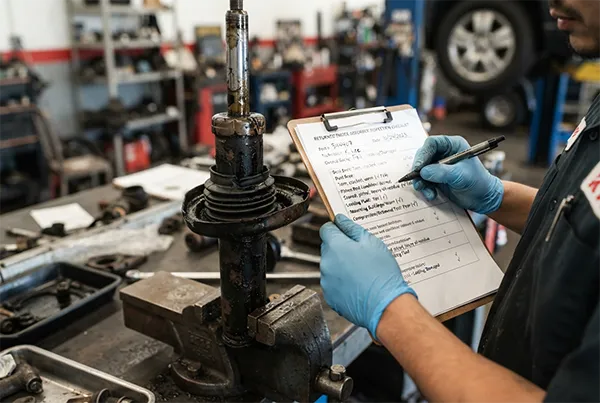
Before accepting an early failure claim, inspect these five things: the dust boot condition, the piston rod for bending or scoring, the mounting bolt torque marks, the condition of the mating suspension components, and the consistency of failure between sides. These five checks will tell you whether the failure is product-related or condition-related in 80% of cases.
A Practical Inspection Protocol
From our experience at the factory, here is the inspection sequence we use for every returned unit:
-
External visual inspection (30 seconds). Is the dust boot intact? Is there impact damage on the tube or rod? If the boot is torn and the rod shows circumferential scoring at the seal line, the failure path is clear: contamination entered through the boot tear, abraded the rod surface, and damaged the seal.
-
Rod straightness check (1 minute). Roll the shock on a flat surface. A straight rod rolls smoothly. A bent rod wobbles. Bent rods are almost always caused by impact — road debris, jacking on the shock body, or improper handling during installation.
-
Leak pattern analysis (1 minute). Where is the oil coming from? A seal leak produces oil on the rod and a thin film on the tube near the seal. A tube body leak — from a weld pinhole or impact dent — produces oil in a specific spot with no rod wetness.
-
Damping force feel check (2 minutes). Compress and extend fully by hand. A unit with genuine internal failure feels inconsistent or "empty." A unit with only external damage often still feels correct internally.
-
Side-to-side comparison (2 minutes). If you have both sides of the axle returned, compare them. Genuine defects often affect only one side. External conditions (road damage, improper installation) can affect one or both — but the pattern of damage differs.
When to Accept vs. When to Educate
The most profitable skill in this business is knowing when to say yes and when to say no — and saying both politely.
- Accept: First-time customer with a genuine-looking defect, even if you are not 100% sure. The relationship is worth more than the unit cost.
- Educate then accept: Repeat customer with a borderline case. Explain your findings, show them the evidence, then offer a goodwill replacement with clear communication about what happened.
- Educate then decline: Customer who consistently submits damaged units as defects. Provide evidence, explain your policy, and offer to sell them replacements at a discounted rate rather than accepting the warranty claim.
Frequently Asked Questions
How many kilometers should a shock absorber last?
There is no universal number. A shock's lifespan is the result of manufacturing quality, vehicle condition, road surfaces, load patterns, and climate. The same shock may last 80,000 km in one application and 25,000 km in another. Focus on controlling the variables you can influence rather than chasing a specific mileage target.
Can a shock absorber fail without leaking oil?
Yes, and this is more common than most buyers realize. Damping attenuation — the gradual loss of internal resistance — can occur before any visible leakage appears. The vehicle may feel bouncy, handle poorly, or show uneven tire wear while the shock body remains completely dry. Damping force testing on a dynamometer is the only reliable way to confirm internal performance.
What is the most common cause of premature shock absorber failure?
In our returned-sample analysis, external damage and installation errors account for roughly 50–60% of premature failures. Torn dust boots, bent rods from improper jacking, and incorrectly torqued mounting bolts are the top three causes. Genuine manufacturing defects account for a much smaller share, typically 15–25% of total returns.
How can I tell if a returned shock has a genuine defect or was damaged by misuse?
Inspect the dust boot condition, the piston rod for bending or scoring, the mounting points for improper torque marks, and the leak pattern. A genuine seal leak produces oil on the rod with no external damage. A misused unit typically shows impact marks, a torn boot, or a bent rod. If the unit looks perfect externally but feels weak internally, it may be genuine damping attenuation.
Does a higher price always mean longer lifespan?
Not necessarily. Price often reflects brand positioning, marketing spend, and distribution costs rather than intrinsic quality. A well-manufactured direct-from-factory product with proper seal systems, consistent damping, and appropriate coating can match or exceed the lifespan of expensive branded alternatives. Evaluate the quality evidence — test data, certifications, manufacturing process — not just the price tag.
Conclusion
Shock absorber lifespan is not a number you find in a catalog. It is the outcome of four interacting variables: the manufacturing quality of the seal and damping system, the correct matching and installation of the product, the severity of the operating conditions, and how proactively you monitor performance before failure becomes visible.
The most expensive mistake you can make is assuming that all early failures are product defects. Roughly half of premature failures we see in returned units trace back to installation errors or external damage. Another quarter are genuine attenuation without visible leakage — units that look fine but no longer perform correctly.
To reduce your warranty costs, build better supplier relationships, and keep your customers satisfied, focus on these actions:
- Demand quality evidence from your factory — not just certifications, but actual damping consistency data and return analysis records.
- Educate your downstream customers on proper installation and inspection — a simple checklist can cut early failure rates significantly.
- Segment your product selection by market conditions — do not send standard shocks into heavy-duty or extreme-climate applications.
- Inspect every return using a structured protocol, and use the data to distinguish genuine defects from condition-related failures.
When you understand what actually drives shock absorber lifespan — and stop treating it as a random variable — you stop accepting premature failure as an unavoidable cost. Instead, you start managing it as a controllable risk.
Want to review actual damping consistency test data or discuss a quality evaluation process for your supply chain? Contact our engineering team — we regularly work with buyers to establish inspection protocols and failure analysis procedures.
"THE EFFECTS OF WELD GEOMETRY ON THE FATIGUE ...", https://www.ideals.illinois.edu/items/14805/bitstreams/52749/data.pdf. Weld-fatigue research identifies incomplete penetration and local weld-profile discontinuities as stress raisers that can promote crack initiation and reduce fatigue life under cyclic loading. Evidence role: mechanism; source type: paper. Supports: Welding-fatigue literature should document how incomplete penetration, weld-profile irregularities, and weld-toe stress concentrations promote fatigue-crack initiation under repeated loads.. Scope note: The literature establishes the general fatigue mechanism but does not by itself prove that weld failure is common in the author's returned shock-absorber population. ↩
"THE IMPACT OF PAVEMENT ROUGHNESS ON VEHICLE ...", https://www.eng.auburn.edu/research/centers/ncat/files/technical-reports/rep15-02.pdf. Vehicle-durability research shows that rougher road inputs, greater vehicle loads, and elevated operating temperatures can increase suspension cycling, thermal stress, and accumulated fatigue damage. Evidence role: general_support; source type: research. Supports: Durability research should show that road roughness, loading, and temperature increase suspension input severity, heat generation, wear, or fatigue damage.. Scope note: This evidence can support the direction of the effect but not the stated 80,000 km and 25,000 km outcomes unless a directly comparable field study reports those values. ↩
"Experimental Comparison of Elastomeric Materials for Hydraulic ...", https://pmc.ncbi.nlm.nih.gov/articles/PMC12694298/. Studies of reciprocating rod-seal systems show that abrasive contamination entering past a damaged or ineffective wiper can score the rod and accelerate seal wear and leakage. Evidence role: mechanism; source type: paper. Supports: Seal-system research should establish that external particles and moisture can damage reciprocating rod surfaces and sealing interfaces, increasing wear and leakage.. Scope note: The mechanism is well established, but a general seal study does not substantiate the article's claim that failure can occur within weeks. ↩
"Reliability Analysis for Unrepairable Automotive Components - PMC - NIH", https://pmc.ncbi.nlm.nih.gov/articles/PMC8619900/. Reliability theory recognizes an early-life or 'infant mortality' period in which latent manufacturing defects may become apparent soon after a component enters service. Evidence role: statistic; source type: paper. Supports: Reliability studies should establish whether manufacturing-related shock-absorber failures cluster in an early-life mileage interval and, ideally, quantify that interval.. Scope note: The general infant-mortality concept does not validate the specific 5,000–15,000 km range; that figure requires shock-absorber-specific field or warranty data. ↩
"Failure mode and effects analysis", https://en.wikipedia.org/wiki/Failure_mode_and_effects_analysis. A field-return study using documented inspection criteria can establish what share of examined shock absorbers was attributed to manufacturing defects rather than installation, impact, or wear. Evidence role: statistic; source type: research. Supports: A field-return or warranty study should report the proportion of returned dampers attributed to manufacturing defects using defined diagnostic criteria.. Scope note: External percentages may not be transferable across manufacturers, markets, vehicles, or warranty-screening practices; the article's own 15–25% figure requires disclosure of its underlying dataset. ↩