
You finally replaced those worn tie rods. The steering feels tighter, and the knocking is gone. But now a nagging question remains: should you spend the money on an alignment, or is it safe to skip? Many car owners and even some mechanics believe that if you carefully match the new tie rod length to the old one, the toe angle stays correct. That belief costs you in hidden tire wear and compromised handling. The truth is that even the best installation on the bench cannot guarantee the toe is within specification, and the only reliable way to confirm is a proper alignment measurement.
Yes, you need an alignment after replacing tie rods — specifically a toe inspection and adjustment on the affected axle.1 While matching the old rod's length or thread count is a practical installation reference, manufacturing tolerances, lock nut positioning, and thread start point variations mean the actual toe angle can shift outside the vehicle's specification. Only a proper alignment confirms the toe is correct, protecting your tires from rapid edge wear and ensuring stable handling.
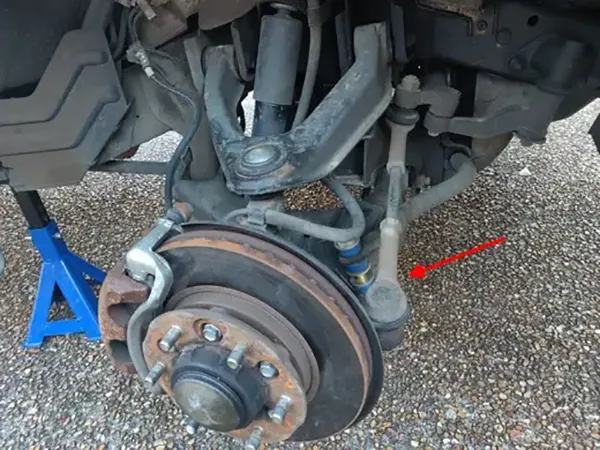

So why can't you simply screw the new tie rod on to the same thread count as the old one and call it done? The answer lies in the gap between what feels "close enough" on the workbench and what a laser alignment rack actually measures at the tire tread. Let's walk through the manufacturing reality that explains this gap, and then look at what an alignment after tie rod replacement really involves.
Why isn't Matching the Old Tie Rod Length Enough to Restore Alignment?
Every tie rod replacement guide tells you to count the threads or measure the effective length of the old part before removing it. That advice exists for a reason: it gets you close enough to drive safely to an alignment shop. But "close enough" is not the same as "within spec." The idea that a DIYer can duplicate the original toe angle by simply screwing the new rod to the same thread count is a widespread myth, and it fails for three manufacturing-related reasons.
Manufacturing tolerances, thread start point variation, and lock nut positioning differences mean that even two tie rods made to the same part number can have slightly different effective lengths. Matching the old rod by thread count or visual measurement cannot compensate for these deviations, and the resulting toe error, while small, is enough to cause uneven tire wear over a few thousand miles.
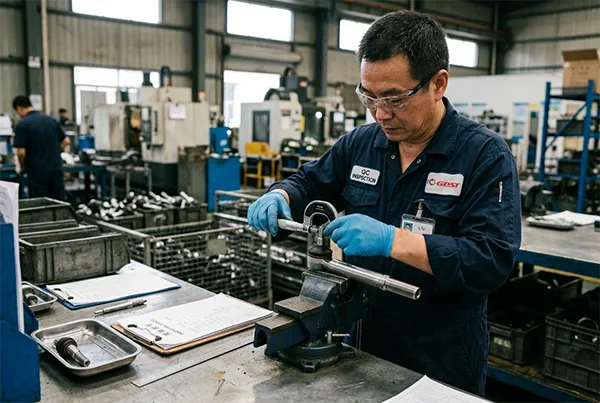

Let me explain from our perspective as a manufacturer. At GDST Auto Parts, every tie rod we produce has its effective length measured in our QC department with dimensional tolerances controlled to ±0.2 mm. Even within that tight band, two rods from the same batch can differ by up to 0.4 mm at the extreme ends of the tolerance range. That might sound tiny, but consider the geometry: the tie rod connects the steering rack to the steering knuckle. A 0.4 mm change at the rod's ball joint translates to a much larger angular change at the tire's contact patch. Depending on the vehicle's steering arm length, that can push toe out by several hundredths of a degree — easily enough to exceed the vehicle manufacturer's specification, which often allows as little as ±0.05° per side.
- Thread start point variation: When a tie rod is assembled at the factory, the adjusting sleeve or inner tie rod is threaded onto the ball joint stud. The start point of the threads relative to the locking mechanism is not perfectly consistent across every unit. Two rods that are "identical" on paper can have the lock nut positioned slightly differently, shifting the effective length.
- Lock nut torque influence: Torquing the jam nut to spec can slightly compress the thread interface, altering the final length by a few hundredths of a millimeter. Even the difference between a dry and lubricated thread changes the final seated position.2
- Visual measurement limitations: Using a tape measure or calipers to match the old rod's length from ball joint center to ball joint center assumes the old part was in spec when removed. But the old rod could have been bent, worn, or previously adjusted improperly. Basing your alignment on a corrupted reference is building error on top of error.
From our production experience, we know that a tie rod that passes our ±0.2 mm effective length check is still a candidate for requiring adjustment after installation. That's not a quality problem; it's a cumulative system tolerance problem between the part, the steering knuckle, and the rack. The only way to know the final toe is to measure it on the vehicle.
Which Tie Rod Replacements Affect Alignment?
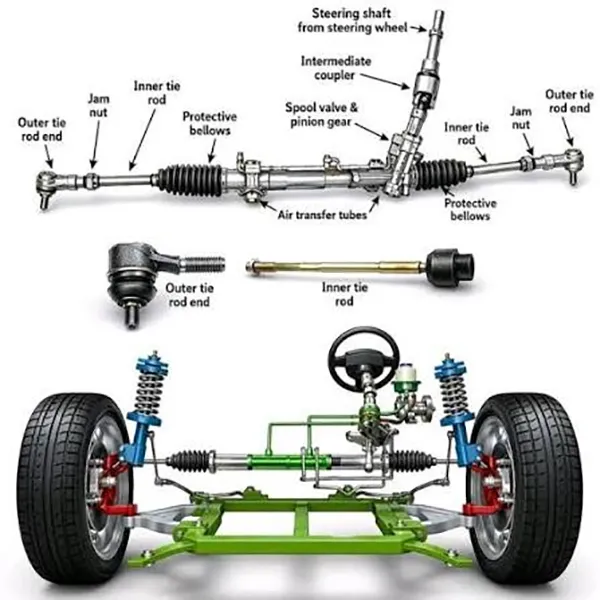
Not all tie rod replacements are equal when it comes to alignment impact. The common assumption is that only the outer tie rod (the one with the ball joint that connects to the knuckle) matters. That is incorrect. Inner tie rods, complete assemblies, and even the rack itself all play a role in establishing the total effective length of the steering linkage.
Every component that changes the effective length between the steering rack and the steering knuckle will affect toe angle.3 Inner tie rods, outer tie rods, and complete tie rod assemblies all influence this geometry. On vehicles with non-adjustable rear suspension, the front tie rods may be the only component that controls toe on that axle, making their correct adjustment critical.

To break it down more clearly:
| Component replaced | Effect on toe | Typical adjustment needed |
|---|---|---|
| Outer tie rod only | Direct – changes the distance from inner ball joint to outer stud | Toe check recommended; often requires small adjustment |
| Inner tie rod only | Direct – changes the length of the threaded rod that connects to the outer rod | Toe check required; likely needs adjustment |
| Complete tie rod assembly (inner + outer) | Direct – fully replaces the linkage length | Toe check required; adjustment often needed |
| [Center link or drag link (on solid axle vehicles) | Indirect – affects steering geometry but not directly toe | Full alignment recommended](https://forms.tri-c.edu/OfficialCourseOutlines/Automotive%20Technology/AUTO-1400.pdf)%%%FOOTNOTE_REF_4%%% |
Why Inner Tie Rods Get Overlooked
Many DIYers only change the outer tie rod because it is more accessible and the inner often looks fine. But when you replace the inner tie rod, you are changing the entire pivot-to-knuckle geometry from the rack housing outward. The inner rod's adjusting sleeve or threaded portion sets the base length. Even if you carefully mark the old inner rod's position, the same tolerance arguments apply. In our experience as a manufacturer, we see inner tie rods replaced less frequently than outers, but when they are, the alignment drift is often larger because the length difference can accumulate between the two components.
On Vehicles With Non-adjustable Rear Suspension
A growing number of modern passenger cars have no rear toe adjustment – the rear suspension is fixed, and only the front toe is adjustable.5 In those cases, the front tie rods become the single most critical factor controlling overall directional stability. If you replace a tie rod on such a vehicle and skip the alignment, you are effectively betting the entire vehicle's straight-line tracking on a thread count guess. That is a high-stakes gamble when you consider that a misaligned front axle on a car with fixed rear toe forces both axles to fight each other, causing a pull or drift that no amount of steering compensation can fully fix.
What Does "Getting an Alignment After Replacement" Actually Mean?
When I recommend an alignment after tie rod replacement to our customers at GDST, I am not talking about a full four-wheel adjustment on every vehicle. That would be over-prescribing and sometimes unnecessary. Instead, the correct action is more targeted and practical.
Getting an alignment after replacing tie rods means measuring the toe angle on the affected axle (usually the front) as soon as possible after installation, and then adjusting it to the vehicle manufacturer's specification. This does not automatically require a full four-wheel alignment. A toe-only check on the front axle is often sufficient, but a full alignment is recommended if the rear suspension is also adjustable or has been disturbed.
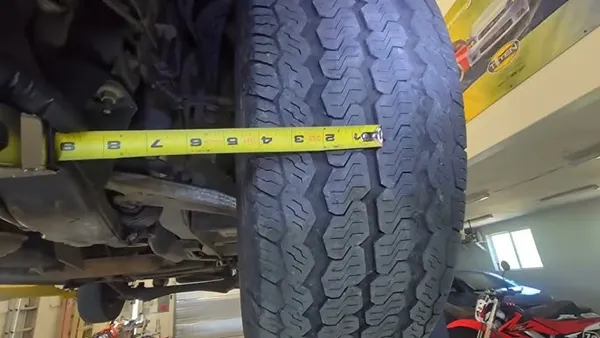

Toe Inspection vs. Full Alignment: What's the Difference?
Many drivers assume that "alignment" means adjusting camber, caster, and toe on all four wheels. In practice, most suspension components are not adjustable without aftermarket kits. The typical alignment procedure for a modern passenger car involves:
- Toe adjustment: Almost always adjustable on the front, and often on the rear as well.
- Camber adjustment: Many vehicles have fixed camber from the factory; adjustable only on some models.
- Caster adjustment: Usually fixed on MacPherson strut vehicles, adjustable on some double-wishbone designs.
When you replace tie rods, the only angle that directly changes is toe. Camber and caster are affected by other suspension components (control arms, struts, bushings) and are very unlikely to have shifted from a tie rod job alone. Therefore, a conscientious alignment shop can simply check front toe on the alignment rack and adjust it if needed. Many shops will still do a "two-wheel alignment" that covers the front axle.
However, if your vehicle has adjustable rear toe and you have not had that checked in a while, the front tie rod replacement is an excellent opportunity to do a full four-wheel alignment. The front and rear toe interact with each other, and the "thrust angle" (the direction the rear wheels point relative to the vehicle centerline) must be within spec for the front to steer straight.
What the Measurement Reveals
When the tie rods are freshly installed and you take the vehicle to an alignment rack, the technician measures the actual toe angle at each wheel. Often, that measurement will show a small deviation — perhaps 0.10° out on one side, or a total toe that is slightly outside the manufacturer's range. The technician then loosens the lock nut on the tie rod, rotates the rod to lengthen or shorten it, and re-tightens until the toe reads correctly. That process takes literally minutes but can save you many months of premature tire wear.
From our QC perspective, we consider a tie rod that has been installed and then adjusted on a rack to be a "successful installation." The part itself is perfectly fine; the adjustment is simply about accounting for the sum of tolerances across the entire system. There is no shame in needing an adjustment — it is expected.
What Risk Signals can You Sense – And What One is Invisible?
After a tie rod replacement, you might be tempted to drive for a week and decide that "it feels fine" to save the alignment cost. That feeling can be misleading. While your hands can detect major steering issues, the most expensive consequence of a slight toe error is completely invisible during a short test drive.
Wandering, an off-center steering wheel, and uneven tire wear are the most common visible and tactile signals of a toe problem after tie rod replacement. However, the highest long-term cost risk — accelerated tire edge wear from a small but persistent toe error — is invisible during a short drive. By the time you see the wear, the tires are already damaged beyond repair.
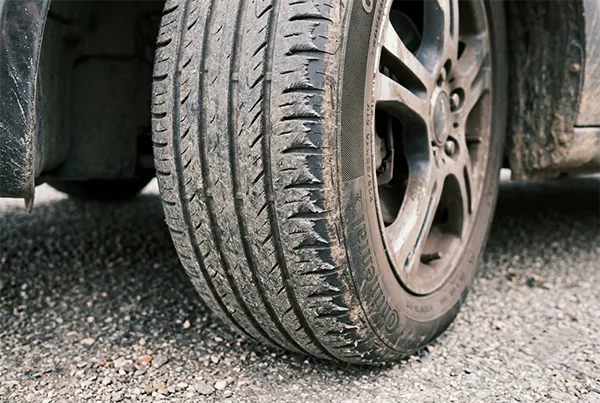

Signals You Can Feel or See
- Off-center steering wheel: If you replaced the tie rods without marking or measuring, or if the new rods are slightly off, the steering wheel may no longer be centered when driving straight. This is often the first clue drivers notice.
- Wandering or nibbling: The car may feel as though it is constantly making small corrections on its own, especially on crowned roads. You find yourself steering more actively.
- Uneven tire wear: Visual inspection of the tire tread after a few thousand miles can reveal feathering on one edge. This is a clear sign of toe error, but by then, the tire is already compromised.
The Invisible Risk: Cumulative Edge Wear
Here is the gap that the "feels fine" decision overlooks. A toe error of just 0.10° per side (within what feels normal for many drivers) can cause the tire to scrub sideways against the road for the equivalent of dragging the tire across several miles of pavement per thousand driven miles. Over 10,000 miles, that scrubbing translates into measurable tread depth loss on the outer or inner edge. The tire wears unevenly, and often the driver does not notice until the next rotation or when the tire becomes noticeably noisy.
- The math: For a typical 235/50R18 tire, a total toe error of 0.15° causes the tire to slide sideways approximately 0.25 inches per revolution. That might not sound like much, but over a typical tire lifespan, it can reduce thread life by 20–30%.
- The cost: A set of premium tires can cost $800–$1,200. An alignment after tie rod replacement typically costs $50–$100. The alignment pays for itself even if it saves only one season of tire life.
From our manufacturing perspective, we test tie rods for pull-out and fatigue strength, but we always remind our customers that the best tie rod in the world cannot compensate for an incorrect toe angle. The part is designed to operate within a defined geometry. If that geometry is off, the ball joint wears differently, the tire wears faster, and the driver blames the part instead of the installation. That is why we recommend: after any tie rod replacement, get the alignment checked. It is not about selling more alignments — it is about making sure the part performs as intended.
Frequently Asked Questions
Can I drive without an alignment after replacing tie rods?
You can drive a short distance to an alignment shop, but you should not drive thousands of miles without checking the toe. Even a small misalignment accelerates tire wear and can affect handling. It is best to drive directly to a reputable alignment shop after installation.
How much does an alignment cost after tie rod replacement?
A front-end alignment (toe-only) typically costs $50–$80. A full four-wheel alignment costs $100–$200. Many shops offer discounts when you purchase tires or other services, but given the cost of premature tire wear, the alignment is money well spent.
Can I align the toe myself at home?
You can use a DIY toe gauge or string method to get a rough measurement, but professional alignment racks are far more accurate. For most drivers, the time and effort spent on a garage alignment is not worth the risk of error. We recommend a professional alignment to confirm the spec.
Do I need an alignment if I only replaced the outer tie rod?
Yes, even replacing only the outer tie rod can shift toe outside the specification. The new ball joint may have a slightly different stud position, and the jam nut torque changes the effective length. Always have the toe checked.
Will a bad tie rod cause alignment to go out?
A worn tie rod with excessive play can cause the alignment to change dynamically under load. That is one reason why replacing the tie rod is necessary. After replacement, the alignment should be set to correct any static error that has accumulated.
Conclusion
The answer to "Do I need an alignment after replacing tie rods?" is a clear yes — but not because your new tie rods are defective. It is because the ideal installation baseline (matching the old rod length) cannot account for manufacturing tolerances, thread start variations, and lock nut positioning differences that accumulate into measurable toe error. A quick toe inspection on an alignment rack resolves that error and protects your tires from expensive edge wear. Whether you are a DIY owner looking to save money or a distributor advising your customers, the most cost-effective and responsible step after a tie rod replacement is to have the toe checked. At GDST Auto Parts, we have seen too many cases where a perfectly good tie rod got blamed for a problem that an alignment would have fixed in five minutes. Measure it, adjust it, and drive with confidence.
Need reliable suspension parts that meet strict tolerances for easy alignment? Contact GDST Auto Parts for OEM/ODM manufacturing of steering and suspension components. We supply ball joints, tie rods, and more to aftermarket brands worldwide.
"MKIII Golf/Jetta Inner and Outer Tie rod DIY.", https://faculty.ccp.edu/faculty/dreed/campingart/jettatech/tierods/tierods.htm. Automotive chassis-service guidance calls for checking wheel alignment after tie-rod replacement because the repair can alter the steering linkage length that establishes toe. Evidence role: expert_consensus; source type: education. Supports: Automotive service guidance identifies a wheel-alignment or toe check as a standard step after tie-rod replacement.. ↩
"The relation of torque to tension for thread-locking devices", https://nvlpubs.nist.gov/nistpubs/jres/7/jresv7n5p945_a2b.pdf. Fastener research shows that lubrication substantially changes thread friction and the torque–preload relationship, so equal tightening torque does not necessarily produce identical clamp conditions in dry and lubricated assemblies. Evidence role: mechanism; source type: paper. Supports: Thread lubrication changes friction and therefore the relationship among applied torque, nut rotation, and bolt preload.. Scope note: This evidence supports variation in fastener seating and preload, but it does not directly quantify a resulting change in installed tie-rod effective length. ↩
"Steering System", http://ruina.tam.cornell.edu/Courses/moonbuggy/2002/design_files/steering.html. Automotive steering references explain that toe adjustment is performed by changing tie-rod effective length, which changes the angular relationship of the steered wheels. Evidence role: mechanism; source type: education. Supports: Toe is commonly adjusted by lengthening or shortening the tie-rod linkage connecting the steering gear to the wheel knuckle.. ↩
"AUTO-1400: Automotive Alignment, Steering and Suspension", https://forms.tri-c.edu/OfficialCourseOutlines/Automotive%20Technology/AUTO-1400.pdf. Descriptions of parallelogram and solid-axle steering systems show that center and drag links locate or transmit steering motion within the linkage, making post-repair geometry checks relevant. Evidence role: general_support; source type: education. Supports: Center and drag links are steering-linkage components whose replacement may require verification of steering geometry and wheel alignment.. Scope note: Whether a center or drag link directly changes toe depends on the linkage design, so this classification should not be treated as universal. ↩
"A STUDY OF PARAMETERS INFLUENCING THE VEHICLE ...", https://ninercommons.charlotte.edu/record/746?ln=en. Vehicle-alignment references document passenger-car designs in which rear toe is fixed at the factory while front toe remains adjustable through the steering tie rods. Evidence role: general_support; source type: research. Supports: Some passenger-vehicle suspension designs provide no factory rear-toe adjustment while retaining front tie-rod toe adjustment.. Scope note: Examples can establish that fixed rear toe is common on some designs, but a longitudinal fleet study would be required to support the claim that the number is growing. ↩