
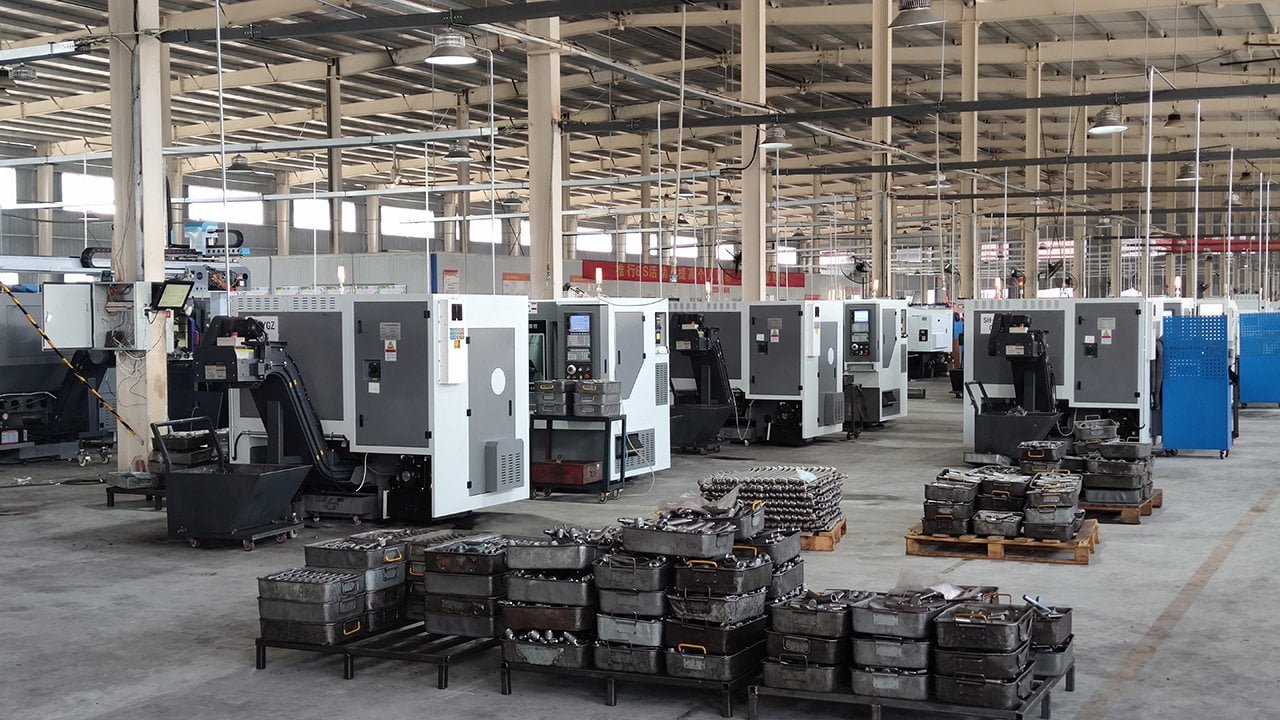
The recommended strut mount replacement interval is difficult to define with one mileage number. If you replace the mount too early, you may add unnecessary cost; if you wait too long, you may allow rubber deterioration, looseness, or bearing problems to affect suspension performance. I recommend using vehicle-specific service information, operating conditions, and inspection results together.
There is no universal strut mount replacement interval that applies to every vehicle. The correct replacement decision depends on the vehicle manufacturer’s service guidance, driving conditions, mount condition, rubber deterioration, bearing condition where applicable, abnormal movement, and inspection results. You should treat mileage or age figures as inspection references rather than automatic replacement deadlines. A qualified technician should confirm the cause of any noise or handling concern before replacement.
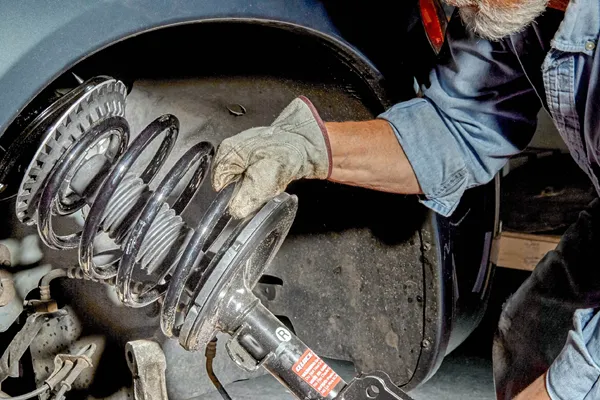
When brand owners, importers, and wholesalers ask me about strut mount service life, they often want one simple answer for product pages or customer support teams. In practice, the better answer is a decision process. Below, I will explain how you can communicate that process clearly without encouraging unnecessary replacement or delayed suspension repairs.
Should You Follow a Fixed Strut Mount Replacement Interval?
A fixed interval sounds convenient, but it can create the wrong expectation. A vehicle used mainly on smooth highways may place very different demands on its mounts than a vehicle used on rough roads, overloaded routes, or heavily salted winter roads. Your replacement guidance should reflect that difference.
You should not use one fixed strut mount replacement interval for all vehicles. First, check the vehicle manufacturer’s service information. Then consider operating conditions, vehicle mileage and age, inspection findings, rubber condition, bearing movement, and related suspension symptoms. Mileage can trigger an inspection, but it should not independently prove that replacement is necessary.
Why mileage alone creates confusion
Mileage is useful because it gives you a convenient point for maintenance planning. However, mileage does not describe the full life of a strut mount. Two vehicles with the same odometer reading may have experienced very different loads.
Important differences may include:
- Frequent driving on potholes or unpaved roads
- Heavy cargo or repeated towing
- Extreme heat, cold, humidity, or road salt
- Long periods of vehicle storage
- Aggressive steering and repeated curb impacts
- Different vehicle weights and suspension designs
- Different rubber compounds and mount constructions
- Different front or rear suspension layouts
The mount may include a rubber isolator, metal housing, fasteners, and, on some applications, an integrated or separate bearing. These parts do not all age in exactly the same way. Rubber can harden, crack, deform, or lose elasticity.1 A bearing can develop roughness or resistance.2 A housing can suffer corrosion or distortion.3 Therefore, a single mileage number cannot describe every possible failure mode.
How you can use mileage responsibly
I suggest that aftermarket brands and distributors use mileage as an inspection prompt rather than a replacement promise. For example, your customer communication can say:
“Inspect the strut mount according to the vehicle manufacturer’s service information, especially when the vehicle has high mileage, severe operating conditions, suspension noise, steering changes, or visible deterioration.”
This wording helps customers understand the next step. It does not claim that every mount must be replaced at a particular distance.
You should also avoid publishing a generic statement such as “replace all strut mounts every 80,000 kilometers.” Unless that number comes from verified vehicle-specific service documentation, the statement may mislead drivers and create unnecessary warranty or after-sales disputes.
A practical decision framework
You can organize the decision into four questions:
-
What does the vehicle manufacturer specify?
Check the official service information for inspection and replacement instructions. -
How has the vehicle been used?
Consider road conditions, load, climate, and driving pattern. -
What did the inspection find?
Look for confirmed deterioration, looseness, abnormal movement, or bearing concerns where applicable. -
What is the risk of waiting?
A qualified technician should assess whether continued use could affect safety, handling, or related parts.
I often see procurement teams looking for a simple service-life figure because it makes catalog writing easier. However, accurate technical content may be more valuable than a simple claim. It protects your customers from unnecessary parts purchases and helps them understand when professional inspection matters.
Which Symptoms Can Indicate a Strut Mount Problem?
Symptoms can help you decide when to inspect the mount, but no single symptom proves that the mount has failed. Noise, steering changes, vibration, or uneven movement can come from several suspension and steering components.
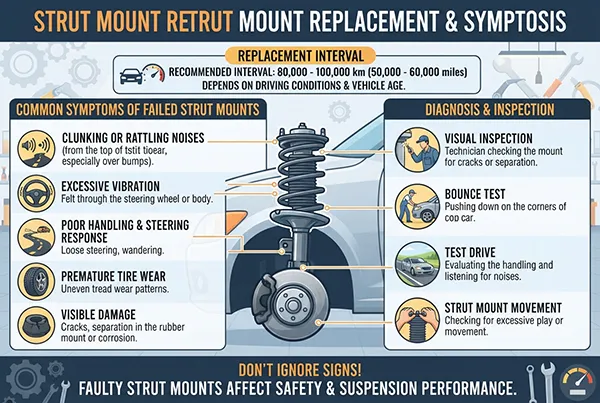
Possible signs of a strut mount concern include abnormal noise, visible rubber deterioration, looseness, abnormal movement, steering resistance, or a bearing problem where the design includes a bearing. However, these symptoms can also come from the strut, coil spring, stabilizer link, control arm, tie rod, or other components. A qualified technician should diagnose the source before replacement.
Noise is a clue, not a diagnosis
Noise is one of the most common reasons customers ask about strut mounts. They may describe a knocking, creaking, clunking, or rubbing sound. These descriptions are useful, but they are not precise enough to identify one component.
For example, a noise during steering may relate to a mount bearing, but it may also involve a spring, strut, steering linkage, or another part. A noise over bumps may come from a stabilizer link, loose fastener, worn bushing, or the strut itself. A damaged dust boot or spring seat may also create symptoms that customers associate with the mount.
This is why I recommend avoiding product content that says, “If your suspension makes a noise, replace the strut mount.” That message is easy to understand, but it is technically too broad.
What should an inspection consider?
A proper inspection may consider several areas:
| Inspection area | What the evaluator may look for | Why it matters |
|---|---|---|
| Rubber isolator | Cracking, hardening, separation, or deformation | Rubber deterioration may reduce isolation or affect alignment of the assembly |
| Mount housing | Corrosion, distortion, or damage | Structural damage can affect fitment and durability |
| Fasteners | Looseness, damage, or incorrect installation | Installation problems can create noise or movement |
| Bearing, if applicable | Roughness, binding, or excessive play | The bearing may affect steering movement |
| Abnormal movement | Excessive vertical or lateral movement | Movement may indicate wear or a related component problem |
| Surrounding parts | Spring, strut, link, arm, tie rod, and bushing condition | Another component may be the actual source of the symptom |
Not every visual mark means replacement is necessary. Surface discoloration, minor aging, or normal movement must be judged against the vehicle design and manufacturer’s specifications. The evaluator should also compare the left and right sides when appropriate.
Why symptom boundaries matter to your customers
As an aftermarket brand or distributor, you may publish installation instructions, fitment notes, or troubleshooting information. Your wording can reduce misdiagnosis. I suggest using phrases such as:
- “Inspect the mount when abnormal noise or steering changes occur.”
- “Confirm the source of the symptom before replacing the part.”
- “Check related suspension and steering components during diagnosis.”
- “Follow the vehicle manufacturer’s inspection and torque procedures.”
These statements are useful without pretending that a parts manufacturer can diagnose every vehicle remotely.
In our own manufacturing discussions, buyer questions often focus on whether a specific noise confirms a failed mount. My answer is consistently cautious: noise can justify inspection, but noise alone cannot confirm failure. The mount, strut, spring, stabilizer link, control arm, or steering components may all require consideration.
Do not overlook installation quality
A correctly manufactured mount can still create problems if it is installed incorrectly. The installer must use the correct part for the application and follow the required assembly sequence, fastener specifications, and torque procedures. Incorrect orientation, damaged threads, reused one-time fasteners, or improper tightening can affect performance.
For this reason, your customer support material should separate three issues:
- Product compatibility
- Product condition
- Installation and vehicle diagnosis
That separation helps reduce incorrect returns and avoids blaming the component before the complete assembly has been checked.
Should You Replace the Strut Mount When Replacing a Strut?
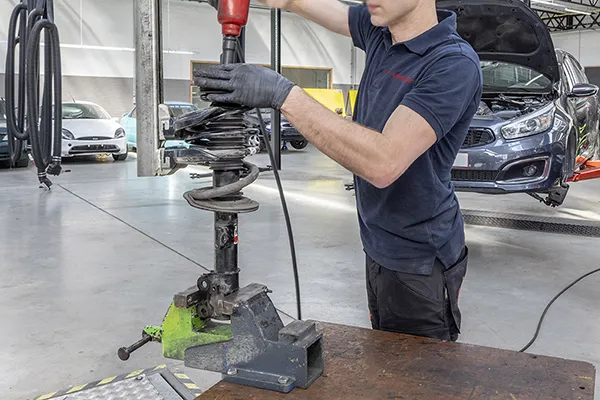
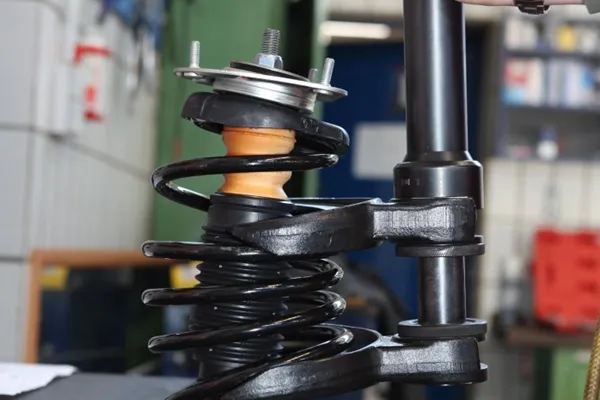
Replacing a strut does not automatically mean that the strut mount must be replaced. However, the mount should receive careful inspection during the strut replacement job because access is already available and repeated labor may increase the total repair cost.
You should inspect the strut mount whenever the strut is removed.4 Replace it when the inspection identifies deterioration, looseness, bearing problems where applicable, damage, or compatibility concerns. If the mount remains within the vehicle manufacturer’s requirements, replacement may not be necessary. The decision should balance condition, safety, labor, parts cost, and the risk of repeating the repair.
Why the “always replace together” rule is too broad
Some repair professionals recommend replacing related components at the same time because the labor overlap can be significant. That can be a reasonable maintenance strategy in certain applications, especially when the mount has visible deterioration or the vehicle has experienced severe service.
However, “always replace the mount with the strut” is not a universal technical rule. The mount may have different construction, service history, and condition from the strut. A recently replaced mount may not need replacement again simply because the strut has failed. Conversely, an older or damaged mount may create future noise or movement if it remains in service.
You should therefore distinguish between:
- Inspection opportunity: The mount is accessible because the strut is being removed.
- Replacement requirement: The inspection confirms that the mount should no longer remain in service.
- Preventive choice: The customer chooses replacement because the additional labor later would be costly or inconvenient.
These are different decisions.
Condition, compatibility, and total cost
A mount replacement decision should consider more than the part price. Your customer may also face:
- Additional labor if the mount is replaced later
- Vehicle downtime
- Wheel alignment or related adjustment requirements
- Risk of repeated disassembly
- Availability of a correct application-specific part
- Warranty and return implications
- The condition of the opposite side
A simple comparison can help:
| Decision | Potential advantage | Potential concern |
|---|---|---|
| Keep the existing mount after inspection | Lower immediate parts cost | Future wear may require another repair |
| Replace a visibly deteriorated mount | Addresses a confirmed condition concern | Adds parts and labor cost |
| Replace both sides preventively | May provide more uniform service condition | May be unnecessary if the vehicle design and inspection do not support it |
| Replace mount and strut automatically | Convenient during one job | Can lead to unnecessary replacement |
The correct option depends on the vehicle and inspection result. You should not present preventive replacement as a guaranteed requirement unless the vehicle manufacturer or qualified evaluator supports it.
What suppliers should communicate
If you sell strut mounts to professional buyers, your product information should emphasize correct application and inspection rather than exaggerated service-life promises. Useful information may include:
- Applicable vehicle models and suspension positions
- OE reference numbers, where verified
- Mount design and included components
- Bearing inclusion or exclusion
- Installation orientation
- Required hardware and accessories
- Packaging and labeling details
- Inspection and warranty procedures
At GDST Auto Parts, I have seen how important application accuracy becomes when customers purchase for multiple markets. Japanese, Korean, American, and European applications can use different designs even when the product names appear similar. A procurement team should confirm drawings, samples, dimensions, and technical requirements before approving a large order.
If you are developing a private-label product line, you can send us your sample, drawing, or technical requirement for review. We can discuss application coverage, packaging, and production arrangements without forcing a one-size-fits-all specification.
How Can You Write Accurate Strut Mount Replacement Guidance?
Product content can either help customers make a careful decision or encourage unnecessary part replacement. You need wording that is simple enough for drivers and precise enough for procurement teams, distributors, and after-sales staff.
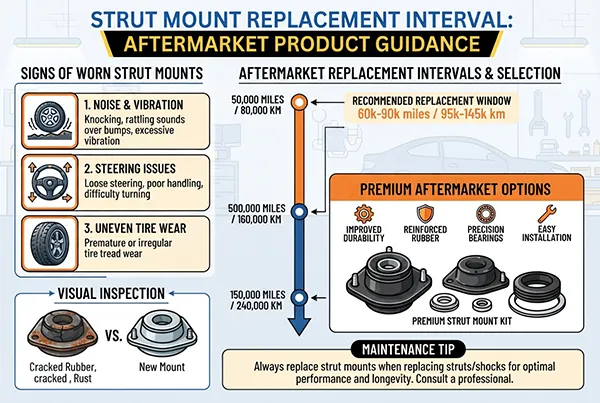
Accurate guidance should explain that the strut mount replacement interval is vehicle-specific and condition-dependent. Your content should encourage inspection based on service information, operating conditions, and confirmed symptoms. It should also make clear that noise alone does not prove mount failure and that a qualified professional should diagnose application-specific concerns.
Use a condition-and-risk message
I recommend replacing mileage-only language with a balanced message:
“Inspect the strut mount according to the vehicle manufacturer’s service information and whenever suspension noise, steering changes, visible deterioration, looseness, or abnormal movement is reported. Replace the mount only after confirming that its condition, compatibility, or installation history justifies replacement.”
This wording works well for catalog pages, customer service scripts, and technical brochures. It gives the reader a next action without making an unsupported promise.
What evidence should a supplier provide?
When you evaluate a strut mount manufacturer, you should ask how the supplier controls quality. Useful evidence may include:
- Material inspection documentation
- Dimensional inspection records
- Product drawings or approved samples
- Process-control information
- Rubber and metal component specifications
- Testing procedures relevant to the application
- Final inspection records
- Traceability and batch information
- Quality management certificates for verification
At our factory, quality-control activities include material checks, dimensional control, hardness testing, torque testing, angle testing, fatigue testing, pull-out and compression testing, salt spray testing, ozone resistance testing, and high- and low-temperature testing. These activities support manufacturing control, but buyers should still verify that the test scope and documentation match their own application and purchasing requirements.
Our stated IATF 16949 and ISO 9001 certifications5 should also be treated as documents for buyer verification. Certification does not remove the need to confirm fitment, design requirements, inspection criteria, and market-specific compliance.
How to reduce after-sales confusion
Your after-sales team can ask customers a short set of questions before recommending a replacement:
- What is the vehicle make, model, year, engine, and suspension position?
- What symptom has appeared?
- When does the symptom occur?
- Has the vehicle experienced pothole impact, overload, or collision damage?
- Has the strut, spring, or related suspension part been replaced recently?
- Has a qualified technician inspected the assembly?
- Is there visible damage, looseness, or abnormal movement?
- Does the supplied part match the confirmed application?
This process does not replace professional diagnosis. It simply prevents the common mistake of treating every noise or mileage figure as proof of mount failure.
A note for procurement teams
If you are an importer or wholesaler, you may need a stable supply of mounts for several vehicle markets. Before you approve a supplier, ask whether the manufacturer can support:
- Sample approval before mass production
- OEM or ODM development
- Private-label packaging
- Consistent mold and dimensional control
- Batch-level inspection
- Clear product labeling
- Communication about design changes
- Reliable production capacity
I work with buyers who need more than a low unit price. They also need consistent quality, delivery stability, and fewer warranty disputes. A technically careful replacement message supports all three goals because it reduces incorrect customer expectations.
Frequently Asked Questions
What is the recommended strut mount replacement interval?
There is no universal interval for every vehicle. You should check the vehicle manufacturer’s service information and use mileage or age as an inspection reference. The final decision should consider operating conditions, rubber deterioration, looseness, bearing condition where applicable, abnormal movement, and professional inspection findings.
Should strut mounts be replaced in pairs?
Not automatically. Some professionals may recommend replacing both sides to maintain a similar service condition, but the decision depends on the vehicle, mount design, condition of each side, and repair strategy. You should inspect both sides and follow qualified technical advice rather than apply a universal rule.
Does a noise mean that the strut mount has failed?
No. Noise may come from the mount, bearing, strut, spring, stabilizer link, control arm, tie rod, bushing, fastener, or another suspension part. Noise should trigger further inspection, but it does not independently confirm strut mount failure.
Should I replace the mount when replacing the strut?
You should inspect the mount whenever the strut is removed. Replacement may be sensible if the mount shows deterioration, looseness, damage, or bearing problems. If the mount remains within the vehicle manufacturer’s requirements, automatic replacement may not be necessary.
What information should I provide when ordering a strut mount?
Provide the vehicle make, model, year, engine, suspension position, OE reference number, and any available sample or drawing. You should also confirm whether the product includes a bearing, hardware, or other components. For private-label orders, share your packaging and quality requirements early.
Conclusion
The recommended strut mount replacement interval is not a universal mileage or age deadline. You should treat any interval as a vehicle-specific inspection reference and confirm the manufacturer’s service information. Operating conditions, rubber condition, looseness, bearing performance, abnormal movement, and related component diagnosis all matter. Replacing a strut does not automatically require replacing the mount, but the mount deserves careful inspection during the job. If you are developing an aftermarket product range or need reliable OEM/ODM suspension parts, contact GDST Auto Parts with your application list, samples, drawings, or packaging requirements.
"Estimation of Synthetic Rubber Lifespan Based on Ozone ...", https://pmc.ncbi.nlm.nih.gov/articles/PMC11944956/. Studies of elastomer aging show that oxidation, ozone exposure, elevated temperature, cyclic strain, and sustained compression can produce hardening, surface cracking, permanent set, and reduced elastic recovery. Evidence role: mechanism; source type: paper. Supports: Materials research should document how heat, oxygen, ozone, cyclic loading, and sustained compression alter elastomer stiffness, surface integrity, shape recovery, and elasticity.. Scope note: The rate and severity of degradation depend on the rubber formulation, geometry, stress history, and environment of the specific mount. ↩
"Study on the failure mechanism and improvement measures ...", https://pmc.ncbi.nlm.nih.gov/articles/PMC12644720/. Rolling-bearing research associates contamination, lubricant deterioration, corrosion, and raceway or rolling-element damage with increased friction, vibration, and irregular rotation, mechanisms consistent with roughness or resistance in a mount bearing. Evidence role: mechanism; source type: research. Supports: Bearing research should connect contamination, corrosion, lubrication failure, and raceway damage with increased friction, vibration, or rough rotation.. Scope note: General rolling-bearing evidence does not diagnose the cause of resistance in a particular strut assembly. ↩
"Economic Analysis of the Environmental Impact of Highway ...", https://nepis.epa.gov/Exe/ZyPURL.cgi?Dockey=300001KJ.TXT. Research on automotive underbody durability identifies chloride-bearing road environments as a driver of metallic corrosion and shows that sufficiently high impact or overload stresses can produce permanent structural deformation. Evidence role: mechanism; source type: paper. Supports: Research should establish that chloride exposure accelerates corrosion of automotive metals and that excessive loads or impacts can cause permanent deformation of suspension structures.. Scope note: This evidence establishes credible damage mechanisms but does not determine whether a particular mount housing is unserviceable. ↩
"AUTO 104 - Suspension and Steering Level 1 - - Delta College", https://catalog.delta.edu/preview_course_nopop.php?catoid=3&coid=3735. Automotive service procedures commonly direct technicians to inspect upper mounts, bearings, spring seats, isolators, and associated hardware when a strut assembly is removed or disassembled, because these components are then directly accessible. Evidence role: general_support; source type: education. Supports: Automotive service-training material should identify the upper mount, bearing, spring seat, isolators, and hardware as components to inspect during strut disassembly or replacement.. Scope note: Inspection criteria and mandatory replacement items differ by vehicle and must be confirmed in the applicable service information. ↩
"GDST Factory Price Manufacturer Supplier OEM D1169 Auto ...", https://m.made-in-china.com/product/GDST-Factory-Price-Manufacturer-Supplier-OEM-D1169-Auto-Parts-Disc-Brakes-Pads-2178279502.html. Current certification-body records should identify the certified GDST legal entity and site, the applicable IATF 16949 and ISO 9001 standards, certificate scope, certificate numbers, and validity dates. Evidence role: case_reference; source type: institution. Supports: A current registry entry or certificate issued by an accredited certification body should verify the certified legal entity, standard, site, scope, certificate number, issue date, and expiration or validity status.. Scope note: Certification verifies the audited management-system scope for the named entity and period; it does not by itself establish the quality, fitment, or compliance of every individual product. ↩