
A broken strut mount can turn an ordinary suspension noise into a serious safety concern. You may feel tempted to keep driving because the car still moves, but hidden looseness can affect steering and stability. The safer solution is to judge the symptoms carefully and arrange a professional inspection as soon as possible.
You should not continue normal driving with a suspected broken strut mount.1 If you only hear mild noise while steering and vehicle control remain normal, drive slowly for the shortest practical distance to a qualified repair facility. Stop driving and arrange a tow if you notice binding steering, instability, obvious looseness, severe impacts, or visible displacement.
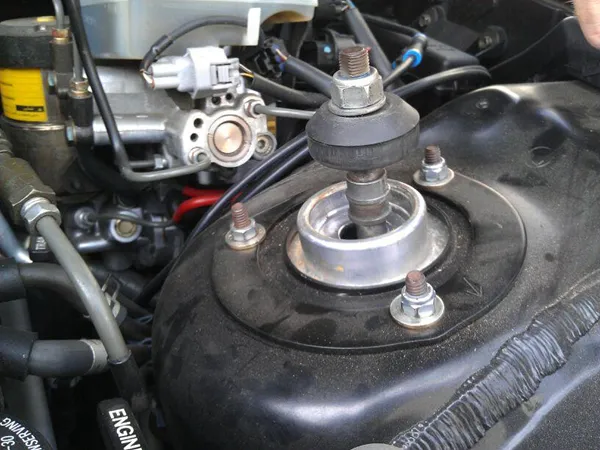
The difficult part is that noise alone cannot confirm the problem. A worn bearing, loose fastener, damaged spring, or failing strut can produce similar symptoms. You need to understand what the mount does, recognize urgent warning signs, and have the entire connected system inspected.
What Does a Broken Strut Mount Affect?
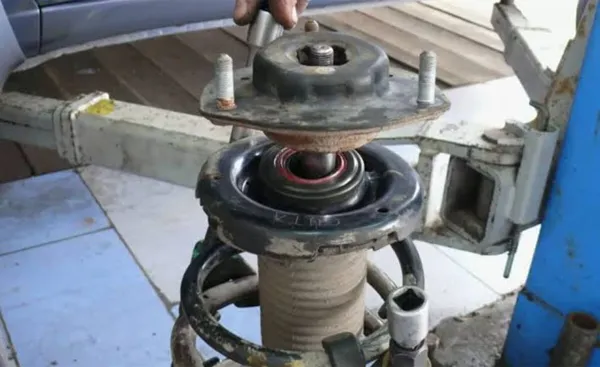
You may think a strut mount is only a rubber cushion that reduces vibration. That description is incomplete. Depending on the suspension design, the mount may help support vehicle loads, locate the upper strut assembly, isolate road vibration, and allow the strut to rotate when you steer.
A broken strut mount can affect ride comfort, suspension alignment, steering movement, and vehicle stability. Its rubber, metal plates, studs, fasteners, and bearing-related structure work together. When one section separates, cracks, loosens, or deforms, the strut assembly may no longer stay securely positioned or move as the vehicle manufacturer intended.
A strut mount has several functions
The exact construction varies by vehicle. However, many front strut mounts contain some combination of:
- A molded rubber insulator
- Upper and lower metal components
- Mounting studs or bolt holes
- A center sleeve or attachment point
- A bearing or separate bearing plate
- Spring-seat interfaces
- Protective coatings and sealing features
On a vehicle with a steering strut, the bearing allows part of the strut assembly to turn smoothly as you move the steering wheel.2 If the bearing binds, you may feel resistance, hear spring movement, or notice that the steering does not return normally.
The rubber section has another role. It helps control vibration while holding connected metal components in the correct relationship. A crack in the rubber does not automatically mean total structural failure. However, substantial separation can allow unwanted movement and impact between parts.
From a manufacturing perspective, I pay close attention to rubber-to-metal bonding, dimensional accuracy, bearing fit, stud position, and assembly consistency. A small dimensional error can affect fitment. Poor bonding or incorrect assembly can also reduce the mount’s ability to manage loads as intended. This does not allow you to diagnose a vehicle from appearance alone, but it explains why looseness and deformation matter.
Why “the car still moves” is not a safety test
A vehicle can remain movable even when a suspension component is badly worn or damaged.3 The important questions are whether:
- The steering operates smoothly and predictably
- The body remains controlled over bumps
- The strut stays in its intended position
- The spring and related hardware remain correctly seated
- The vehicle tracks normally
- The damage is becoming worse
A broken strut mount may deteriorate gradually, or a connection may shift more suddenly after a pothole or hard impact. You cannot convert that uncertainty into a universally safe number of miles.
When Can You Drive with a Suspected Broken Strut Mount?
A faint clunk or creak can be worrying, but it does not always mean the mount has separated. At the same time, you should not ignore a new suspension noise simply because steering still feels acceptable. Your decision should depend on control, looseness, and damage severity—not convenience.
If the only symptom is mild noise and the steering, braking, ride height, and body control remain normal, you may cautiously drive the shortest practical distance to a professional inspection. Keep your speed low and avoid rough roads. This advice does not apply when the vehicle feels unstable, loose, or difficult to steer.
Use a risk-based decision, not a mileage limit
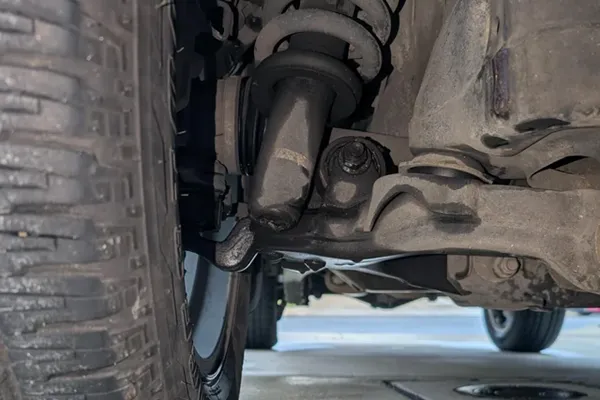
No responsible answer can promise that driving 5, 10, or 50 miles will be safe. Different mount designs fail in different ways. Road conditions, vehicle weight, speed, and the condition of the remaining suspension parts also affect the risk.
Use the following guide as a cautious decision aid:
| What you notice | Recommended response |
|---|---|
| Mild occasional noise, with normal steering and stable body control | Drive slowly only to the nearest suitable inspection facility |
| Noise becoming louder or more frequent | Avoid unnecessary driving and arrange prompt inspection |
| Steering feels notchy, heavy, delayed, or reluctant to return | Stop driving and arrange a tow |
| Vehicle wanders, leans unusually, or feels unstable | Stop and tow |
| Loud metal-on-metal impact over small bumps | Stop and tow |
| Visible movement or displacement near the upper strut mount | Do not drive |
| Spring appears displaced or damaged | Do not drive |
| Mounting hardware is loose, missing, or pulling through metal | Do not drive |
You should also consider the route. A short journey on a smooth, low-speed road does not create the same loading as highway travel, heavy braking, sharp cornering, or repeated pothole impacts. However, even a short journey is inappropriate when severe warning signs are present.
What should you do during a cautious trip?
If the symptoms are mild and you decide to travel directly for inspection:
- Reduce your speed. Lower speed reduces impact forces over road irregularities.
- Avoid potholes and speed bumps where possible.
- Leave extra space for braking. Unexpected movement can reduce your confidence and control.
- Avoid heavy loads. Extra weight can increase suspension loading.4
- Do not make unnecessary stops or detours.
- Stop immediately if the symptoms worsen.
You should not use a cautious trip as permission for continued commuting. A suspected broken strut mount needs inspection even if the car seems manageable at first.
A short drive to an inspection is a limited risk decision, not proof that the vehicle is safe for normal use.
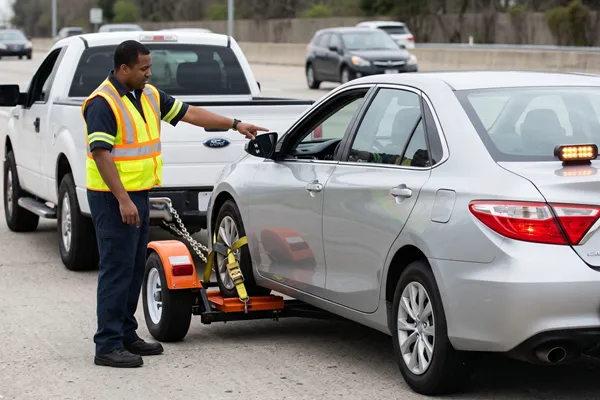
When Should a Broken Strut Mount Make You Stop and Tow?
Some symptoms move the situation beyond “schedule an inspection” and into “do not keep driving.” The strongest warnings involve steering changes, unstable body movement, severe mechanical impacts, or visible displacement. These signs suggest that the problem may affect more than noise isolation.
Stop driving and arrange professional recovery when a suspected broken strut mount is accompanied by abnormal steering, obvious looseness, unstable handling, severe impact noise, metal-on-metal contact, a shifted strut position, displaced spring components, or damaged mounting points. Continuing to drive may worsen the damage and reduce predictable control.
Steering that binds or behaves unpredictably
A damaged or seized upper bearing can interfere with smooth steering movement on applicable designs. You might notice:
- The steering wheel feels unusually heavy
- Steering effort changes during a turn
- The wheel moves in steps instead of smoothly
- The steering does not return toward the center normally
- You hear the spring wind up and release
- The car changes direction less predictably than usual
These symptoms do not prove that the mount is the only cause. Steering joints, springs, power steering components, alignment problems, and other faults can create similar behavior. However, abnormal steering is serious enough that you should not keep driving merely to confirm the source.
Excessive body movement or looseness
A functioning mount helps locate the upper end of the strut assembly.5 If its structural connection has deteriorated, you may hear a heavy knock while the vehicle body moves more than expected.
Pay attention if the car:
- Bounces or shifts unusually after a bump
- Pulls or wanders
- Feels vague during lane changes
- Leans unexpectedly
- Makes a heavy impact during braking or acceleration
- Produces repeated clunks from the upper suspension area
A failed damper can also cause poor body control, so these symptoms require a system-level inspection.
Visible displacement or structural damage
You may be able to inspect the upper mounting area under the hood, but you should not place any part of your body under an unsupported vehicle. You should also avoid touching or dismantling a loaded spring assembly.6
Warning signs can include:
- Rubber that has substantially separated from metal
- A center section that appears off-center
- Cracked or deformed metal
- Loose or missing mounting nuts
- Studs pulling through the mount
- Unusual movement when the steering turns
- Contact marks where parts have been striking each other
Some mount movement may be normal by design, and appearance differs between vehicles. You should compare findings with the vehicle manufacturer’s repair information and have a qualified professional determine whether the movement exceeds specification.
How Is a Broken Strut Mount Diagnosed Correctly?
A clunk near the top of the suspension can sound convincing, but sound travels through the body and chassis.7 You can easily blame the wrong component. Replacing parts based only on noise can waste money while leaving the actual safety problem unresolved.
A broken strut mount should be diagnosed by inspecting the complete strut and steering connection. The inspection should consider the mount rubber, bearing, fasteners, spring seating, strut condition, surrounding body attachment, and nearby suspension joints. The final decision should follow actual findings and vehicle-specific service information.

Other parts can create similar symptoms
Several components can produce knocking, creaking, or steering noise:
| Possible source | Common clue | What needs checking |
|---|---|---|
| Strut mount rubber | Thump or movement near the upper mount | Separation, deformation, and excess play |
| Mount bearing | Creaking, popping, or notchy steering | Smooth rotation and correct assembly |
| Strut or shock absorber | Bouncing, leakage, or poor control | Damping condition and attachment points |
| Coil spring | Clunking or sudden release noise | Cracks, seating, orientation, and corrosion |
| Loose fasteners | Repeated knocking | Correct hardware condition and torque |
| Stabilizer link | Rattle over uneven roads | Joint play and damaged boots |
| Ball joint or control-arm bushing | Knock, wander, or tire wear | Play, rubber condition, and alignment |
| Tie rod end | Steering looseness or clicking | Joint play and secure attachment |
| Body mounting area | Movement around the strut tower | Cracking, corrosion, or deformation |
A technician may inspect the vehicle while it is stationary, lifted correctly, or loaded in its normal position. The correct method depends on the design because unloading the suspension can hide or change some movement.
Manufacturing details explain why fitment matters
In strut-mount production, dimensional and assembly control are not cosmetic concerns. Important characteristics can include:
- Stud spacing and position
- Overall mount height
- Center-bore dimensions
- Rubber hardness and bonding quality
- Bearing dimensions and rotational smoothness
- Metal thickness and forming accuracy
- Surface-treatment coverage
- Spring-seat relationship
- Assembly orientation
At GDST Auto Parts, our experience with suspension-part manufacturing has shown me why buyers and inspectors need to verify materials, dimensions, connections, and fitment rather than judge a component by appearance alone. Our molds are developed to OE specifications, with relevant dimensional tolerances controlled within ±0.2 mm, and our broader quality processes include material checks, hardness testing, fatigue testing, torque testing, and environmental testing where applicable.
These manufacturing controls explain how a mount should be evaluated as a structured assembly. They do not replace workshop diagnosis. The vehicle’s condition, installation quality, accident history, corrosion, and connected components can all change what an inspector finds.
Should you replace other parts at the same time?
You should not automatically replace every connected part or assume both sides require identical work. A qualified technician should consider:
- The vehicle manufacturer’s repair procedure
- Whether the mount and bearing are separate or integrated
- The condition of the opposite-side component
- Strut leakage or weak damping
- Spring condition and seating
- Fastener replacement requirements
- Alignment needs after reassembly
- Differences in wear between the left and right sides
Some service procedures recommend replacing certain hardware after removal. Some repairs may also require wheel alignment. The correct decision must follow the specific vehicle design, component condition, and reliable repair information.
Frequently Asked Questions
Can a broken strut mount affect steering?
Yes. On vehicles where the upper mount includes or works with a steering bearing, damage can cause binding, popping, uneven steering effort, or poor steering return. Other steering and suspension faults can cause the same symptoms, so you need a complete inspection rather than a diagnosis based only on noise.
What does a bad strut mount sound like?
A damaged mount may produce clunking, knocking, creaking, popping, or metal-on-metal impact sounds. The noise may appear over bumps or while turning. However, springs, struts, stabilizer links, ball joints, tie rods, and loose fasteners can sound similar. Noise alone does not confirm a broken strut mount.
Can you see a broken strut mount under the hood?
You may see severe rubber separation, off-center positioning, damaged metal, or loose fasteners around some upper mounts. However, covers and vehicle design can hide important areas. Some movement is also normal. Do not dismantle a spring-loaded strut assembly yourself unless you have the correct training and equipment.
How long can you drive with a bad strut mount?
There is no universally safe distance or period. Damage severity can vary, and symptoms can worsen after an impact. If control remains normal and the noise is mild, limit driving to the shortest practical trip for inspection. If steering, stability, or structural positioning is abnormal, stop and arrange a tow.
Does replacing a strut mount require an alignment?
An alignment may be necessary when the repair changes strut position or disturbs alignment-related fasteners. Requirements vary by suspension design and repair procedure. You should follow the vehicle manufacturer’s service information and have alignment angles checked when the repair could affect suspension geometry.
Conclusion
A broken strut mount is not simply a question of how many miles your car can still travel. You need to judge steering behavior, vehicle stability, mechanical looseness, impact noise, and visible displacement. Mild noise with otherwise normal control may justify only a slow, direct trip for inspection. Binding steering, severe knocking, instability, or structural movement calls for a tow. If you need dependable strut-mount manufacturing or customized suspension components, contact GDST Auto Parts to discuss your drawings, samples, fitment requirements, and quality-control expectations.
"19VAC30-70-110. Steering and suspension. - Virginia Law", https://law.lis.virginia.gov/admincode/title19/agency30/chapter70/section110/. Official roadworthiness standards generally classify fractured, insecure, or displaced suspension components as serious defects because they can compromise controlled vehicle operation. Evidence role: expert_consensus; source type: government. Supports: Official inspection guidance should show that insecure, fractured, or displaced suspension mountings are treated as safety defects, particularly when steering or stability is affected.. Scope note: Inspection classifications vary by jurisdiction and may not specifically name every form of strut-mount deterioration. ↩
"Quiz: - Brakes Steering and Suspension", https://brakes.siu.edu/steering.htm. Technical descriptions of MacPherson-type suspensions explain that the steerable strut turns with the wheel assembly and that an upper bearing permits rotation relative to the vehicle body. Evidence role: mechanism; source type: education. Supports: A technical source should explain that a MacPherson-type steering strut rotates as the wheels are steered and that an upper bearing accommodates this movement.. Scope note: This mechanism applies to steerable strut layouts and not necessarily to every suspension or rear strut design. ↩
"Injury-severity analysis of crashes involving defective vehicles and ...", https://pmc.ncbi.nlm.nih.gov/articles/PMC10907794/. Roadworthiness standards identify fractured, insecure, or excessively worn suspension parts as safety defects even when a vehicle remains capable of moving under its own power. Evidence role: general_support; source type: government. Supports: Government inspection standards or defect reports should demonstrate that a vehicle may still operate while having suspension defects classified as serious or dangerous.. Scope note: Roadworthiness classifications establish safety significance rather than predicting how long a particular damaged component will continue to function. ↩
"The influence of the suspension upon the axle weight distribution for ...", https://www.academia.edu/83973933/The_influence_of_the_suspension_upon_the_axle_weight_distribution_for_heavy_trucks. Transport-safety and vehicle-engineering guidance recognizes that additional payload increases axle loading and can reduce available suspension travel while altering handling response. Evidence role: mechanism; source type: government. Supports: An engineering or transport-safety source should confirm that added payload raises axle loads and can alter suspension travel, handling, and component loading.. Scope note: The incremental load on an individual strut mount depends on payload distribution, suspension geometry, and dynamic conditions. ↩
"MacPherson strut", https://en.wikipedia.org/wiki/MacPherson_strut. Descriptions of MacPherson-strut construction identify the upper mount as the body-side attachment that locates the top of the combined spring-and-damper assembly. Evidence role: definition; source type: encyclopedia. Supports: A reference source should define the upper mount as the body-side attachment and locating point for the top of the strut assembly.. Scope note: Mount geometry and the extent of its load-bearing role differ among suspension designs. ↩
"[PDF] Injury and Illness Prevention Program | San Bruno, CA", https://www.sanbruno.ca.gov/DocumentCenter/View/2717/Injury-and-Illness-Prevention-Program-PDF. Occupational-safety guidance warns that compressed suspension springs contain substantial stored energy and may cause severe injury if released without correctly rated equipment and controlled procedures. Evidence role: expert_consensus; source type: government. Supports: Occupational-safety guidance should establish that compressed vehicle springs retain substantial energy and can cause serious injury if released without suitable restraints and procedures.. ↩
"Numerical and Experimental NVH Testing of Vehicle Components", https://www.academia.edu/119658744/Numerical_and_Experimental_NVH_Testing_of_Vehicle_Components_from_Simple_Part_to_Complex_Assembly. Automotive noise-and-vibration research distinguishes structure-borne sound, in which mechanical excitation propagates through connected chassis and body components before becoming audible away from its source. Evidence role: mechanism; source type: paper. Supports: Noise-and-vibration research should show that mechanical excitation can travel through connected vehicle structures and radiate at locations away from the originating component.. Scope note: This principle explains why localization by ear can be unreliable, but it does not identify the defective component in an individual vehicle. ↩