
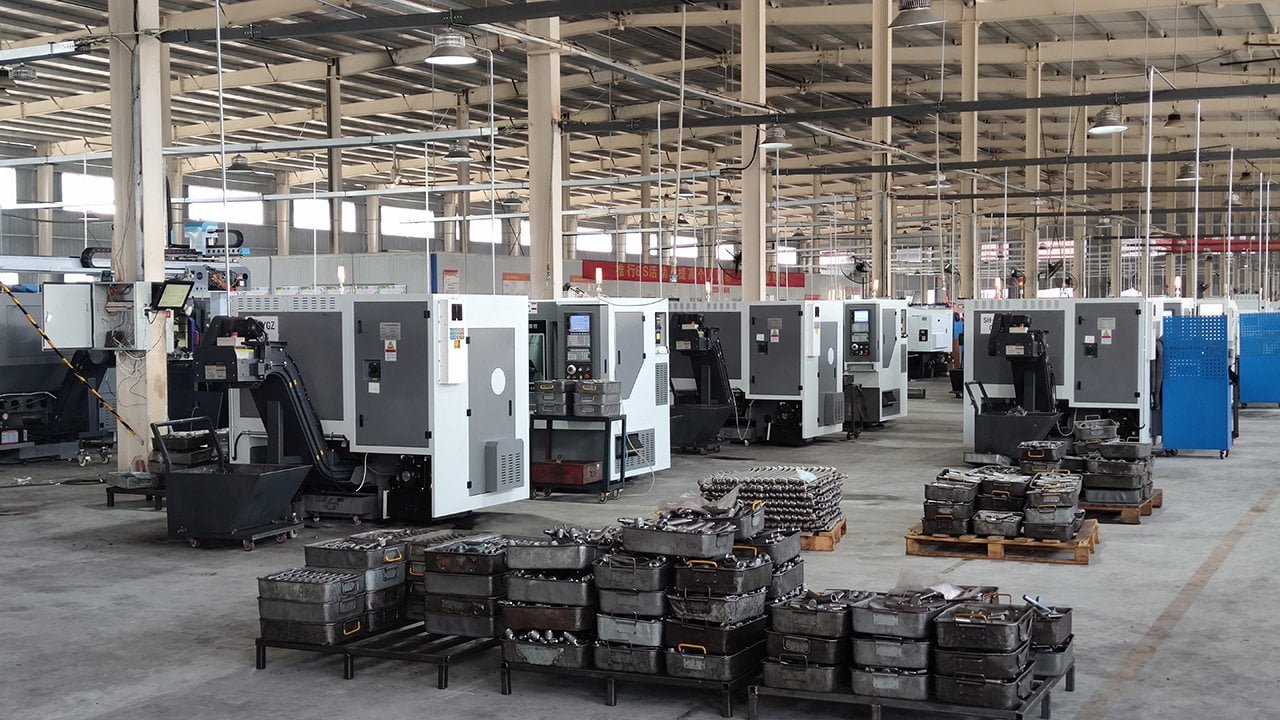
Most buyers get burned not because they chose the wrong product, but because they chose the wrong partner1 — and only found out after the first big problem hit.
Real service support from a suspension parts supplier means three things: responsive technical communication, flexible OEM/ODM manufacturing, and a verifiable supply chain. Any supplier can claim "full support." The question is whether they can show you the processes behind that claim.
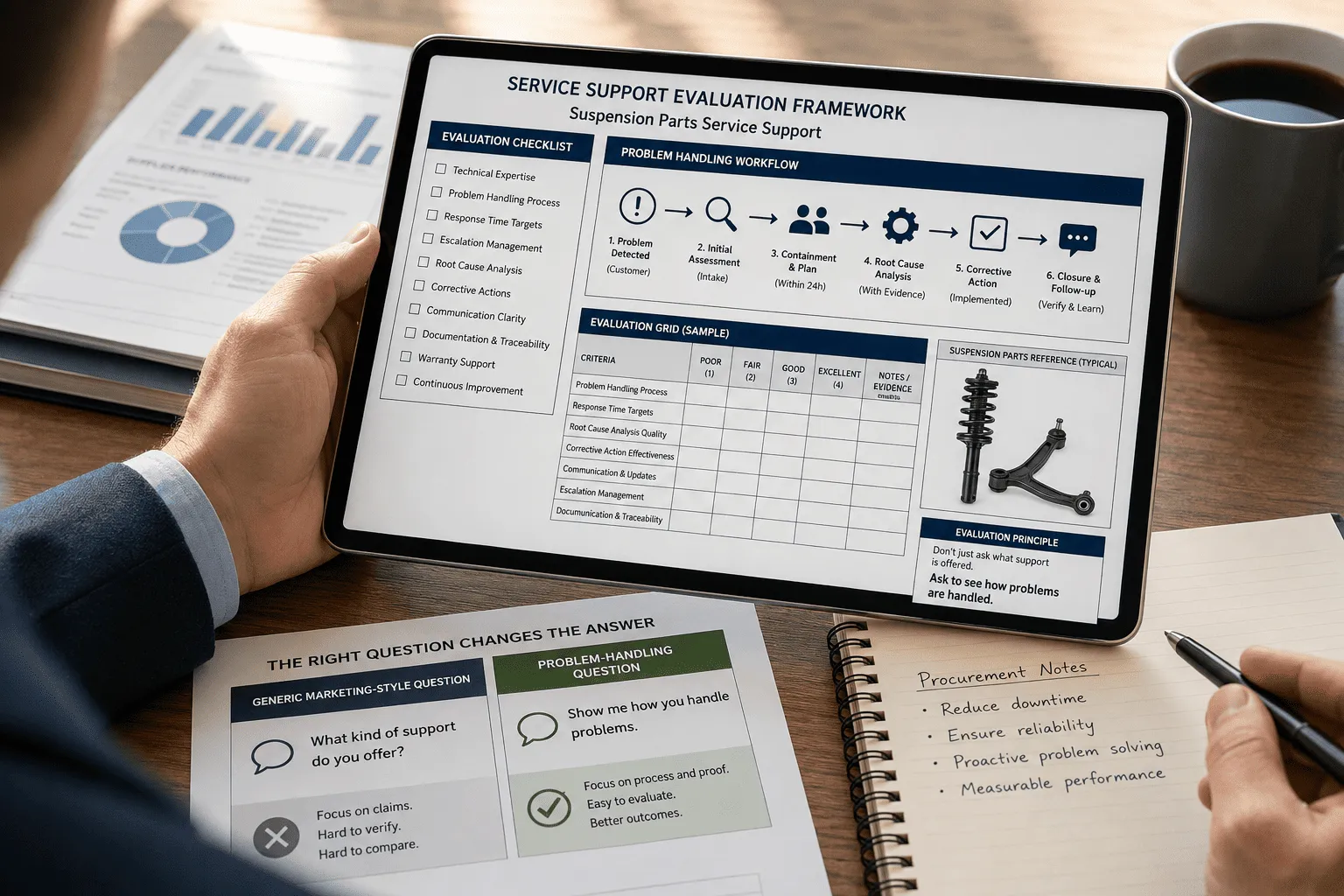

A common question we get from procurement managers is: "What kind of after-sales support do you offer?" It's a reasonable question. But it's also the wrong question to start with. It puts the conversation into marketing territory, where every supplier sounds the same. A more useful starting point is this: "Can you show me how your business handles problems?" That one shift changes everything.
Is "Service Support" a Department or a System?
Most buyers treat service support like a checkbox. Either a supplier has a support team, or they don't. But after years of working with procurement managers across different markets, I've seen that the ones who make the best long-term sourcing decisions think about it differently.
Service support is not a single department. It is a combination of three things working together: technical communication that is fast and accurate, manufacturing flexibility that covers OEM and ODM needs, and a supply chain that is stable enough to be predictable2. If any one of these is weak, the whole system fails.
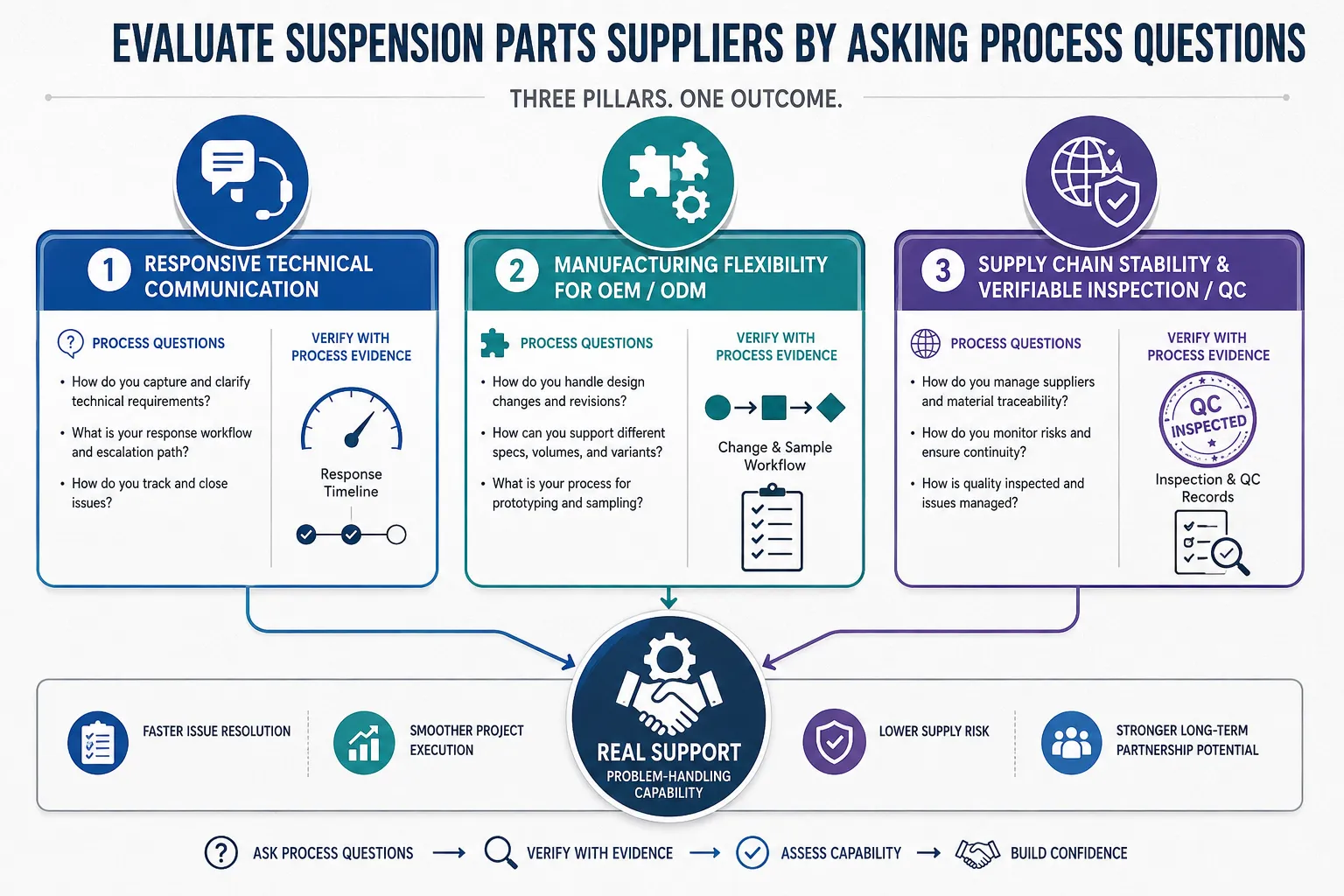

Let me break down why each of these matters on its own, and why they only work as a complete system.
Technical communication is where most suppliers fall short first. When a buyer has a fitment issue or a custom requirement, the speed and accuracy of the response matters more than the initial product pitch. If your technical questions go through a salesperson who then has to ask the engineering team, then wait for a translation, then send back a partial answer — that delay costs you time, and in some cases, it costs you customers. The question to ask here is not "Do you have a technical team?" but "How long does it take your team to respond to a technical inquiry, and who exactly responds?"
Manufacturing flexibility means something specific in this context. For private label brands, it means the supplier can work from your specifications, support your packaging design, and adjust production runs based on your market cycles. For a regional wholesaler, it might mean something simpler: can they hold stock configurations that match your most common SKUs? A supplier who only does one thing well — say, high-volume standard production — may not be the right fit for a brand that needs custom development. The mismatch between what a supplier is built to do and what a buyer actually needs is one of the most common and most avoidable sourcing mistakes I've seen3.
Supply chain stability is harder to verify, but it is the most important. Lead time promises are easy to make. The real test is what happens when a raw material batch fails incoming inspection, or when a production line has an unplanned stoppage. Does the supplier have redundancy built in? Do they have relationships with multiple material sources? At our factory, all steel is sourced from major Chinese mills like Baosteel and Shagang4, and every batch comes with material inspection reports. We also run random composition tests in-house. That process exists not because it is required, but because it is what keeps production on schedule when one batch does not meet spec.
| Support Area | Weak Signal | Strong Signal |
|---|---|---|
| Technical Communication | Sales team relays all questions | Direct access to engineering team with defined response time |
| Manufacturing Flexibility | Standard catalog only | OEM/ODM capability with documented development process |
| Supply Chain Stability | Single-source materials, no inspection records | Multi-source materials with batch-level inspection and QC reports |
Does a Certification Like IATF16949 Guarantee You Will Get Good Support?
This is one of the most common misconceptions I see among buyers who are newer to international sourcing. They see IATF16949 on a supplier profile and treat it as a quality guarantee. It is not.
IATF16949 certification5 means a supplier has documented quality management processes and has passed a third-party audit of those processes. It does not guarantee that every part will meet your spec, or that the supplier will handle exceptions well.6 The real test is how they manage problems, not how they manage routine production.
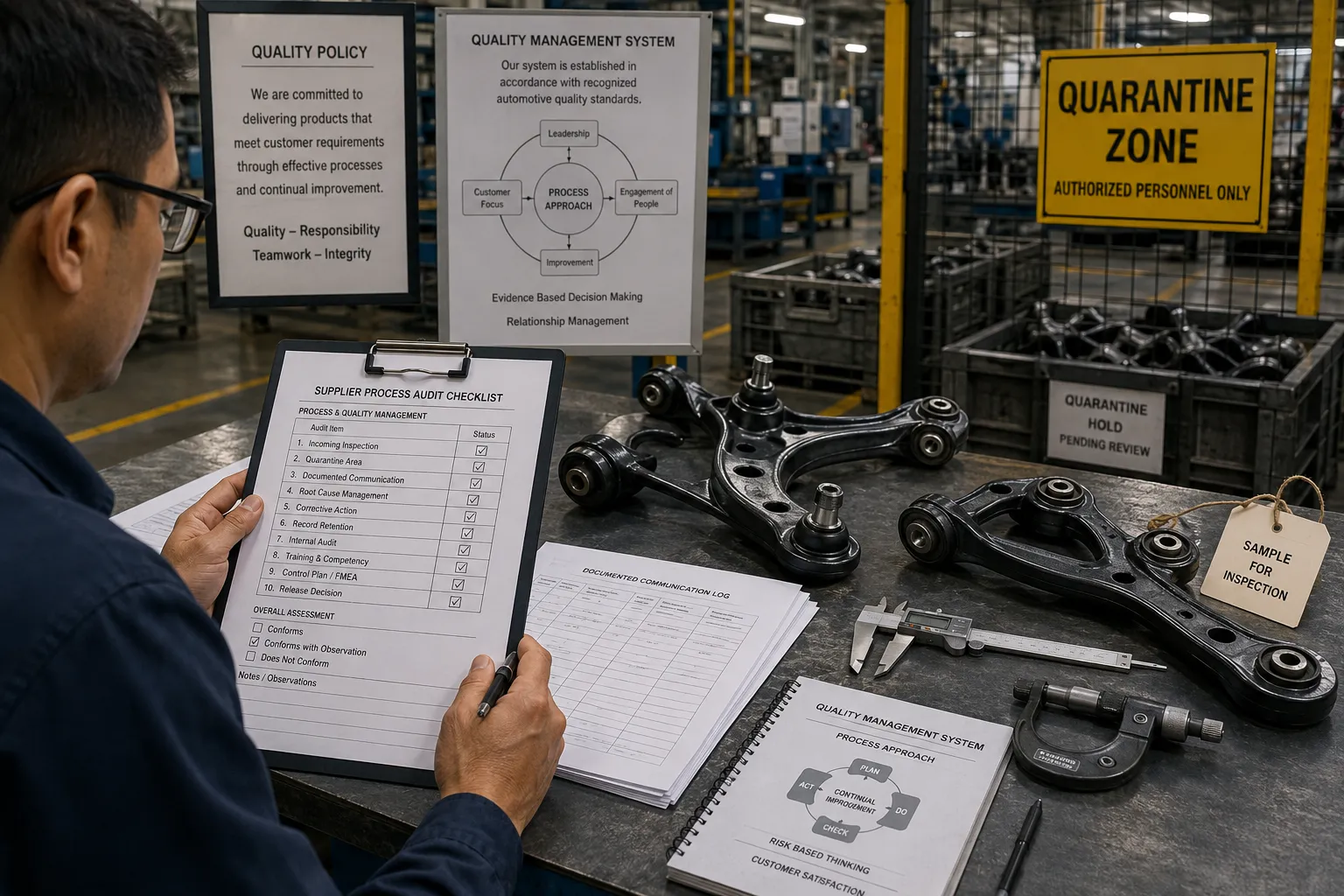

Here is a practical way to think about it. A certification tells you that a process exists on paper. What it cannot tell you is how a supplier responds when their own upstream material supplier ships a defective steel batch. Do they catch it at incoming inspection? Do they have a documented process for quarantining that batch and communicating the delay to customers? Or do they push it through to meet a delivery date and hope the issue doesn't surface in the field?
A more insightful question to ask any certified supplier is: "Can you walk me through what happened the last time you had a raw material failure, and how you handled it?" That question is not asking for a perfect answer. It is asking for a real one. A supplier who has a clear, honest answer to that question — including what went wrong and what they changed afterward — is more trustworthy than one who only shows you the certification.
The same logic applies to custom requirements. A buyer once asked me how we handle a situation where a custom part fails its initial testing. The honest answer is that it happens. The question is whether the supplier has a structured process for root cause analysis, design revision, and retesting — or whether they just try the same thing again and hope for a different result. Certifications do not answer that. Conversations do.
| Certification Claim | What It Proves | What It Does Not Prove |
|---|---|---|
| IATF16949 | Documented QMS processes exist and have been audited | That exceptions and failures are handled competently |
| ISO90017 | Quality management system is structured | That every batch meets your specific requirements |
| Material Test Reports | Batch-level material composition was checked | That the right material was used in your specific order |
The point here is not to dismiss certifications. They are a baseline requirement, not a finish line. A supplier without them is almost certainly not worth evaluating further. But a supplier with them still needs to prove how they operate when things go wrong.
Does Every Buyer Need the Same Kind of Support?
A question I find more useful than "What support do you offer?" is "What kind of support does my business model actually require?" These are very different questions, and most suppliers will not volunteer the distinction.
The right support structure depends entirely on your business model.8 A private label brand needs deep product development collaboration and packaging flexibility. A regional wholesaler needs stable inventory, predictable lead times, and logistical consistency. A one-size-fits-all support promise from a supplier is a warning sign, not a selling point.
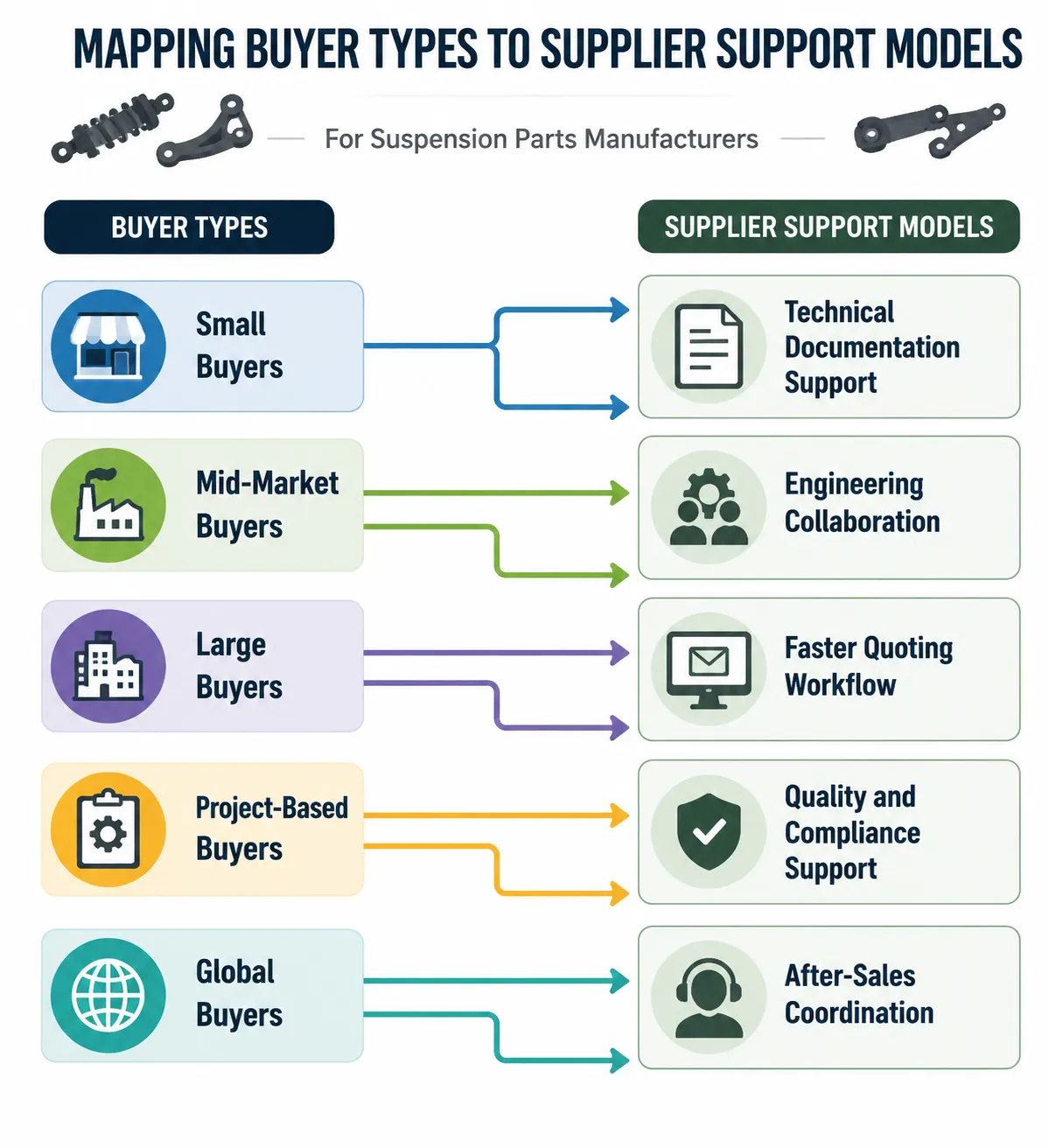

I work with buyers across very different business structures, and their support needs are genuinely different. Here is how I think about the main types:
Private label brands9 need a supplier who can function as a development partner. This means working from customer samples, drawings, or technical requirements to build a part that meets specific performance standards and then packaging it under the customer's brand. The support requirement here is heavily front-loaded — it lives in the development and testing phase. The supplier needs in-house tooling, mold development capability, and a design team that can support custom packaging. If a supplier only handles standard catalog parts, they are not the right fit, regardless of how good their quality is.
Importers and regional wholesalers10 have a very different priority set. They are not usually developing new products. They need a supplier who can hold the SKUs they move most often, communicate accurately about lead times, and ship consistently. For this buyer type, supply chain transparency matters more than R&D flexibility. They need to know: What is your realistic production lead time for a reorder? What happens if my volume doubles for one quarter? Do you have the capacity to absorb that?
Distributors serving multiple local markets often need a combination of both. They may carry some private label products alongside standard aftermarket lines. For them, the most important support element is communication — specifically, the ability to get accurate, fast answers to market-specific questions about vehicle coverage, fitment, and compliance requirements.
| Buyer Type | Primary Support Need | Key Questions to Ask Supplier |
|---|---|---|
| Private Label Brand | OEM/ODM development, packaging collaboration | What is your mold development process? How do you handle a design revision? |
| Regional Wholesaler | Stable inventory, accurate lead times | What is your average reorder lead time? How do you handle volume spikes? |
| Multi-Market Distributor | Vehicle coverage accuracy, fast communication | How do you verify fitment for specific regional vehicle applications? |
The mismatch between buyer need and supplier capability is avoidable. But it requires buyers to define their own requirements clearly before evaluating suppliers, not after.
Are You Asking the Right Questions When You Evaluate a Supplier?
The most experienced procurement managers I have worked with share one habit: they ask process questions, not feature questions11. This is a small shift in approach, but it separates useful information from marketing language very quickly.
Instead of asking "What is your warranty policy?", ask "Can you walk me through your process for investigating and resolving a warranty claim from a customer in my region?" The first question gets you a policy document. The second question tells you whether that policy actually works.12
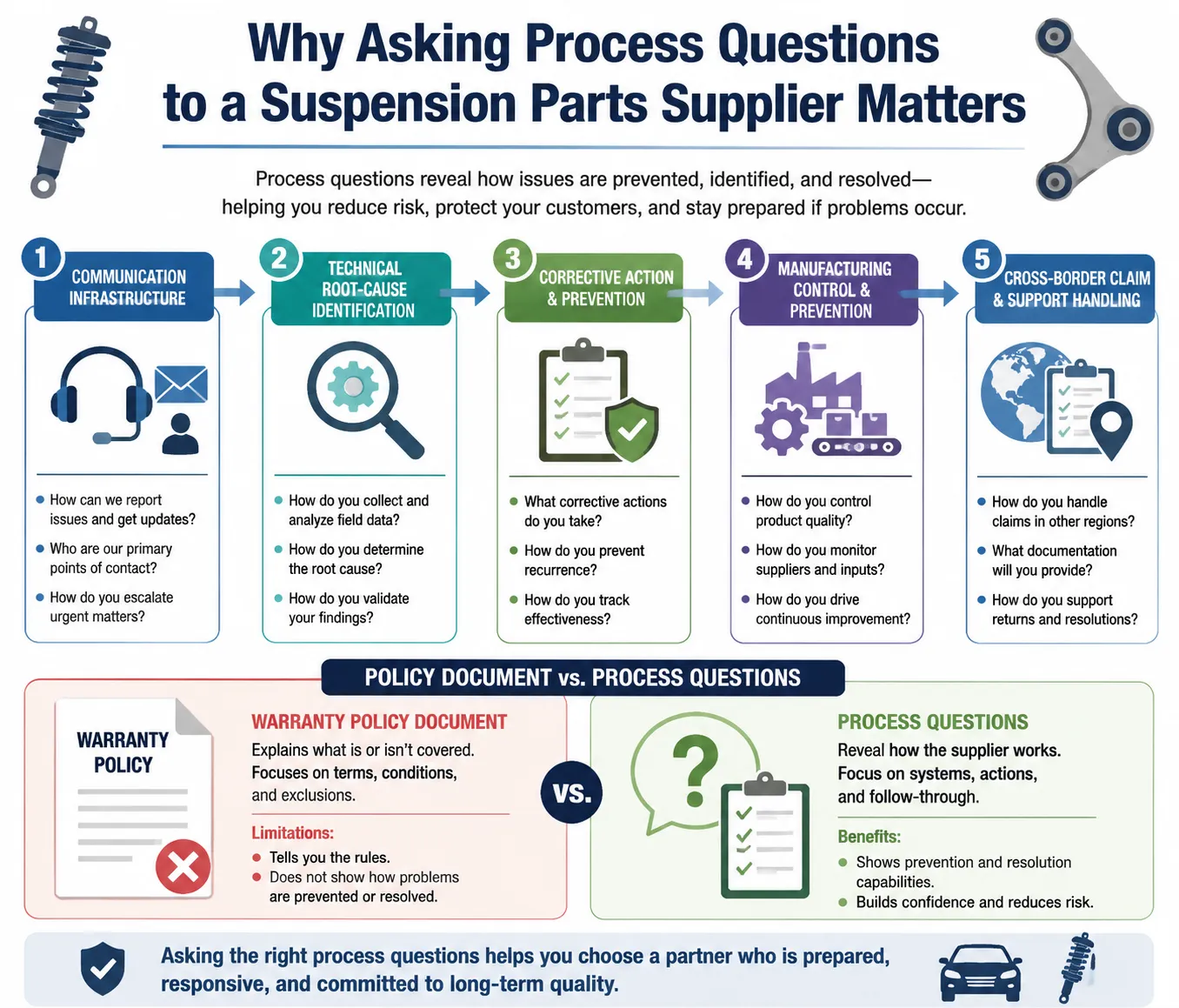

Here is the logic behind this approach. Any supplier can write a warranty policy. What a policy document cannot tell you is whether the supplier has the communication infrastructure to handle a cross-border claim, the technical depth to identify root causes, and the manufacturing process to prevent the same issue from happening again. A process question forces the supplier to describe reality, not aspirations.
The same principle applies across every area of evaluation. Some examples:
On quality control: Instead of "Do you do 100% inspection?", ask "What does your final inspection process look like for a typical order, and what happens when an inspector flags a defective unit during that process?"
On lead times: Instead of "What is your lead time?", ask "What is your lead time on a reorder for a product that has already been in production, and what is your lead time when you have a production line issue affecting that product?"
On OEM capability: Instead of "Can you do custom parts?", ask "What information do you need from me to start a custom development project, and what does your process look like from first sample to approved production?"
On material sourcing: Instead of "Do you use quality steel?", ask "Who are your steel suppliers, and what is your process for verifying material compliance on each batch?"
| Common Buyer Question | Why It Falls Short | Better Process Question |
|---|---|---|
| What is your warranty? | Gets you a policy, not a process | Walk me through how you resolve a warranty claim from my region. |
| Do you do 100% inspection? | "Yes" tells you nothing | What happens when an inspector finds a defect in final inspection? |
| What is your lead time? | Best-case answer only | What is your lead time when a production issue affects my order? |
| Can you do OEM parts? | Yes/no with no substance | What do you need from me to start a custom project, and what are the steps? |
Process questions do one more thing that feature questions do not. They signal to the supplier that you are a serious, experienced buyer. In my experience, that signal changes how a supplier engages with you. It shifts the conversation from a pitch to a real evaluation. And real evaluations are where you find out whether a supplier is actually worth your business.
Conclusion
Choosing a suspension parts supplier means evaluating three things: their communication, their manufacturing capability, and their supply chain stability. Certifications matter, but process questions reveal more. Your business model defines what support you actually need — make sure your supplier is built to deliver it.
""Supplier Selection and Assessment: Their Impact on ...", https://digitalcommons.usu.edu/manage_facpub/271/. Research in supply chain management indicates that failures in supplier relationships, such as poor communication, lack of transparency, and misalignment of capabilities, are significant contributors to procurement problems, often outweighing issues with the product itself. Evidence role: general_support; source type: paper. Supports: The claim that supplier-related issues, rather than product-specific ones, are a primary cause of negative outcomes in procurement.. Scope note: The source would provide general principles of supply chain failure, which may not be specific to the automotive parts industry. ↩
"Setting Up a Robust Supplier Evaluation Framework - CollectiveSpend", https://www.collectivespend.com/robust-supplier-evaluation-framework/. Supply chain management principles emphasize evaluating suppliers on a holistic set of criteria, including communication responsiveness, manufacturing agility, and the robustness of their own upstream supply chain, rather than on a single metric. Evidence role: general_support; source type: education. Supports: The idea that effective supplier support is a systemic capability comprising communication, operational flexibility, and supply chain reliability.. ↩
"Common Pitfalls in Supplier Selection and How to Avoid Them", https://bestforecommerce.com/supplier-selection/common-pitfalls-in-supplier-selection/. Studies on strategic sourcing identify the failure to align supplier capabilities with specific business requirements as a common pitfall that can lead to increased costs, delays, and relationship breakdowns. Evidence role: general_support; source type: paper. Supports: The claim that a mismatch between a buyer's strategic needs and a supplier's core capabilities is a frequent cause of sourcing failure.. ↩
"Steel industry in China - Wikipedia", https://en.wikipedia.org/wiki/Steel_industry_in_China. Baosteel (part of China Baowu Steel Group) and Shagang Group are consistently ranked among the largest steel producers globally and within China, recognized as key players in the national and international steel market. Evidence role: case_reference; source type: other. Supports: The status of Baosteel and Shagang as major steel producers.. Scope note: This citation supports their status as major producers but does not directly prove the quality of a specific batch of steel from these mills. ↩
"IATF 16949 - Wikipedia", https://en.wikipedia.org/wiki/IATF_16949. IATF 16949:2016 is a technical specification for quality management systems in the automotive sector, published by the International Automotive Task Force (IATF). It requires organizations to establish and maintain a QMS that has been successfully audited by a third-party certification body. Evidence role: definition; source type: institution. Supports: The definition of IATF 16949 certification.. ↩
"Common Challenges During IATF 16949 Implementation - Smithers", https://www.smithers.com/resources/2025/june/common-challenges-during-iatf-16949-implementation. Quality management standards like IATF 16949 certify that a supplier has a compliant system and processes in place for achieving quality; they do not serve as a guarantee of zero defects for any specific product batch or ensure a particular outcome when handling non-conformities. Evidence role: expert_consensus; source type: institution. Supports: The fact that IATF 16949 certifies the existence and auditing of a quality management system, not the quality of every individual product.. ↩
"ISO 9000 family - Wikipedia", https://en.wikipedia.org/wiki/ISO_9000_family. ISO 9001 is an international standard that specifies requirements for a quality management system (QMS). Organizations use the standard to demonstrate the ability to consistently provide products and services that meet customer and regulatory requirements. Evidence role: definition; source type: institution. Supports: The definition and purpose of the ISO 9001 standard.. ↩
"Aligning Supply Chain Strategy With Business Objectives", https://brittsimperial.com/aligning-supply-chain-strategy-with-business-objectives/. Business strategy literature emphasizes that a company's supply chain strategy, including its criteria for supplier selection and support, must be aligned with its overall business model to achieve a competitive advantage. Evidence role: general_support; source type: paper. Supports: The principle that a company's business model dictates its specific supply chain and supplier support requirements.. ↩
"PRIVATE LABEL MANUFACTURING AND SUPPLY AGREEMENT", https://www.sec.gov/Archives/edgar/data/1548805/000151506812000042/barrier4ex103041512mpactpriv.htm. Industry analyses of private label business models show that success often depends on close collaboration with manufacturing partners who possess strong R&D, product development, and packaging customization capabilities, distinguishing their needs from those of traditional wholesalers. Evidence role: general_support; source type: research. Supports: The specific support needs of private label brands, such as product development and customization.. ↩
"Mastering Wholesale Supply Chain: 7 Strategies for Success", https://scw-mag.com/news/mastering-wholesale-supply-chain-7-strategies-for-success/. For businesses in wholesale and distribution, key supplier performance metrics typically center on operational efficiency, such as order fill rates, on-time delivery, and lead time predictability, rather than on new product development capabilities. Evidence role: general_support; source type: research. Supports: The primary support needs of importers and wholesalers, focusing on inventory and logistics.. ↩
"Top Sourcing Strategy Tips from My 7 Step Strategic Sourcing Plan", https://artofprocurement.com/blog/sourcing-strategy-tips. Experts in strategic sourcing and supplier auditing advocate for asking process-oriented questions, which require a supplier to describe how they operate in practice, as this provides deeper insight into their actual capabilities than questions about policies or features. Evidence role: expert_consensus; source type: education. Supports: The best practice of using process-based questions to evaluate suppliers.. ↩
"Supplier Audit or Supplier Verification - Goodada Blog", https://www.goodada.com/blog/supplier-audit-or-supplier-verification/. Supplier evaluation frameworks emphasize the importance of process verification, as a supplier's ability to articulate and demonstrate a robust process for handling issues like warranty claims is a stronger indicator of capability than the existence of a policy document alone. Evidence role: mechanism; source type: paper. Supports: The idea that evaluating a supplier's described process reveals more about their operational competence than reviewing a static policy document.. ↩