
A tie rod end looks simple, so many buyers treat it like a basic catalog item. That is where problems start. A buyer once came to us asking only for an OEM number and price. Six months later, he came back with failures. The solution was not a lower price or a different label. The solution was understanding what a tie rod end really does in real working conditions.
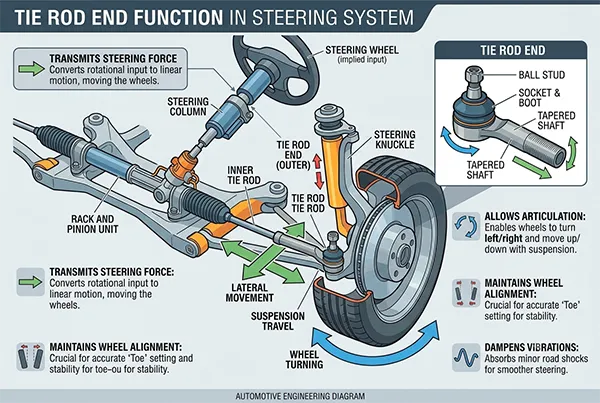
A tie rod end connects the steering linkage to the steering knuckle and transfers steering input to the wheels while allowing controlled movement through suspension travel.1 In practice, a tie rod end does more than help a vehicle turn. It must also hold alignment accuracy, absorb road shock, and survive dirt, water, heat, and load without developing excessive play.

If you source steering parts, that definition is only the starting point. The real issue is this: two parts with the same fitment can perform very differently. In my experience, the buying risk is not misunderstanding the name of the part. The buying risk is misunderstanding what makes one tie rod end last and another one fail early.
What Does a Tie Rod End Do in Real Driving Conditions?
A catalog description sounds clean and simple. Real roads are not. A tie rod end does its job under vibration, impact, changing temperature, and contamination. If you only think about fitment, you miss the reason some parts create returns and warranty claims.
A tie rod end transfers steering force, maintains wheel direction, and allows angular movement as the suspension moves up and down. It also helps preserve steering precision by limiting unwanted play inside the ball joint. If internal clearance grows too fast, steering feel becomes loose and service life drops sharply.2

The functional role is simple, but the performance demand is not
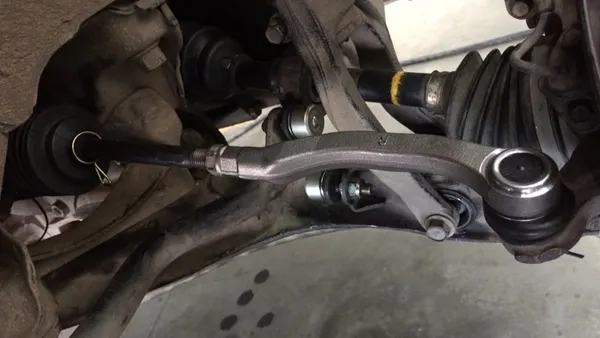
At a basic level, a tie rod end sits at the outer part of the steering linkage. It connects steering motion from the rack or center link to the wheel side. That part is well known. What matters more for sourcing is how it behaves after thousands of steering cycles and repeated road shock.
In our experience working with buyers across 100+ countries, we have found that the part has to do three jobs at the same time:
- Transmit steering force accurately
- Allow articulation without binding
- Resist wear while exposed to contamination
That combination is what makes it a safety-critical component rather than a simple metal part.
Why steering accuracy depends on internal control
A tie rod end contains a ball stud and socket structure. That structure must move smoothly, but it cannot be too loose. If the internal clearance is too tight, movement becomes stiff and wear can accelerate under load. If the clearance is too loose, steering precision degrades and play appears early.
This balance affects:
- Steering response
- Alignment stability
- Driver confidence
- Tire wear
- Noise and vibration behavior
I have spoken with buyers who focused only on hardness values or surface finish. Those details matter, but they do not tell the full story. A tie rod end can look acceptable in a basic inspection and still fail early because the socket design, preload, or grease retention were poorly controlled.
Real-world conditions change the answer
A passenger car running on relatively smooth roads in a mild climate places very different demands on a tie rod end than:
- A pickup truck carrying variable loads
- An SUV used on rough roads
- A light truck exposed to dust and water
- A fleet vehicle operating in high heat
So when someone asks me, “What does a tie rod end do?” I usually think of a second question:
> How long can it keep doing that job without developing play, contamination, or instability?
That is the more useful sourcing question.
Why Does the Same OEM Number Not Guarantee the Same Tie Rod End Performance?
This is one of the most common mistakes I see. A buyer finds the correct OEM number and assumes the performance question is solved. Then the complaints begin. The geometry may match, but the service life can still be completely different.
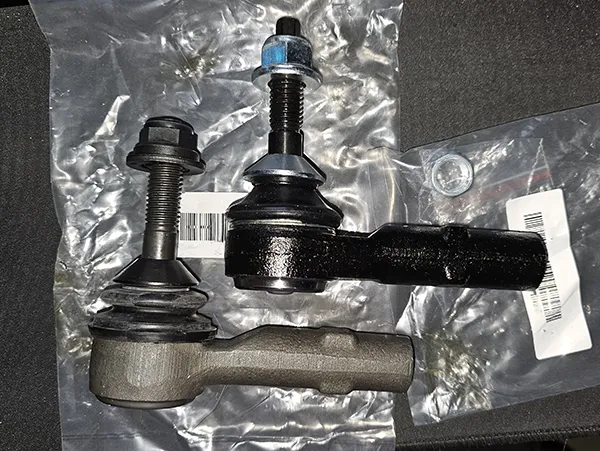
The same OEM number usually confirms fitment geometry, thread, and mounting compatibility.3 It does not guarantee the same forging method, ball stud strength, socket design, dust boot material, grease volume, or wear resistance. Two tie rod ends can fit the same vehicle and perform very differently in the field.

Fitment sameness is not structural sameness
This is the trap. A tie rod end can match:
- Length
- Taper
- Thread specification
- Installation position
Yet still differ in critical internal and material details.
In one anonymized case, a buyer came to us with a failed part sample. He said, “The OEM number is correct, so why did this happen?” When we reviewed the sample, the problem was not fitment. The issue was structural durability. The stud design and sealing system were not suitable for the vehicle’s operating environment.
What can vary even under the same OEM reference?
Here is a practical comparison:
| Factor | Lower-cost version | Better-engineered version | Why it matters |
|---|---|---|---|
| Ball stud process | Cast | Cold forged | Forging usually gives better grain flow and strength |
| Internal clearance control | Broad tolerance | Tighter controlled tolerance | Affects play growth and steering feel |
| Grease volume | Minimal | Adequate and application-matched | Supports wear protection and smooth articulation |
| Dust boot material | Basic rubber | More durable CR or equivalent blend | Resists tearing, ozone, and contamination |
| Socket design | Simple low-cost structure | Reinforced wear-focused structure | Affects load distribution and service life |
| Surface treatment | Basic | Improved corrosion protection | Matters in wet or salt environments |
What Design Features Make a Tie Rod End Last Longer?
A tie rod end does not fail only because of bad luck or poor roads. In many cases, service life follows design choices. If you want to predict durability, you need to look inside the part, not just at the label or coating.
The design features that most influence tie rod end life are the ball stud manufacturing process, socket structure, internal clearance control, lubrication system, and sealing quality. In many field cases, these factors matter more than the OEM number or a small price difference.
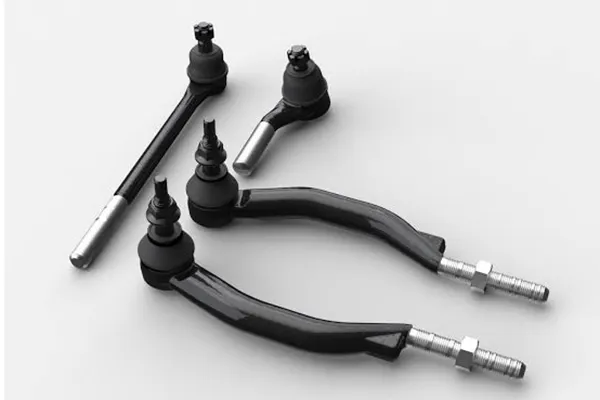

Ball stud process: cold forging vs. casting
This is one of the clearest technical differences. In our experience, a cold-forged ball stud generally offers better structural integrity than a cast stud, especially in demanding applications.
Why cold forging often performs better
- It improves metal grain flow
- It usually increases mechanical strength
- It supports better fatigue resistance
- It reduces the risk of weak internal structure compared with poor casting control
That does not mean every cast stud is automatically bad. Some lower-load or budget-driven applications may accept that tradeoff. But if the vehicle sees higher loads, rough roads, or harsh climate, the process choice becomes far more important.
Clearance control and socket design
The ball joint must articulate smoothly while resisting looseness. That sounds simple, but the tolerance window is critical. We often explain this to buyers using a very practical point: initial feel is not enough. A part can feel acceptable at inspection and still wear too quickly if internal geometry and preload are not controlled well.
Key concerns include:
- Ball seat material behavior under load
- Socket crimping consistency
- Preload balance
- Wear compensation design
If any of these are weak, steering play appears earlier.
Why Is the Dust Boot So Important on a Tie Rod End?
Many people treat the boot as a minor rubber accessory. In practice, it is often the part that decides whether the tie rod end survives. A strong ball stud cannot do much if dirt and moisture enter the joint and destroy the lubrication system.
The dust boot protects the tie rod end ball joint from water, grit, salt, and ozone exposure.4 Once the boot tears, hardens, or loses sealing performance, contamination enters the joint, grease degrades, wear accelerates, and steering play can develop much faster than expected.5
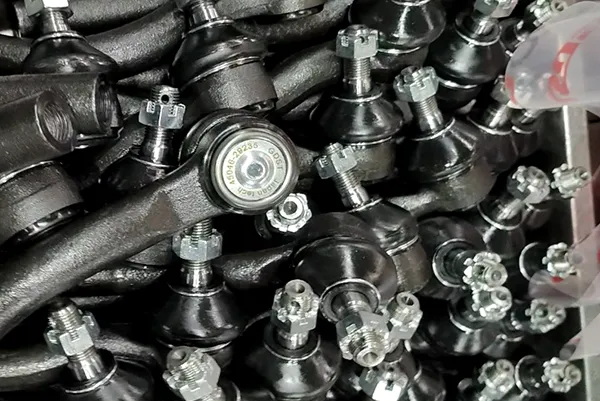

Most premature failures begin with contamination
This is a pattern we see often. The internal metal parts may still be structurally acceptable, but the boot fails first. Once that happens, outside material enters the joint. Then the grease no longer protects the contact surfaces properly. Wear starts to grow quickly.
Common boot-related failure paths include:
- Small tears from poor elasticity
- Cracking from ozone exposure
- Hardening under high heat
- Poor sealing lip design
- Material incompatibility with grease
Questions worth asking your supplier
If you want to reduce field risk, ask these directly:
- What boot material is used?
- Has the boot passed ozone and aging tests?
- How is sealing performance validated?
- Is the boot design the same across all applications?
- Is the grease selected to work with the boot compound?
Those questions often reveal more than a polished catalog ever will.
How Should You Match a Tie Rod End to Vehicle Use and Market Conditions?
A tie rod end that performs well in one market may struggle in another. This is not always a manufacturing defect. Sometimes the part was simply not matched to the real operating environment.
You should match a tie rod end to vehicle load, road quality, climate, dust and water exposure, and service expectations. The correct design for a compact passenger car in mild conditions may not be the correct choice for a heavier vehicle operating on rough roads or in extreme temperatures.
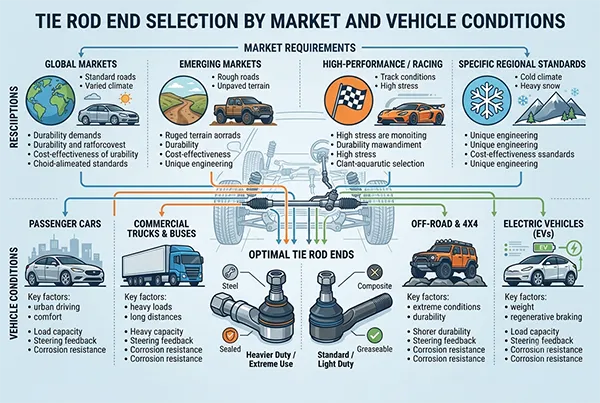

Application matching is a real durability factor
In our experience, this is where many avoidable mistakes happen. A buyer may standardize on one low-cost specification because the dimensions fit multiple applications. On paper, that can look efficient. In field use, it can create uneven performance and claims.
Conditions that change the right tie rod end choice
- Vehicle curb weight and payload
- Road surface quality
- Frequency of potholes or impact loads
- Ambient temperature range
- Humidity and water exposure
- Dust and sand conditions
- Target service interval
A simple risk comparison
| Operating condition | Lower-risk tie rod end choice | Why |
|---|---|---|
| Mild urban passenger car use | Cost-balanced standard design | Lower impact and contamination levels |
| Rough-road SUV use | Reinforced stud, stronger boot, robust grease | Higher articulation and shock load |
| Hot, dusty market | Better sealing and ozone-resistant boot | Contamination and heat drive wear |
| Wet or coastal market | Better corrosion protection and sealing | Moisture and salt speed degradation |
| Light truck variable load use | Stronger structure and tighter control | Load swings stress the joint more |
Not every application needs the highest specification
I want to be balanced here. Cheap options exist for a reason. In some low-demand applications, they may be commercially reasonable. If the vehicle usage is light, the roads are decent, and the market expects a shorter service life, a basic tie rod end may have its place.
But the key is making that choice consciously.
I have had conversations where the real issue was not that the buyer chose a lower-cost option. The issue was that the buyer chose a lower-cost option without understanding the operating risk. That difference matters.
Frequently Asked Questions
Is a tie rod end a safety-critical part?
Yes. A tie rod end directly affects steering control and alignment stability. Excessive wear or contamination can create play, poor steering response, and uneven tire wear. That is why I always treat tie rod end sourcing as a performance and risk decision, not just a fitment decision.
What causes most tie rod end failures?
In many field cases, premature tie rod end failure starts with contamination. Once the dust boot tears or loses sealing performance, dirt and moisture enter the joint, grease protection drops, and wear accelerates. Poor clearance control and weak structural design can make the problem worse.
Does a more expensive tie rod end always last longer?
No. Price alone does not guarantee better performance. I have seen expensive parts with weak design choices, and cost-balanced parts with strong engineering. The better approach is to compare specific factors like stud process, boot material, grease system, tolerance control, and test validation.
Conclusion
A tie rod end does more than connect steering components. It must transfer steering force accurately, maintain stability, and survive contamination, heat, load, and vibration over time. In my experience, the biggest buying mistakes happen when people assume the same OEM number means the same performance. It does not. Structure, boot quality, lubrication, and application matching are what really decide service life. If you want to reduce failures and source more confidently, talk with a supplier who can explain those design differences clearly and back them with real manufacturing experience.
"What Is Steering Linkage? | UTI", https://www.uti.edu/blog/diesel/steering-linkage. Sources describing steering linkage components should confirm that a tie rod end links steering motion to the wheel assembly and permits angular movement as the suspension moves. Evidence role: definition; source type: education. Supports: the basic mechanical role of a tie rod end in the steering linkage and its allowance for articulation. Scope note: Contextual support rather than proof of the article’s broader performance claims. ↩
"BALL JOINT WEAR 2", https://www.mshp.dps.missouri.gov/MSHPWeb/Publications/OtherPublications/documents/ballJointTolerances.pdf. Studies of ball-joint wear should support that increasing internal clearance produces steering play and degrades precision, with wear progression reducing service life. Evidence role: mechanism; source type: paper. Supports: that increased clearance in a ball-joint steering connection leads to play and degraded steering precision. Scope note: The source should be read as mechanical context rather than direct proof of the article’s severity claim. ↩
"TRANSPORT MEANS 2018", https://transportmeans.ktu.edu/wp-content/uploads/sites/307/2018/02/Transport-means-I-dalis-2018-09-25.pdf. Reference material on automotive parts identification should indicate that OEM numbers are used to match fitment dimensions, thread, and mounting compatibility. Evidence role: definition; source type: education. Supports: that OEM references are commonly used to identify compatible fitment dimensions and mounting attributes. Scope note: This does not establish that every OEM-numbered part has identical engineering quality. ↩
"Estimation of Synthetic Rubber Lifespan Based on Ozone ...", https://pmc.ncbi.nlm.nih.gov/articles/PMC11944956/. Research on automotive seals and elastomers should support that a dust boot helps block contamination and that ozone exposure can degrade boot materials. Evidence role: mechanism; source type: research. Supports: that protective boots or seals limit contamination ingress and that ozone can degrade elastomeric components. Scope note: This is general sealing evidence, not a direct test of the specific tie rod end design in the article. ↩
"Study on the failure of oil-contaminated wheel-rail conditions", https://pmc.ncbi.nlm.nih.gov/articles/PMC11902288/. Studies of lubricated ball joints should support that loss of seal integrity permits contamination ingress, accelerating wear and clearance growth. Evidence role: mechanism; source type: paper. Supports: that seal failure can allow contamination into lubricated joints, increasing wear and play. Scope note: This supports the failure mechanism in general, not the timing or extent described in the article. ↩