
Choosing the wrong ball joint costs you more than money — it costs you customers. Here is everything you need to know before placing your next order.
A ball joint is a spherical bearing that connects the wheel hub to the suspension control arm, allowing controlled movement in multiple directions.1 Choosing the right one means matching the OE specifications, load rating, material grade, and fitment range to your vehicle application. Getting this wrong leads to premature failure and warranty claims.
Most buyers think picking a ball joint is simple. You find the part number, check the price, and place the order. But after 20 years of manufacturing suspension parts for aftermarket brands across 100+ countries, I have seen that approach create expensive problems — returns, complaints, and lost customers. This guide will walk you through what actually matters when you buy ball joints, whether you are sourcing for the first time or reviewing your current supplier.
What Is a Ball Joint and How Does It Work?
Most people know ball joints exist. Few people know what they actually do inside the suspension system.
A ball joint acts like the human hip joint.2 It connects two moving parts and lets them rotate in multiple directions at the same time. In a vehicle, it sits between the control arm and the steering knuckle. It carries the vehicle's weight while also allowing the wheel to steer and move up and down over road bumps.
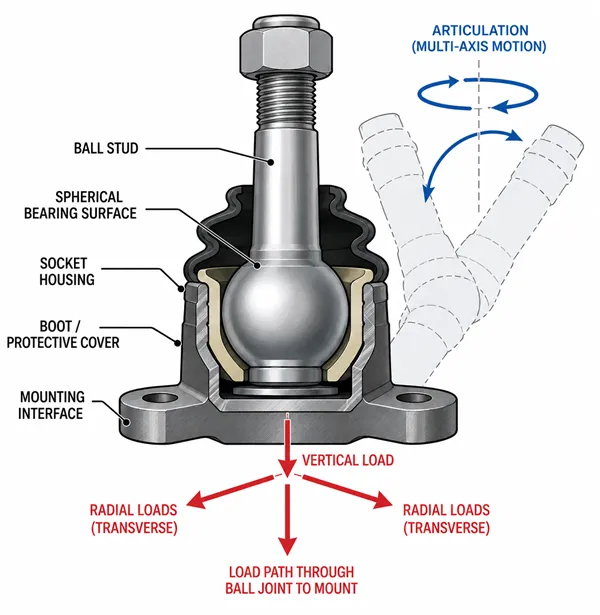
Understanding how a ball joint works tells you exactly why quality matters so much. This is not a simple bracket or bushing. It is a precision component under constant stress.
What forces does a ball joint handle?
A ball joint handles three types of load at the same time:
| Load Type | Description | Effect of Poor Quality |
|---|---|---|
| Vertical load | Weight of the vehicle pressing down | Premature wear, deformation |
| Lateral load | Side forces during cornering | Looseness, instability |
| Axial load3 | Pulling or pushing force along the stud axis | Stud pull-out failure |
The ball stud sits inside a housing filled with a bearing seat — usually made from nylon, PTFE, or metal depending on the application. Grease fills the cavity to reduce friction. A rubber boot seals everything from dirt and water. If any one of these elements is made from the wrong material or machined out of tolerance, the joint fails early.
I have tested hundreds of samples over the years. The most common failure point is not the stud itself. It is the bearing seat material and the boot quality.4 These two elements determine how long the joint will last in real-world conditions.
What Are the Main Types of Ball Joints?
Not every ball joint is the same, and buying the wrong type for the wrong application is one of the most common mistakes I see from new buyers.
Ball joints are divided by their position in the suspension system — upper or lower — and by their load-carrying role. Load-carrying ball joints support the vehicle's weight directly.5 Follower ball joints guide movement but carry less load. Each type has different strength and wear requirements.
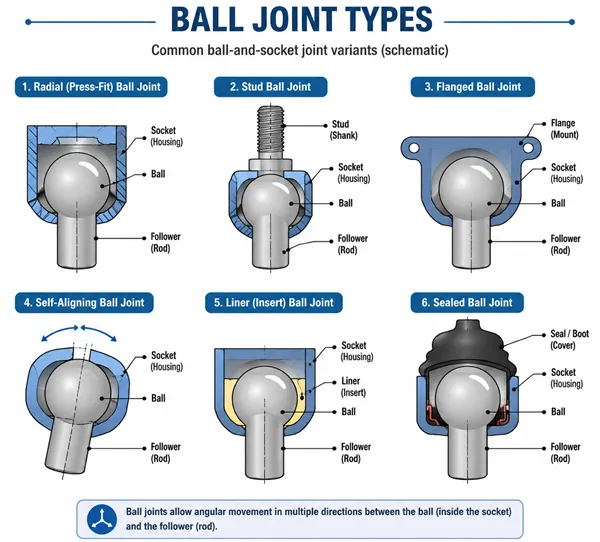
The type of ball joint you need depends entirely on the suspension design of the target vehicle. Mixing them up causes fast failure.
How do you tell the difference between load-carrying and follower ball joints?
Here is a quick breakdown of the main types:
| Type | Position | Load Role | Key Feature |
|---|---|---|---|
| Load-carrying (lower) | Lower control arm | Supports vehicle weight | Heavier stud, stronger housing |
| Follower (upper) | Upper control arm | Guides movement only | Lighter design, less stress rating |
| Press-in type | Pressed into control arm | Varies | Replaced with arm in some cases |
| Bolt-in type | Bolted to control arm | Varies | Easier replacement, common in trucks |
| Greaseable | Any position | Varies | Has grease nipple for maintenance |
| Sealed for life | Any position | Varies | Pre-greased, no maintenance needed |
In my experience, the most overlooked detail here is the difference between greaseable and sealed designs. Many buyers default to sealed units because they are easier to sell. But for heavy-duty truck applications, greaseable joints are often the better choice6. They allow field maintenance, which means longer service life and fewer replacements in demanding conditions.
What Materials and Manufacturing Processes Should You Look For?
This is where I see the biggest quality difference between suppliers. Two ball joints can look identical. Inside, they are completely different.
The ball stud should be made from medium-carbon alloy steel and heat-treated to achieve the right hardness balance7 — hard enough to resist wear, tough enough not to crack under impact. The housing should be forged or cast from high-strength steel. The bearing seat material directly affects wear rate and joint lifespan.
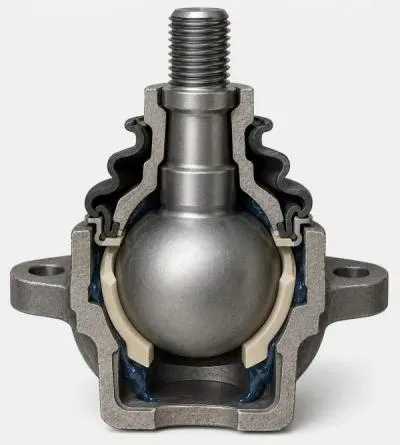
I have seen suppliers use lower-grade steel to cut costs. The joints pass initial testing but fail in the field within six months. The reason is always the same: wrong material grade or insufficient heat treatment.
What manufacturing steps determine ball joint quality?
Here is what happens in a proper manufacturing process:
| Process Step | What It Controls | Why It Matters |
|---|---|---|
| Forging or casting | Housing strength and density | Forged housings have better grain structure and strength8 |
| CNC machining | Dimensional accuracy | Tolerances must stay within ±0.2 mm for OE fitment9 |
| Heat treatment | Stud hardness and toughness | Wrong hardness leads to either wear or brittle fracture |
| Surface treatment | Corrosion resistance | Zinc plating or other coatings protect in salt environments10 |
| Boot material selection | Sealing performance | Poor boots crack early and let in water and dirt |
| Assembly and greasing | Internal clearance and lubrication | Incorrect clearance causes noise or early looseness |
At our factory, all steel materials come from major Chinese producers like Baosteel and Shagang. Every batch comes with a material inspection report. Our QC team runs random chemical composition checks on incoming steel. This is not standard practice at all suppliers. I recommend you ask any supplier you evaluate to show you their incoming material inspection records.
How Do You Evaluate a Ball Joint Supplier?
Finding a product at the right price is not the same as finding the right supplier. I have watched brands switch to cheaper sources and spend the next year dealing with the consequences.
A reliable ball joint supplier must demonstrate stable quality management, proper certifications, real production capability, and responsive communication. The lowest price should never be the only factor. A supplier who cannot support you after shipment will cost you far more in the long run.
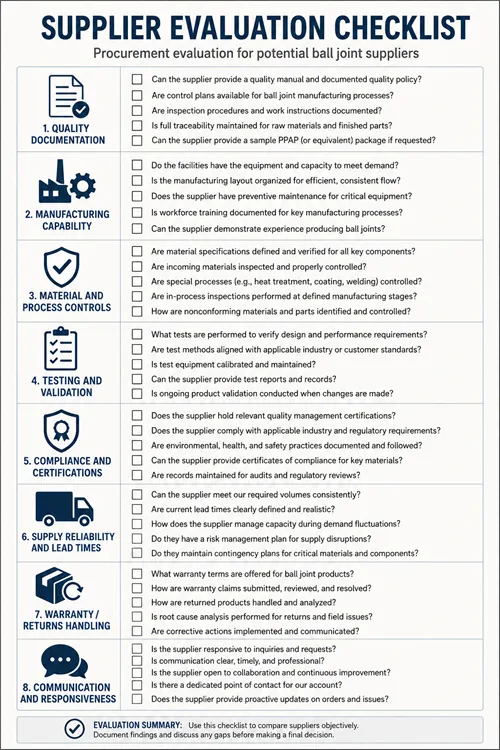
When I speak with procurement managers from major aftermarket brands, they all say the same thing: they regret choosing suppliers based on price alone. The hidden costs of poor quality are always higher than the savings.
What questions should you ask a ball joint supplier?
Use this checklist when evaluating any supplier:
| Evaluation Area | Questions to Ask | What to Look For |
|---|---|---|
| Certifications | Do you hold IATF1694911 or ISO9001? | Both certifications show systematic quality management |
| Material sourcing | Where does your steel come from? Do you have mill certificates? | Named steel mills, documented inspection records |
| Production capacity | How many production lines do you operate? What is your monthly capacity? | Enough capacity to handle your volume without delays |
| QC process | What tests do you perform on ball joints? | Pull-out, torque, salt spray, fatigue, and temperature testing |
| OEM/ODM capability | Can you produce to my drawings or samples? | Confirm tooling capability and dimensional control |
| Packaging and branding | Can you do private label? | In-house design team is a plus |
| After-sales support | How do you handle quality complaints? | Clear process, fast response, documented resolution |
One thing I always tell buyers: visit the factory if you can. Or request a video factory audit. A supplier who is confident in their operation will welcome it. A supplier who avoids it is giving you important information.
What Quality Tests Should Ball Joints Pass Before You Accept Them?
Accepting a shipment without knowing what tests were done is a risk you should not take. Testing is where quality claims are either proven or exposed.
Before accepting a ball joint order, the product should pass pull-out force testing, torque testing, salt spray testing, fatigue testing, high and low temperature testing, and dimensional inspection. These tests confirm the joint can perform under real operating conditions across different environments.
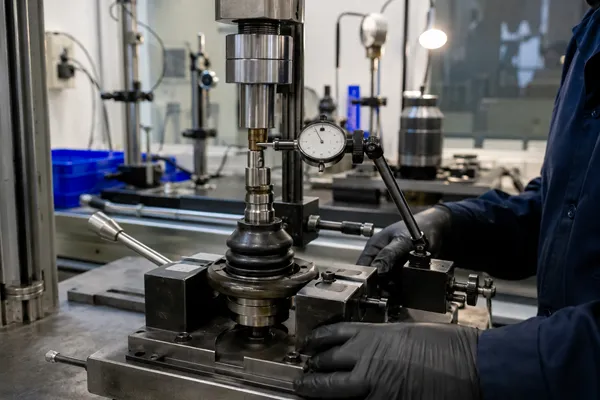
I have had buyers tell me they never asked for test reports before. Then they come back after their first quality complaint and ask what tests we do. At that point the damage is already done. Asking before you order protects you.
What does each test tell you about ball joint quality?
| Test Type | What It Measures | Why It Matters |
|---|---|---|
| Pull-out force test | Force required to separate stud from housing | Confirms the joint will not fail under suspension separation load |
| Compression force test | Resistance to vertical load | Confirms housing and bearing seat strength |
| Torque test | Rotational resistance of the stud | Ensures steering feel and movement is within spec |
| Salt spray test | Corrosion resistance of surface coating | Confirms the joint will survive in wet and salty environments |
| Fatigue test12 | Durability under repeated load cycles | Simulates years of road use in compressed time |
| High/low temperature test | Performance at extreme temperatures | Confirms boot and grease performance in hot and cold climates |
| Dimensional inspection | All critical measurements vs. OE spec | Confirms fitment accuracy and tolerance compliance |
We run all of these tests in-house. I can say with confidence that full testing before shipment is what separates a supplier who stands behind their product from one who hopes problems do not come back to them.
Conclusion
Buying ball joints well means understanding what they do, what quality looks like, and what to demand from your supplier. Getting these decisions right protects your brand and your customers.
"What Are Ball Joints? | UTI - Universal Technical Institute", https://www.uti.edu/blog/automotive/ball-joints. Provides a technical definition of a ball joint as a component of an automobile's suspension system, describing it as a spherical bearing that connects the control arms to the steering knuckles, allowing for pivoting movement. Evidence role: definition; source type: encyclopedia. Supports: The source should define a ball joint and its role in connecting the control arm to the steering knuckle or wheel hub.. ↩
"What Are Ball Joints? | UTI - Universal Technical Institute", https://www.uti.edu/blog/automotive/ball-joints. Explains that a ball joint functions as a pivot, similar to the ball-and-socket joint in a human hip, allowing for both rotational and swinging motion in a vehicle's suspension. Evidence role: mechanism; source type: education. Supports: The source should explain the function of a ball joint, ideally using the hip joint analogy to describe its range of motion.. ↩
"What Are Ball Joints? | UTI - Universal Technical Institute", https://www.uti.edu/blog/automotive/ball-joints. A study on suspension component forces defines axial load as the force acting along the longitudinal axis of a component, such as the stud of a ball joint, which occurs during events like braking and acceleration. Evidence role: definition; source type: paper. Supports: The source should define axial load and describe how it acts on suspension components like ball joints during vehicle operation (e.g., during braking or acceleration).. ↩
"[PDF] Durability Analysis of Helical Coil Spring in Vehicle Suspension ...", https://vtechworks.lib.vt.edu/bitstream/handle/10919/106624/Kumar_D_T_2021.pdf. Research into the failure mechanisms of automotive suspension parts indicates that ball joint failure is frequently initiated by the degradation of the sealing boot, which allows contaminants to enter and accelerate wear on the polymer or metal bearing surfaces. Evidence role: general_support; source type: research. Supports: The source should analyze common failure modes of ball joints, highlighting the role of wear in the bearing and degradation of the protective boot.. Scope note: The source may not state that these are the 'most common' failures in all cases but will support them as significant and frequent failure modes. ↩
"What Are Ball Joints? | UTI - Universal Technical Institute", https://www.uti.edu/blog/automotive/ball-joints. Automotive technology resources explain that in many suspension designs, one ball joint (typically the lower one) is designated as the 'load-carrying' joint because it directly supports the vehicle's weight transferred from the coil spring or torsion bar. Evidence role: definition; source type: education. Supports: The source should differentiate between ball joint types, defining load-carrying ball joints as those that bear the vertical forces from the vehicle's weight via the spring.. ↩
"Greased or Sealed Ball Joint: Which Is Better? -", https://www.tomorrowstechnician.com/greased-or-sealed-ball-joint-which-is-better/. Fleet maintenance guides and heavy-duty parts suppliers often recommend greaseable joints for commercial vehicles, as regular greasing can flush out contaminants and replenish lubrication, significantly extending the component's service life in high-mileage or harsh-environment applications. Evidence role: general_support; source type: other. Supports: The source should discuss the maintenance and longevity of suspension parts in heavy-duty applications, explaining why the ability to purge contaminants and replenish grease can extend service life.. ↩
"What kind of steel are the ball joints in a car made of?", https://www.quora.com/What-kind-of-steel-are-the-ball-joints-in-a-car-made-of. A study on the manufacturing of steering and suspension components specifies the use of medium-carbon alloy steels (such as SAE 4140 or 5140) for ball studs, which are then heat-treated to create a hard, wear-resistant surface while maintaining a tough, ductile core to resist fracture. Evidence role: mechanism; source type: paper. Supports: The source should discuss the material selection for critical suspension components, specifying the use of medium-carbon alloy steels and the necessity of heat treatment processes like quenching and tempering to achieve desired mechanical properties.. ↩
"Forging vs Casting: Key Differences & Strength Comparison", https://www.weforging.com/forging-vs-casting/. Materials engineering resources explain that the forging process deforms metal under pressure, refining and directing the grain flow to follow the part's contour, which eliminates the porosity found in castings and results in superior strength, ductility, and fatigue resistance. Evidence role: mechanism; source type: education. Supports: The source should explain the metallurgical differences between forging and casting, specifically how the forging process aligns the material's grain structure, resulting in higher tensile strength and fatigue resistance.. ↩
"[PDF] Introduction to Formula SAE Suspension and Frame Design", https://racing.byu.edu/0000018a-6be7-df21-a5fe-fbef2f9d0001/intro-to-frame-and-suspension-design. Research on automotive manufacturing processes highlights that critical mating components in suspension systems require tight geometric dimensioning and tolerancing, often in the sub-millimeter range, to ensure correct assembly, alignment, and performance. Evidence role: general_support; source type: research. Supports: The source should discuss the importance of tight dimensional tolerances in the manufacturing of interchangeable automotive parts for proper fit and function.. Scope note: The source will support the need for tight tolerances but may not specify the exact ±0.2 mm figure, as this can be application-specific. ↩
"Salt spray test - Wikipedia", https://en.wikipedia.org/wiki/Salt_spray_test. Studies on automotive corrosion show that sacrificial coatings, such as zinc or zinc-alloy plating, are applied to steel components to provide cathodic protection. The coating corrodes preferentially to the steel substrate, significantly delaying the onset of rust, especially in the presence of de-icing salts. Evidence role: mechanism; source type: research. Supports: The source should explain how sacrificial coatings like zinc plating protect the underlying steel from corrosion, particularly in environments with road salt.. ↩
"IATF 16949 - Wikipedia", https://en.wikipedia.org/wiki/IATF_16949. The International Automotive Task Force (IATF) defines IATF 16949 as the global technical specification and quality management standard for the automotive industry, which is built upon ISO 9001 and includes specific requirements for automotive production and service parts organizations. Evidence role: definition; source type: institution. Supports: The source should define IATF 16949 as the international quality management system standard for the automotive industry.. ↩
"[PDF] Multiaxial Fatigue - University of Illinois", https://fcp.mechse.illinois.edu/files/2014/07/3.0-Multiaxial-fatigue.pdf. Describes fatigue testing for suspension components, which involves subjecting the part to hundreds of thousands or millions of load cycles that simulate forces encountered during driving, to verify its durability and predict its service life under normal and extreme conditions. Evidence role: mechanism; source type: paper. Supports: The source should describe the process and purpose of fatigue testing for components like ball joints, involving the application of cyclic loads to simulate real-world conditions and determine the component's lifespan.. ↩