
If you are trying to find the rack end, the first problem is usually simple: you can see the steering linkage, but you cannot tell which joint is which. That mistake can send you to the wrong part, the wrong order, or the wrong diagnosis. The good news is that the rack end has a very clear position once you know what to look for.
The rack end is the inner tie rod joint that sits closest to the steering rack, usually hidden under the rubber bellows boot. It connects the steering rack to the outer tie rod end, so it is not the joint near the wheel. If you are looking at the wheel end, you are one joint too far out.
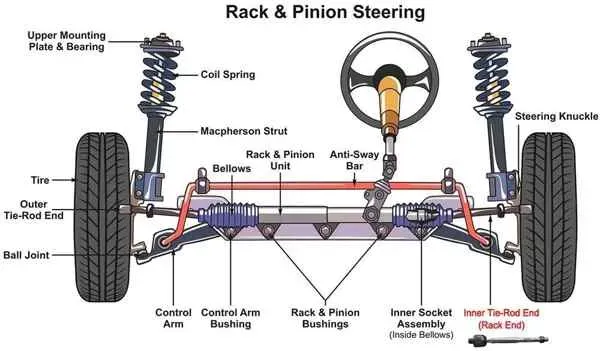
Most people spot the outer tie rod end first because it is visible beside the wheel. That is the visual trap. I have seen this confusion many times from the factory side, especially when people compare parts by eye instead of by position. Once you understand the rack end’s place in the steering system, the whole layout becomes easier to read.
Where is the Rack End in the Steering System?
If you cannot find the rack end, the problem is usually that you are starting from the wheel side instead of the rack side. That makes the outer joint look like the main part. But the rack end sits deeper in the steering linkage, and the boot hides it from plain view.
The rack end is located at the inner end of the steering linkage, right where the steering rack pushes and pulls the tie rod assembly.1 On most vehicles, it sits inside or just under the rubber bellows boot, between the rack housing and the outer tie rod end.2
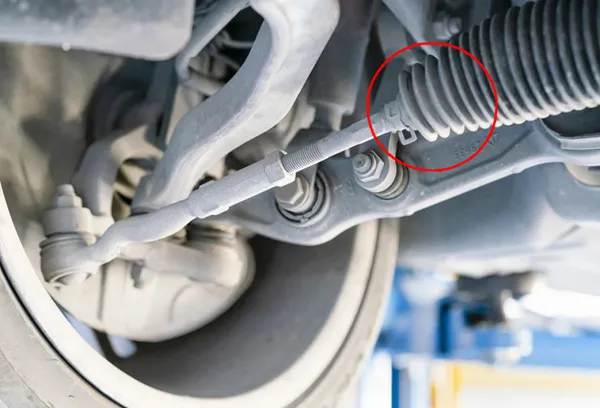
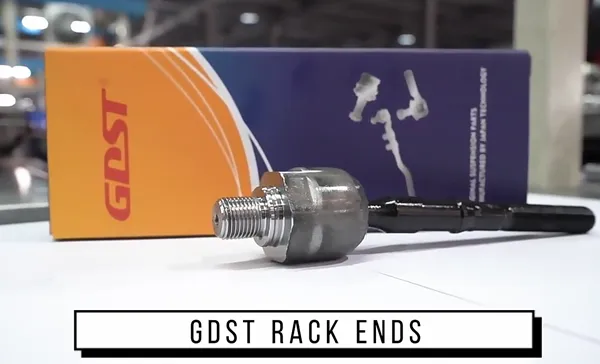
When I look at rack ends from the production side, I think of them as the bridge between the rack and the visible steering arm. On the bench, the part usually has a threaded body on one side and a ball-joint head on the other. On the car, the key clue is not the shape alone. It is the position. The rack end is always closer to the steering rack than the wheel.
What you should look for under the car
If you are under the car on jack stands, start at the steering rack housing and follow the steering linkage outward.3 You will usually see:
- The steering rack in the center.
- A rubber bellows boot coming off each side.
- The rack end hidden at the inner end of that boot.
- The outer tie rod end farther out, attached to the steering knuckle.
That order matters. If you can see a joint connected directly to the knuckle by the wheel, that joint is the outer tie rod end, not the rack end. The rack end is one step inward.
Why the boot matters
The boot covers the rack end on many cars because it protects the inner joint from dirt, water, and road salt. So if you are expecting to see the rack end in the open, you may miss it completely. I have seen this happen when someone checks the front suspension from the driveway and assumes the part must be visible right away. In reality, you often need to look past the wheel-end joint and back toward the steering rack housing.
How Do You Tell a Rack End from an Outer Tie Rod End?
This is the most common mistake I see, and it is easy to make. The rack end and outer tie rod end both belong to the same steering line, but they do different jobs and sit in different places. If you mix them up, you may order the wrong replacement part.
The rack end is the inner joint closest to the steering rack and usually sits under the bellows boot. The outer tie rod end is the visible joint near the wheel, attached to the steering knuckle. If you are looking at the wheel end, you are not looking at the rack end.
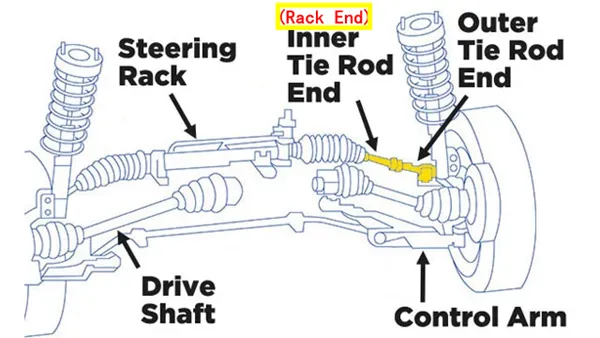
I like to explain it this way: the outer tie rod end is the part you can usually touch without moving much plastic or rubber. The rack end is the part you usually find after following the linkage inward. That simple difference saves a lot of guesswork.
Fast visual comparison
| Feature | Rack end | Outer tie rod end |
|---|---|---|
| Position | Closest to steering rack | Closest to wheel |
| Visibility | Often hidden by boot | Usually visible |
| Connection point | Inner steering rod / rack output | Steering knuckle |
| Common confusion | Mistaken as part of rack assembly | Mistaken as rack end |
| Replacement view | Often reached from under boot area | Easy to spot from wheel side |
A simple rule I use
If you can see the part beside the wheel, it is probably the outer tie rod end. If you have to follow the linkage inward toward the rack housing, you are getting closer to the rack end.
If the part is at the wheel end, it is one joint too far out.
Does the Rack End Always Look the Same on Every Vehicle?
No, and this is where people sometimes get frustrated. The rack end follows the same basic location principle on most vehicles, but the exact shape, boot style, and mounting detail can vary from car to car. A passenger car, SUV, or light truck may use a slightly different inner joint design.
The rack end always sits closest to the steering rack, but the attachment style and boot arrangement depend on the vehicle platform. Some designs are compact and tucked tightly under the boot, while others have more exposed threaded sections or different locknut positions.
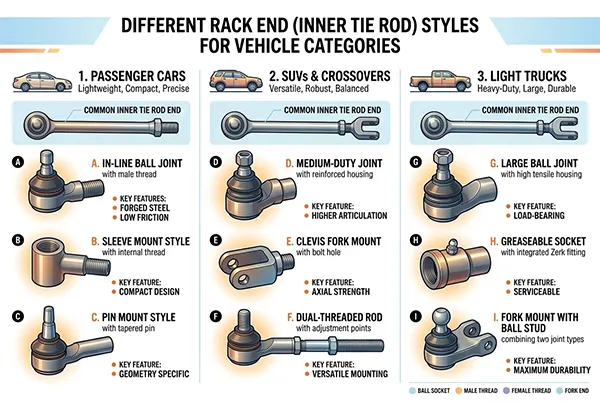
Based on the rack ends we manufacture, the most common configuration is a threaded inner joint that screws into the rack’s inner rod. But I would never tell a reader that every vehicle uses exactly the same layout. That would not be accurate. I have seen enough variation across Japanese, Korean, American, and European applications to know that the shape changes, but the location logic stays consistent.
Common variation points
Here are the main differences you may see:
- Thread direction: Some parts use left-hand threads, others use right-hand threads.
- Boot coverage: Some boots cover more of the joint, while others leave more of the rod visible.
- Body shape: The joint body may be slim, reinforced, or longer depending on the platform.
- Locking method: Some use a visible jam nut, while others sit deeper in the boot area.
- Vehicle size: SUVs and trucks may use a larger, heavier-duty inner joint than a small passenger car.
What does this mean for you?
It means you should use the location first and the vehicle application second. The rack end is still the joint closest to the rack. But if you are checking fitment or ordering a replacement, you should match the exact vehicle platform and not rely on shape alone.
Is the Rack End a Separate Part or Part of the Steering Rack?
Many people think the rack end is built into the steering rack and cannot be replaced by itself. That is a common misunderstanding. In most steering systems, the rack end is a separate component that threads into the inner rod or rack output area.
The rack end is usually a replaceable threaded ball joint, not the entire steering rack. It connects to the rack from the inner side and to the outer tie rod end on the outer side, so you can often replace it without replacing the whole rack assembly.4
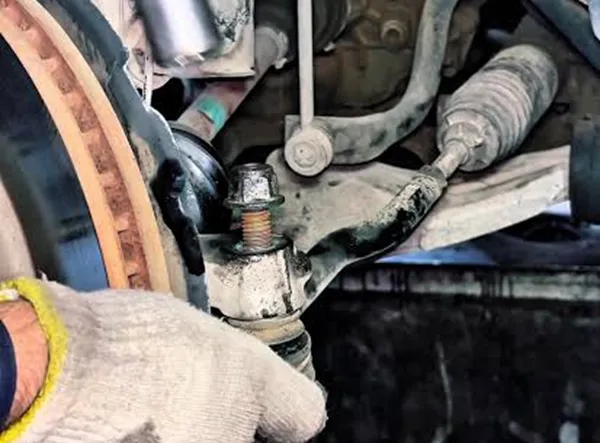
From a manufacturing point of view, this is one reason the part matters so much. The rack end is not just a lump of metal hidden in the system. It has a clear structure: a threaded interface, a joint body, and a connection point toward the outer steering linkage. When someone sees it on the bench, it is obvious that it is its own part. When someone sees it under the car, the boot can make it look like part of a larger assembly.
Why this distinction matters
If you identify the rack end correctly, you avoid three common problems:
-
Wrong part ordering
You may buy an outer tie rod end when you actually need the inner joint. -
Unnecessary replacement
You may assume the whole steering rack is damaged when only the rack end is worn. -
Bad diagnosis
You may inspect the wrong joint and miss the real source of play or noise.
I often tell people to think of the steering system in layers. The steering wheel turns the rack. The rack moves the inner joint. The inner joint connects to the outer joint. That layered view helps you place the rack end in the right spot without overcomplicating the system.
What it looks like in real life
When you are under the car, the rack end usually appears as a joint tucked behind or inside the boot area. You may see:
- a metal joint body,
- a threaded section,
- a locknut nearby,
- and the outer tie rod continuing toward the wheel.
That is the practical visual clue set. If you see those parts near the rack housing, you are likely looking at the rack end area.
What is the Easiest Way to Find the Rack End Without a Lift?
You do not need a shop lift to locate the rack end. You can usually find it from the ground or on jack stands if you know the sequence. The key is to work from the steering rack outward, not from the wheel inward.
The easiest way to find the rack end without a lift is to locate the steering rack housing, follow the bellows boot, and look for the inner joint hidden at the boot’s inner edge. The visible joint near the wheel is the outer tie rod end, so do not stop there.
I have noticed that DIY readers often start at the wheel because that is the easiest place to reach. But the wheel-side joint can trick you. If you want the rack end, you need to retrace the linkage back toward the center of the car. That is the faster mental map.
A practical driveway-level method
Use this simple approach:
- Turn the steering wheel so the wheel angle gives you more access.
- Find the outer tie rod end near the steering knuckle.
- Follow the rod inward.
- Look for the rubber boot.
- Check the inner end of that boot for the rack end.
What you may not see right away
You may not get a full clear view of the rack end on every vehicle. Some designs keep it deep under the boot. Some front suspensions block part of the view. That does not mean the part is not there. It just means the platform hides it more than others.
Why Does Rack End Identification Matter Before Replacement?
If you are preparing to replace a steering part, correct identification saves time, money, and frustration. The rack end and outer tie rod end may both seem like “tie rod parts,” but they are not the same replacement job, and they are not the same location.
Correct rack end identification helps you order the right part, inspect the correct joint, and avoid confusing the inner steering joint with the visible wheel-side tie rod end.
In my experience, the biggest issue is not that people cannot find the steering linkage. The issue is that they find the wrong end of it first. That leads to wrong assumptions. A driver may hear play in the front end and blame the wrong joint. Then they buy the wrong part and lose a weekend.
A quick memory trick
Wheel end = outer tie rod end
Rack end = inner joint near the steering rack
If you keep that one line in mind, you will avoid the most common positioning mistake.
Frequently Asked Questions
Is the rack end the same as the inner tie rod end?
Yes, in most everyday repair conversations, the rack end is the inner tie rod end. It is the steering joint closest to the rack and usually sits under the bellows boot. The outer tie rod end is the one near the wheel.
Can I see the rack end without removing anything?
Sometimes, yes. But on many vehicles, the boot hides most of it. You may need to look carefully from underneath the car or from the wheel well area. If you only see the joint near the wheel, that is usually the outer tie rod end.
Does every car have a rack end?
Most rack-and-pinion steering systems do. However, the exact design can vary by vehicle platform. The rack end may look different on passenger cars, SUVs, and light trucks, but the basic location remains the same: closest to the steering rack.
Why do people confuse the rack end with the outer tie rod end?
Because the outer tie rod end is easier to see. It sits near the wheel and connects to the steering knuckle. Many first-time DIY owners stop there and assume they found the rack end. In reality, they are usually looking at the outer joint.
Is the rack end always under the rubber boot?
Usually, yes. The rubber bellows boot commonly covers the inner steering joint to protect it from dirt and water. On some vehicles, the boot shape and coverage vary, but the rack end is still generally located at the inner end of that protected area.
Conclusion
The rack end is the inner steering joint closest to the steering rack, usually hidden inside the bellows boot. It is not the joint near the wheel, and that is the most common mistake I see. If you remember one thing, remember this: the wheel-side joint is the outer tie rod end, and the rack end sits one step inward. If you need help matching the right rack end for your vehicle platform, GDST Auto Parts can support OEM/ODM supply and application-specific steering parts solutions.
"Cornell Moonbuggy", http://ruina.tam.cornell.edu/Courses/moonbuggy/2001/steering.html. Source should explain that the steering rack’s motion is transmitted to the tie rod assembly through the inner joint at the linkage’s inboard end. Evidence role: mechanism; source type: education. Supports: Describes how rack-and-pinion steering motion is transferred to the tie rod assembly through the inner joint.. ↩
"19 Va. Admin. Code § 30-70-110 - Steering and suspension", https://www.law.cornell.edu/regulations/virginia/19VAC30-70-110. Source should indicate that the inner tie rod is commonly located beneath the steering rack bellows boot and between the rack housing and outer tie rod end; the wording should be treated as common configuration rather than a universal rule. Evidence role: general_support; source type: research. Supports: Supports the common placement of the inner tie rod/rack end beneath the steering rack boot on many vehicles.. Scope note: common configuration, not universal ↩
"9+ Signs: How to Tell if Tie Rod is Bad (Quick Check)", https://bigblue.atlantisuniversity.edu/how-to-tell-if-tie-rod-is-bad/. Source should support the inspection method of tracing the steering linkage from the steering rack outward to locate the inner tie rod/rack end; this is procedural guidance rather than proof of a single fixed layout. Evidence role: general_support; source type: education. Supports: Supports the inspection approach of tracing the steering linkage outward from the rack to locate the inner joint.. Scope note: procedural guidance ↩
"MKIII Golf/Jetta Inner and Outer Tie rod DIY.", https://faculty.ccp.edu/faculty/dreed/campingart/jettatech/tierods/tierods.htm. Source should support the connection pathway from rack to outer tie rod through the inner joint and the common possibility of replacing that joint independently; this is a general repair-context statement, not a universal mandate. Evidence role: general_support; source type: research. Supports: Supports the mechanical connection of the inner tie rod to the rack and notes that replacement may be performed without full rack replacement in many systems.. Scope note: general repair-context statement ↩