
You've heard this question before. A customer complains, a return lands on your desk, and someone asks: how bad is bad? The real cost isn't what you think.
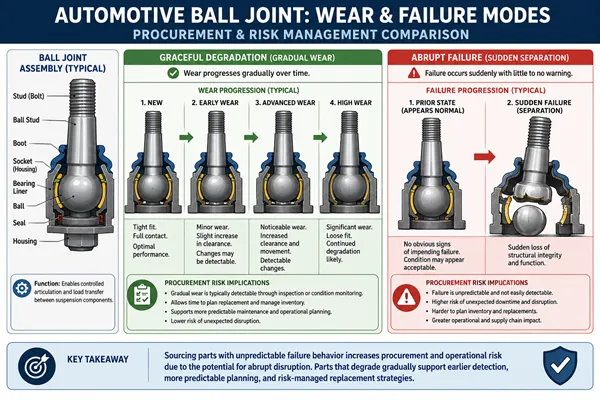
A worn ball joint doesn't always fail the same way. A quality part degrades gradually, giving warnings like noise and looseness before it becomes dangerous. A low-quality part can separate without warning.1 For buyers sourcing at scale, the difference between these two outcomes is the difference between a manageable warranty claim and a product liability crisis.2
This article is not driving advice for end-users. It is a procurement and risk management guide for importers, wholesalers, and brand owners. If you are deciding which supplier to use or which price tier to commit to, the question "can you still drive with a bad ball joint?" is actually the wrong question. The right question is: what are you risking when you source a part that fails unpredictably?
Does a "Bad" Ball Joint Always Fail the Same Way?
Not all worn parts carry the same risk. So why do buyers treat them as if they do?
The failure mode depends entirely on how the part was made. A well-manufactured ball joint loses preload gradually. You get noise, steering looseness, and uneven tire wear before the joint becomes unsafe. A poorly made one can skip those warnings entirely and separate under load.
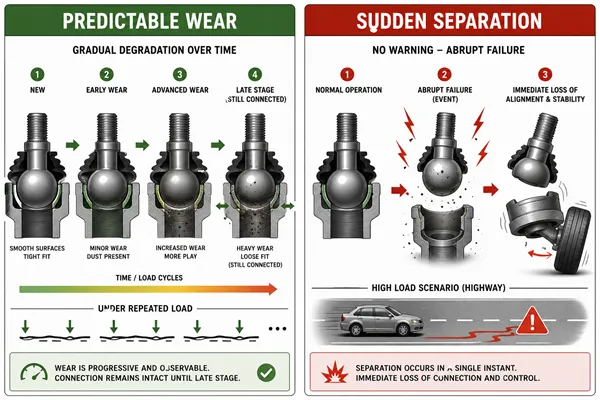
From our experience discussing returns and warranty claims with importers over the years, the most damaging situations don't come from parts that wear out early. They come from parts that fail without a pattern. A customer can plan for wear. They cannot plan for a ball joint that separates on a highway with no prior symptoms.
The reason this happens comes down to manufacturing consistency, not just material grade. Two suppliers can use the same steel spec on paper. But if one supplier has inconsistent heat treatment, the actual hardness distribution across a batch will vary.3 Some parts will last. Some will not. And there is no way to tell which is which by looking at them.
This is what we mean by abrupt failure versus graceful degradation. The table below breaks down what separates the two.
| Factor | Graceful Degradation | Abrupt Failure |
|---|---|---|
| Pre-failure symptoms | Noise, looseness, vibration | None or minimal |
| End-user detection | Possible with inspection | Often impossible |
| Root cause | Normal wear over time | Material inconsistency, poor heat treatment, inadequate grease retention |
| Buyer risk level | Manageable (warranty replacement) | High (liability, brand damage) |
| Supplier traceability | Clear batch tracking | Often untraceable |
When you source at volume, you are not buying one part. You are buying a distribution of outcomes. Understanding which failure mode your supplier produces is the most important procurement question you can ask.
Why Do Specs on Paper Not Tell the Whole Story?
Most buyers request a technical datasheet. Most suppliers provide one. So why do quality problems still happen?
Specifications describe what a part is supposed to be. They do not describe what a part actually is after production.4 The gap between a stated spec and a finished part is filled by process controls, material traceability, and inspection discipline. Without those, a spec sheet is just a document.
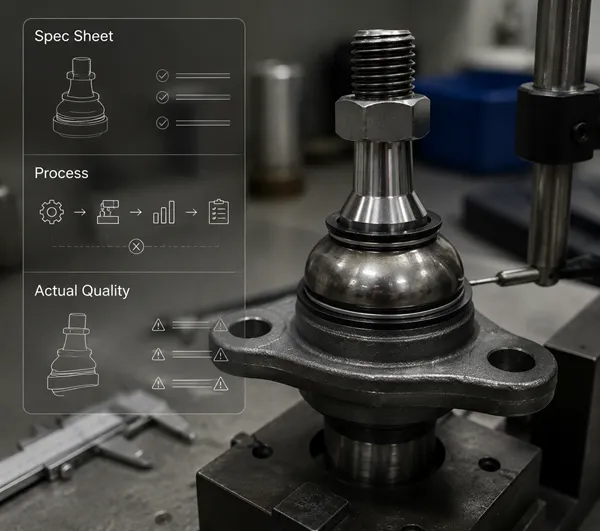
We see this frequently when buyers come to us after a bad experience with another supplier. They will show us a datasheet and say: the specs looked right, so what went wrong? The answer is almost always in the process, not the paper.
Here is a concrete example. A ball joint stud made from 40Cr steel can perform very differently depending on the heat treatment cycle used.5 If the quench and temper process is not precisely controlled, you can get the right average hardness on a test sample, but with inconsistent hardness across the full stud length. That stud will pass a spot-check. It will fail in service under repeated load.
The same logic applies to grease. A spec might list NLGI Grade 2 grease as the fill material. But the fill volume, the seal retention design, and the operating temperature range all affect how long that grease actually protects the joint in real conditions.6 A part sold into Southeast Asia for a pickup truck on unpaved roads needs a different grease retention performance than the same part sold into Europe for a passenger sedan on paved highways.
What this means for buyers is straightforward:
- Ask about the process, not just the material. What is the heat treatment cycle? What temperature tolerances are used? How is it verified?
- Ask about vehicle application context. Has this part been tested or validated under the load and road conditions of your target market?
- Ask for material traceability. Can the supplier provide batch-level material inspection reports? Are materials sourced from traceable mills?
A supplier who can answer these questions specifically is describing a process they actually control. A supplier who responds with a datasheet and a quality certificate is describing a target they may or may not hit consistently.
What Should Buyers Ask Instead of "Is This a Good Part?"
The question "is this a good part?" sounds reasonable. In practice, it is not useful.
Good and bad are outcomes. What buyers need to evaluate is the process that produces those outcomes. The right questions are about manufacturing controls, batch consistency, and what happens when something goes wrong. These questions reveal supplier reliability far better than product samples alone.
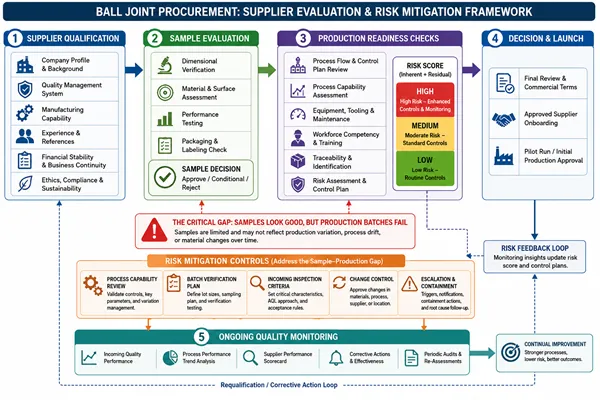
When we talk to procurement managers for the first time, we often hear that they requested samples, the samples were fine, and then the first production batch had problems. This is a well-known risk in manufacturing. Samples are made carefully. Production batches are made at volume under time and cost pressure.7
The gap between a good sample and a consistent production batch is closed by one thing: documented process controls that run independently of whether anyone is watching.
Here is a practical framework for evaluating a supplier's process reliability before you commit to volume:
Does the supplier control raw material inputs?
Ask for material inspection reports from actual production batches, not just a supplier certificate. We source steel from domestic mills with traceable batch documentation and conduct our own chemical composition verification on incoming material. This matters because steel variability at the input stage creates quality variance that no downstream process can fully correct.8
Does the supplier control the manufacturing process itself?
Dimensional tolerance is a useful proxy. Ask what the tolerance control standard is and how it is enforced. We hold dimensional tolerances within ±0.2 mm across production, verified through in-process inspection. Ask how the supplier detects and handles out-of-tolerance parts mid-run, not just at final inspection.
What does the supplier's testing protocol cover?
Testing should match the failure modes that matter for your market. A salt spray test matters for coastal markets. A fatigue test under cyclic load matters for commercial vehicles. A torque and angle test matters for steering safety compliance.9 Ask specifically which tests are performed, what the pass/fail criteria are, and whether test records are available per batch.
What happens when there is a problem?
A supplier's response to defects tells you more than their response to normal orders.10 Ask about their corrective action process. How are warranty claims tracked? Can they trace a defective unit back to a production batch and identify the root cause? Suppliers with strong process controls can answer this clearly. Suppliers without them tend to offer replacements without explanations.
| Evaluation Area | Weak Supplier Signal | Strong Supplier Signal |
|---|---|---|
| Raw materials | Generic mill certificate | Batch-level inspection reports, named mill source |
| Process control | Final inspection only | In-process inspection at each stage |
| Testing | Basic visual and dimensional | Fatigue, salt spray, torque, pull-out, temperature testing |
| Problem response | Replacement offer only | Root cause analysis, batch traceability, corrective action documentation |
| Communication | Slow or generic responses | Specific answers, technical documentation available on request |
What Is the Real Business Risk for Importers and Brand Owners?
A single defective part causes a single claim. But what causes a sourcing decision to destroy a business relationship or a brand?
The real risk for importers and brand owners is not one accident or one return. It is a systemic pattern of failures that triggers a surge in warranty claims, damages the trust of distribution partners, and forces a product recall or market exit.11 That risk lives in the sourcing decision, not in the individual part.
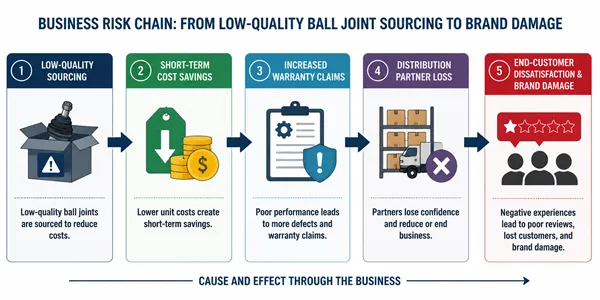
We have had direct conversations with importers who came to us after exactly this situation. A price-driven sourcing switch saved them money per unit in year one. In year two, warranty claims increased. By year three, a key distribution partner stopped carrying their brand because end customers were asking for a different label. The cost of rebuilding that market position was far higher than the savings from the cheaper parts.
This is the business case for understanding ball joint failure modes at a sourcing level. You are not just buying a part. You are buying the quality risk profile that comes with it. A part that degrades predictably gives your customers time to act. A part that fails without warning creates liability, negative reviews, and lost accounts.
The math looks different when you account for the full cost of a quality failure:
| Cost Category | Visible to Buyer at Purchase | Visible After Deployment |
|---|---|---|
| Unit price | Yes | — |
| Freight and import costs | Yes | — |
| Warranty replacement cost | Partial | Yes |
| Customer service labor | No | Yes |
| Distribution partner retention | No | Yes |
| Brand reputation in market | No | Yes |
| Potential regulatory or liability exposure | No | Yes (in safety-critical failure scenarios) |
The unit price is the smallest number in that table.12 Every other cost is invisible until the parts are already in the market.
This is why the question "can you still drive with a bad ball joint?" matters to you as a buyer. Not because your end customer is asking it, but because the answer defines how much hidden liability you are absorbing into your supply chain every time you place an order.
Buyers who understand this shift their supplier conversations away from price negotiation and toward process verification. They ask harder questions earlier. They pay closer attention to batch consistency than to sample quality. And they choose suppliers based on what happens at volume, under pressure, over time.
Conclusion
The real question is never about one part or one drive. It is about what your supplier's process produces at scale, and what that costs your business when it goes wrong.
"Characterization and Failure Analysis of an Automotive Ball Joint", https://www.academia.edu/86760381/Characterization_and_Failure_Analysis_of_an_Automotive_Ball_Joint. Supports the claim that ball joints can exhibit different failure modes, with higher quality components often showing signs of gradual wear (e.g., noise, looseness) before failure, while lower quality components may be more prone to sudden, catastrophic separation without prior warning. Evidence role: mechanism; source type: paper. Supports: The different failure modes of ball joints (gradual wear vs. sudden separation) and how they relate to part quality.. ↩
"[PDF] Component Part Manufacturer's Liability for Design and Warning ...", https://scholar.smu.edu/cgi/viewcontent.cgi?article=1847&context=jalc. Provides context on the business and legal risks associated with safety-critical component failures, illustrating how sudden failures can lead to recalls and liability issues, which are distinct from standard warranty claims for parts that wear out predictably. Evidence role: case_reference; source type: government. Supports: The significant legal and financial consequences of safety-critical component failures, such as product recalls and liability lawsuits.. Scope note: The source may discuss automotive recalls in general rather than specifically contrasting the business impact of different ball joint failure modes. ↩
"Characterization and Failure Analysis of an Automotive Ball Joint", https://www.academia.edu/86760381/Characterization_and_Failure_Analysis_of_an_Automotive_Ball_Joint. Explains how improper or inconsistent heat treatment processes for steel alloys can lead to non-uniform microstructures and hardness, resulting in unpredictable mechanical performance and premature failure under load. Evidence role: mechanism; source type: paper. Supports: The link between inconsistent heat treatment of steel and variations in mechanical properties like hardness and fatigue resistance.. ↩
"CHAPTER 8: PRODUCT/SERVICES AND QUALITY - NAU", https://www2.nau.edu/~rgm/ha400/class/productservice/productservice/textqual.html. Supports the principle that while specifications define the design intent, manufacturing process control is essential to ensure that the final product consistently meets those specifications. The gap between design and execution is a key focus of quality management systems. Evidence role: general_support; source type: education. Supports: The principle that manufacturing process controls, not just design specifications, are what determine the final quality and consistency of a product.. ↩
"Heat treatment and properties of iron and steel", https://nvlpubs.nist.gov/nistpubs/legacy/mono/nbsmonograph88.pdf. Provides material property data for 40Cr steel (or its equivalent, AISI 5140), showing how different heat treatment processes (e.g., quenching and tempering temperatures) result in a wide range of possible hardness, tensile strength, and toughness values. Evidence role: definition; source type: other. Supports: The fact that the mechanical properties of 40Cr steel (an equivalent of AISI 5140) are highly dependent on the specific heat treatment process applied.. Scope note: The source will provide general material data and may not specifically discuss its application in ball joint studs. ↩
"The Grease Life Factor concept for ball bearings - ScienceDirect.com", https://www.sciencedirect.com/science/article/pii/S0301679X22000330. Explains that the effective life of lubricating grease in a bearing or joint is determined not only by the grease's properties but also by mechanical factors like seal design, fill quantity, and operating conditions such as temperature and contamination. Evidence role: mechanism; source type: paper. Supports: The factors beyond grease grade (like fill volume, seal effectiveness, temperature, and contamination) that determine the effective lubrication life in a mechanical joint.. ↩
"Production part approval process - Wikipedia", https://en.wikipedia.org/wiki/Production_part_approval_process. Discusses the 'golden sample' issue in manufacturing, where initial samples approved by a buyer are of a higher quality than the subsequent mass-produced parts, highlighting the need for robust process controls beyond sample approval. Evidence role: general_support; source type: education. Supports: The common discrepancy between pre-production samples and mass-production quality, which is a recognized challenge in supply chain management.. ↩
"Quality control of raw materials - PubMed", https://pubmed.ncbi.nlm.nih.gov/21337098/. Supports the quality management principle that controlling the quality of incoming raw materials is fundamental, as downstream processes are often designed with the assumption of consistent inputs and cannot fully correct for initial material defects or variability. Evidence role: general_support; source type: education. Supports: The principle in quality management that the quality of raw materials is a critical input variable, and variations at this stage are difficult or impossible to compensate for in downstream manufacturing processes.. ↩
"Salt spray test - Wikipedia", https://en.wikipedia.org/wiki/Salt_spray_test. Describes the purpose of various standardized tests used in the automotive industry, such as salt spray testing (e.g., ASTM B117) to evaluate corrosion resistance, fatigue testing to assess durability under cyclic loads, and torque testing to ensure safety and performance of steering and suspension components. Evidence role: definition; source type: institution. Supports: The purpose of standardized tests like salt spray (corrosion), fatigue (durability under load), and torque (rotational force/safety) in evaluating automotive components.. Scope note: The source will likely describe the tests individually and may not directly link them to specific vehicle types or market conditions in a single document. ↩
"Managing Relationships with Suppliers and Vendors You Use", https://www.apu.apus.edu/area-of-study/business-and-management/resources/managing-relationships-with-suppliers-and-vendors-you-use/. Supports the idea that a supplier's process for handling non-conformities and customer complaints, often formalized in a Corrective Action Report (CAR), is a critical data point for assessing their commitment to quality and their reliability as a long-term partner. Evidence role: general_support; source type: education. Supports: The importance of evaluating a supplier's corrective and preventive action (CAPA) processes as a key indicator of their quality management maturity and reliability.. ↩
"[PDF] Robustness of supply chain networks against underload cascading ...", https://par.nsf.gov/servlets/purl/10198735. Provides a framework for understanding the 'Cost of Poor Quality' (COPQ), which includes not only internal and external failure costs (like warranty and repairs) but also less tangible, long-term costs such as damaged brand reputation and lost future sales, which often far exceed the initial production savings. Evidence role: general_support; source type: research. Supports: The concept that the total cost of poor quality extends far beyond immediate replacement costs to include intangible costs like brand damage, loss of customer loyalty, and reduced market share.. ↩
"[PDF] Managing Quality: Modeling the Cost of Quality Improvement", https://www.cameron.edu/storage/departments/business/Journals/Vol-12-Managing-Quality.pdf. Explains the Total Cost of Ownership (TCO) framework, which is used in procurement to account for all direct and indirect costs associated with a product or service, including acquisition price, maintenance, warranty, failure costs, and other 'hidden' expenses that occur over its lifecycle. Evidence role: definition; source type: education. Supports: The Total Cost of Ownership (TCO) model in procurement, which argues that the initial purchase price of a product is often only a small fraction of its total lifetime cost.. Scope note: The source will explain the TCO model generally and will not provide specific cost data for automotive components. ↩