
A center link does not have one guaranteed service life for every vehicle. If you rely on a fixed mileage number, you may overlook looseness, steering instability, or wear caused by heavy loads, road impacts, poor installation, or damaged related parts. You can make a safer replacement decision by combining symptoms, application details, maintenance history, and a complete steering inspection.
A center link may last for many years, but its actual service life depends on the vehicle design, load, road conditions, driving habits, installation quality, lubrication and maintenance, and the condition of connected steering parts. You should not replace it by mileage alone. Instead, you should inspect the complete steering system when you notice looseness, unusual noise, unstable steering, abnormal tire wear, or other changes in handling.
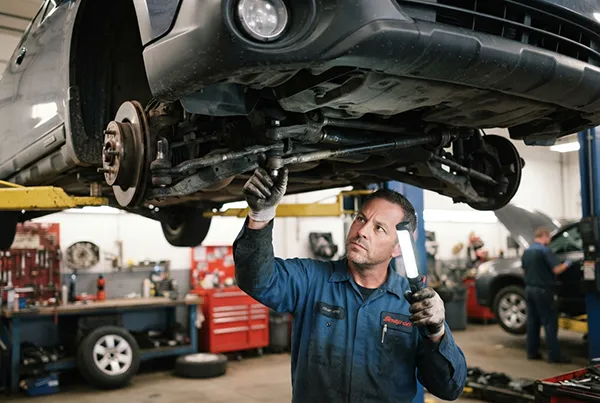

The better question is not simply, “How many miles will this part last?” The better question is, “What conditions could be increasing the risk of steering wear on this vehicle?” In my manufacturing and quality-control experience, customer feedback often involves several connected symptoms at the same time. That is why center-link evaluation requires both correct part identification and careful inspection.
What Determines How Long a Center Link Lasts?
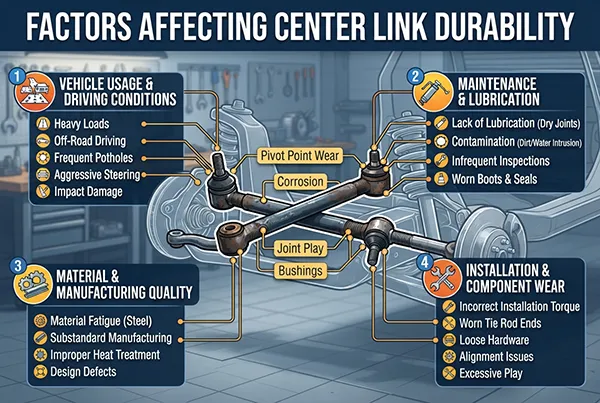
A center link lasts longer when it matches the vehicle application, carries the expected load, and operates with correctly installed and properly maintained steering components. Severe road impacts, overloads, corrosion, incorrect fitment, and worn connected parts may accelerate wear. A quality part can reduce risk, but it cannot remove every operating variable.

Why vehicle application matters
A center link is not a universal steering component. Its design depends on the steering system, vehicle weight, suspension layout, axle configuration, and expected operating conditions.1 A passenger car, an SUV, an off-road vehicle, and a heavy-duty truck may place very different loads on their steering linkage.
You should confirm the following information before judging expected durability:
- Vehicle make, model, and production year
- Engine and axle configuration
- Gross vehicle weight and typical payload
- Two-wheel-drive or four-wheel-drive design
- Left-hand-drive or right-hand-drive application, when relevant
- OE number and cross-reference information
- Steering-system design and connected components
- Intended road or off-road use
A part that looks similar may still have different dimensions, thread specifications, joint angles, or load requirements. An incorrect center link can create poor alignment, abnormal joint movement, difficult installation, or early wear. It can also create unnecessary warranty disputes because the component may be blamed when the real problem is incorrect application.
How operating conditions affect wear
Road and load conditions strongly influence steering-part life. Repeated pothole impacts, rough construction roads, unpaved routes, and frequent curb contact can transfer sudden forces into the center link and its joints.2 Heavy cargo or towing may also increase steering loads, especially when the vehicle regularly operates near its rated capacity.3
You should consider whether the vehicle operates in:
- Urban traffic, where frequent turning and braking create repeated steering movement.
- Rural or construction areas, where impact loads and dust may be greater.
- Off-road environments, where suspension articulation and contamination can increase stress.
- Cold or coastal regions, where water, salt, and corrosion may affect exposed surfaces.
- Commercial service, where high annual usage and heavy loads increase total cycles.
These conditions do not create a universal replacement schedule. They simply change the level of inspection attention that may be appropriate.
How installation and maintenance influence service life
Even a well-made center link may wear prematurely if installation is not correct. Improper torque, damaged threads, incorrect joint positioning, missing hardware, or a failure to inspect related steering parts can affect how the assembly operates.
Installation quality may involve:
- Correct tightening torque
- Proper locking devices and retaining hardware
- Accurate seating of tapered studs
- Correct alignment of the steering linkage
- Inspection for damaged threads or mounting points
- Verification that joints move within their intended range
- Replacement of damaged boots, seals, or related components
Maintenance also matters. Some steering systems use serviceable joints that require appropriate lubrication, while other designs are sealed and should not be greased. You should follow the applicable service information instead of applying a general lubrication rule to every center link.
How related parts influence center-link wear
The center link works as part of a steering system. Tie rod ends, drag links, idler arms, pitman arms, steering arms, bushings, and wheel-end components may all influence steering movement and tire wear.
If one connected part has excessive play, the driver may feel symptoms that appear to come from the center link. A worn idler arm, for example, may contribute to steering looseness.4 A damaged tie rod end may create noise or uneven tire wear. Replacing only the center link may not solve the underlying problem.
I have seen customer descriptions use “center link” as a general term for several steering components. That confusion can lead to incorrect purchasing and installation. You should identify the actual component by its position, OE reference, design, and vehicle application before making a durability decision.
What Symptoms Suggest That a Center Link Needs Inspection?
Looseness, unusual noise, unstable steering, and abnormal tire wear are useful inspection triggers, but none of these symptoms proves that the center link has failed. A qualified technician should check the center link together with the complete steering and suspension system before recommending replacement.


Why symptoms should not become automatic diagnoses
A symptom tells you that something deserves attention. It does not identify the failed component by itself. For example, unstable steering may result from steering-linkage play, incorrect alignment, tire pressure, worn suspension parts, wheel-bearing problems, or other conditions.
The same principle applies to noise. A clicking, knocking, or clunking sound may come from a joint, bushing, mounting point, or another nearby component. Noise should not be treated as the only or definitive sign of center-link failure.
You should look for a combination of evidence:
- Visible damage, bending, cracking, or corrosion
- Measurable joint looseness or movement outside specification
- Damaged dust boots or seals
- Abnormal steering free play
- Uneven tire wear that remains after alignment checks
- Changes in steering response
- Movement between connected parts during inspection
- Installation or fitment issues
Common symptoms and what they may indicate
| Observed symptom | What it may suggest | Why further inspection matters |
|---|---|---|
| Steering feels loose | Center link, tie rod, idler arm, pitman arm, or alignment issue | Several parts can create similar play |
| Knocking or clunking | Worn joint, bushing, mounting point, or loose hardware | Noise location can be difficult to judge while driving |
| Vehicle wanders | Linkage wear, tire issue, alignment, suspension, or road influence | The center link may not be the root cause |
| Uneven tire wear | Alignment, loose steering parts, tire pressure, or suspension wear | Tire wear can develop after multiple issues |
| Heavy or inconsistent steering | Binding joint, incorrect installation, steering gear, or other system fault | A center link should not be diagnosed in isolation |
| Visible corrosion or boot damage | Possible contamination or loss of protection | The internal condition may require professional assessment |
This table helps you organize an inspection, but it does not replace vehicle-specific service information.
Why a complete steering inspection reduces repeat replacements
If you replace a center link while leaving a worn connected component in place, the replacement may experience abnormal movement or loading. The vehicle may continue to show looseness or tire wear. In that situation, the customer may conclude that the replacement part is defective even when the system has not been fully repaired.
A good inspection should examine:
- The center link body and connection points.
- All attached tie rod ends and drag-link connections.
- The pitman arm and idler arm, where used.
- Steering gear mounting and shaft connections.
- Ball joints, wheel bearings, and suspension bushings.
- Wheel alignment and tire condition.
- Fastener torque and evidence of previous incorrect installation.
A professional evaluator should use the vehicle manufacturer’s inspection method and allowable movement limits. I can explain manufacturing controls and common wear factors, but I cannot diagnose a specific vehicle remotely from a short symptom description.
How Can You Evaluate Center-Link Quality and Supplier Reliability?
You can evaluate center-link quality by reviewing application accuracy, material controls, manufacturing consistency, dimensional inspection, assembly quality, durability testing, final inspection, and documentation. These controls may reduce premature-failure risk, but laboratory results should not be converted into a guaranteed road mileage or fixed service-life promise.

Start with application and fitment control
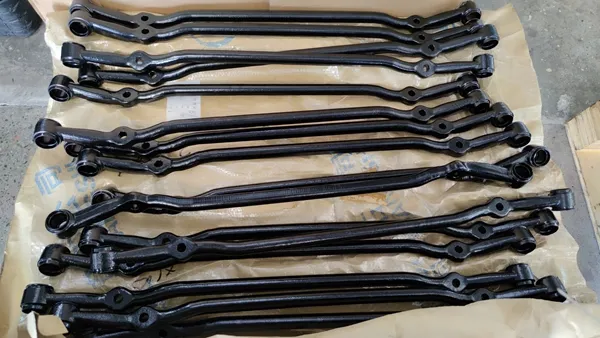
A reliable supplier should be able to explain how it controls fitment. You should request clear information about OE references, vehicle coverage, dimensions, joint specifications, and any application limitations.
Useful supplier questions include:
- How does the supplier verify OE dimensions?
- Are molds developed from approved drawings or verified samples?
- How are dimensional tolerances recorded?
- Does the supplier control different applications separately?
- Can the supplier provide technical drawings or inspection records?
- How does the supplier prevent mixed labeling or incorrect packaging?
- What process is used when a customer reports a fitment issue?
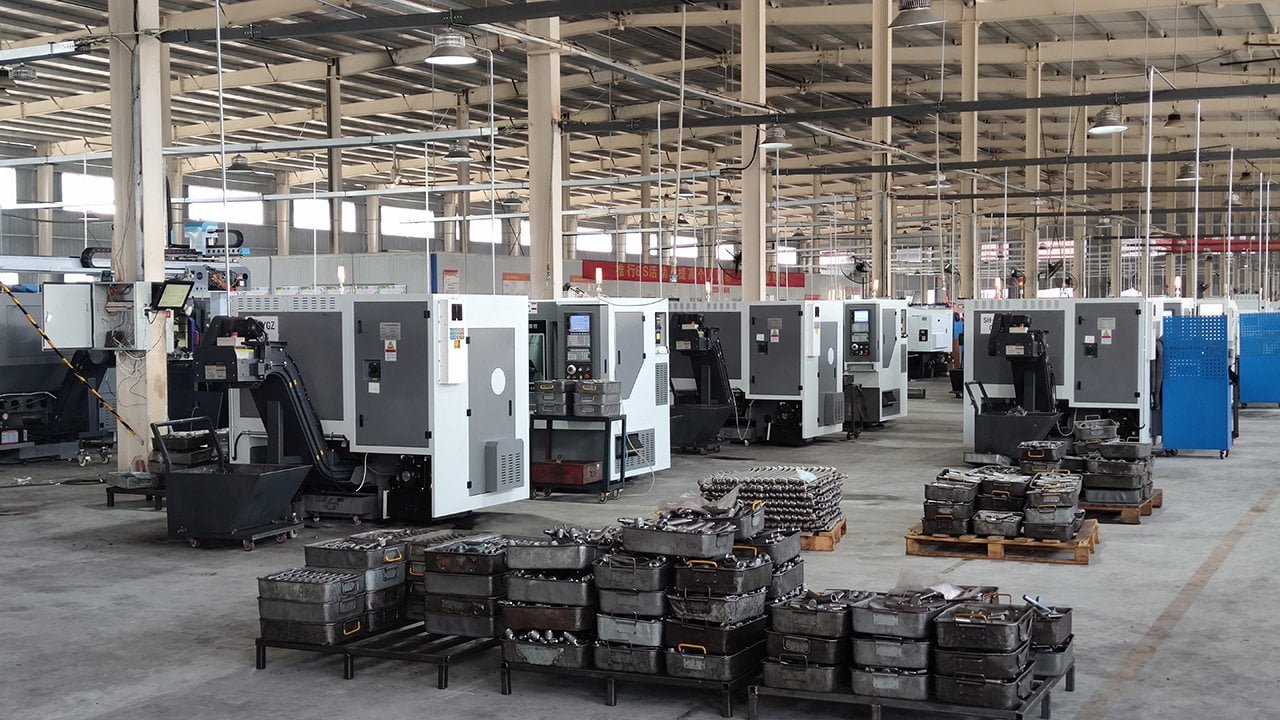
At GDST Auto Parts, our manufacturing work includes casting, forging, welding, CNC machining, assembly, and surface treatment. Our molds are developed according to OE specifications, with dimensional tolerances controlled within ±0.2 mm in the stated production process. Buyers should still verify that a supplier’s documents and specifications apply to the exact product and application being considered.
Review material and process controls
Material consistency is important because the center link and its connected joints must withstand repeated steering forces. Material selection alone does not prove durability. The supplier should also control incoming material, forming, machining, heat treatment where applicable, assembly, and surface protection.
A useful quality review may include:
| Evaluation area | Evidence you may request |
|---|---|
| Raw materials | Material certificates and batch inspection reports |
| Chemical composition | Random test records or laboratory reports |
| Dimensions | Inspection reports and calibrated measurement records |
| Assembly | Torque records, process instructions, and operator controls |
| Surface treatment | Coating or corrosion-resistance specifications |
| Durability | Test methods, samples, conditions, and results |
| Final inspection | Quantity, packaging, labeling, and visual inspection records |
| Management systems | Current certification documents for verification |
Our factory sources steel from manufacturers such as Baosteel, Shagang, and Yuanli. Our QC department reviews material inspection reports and conducts random chemical composition testing. These controls support production consistency, but they do not guarantee that every center link will experience the same road conditions or service life.
Understand what durability testing can and cannot prove
Durability testing can help identify weaknesses in materials, design, assembly, and surface protection. Depending on the product and customer requirements, testing may include:
- Pull-out and compression force testing
- Fatigue testing
- Torque testing
- Angle testing
- Hardness testing
- Salt spray testing
- Ozone resistance testing
- High- and low-temperature testing
These tests are valuable because they create controlled conditions. However, a laboratory test is not the same as a vehicle operating on changing roads, with variable loads, contamination, driving habits, alignment conditions, and installation quality.
You should ask how a test was performed rather than looking only at the word “tested.” Important details include the test standard, load, cycle count, temperature, sample quantity, failure criteria, and whether the test represents the intended vehicle application.
Consider consistency across production batches
A supplier relationship involves more than one successful sample. You should evaluate whether the supplier can repeat the same specifications across regular production. Inconsistent dimensions, joint torque, surface treatment, packaging, or labeling can create returns and installation problems.
GDST operates 20 production lines with standardized procedures and QC monitoring. Our quality team checks production processes and performs 100% final inspection before shipment. Final checks include product condition, quantity, packaging, shipping marks, labeling, and pallet condition.
You should also verify certifications directly. GDST operates under IATF 16949 and ISO 9001 quality-management systems, but certification documents should be checked for validity, scope, issuing body, and covered facility. A certificate supports supplier evaluation; it does not replace product-specific inspection or application testing.
How Should You Estimate Center-Link Replacement Risk?
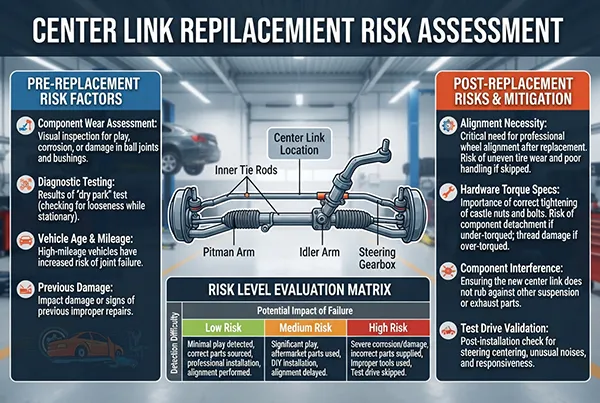
You should estimate center-link replacement risk by combining application severity, observed symptoms, inspection findings, maintenance history, installation quality, and supplier documentation. A risk-based approach is more useful than assigning one mileage figure to every vehicle because real operating conditions vary significantly.

Use a practical evaluation sequence
You can organize a replacement decision with the following steps:
-
Identify the exact part.
Confirm whether the component is a center link, tie rod, drag link, idler arm, pitman arm, or another steering part. -
Confirm the application.
Match the part with the vehicle, steering design, OE reference, dimensions, and operating load. -
Record the symptoms.
Note looseness, noise, steering instability, tire wear, vibration, or visible damage without assuming the cause. -
Inspect the entire system.
Check connected joints, steering gear, suspension parts, tires, alignment, fasteners, and mounting points. -
Review service conditions.
Consider road impacts, payload, towing, corrosion exposure, off-road use, and maintenance history. -
Review installation quality.
Check torque, locking hardware, joint seating, fitment, and whether previous repairs used the correct parts. -
Select a documented replacement.
Review material, manufacturing, testing, inspection, and traceability information from the supplier. -
Monitor field feedback.
Track returns by application, batch, symptom, installation condition, and operating environment.
This process supports better warranty decisions because it separates product-related concerns from application or installation-related concerns.
Build better after-sales guidance
If you sell or distribute steering parts, your replacement instructions should avoid promising a fixed lifespan. A clearer message tells the user to inspect the component when symptoms appear, after significant impact, or during scheduled steering and suspension checks.
You can include:
- The correct application and OE references
- Installation torque requirements
- Required replacement hardware
- Greasing instructions, if applicable
- A warning to inspect related steering components
- Alignment recommendations after relevant repairs
- Instructions to stop using the vehicle if steering control becomes unsafe
- A recommendation for qualified professional inspection
This guidance helps reduce incorrect purchases and repeated replacements. It also gives technical teams better information when a customer reports a problem.
Use field data carefully
Warranty and return data can reveal patterns, but you should avoid drawing conclusions from a single complaint. A useful internal record may include:
- Product number and production batch
- Vehicle application and operating environment
- Installation date and installer type
- Reported symptom
- Photographs of the part and packaging
- Related components replaced at the same time
- Alignment and torque information
- Inspection results
- Whether the part was modified or incorrectly installed
In my experience, customer feedback involving looseness, noise, unstable steering, or abnormal wear often becomes more useful when the entire steering system is documented. That information can help manufacturers improve process control and help distributors identify application or installation issues earlier.
Frequently Asked Questions
Can a center link last the entire life of a vehicle?
A center link may last for a long period under suitable conditions, but no universal lifetime promise applies to every vehicle. Road impacts, load, corrosion, maintenance, installation quality, and related steering-part condition can all change service life. You should follow inspection findings rather than rely on a fixed age or mileage number.
Does noise always mean the center link needs replacement?
No. Noise may come from a center link, tie rod end, idler arm, pitman arm, suspension bushing, mounting point, or loose hardware. You should treat noise as an inspection trigger, not an automatic diagnosis. A qualified technician should locate the source and check the complete steering system.
Can abnormal tire wear be caused by a center link?
A worn or incorrectly installed center link may contribute to steering movement and alignment changes, which can affect tire wear. However, tire pressure, wheel alignment, suspension wear, tire condition, and other steering parts may produce similar patterns. You should inspect these possible causes together.
Do durability test results prove a specific road mileage?
No. Durability tests provide controlled evidence about a product under defined conditions.5 They do not reproduce every combination of road surface, vehicle load, weather, maintenance, installation quality, and driving behavior. Test results can support a quality evaluation, but they should not become a guaranteed mileage claim.
What should you request from a center-link supplier?
You should request application and OE information, dimensional specifications, material documentation, inspection records, test methods, final-inspection procedures, packaging details, and valid quality-management certificates. You should also ask how the supplier manages batch traceability, fitment complaints, and corrective actions.
Conclusion
A center link does not have one fixed service life that applies to every vehicle. You can make a more reliable decision by considering the application, operating conditions, vehicle load, installation, maintenance, symptoms, and condition of connected steering parts. Manufacturing controls, accurate fitment, material inspection, assembly consistency, and durability testing may reduce premature-failure risk, but they cannot guarantee a specific mileage. If you need center-link development, OEM/ODM production, or application support, contact GDST Auto Parts for a technical discussion based on your vehicle requirements.
"Design of Three and Four Link Suspensions for Off Road Use", https://arches.union.edu/do/52172/iiif/5dd6f344-804f-48dd-bdd2-25670aa6756b/full/full/0/2017_DavisB.pdf. Automotive steering-linkage design is governed by vehicle geometry and load paths, so linkage dimensions, articulation, and strength requirements vary among suspension and axle configurations. Evidence role: mechanism; source type: paper. Supports: An automotive engineering source should explain that steering-linkage geometry and component loads are functions of suspension layout, vehicle mass, axle design, and operating requirements.. Scope note: General steering-system design literature may establish the engineering principle without discussing every commercial center-link application. ↩
"critical parameters in determining the effects of potholes on motor vehicle ...", https://www.academia.edu/104262522/CRITICAL_PARAMETERS_IN_DETERMINING_THE_EFFECTS_OF_POTHOLES_ON_MOTOR_VEHICLE_STRUCTURES. Vehicle-impact studies show that pothole and curb encounters can generate high transient wheel loads that are transmitted into suspension and steering load paths. Evidence role: mechanism; source type: paper. Supports: A vehicle-dynamics or road-impact study should document that pothole and curb events generate transient wheel loads transmitted through suspension and steering assemblies.. Scope note: Measured loads depend on impact geometry, speed, tire properties, suspension design, and vehicle mass, and therefore do not quantify center-link life directly. ↩
"Ford", https://static.nhtsa.gov/odi/inv/2013/INRL-PE13014-57341P.pdf. Payload and trailer tongue weight alter axle loading and vehicle dynamics, which can increase demands on tires, suspension components, and steering systems. Evidence role: mechanism; source type: government. Supports: A government or engineering source should establish that added payload or trailer tongue weight changes axle loads and can affect steering response and component loading.. Scope note: This relationship does not by itself establish a specific wear rate for a center link operated within the vehicle's rated limits. ↩
"19VAC30-70-470. Steering. - Virginia Law", https://law.lis.virginia.gov/admincode/title19/agency30/chapter70/section470/. Vehicle inspection standards treat excessive movement in idler arms and related steering-linkage joints as a defect because it can increase free play and reduce steering precision. Evidence role: mechanism; source type: government. Supports: An official vehicle-inspection manual should identify excessive idler-arm or steering-linkage movement as a source of steering play or as a rejectable defect.. ↩
"A Methodology for Testing", https://nvlpubs.nist.gov/nistpubs/Legacy/IR/nbsir76-1157.pdf. Durability and fatigue tests evaluate a specimen under specified loads, cycles, environments, and failure criteria, allowing repeatable comparison within the defined test protocol. Evidence role: definition; source type: research. Supports: A standards or reliability-engineering source should define durability or fatigue testing as evaluation under documented test conditions and acceptance criteria.. Scope note: The result applies directly only to the tested specimens and conditions unless a validated model supports broader extrapolation. ↩