
Symptoms of a bad center link can make a steering complaint difficult to interpret. You may hear about steering play, wandering, pulling, or clunking and assume that one component has failed. That assumption can lead to unnecessary replacements and returns. A structured inspection helps you separate a possible center-link problem from other steering, suspension, tire, and alignment faults.
Symptoms of a bad center link may include excessive steering play, imprecise response, wandering, pulling, clunking, or uneven tire wear. However, these signs do not prove center-link failure. You need a qualified technician to inspect movement, joints, attachment points, physical condition, alignment, and connected steering parts before deciding what to replace.

If you manage aftermarket purchasing or warranty claims, the distinction matters. The customer describes what the vehicle does, but the returned component shows what can actually be observed. You need both types of evidence before you assign responsibility, approve a claim, or change suppliers.
What Are the Most Common Symptoms of a Bad Center Link?
Steering complaints often arrive as short descriptions such as “loose steering” or “vehicle pulls.” These statements are useful, but they can also create tunnel vision. If you treat every symptom as proof, you may replace the center link while leaving the real cause unresolved.
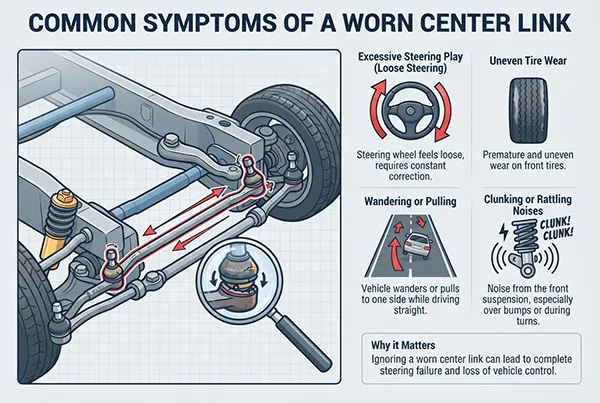
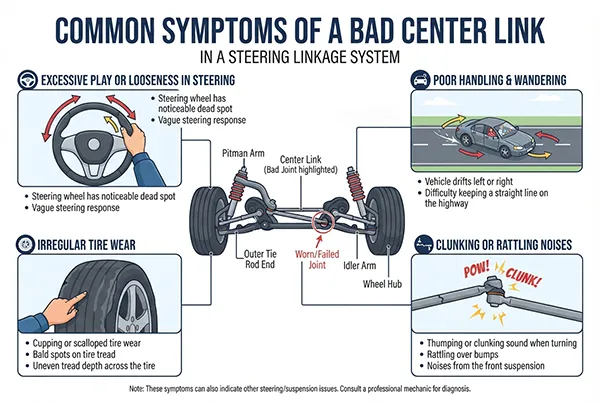
Symptoms of a bad center link can include increased steering-wheel free play, delayed steering response, wandering, pulling, clunking, and abnormal tire wear. A worn joint, loose connection, or deformed link may contribute to these conditions. Still, tie-rod ends, pitman arms, idler arms, tires, wheel alignment, and other components can produce similar symptoms.

Excessive steering play or delayed response
In a conventional parallelogram steering system, the center link transfers steering movement between the pitman arm, idler arm, and tie-rod assemblies. Its exact construction varies by vehicle application. Some designs incorporate joints, while others rely more heavily on connected components.
Wear or looseness at a joint or attachment can allow movement that does not immediately translate into wheel direction. You may experience this as:
- A vague feeling around the steering wheel’s center position
- A delay between steering input and vehicle response
- Frequent small corrections on a straight road
- Steering that feels less precise than expected
However, steering play can also come from a steering gear, tie-rod end, idler arm, pitman arm, wheel bearing, or another connection. The symptom only tells you that the system needs inspection.
Wandering or pulling
A loose or deformed center link may alter how steering movement reaches the wheels. It can therefore contribute to wandering or an inconsistent steering response. A vehicle may also seem to drift or require repeated correction.
Pulling has an especially broad list of possible causes. These can include:
- Incorrect wheel alignment1
- Uneven tire pressure
- Tire construction or wear differences
- Brake drag
- Bent steering or suspension parts
- Worn control-arm bushings or ball joints
- Road crown
- Loose steering-linkage components
You should avoid recording “pulling” as confirmed center-link failure unless an inspection identifies a relevant defect.
Clunking or knocking sounds
Looseness at a joint or mounting point can sometimes cause a clunk during steering input or suspension movement. A damaged dust boot may also allow grease loss and contaminant entry, which can accelerate internal wear.2
Noise location is difficult to determine from a customer description alone. Several connected parts move at the same time, and chassis noise can travel through the structure.3 A clunk is therefore an inspection trigger rather than a component verdict.
Uneven tire wear
Steering-linkage looseness can interfere with consistent wheel alignment.4 Over time, that condition may contribute to irregular tire wear. Yet tire wear patterns can also result from alignment settings, inflation, wheel imbalance, worn dampers, or suspension geometry problems.
| Reported symptom | Possible center-link involvement | Other common areas to inspect |
|---|---|---|
| Steering play | Joint or attachment looseness | Tie rods, steering gear, idler arm, pitman arm |
| Wandering | Wear or deformation affecting linkage control | Tires, alignment, ball joints, bushings |
| Pulling | Possible geometry or movement inconsistency | Tires, brakes, alignment, road conditions |
| Clunking | Loose joint or connection | Ball joints, tie rods, bushings, stabilizer links |
| Uneven tire wear | Inconsistent steering geometry | Alignment, tires, suspension wear |
Why Do Symptoms of a Bad Center Link Not Prove Failure?
A symptom tells you how the complete vehicle behaves, not which individual part caused that behavior. Steering components work as a connected system. If you identify one part from a complaint description alone, you risk confusing correlation with evidence and may approve an unnecessary replacement.
Symptoms of a bad center link do not prove failure because tie-rod ends, idler arms, pitman arms, steering gears, tires, wheel alignment, and suspension components can create overlapping effects. Confirmation requires an application-appropriate inspection of play, attachment points, joint condition, deformation, dust boots, and the rest of the steering system.

The “one symptom, one part” assumption causes problems
A customer may report that a new noise appeared and identify the center link because it is a visible part of the steering linkage. A workshop may also list it on an initial claim before completing a full root-cause analysis. Neither situation necessarily means that the report is dishonest. It means the available evidence is incomplete.
In our manufacturing work, we have reviewed anonymized complaints in which the center link was initially blamed for steering play or noise. Returned samples have shown different observable conditions. Some had meaningful looseness. Some showed dust-boot damage or physical deformation. Others did not show an obvious center-link defect that explained the reported symptom.
These examples help you understand field-claim complexity, but they are not remote diagnoses of the vehicles. Once a part has been removed, you cannot recreate every installation condition, loading event, adjacent-component condition, or road input.
A part does not need a visible crack to be worn
Buyers sometimes expect every failed part to have a dramatic visual defect. In reality, wear can be less obvious. A returned center link may look generally intact while exhibiting looseness or abnormal movement at a joint. Dust-boot deterioration may indicate that sealing performance has been compromised. Wear marks around an attachment point can also justify further investigation.
A qualified technician may need to assess:
- Relative movement: Is movement coming from the center link or a connected joint?
- Attachment security: Are the specified fasteners, tapers, and mounting points correctly seated?
- Physical condition: Is the body bent, twisted, cracked, corroded, or impact-damaged?
- Joint condition: Is there unusual looseness, binding, or rough movement?
- Dust-boot condition: Is the boot split, displaced, hardened, or leaking grease?
- Related components: Do the tie rods, idler arm, pitman arm, or steering gear show wear?
- Alignment and tires: Could geometry or tire condition explain the complaint?
Inspection methods and acceptance limits can differ by vehicle.5 You should use the relevant OE procedure and qualified technical judgment rather than applying a universal play limit.
> A symptom establishes suspicion. Inspection establishes whether that suspicion is supported.
How Should Symptoms of a Bad Center Link Be Confirmed?
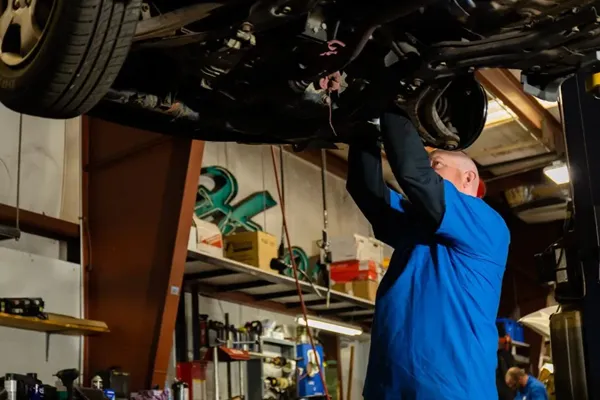
You should confirm a suspected center-link problem through a complete steering-system inspection, not a symptom checklist. The technician needs to locate abnormal movement, verify connection security, assess physical condition, and compare findings with the vehicle manufacturer’s procedure. Connected steering and suspension parts should be evaluated at the same time.
A qualified inspection should determine whether looseness, binding, deformation, boot damage, or attachment problems are present at the center link. It should also rule out tie-rod, pitman-arm, idler-arm, steering-gear, alignment, tire, brake, and suspension causes before the center link is identified as the failed component.

Start with the complaint, but do not stop there
A useful claim record describes the operating condition instead of naming a presumed cause. For example, “clunk occurs during low-speed steering input” provides more value than “center link is bad.” The first statement documents an observation. The second statement gives a conclusion that still requires proof.
You can ask a distributor, workshop, or claim handler to record:
- When the symptom occurs
- Whether the symptom is constant or intermittent
- Whether it appeared before or after installation
- The vehicle application and VIN-relevant fitment information
- Installation date and available mileage information
- Alignment records, if relevant
- Photos of the installed linkage before removal
- Photos or video showing the suspected abnormal movement
- Condition of connected parts and mounting hardware
- Part identification, batch code, and packaging label
This evidence does not replace a technician’s inspection. It gives you a better foundation for claim review and supplier communication.
Inspect the system as a chain of connections
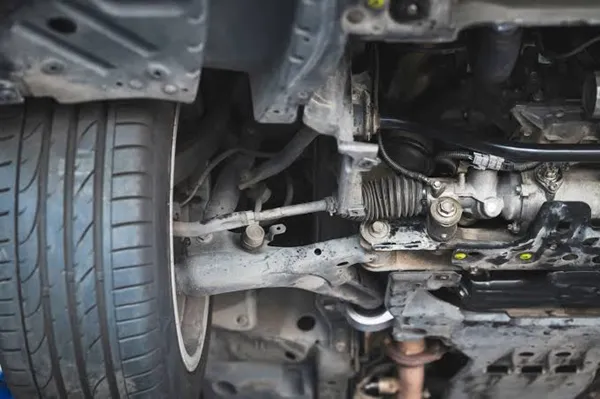
A center link does not operate in isolation. The pitman arm moves it from the steering gear side. The idler arm supports it on the opposite side in many designs. Tie rods then transfer movement toward the steering knuckles.
Wear in one location can create movement that appears to come from another. Installation errors can complicate the picture further. Incorrect fitment, damaged tapers, unsuitable hardware, improper tightening procedures, or a missed alignment can produce symptoms that resemble product defects.
The technician should follow application-specific service information. Your procurement or warranty team should then separate the findings into clear categories:
| Finding category | Examples | Appropriate response |
|---|---|---|
| Confirmed product condition | Abnormal joint looseness, material defect, incorrect dimension | Preserve sample and begin supplier analysis |
| Installation-related concern | Incorrect fitment, damaged attachment, improper hardware | Review installation process and application data |
| Related-component issue | Worn idler arm, tie-rod end, or steering gear | Correct the actual system fault |
| External damage | Impact deformation or severe contamination | Investigate operating conditions |
| Inconclusive evidence | Symptom report without sample or inspection results | Request additional documentation |
A center-link replacement may require an alignment check or other vehicle-specific service steps. You should rely on the relevant repair procedure and a qualified automotive professional for those decisions.
How Can Buyers Manage Symptoms of a Bad Center Link and Reduce Claims?
If a professional inspection implicates the center link, you still need to ask why the condition developed. Correct part selection, material quality, forging or casting control, machining accuracy, joint assembly, boot sealing, lubrication, testing, packaging, and traceability can all influence replacement-part quality.
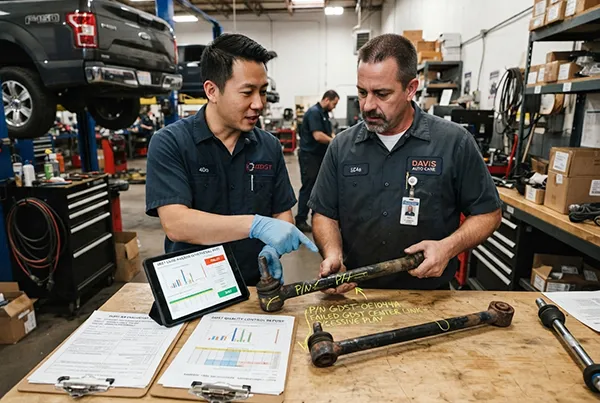
Buyers can reduce center-link claim risk by combining accurate fitment data with supplier verification and disciplined complaint analysis. You should review drawings, materials, production controls, joint performance, dust-boot quality, durability testing, batch traceability, packaging, and change management instead of judging a replacement center link by appearance or price alone.

Verify fitment before evaluating failure
An incorrect part can sometimes be installed even when it looks similar to the original. Small differences in length, taper geometry, joint orientation, mounting position, or clearance can affect installation and steering geometry.
Your fitment review should include:
- OE and aftermarket cross-references
- Vehicle model, year, chassis, and steering configuration
- Critical dimensions and tolerances
- Taper and thread specifications
- Joint orientation and operating angle
- Required hardware and accessories
- Superseded or region-specific applications
At GDST Auto Parts, we develop molds according to OE specifications and control relevant dimensions according to approved product requirements. However, you should still verify the drawing, sample approval, and application data for your own program.
Examine material and manufacturing controls
The center link must maintain geometry while transmitting repeated steering loads. Depending on the design, production may involve forging, casting, CNC machining, heat treatment, surface treatment, joint assembly, lubrication, and boot installation.
You should ask potential suppliers for evidence covering:
- Material control: Material grades, inspection reports, and batch traceability
- Forming control: Forging or casting parameters and defect inspection
- Machining control: Dimensions, tapers, threads, and process capability
- Heat treatment: Hardness specifications and verification records
- Joint assembly: Stud, socket, grease, preload, and assembly consistency
- Dust boots: Material, sealing design, ozone resistance, and fit
- Surface protection: Coating specifications and corrosion testing
- Final inspection: Identification, quantity, packaging, and product condition
Our factory uses material inspection reports and random chemical-composition checks as part of incoming control. Our testing capabilities also include pull-out and compression-force testing, fatigue testing, torque and angle testing, hardness checks, ozone testing, temperature testing, and salt-spray testing. These controls support consistency, but no control should be presented as a guarantee against every application, installation, or operating failure.
Treat certificates as documents to verify
IATF 16949 and ISO 9001 certificates can support your supplier review, but a certificate is not a substitute for product-level evidence. You should verify:
- Certificate validity and issuing body
- Manufacturing-site coverage
- Product and process scope
- Audit status
- Control plans and inspection records
- Calibration and traceability procedures
- Corrective-action examples
- Engineering-change controls
When you combine system certification with sample validation, testing records, production audits, and claim-response capability, you get a more realistic view of supplier quality.
Frequently Asked Questions
Can you drive with symptoms of a bad center link?
You should arrange a timely professional inspection if you notice steering play, wandering, pulling, or unusual noise. These symptoms do not confirm a bad center link, but they can indicate a steering, suspension, tire, brake, or alignment problem that requires qualified evaluation. Avoid making a safety judgment from an online checklist.
Can a bad center link cause loose steering?
A worn or loose center link can contribute to steering play or delayed response. However, tie-rod ends, idler arms, pitman arms, the steering gear, and other connections can cause a similar feeling. A technician needs to identify the exact point of abnormal movement before replacement.
Can a center link be bad without being bent or cracked?
Yes. A center link may show joint wear, looseness, binding, dust-boot damage, or attachment wear without a dramatic crack or severe bend. Visual inspection alone may therefore be insufficient. The applicable OE inspection procedure should guide the assessment.
Does pulling mean that the center link has failed?
No. Pulling can result from tire pressure, tire wear, alignment, brake drag, road crown, suspension wear, or steering-linkage problems. A center link may be involved, but pulling alone does not establish component failure.
What should you request when reviewing a center-link warranty claim?
You should request the vehicle and application details, installation history, complaint conditions, inspection findings, photos or video, alignment information where relevant, connected-component findings, part identification, and the returned sample when available. This evidence supports a more reliable root-cause review.
Conclusion
Symptoms of a bad center link should prompt inspection, not an automatic replacement decision. Steering play, wandering, pulling, noise, and tire wear can involve the center link, but they also overlap with many other faults. You should confirm the condition through qualified, application-specific evaluation and then review fitment, materials, process control, testing, and traceability. If you need an OEM/ODM center-link program with custom specifications, private labeling, and documented quality controls, contact GDST Auto Parts to discuss your application and procurement requirements.
"Service Bulletin", https://static.nhtsa.gov/odi/tsbs/2025/MC-11015409-0001.pdf. Automotive alignment references identify side-to-side differences in alignment geometry as possible contributors to directional pull, while also recognizing tires, brakes, road slope, and suspension condition as alternative causes. Evidence role: general_support; source type: education. Supports: An automotive engineering or university source should identify alignment conditions such as unequal caster or camber as possible contributors to directional pull.. Scope note: Alignment measurements alone do not establish the source of every pulling complaint, and vehicle-specific specifications remain necessary. ↩
"Greaseable vs. Sealed Tie Rod Ends: Which One Is Right for ...", https://www.academia.edu/169784145/Greaseable_vs_Sealed_Tie_Rod_Ends_Which_One_Is_Right_for_Your_Vehicle. Tribology research shows that lubricant loss and ingress of water or particulate contamination can increase friction and wear in lubricated joints, explaining why a compromised protective boot can shorten joint life. Evidence role: mechanism; source type: paper. Supports: Research on lubricated joints and protective boots should show that seal damage can enable lubricant leakage and contaminant ingress, increasing abrasive or adhesive wear.. Scope note: General tribology findings explain the mechanism but do not establish that a particular damaged center-link boot has already caused unacceptable internal wear. ↩
"Automotive NVH", https://vasqrlab.uta.edu/research/automotive-nvh.php. Vehicle noise-and-vibration studies distinguish structure-borne noise from airborne noise and show that vibration can propagate through connected chassis members, complicating localization based only on where an occupant perceives a sound. Evidence role: mechanism; source type: paper. Supports: Vehicle noise and vibration research should explain that mechanical excitation can propagate through connected structures and be perceived at locations remote from the source.. Scope note: This principle explains why reported noise location may be misleading but does not identify the source of a specific clunk. ↩
".02 Steering, Alignment, and Suspension.", https://regs.maryland.gov/us/md/exec/comar/11.14.04.02. Vehicle-dynamics and tire-wear literature associates changes in toe and steering compliance with altered tread contact and wear, providing a mechanism by which excessive linkage play may contribute to irregular tire wear. Evidence role: mechanism; source type: research. Supports: A vehicle-dynamics or tire-wear source should explain that uncontrolled compliance or play can alter toe and contact conditions, contributing to irregular tread wear.. Scope note: Tire wear is multifactorial, so the wear pattern by itself cannot establish that steering-linkage looseness is the cause. ↩
".02 Steering, Alignment, and Suspension.", https://regs.maryland.gov/us/md/exec/comar/11.14.02.02. Vehicle-inspection guidance generally requires steering free play and joint condition to be assessed using the applicable design or manufacturer's specifications, rather than assuming a single tolerance for all vehicles. Evidence role: expert_consensus; source type: government. Supports: Inspection rules or service guidance should direct technicians to use manufacturer specifications or design-specific procedures when evaluating steering play.. Scope note: A general inspection standard may defer to manufacturer data and therefore may not provide the numerical limit for a particular application. ↩