
Sourcing the wrong stabilizer link supplier costs more than just the unit price. It leads to warranty claims, customer complaints, and damaged market reputation—problems that are hard to undo.1
The short answer: a reliable OEM stabilizer link supplier is one you can verify, not just one who claims compliance. You verify them by asking specific questions about material sourcing, manufacturing process, quality testing cycles, and batch consistency—not by accepting certificates alone.
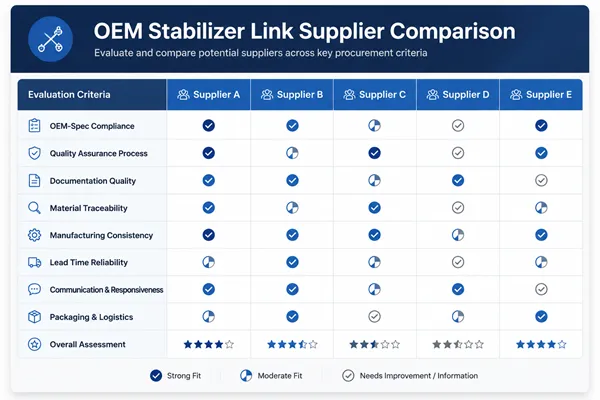
Most procurement managers I speak with already know the basics. They know what a stabilizer link does, and they know they need OEM-spec parts. The real problem starts right after that. The moment you begin comparing suppliers, the claims all start to sound the same. Everyone says "high quality." Everyone has ISO certificates. Everyone promises on-time delivery. So how do you actually tell the difference? The answer is in what you ask next.
Does "OEM-Spec" Actually Mean the Same Thing to Every Supplier?
You've probably received a quote where the supplier listed "OEM specification" as a product feature. But what does that mean to them, exactly?
"OEM-spec" is not a single universal standard.2 It means a supplier is claiming to match the original equipment manufacturer's dimensions and performance requirements. What it does not tell you is how they verified that, what materials they used, or whether their process can replicate that result consistently across every production batch.
This is one of the most common points of confusion we see from buyers who are entering a new supplier relationship. Two factories can both say "OEM-spec" and produce parts with a significant performance gap. The difference usually comes down to three things: where the steel comes from, how the part is formed, and how the finished product is tested.
Why Steel Origin Matters More Than You Think
The steel used in a stabilizer link directly determines its load tolerance, fatigue life, and surface treatment adhesion.3 In our production, we source steel from suppliers like Baosteel, Shagang, and Yuanli, and we receive material inspection reports for every batch. We also run random chemical composition tests in-house.
A supplier using generic, untracked steel stock can still claim OEM-spec dimensions. The part may look identical. But under repeated stress cycles, the performance gap becomes visible—through surface cracking, premature bush wear, or ball joint failure.
When you talk to a new supplier, ask them directly: "Where do you source your steel, and can you provide a material composition report for this production lot?" If they cannot answer that clearly, it is a signal worth taking seriously.
Forging vs. Welding: Why the Process Changes the Risk Profile
| Manufacturing Method | Typical Strength | Consistency | Best Fit For |
|---|---|---|---|
| Forging | High | High | Heavy-duty, high-load applications |
| Welding | Medium | Variable | Light-duty, cost-sensitive markets |
| CNC Machining (post-forming) | High precision | High | European passenger car applications |
A forged stabilizer link bar has a continuous grain structure. This improves its resistance to bending fatigue.4 A welded construction introduces a joint point, which under cyclic load is a potential failure zone.5 Neither is wrong by default—but the right choice depends on your end-user's vehicle type and road conditions. A supplier who uses the same process for every market is either limiting your options or not being fully transparent.
Does Your Market Define What "Good Quality" Actually Means?
A stabilizer link that performs well in European passenger car applications may not be the right choice for a heavy-duty truck running on unpaved roads in South America. The quality standard is not universal. It is defined by the end-use environment.
Quality, in practical terms, means the part performs without failure for the expected service life in the specific conditions your end customers face. That means road surface, load conditions, climate, and maintenance habits all need to shape your product specification before you approach a supplier.
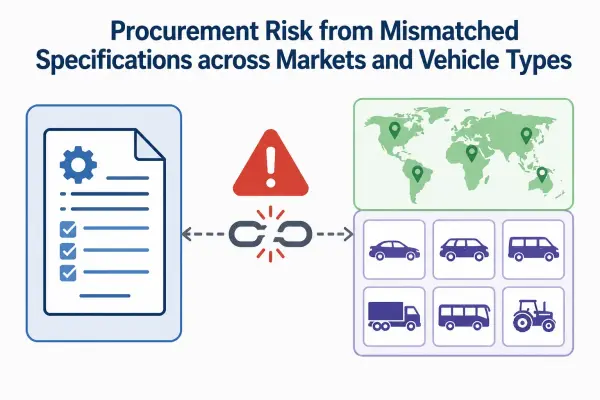
We have had clients come to us after problems in the field, and in many of those cases, the part met the stated spec. The issue was that the spec was not defined for their actual market. This is a procurement risk that starts long before you review a supplier's test reports.
Matching Product Spec to End-User Conditions
Here is a simple framework we advise buyers to use before comparing suppliers:
| Market Condition | Key Risk Factor | Specification Priority |
|---|---|---|
| High humidity / coastal region | Corrosion, rust on ball joint and boot | Salt spray test performance (500+ hours minimum)6 |
| Rough roads / off-road use | Impact fatigue, bush tear7 | Pull-out force test, fatigue cycle count |
| High-temperature climate | Boot degradation, grease breakdown8 | Ozone resistance, high-temp grease spec |
| European passenger cars | NVH (noise, vibration, harshness)9 | Torque spec, dimensional tolerance ±0.2mm |
| Heavy-duty trucks | High load, long service interval | Forged construction, hardness rating |
When you walk into a supplier conversation with this table filled out for your market, you stop evaluating on price alone. You are now evaluating fit. And a supplier who can respond to each row with a specific test result or process detail is a supplier worth continuing the conversation with.
How to Connect Test Results to Business Outcomes
Salt spray testing, for example, is often listed on a product spec sheet as "500 hours" or "1000 hours." But what does that mean for your business? It means a stabilizer link sold into a coastal or high-humidity market should hold its surface integrity long enough to stay within your warranty period. If a product fails corrosion resistance in testing, it will fail in the field—and the cost of that failure lands on your brand, not the factory's.
Torque testing and angle testing are equally important for passenger car applications. These tests verify that the part operates within the correct resistance range, which directly affects steering feel and driver safety. If your market is Europe or North America, buyers in those markets expect tighter tolerances and will notice performance differences. This is why understanding which tests a factory actually runs—not just lists—is a core part of supplier evaluation.
Are You Asking the Right Questions to Verify Quality Claims?
Most supplier quality conversations stay at the level of certificates. You ask for ISO, they send you IATF16949. That tells you they have a quality management system. It does not tell you how they apply it.10
To verify a supplier's quality claims, you need to ask questions that require specific, operational answers. General claims like "our quality is stable" have no verification path. Questions like "What is your standard fatigue testing cycle count for this part?" force a factual response that you can compare across suppliers.
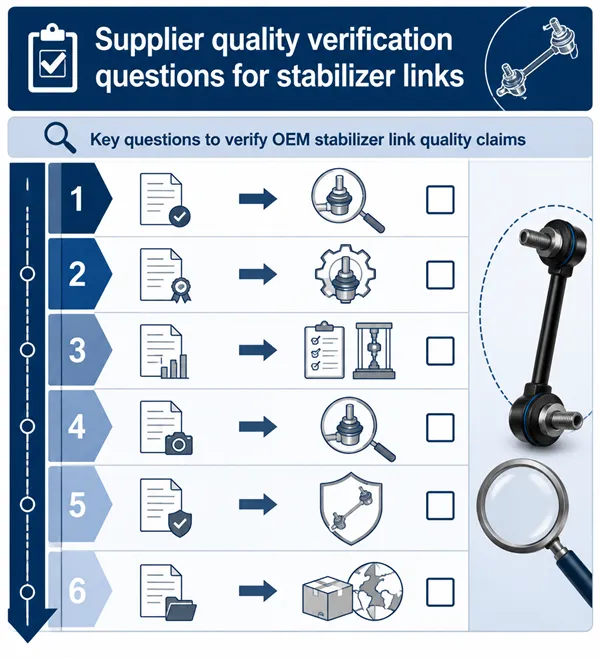
In our experience, the questions that reveal the most about a supplier's real quality capability are the ones that go one level deeper than documentation. Anyone can have a certificate. Fewer factories have a consistent, documented answer to every production variable.
Questions That Reveal Real Manufacturing Capability
Here is a set of questions we recommend buyers use when evaluating any OEM stabilizer link supplier:
| Question | What It Reveals |
|---|---|
| What fatigue testing cycle count is your standard for this part number? | Whether their durability standard matches your market's service-life expectations |
| How do you ensure consistency between production batches? | Whether they have process controls or just end-of-line inspection |
| Can you provide a material composition report for this specific batch? | Whether steel sourcing is documented and traceable |
| What is your dimensional tolerance for ball stud length and thread spec? | Whether they engineer to OEM accuracy or approximate it |
| How do you handle a quality dispute after shipment? | Whether their after-sales process is defined and responsive |
| What is your production lead time during peak season? | Whether their supply chain can handle your procurement cycle |
These questions are not designed to catch a supplier off guard. A capable supplier will welcome them. If a supplier becomes vague or defensive when you ask for specific test data or batch-level traceability, that response itself is useful information.
Why Batch Consistency Is a Bigger Risk Than Single-Sample Quality
A common issue we hear from buyers who switched suppliers is this: the samples were excellent, but the first bulk order had visible inconsistencies. This happens when a factory produces strong samples for qualification but does not have the process control to replicate that quality across 10,000 units.
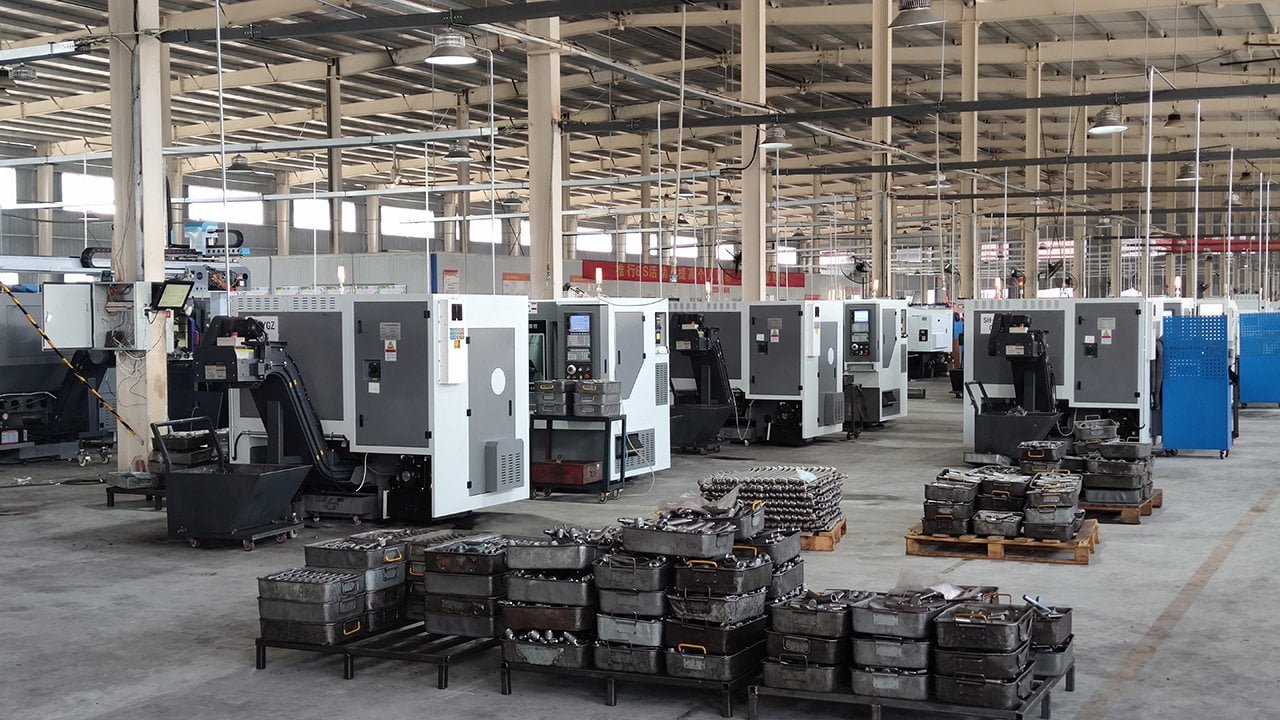
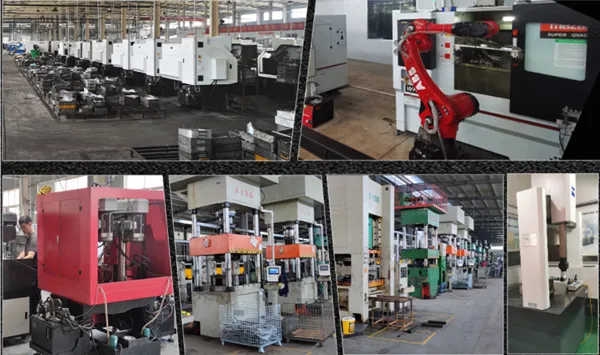
Batch consistency depends on standardized manufacturing procedures, QC staff with enough experience to catch deviation early, and a production monitoring system that tracks each step. At our factory, all 20 production lines operate under standardized procedures, and QC staff with more than five years of experience monitor each stage. We do a 100% final inspection before shipment—covering product dimensions, quantity, packaging, labeling, and pallet condition. This is not just a quality control measure. It is a supply chain risk reduction measure for our clients.
Is Unit Price the Real Cost of Your Stabilizer Link Purchase?
Procurement managers are measured on cost. That is a real constraint. But in the automotive aftermarket, unit price and total cost are two different numbers—and the gap between them grows every time a product fails in the field.
Total Cost of Ownership (TCO) for automotive spare parts11 includes the unit price plus the cost of warranty claims, customer returns, emergency restocking, and brand damage. A lower unit price from an unstable supplier routinely results in a higher TCO than a slightly higher price from a reliable one.12
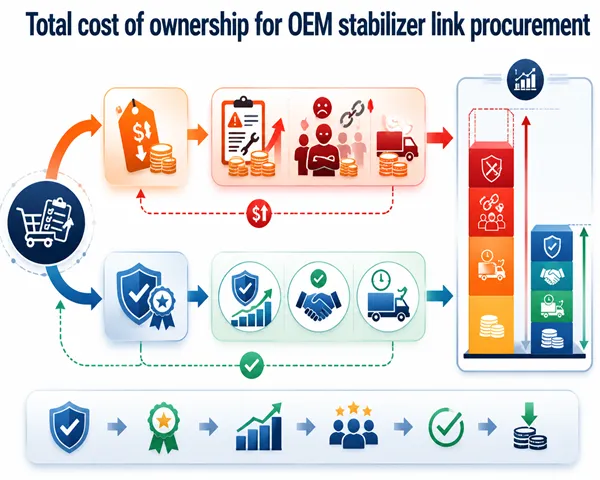
We have seen this play out directly with clients who came to us after a difficult experience with a lower-cost supplier. The product failed at a rate that triggered warranty claims in their distribution network. The cost of handling those claims, plus the damage to their relationships with local distributors, far exceeded the savings from the lower unit price. One client described it as "paying twice for the same inventory."
Breaking Down TCO for Stabilizer Link Procurement
| Cost Category | Low-Cost Unstable Supplier | Reliable OEM Partner |
|---|---|---|
| Unit price | Lower | Slightly higher |
| Warranty claim rate | Higher | Lower |
| Emergency reorder cost | High (supply disruption risk) | Low (stable supply chain) |
| Brand reputation cost | Variable but significant | Minimal |
| Private label / packaging support | Often limited | Flexible, in-house design support |
| Technical support responsiveness | Inconsistent | Defined response process |
| Estimated TCO | Higher over 12 months | Lower over 12 months |
This table is a simplification, but the pattern is consistent. The buyers who anchor exclusively on unit price tend to cycle through suppliers every one to two years. The buyers who evaluate on TCO tend to build longer-term supplier relationships because the business case is more stable on both sides.
What a Reliable Supply Chain Actually Looks Like
Beyond product quality, supply chain reliability is the other major driver of TCO. A supplier who cannot deliver consistently during peak seasons forces you into emergency buying, which always costs more. A supplier who cannot support private label packaging makes your brand positioning harder. A supplier who is slow to respond to technical questions forces you to carry more inspection overhead internally.
When we talk with procurement managers evaluating GDST as a potential partner, we are direct about what we offer: OEM/ODM manufacturing across 20 production lines, flexible private label and packaging solutions supported by an in-house design team, and a supply chain that currently serves customers in more than 100 countries. We mention this not because we are the only factory that meets this standard, but because these are the benchmarks a buyer should be applying to every supplier in their evaluation process.
Conclusion
Sourcing a reliable OEM stabilizer link comes down to one skill: asking the right questions at the right stage. Define your market needs first, verify supplier claims with specific operational questions, and evaluate total cost—not just unit price.
"The impact of brand image on customer satisfaction and brand loyalty", https://pmc.ncbi.nlm.nih.gov/articles/PMC11378958/. Business and marketing research indicates that product quality is a primary driver of brand reputation, and that failures or recalls can lead to significant, long-term erosion of consumer trust and market share. Evidence role: general_support; source type: paper. Supports: The source should provide evidence that product failures, especially in the automotive sector, have a measurable negative impact on a brand's reputation and customer loyalty.. ↩
"Original equipment manufacturer - Wikipedia", https://en.wikipedia.org/wiki/Original_equipment_manufacturer. Sources within the automotive aftermarket industry explain that terms like 'OEM-spec' indicate a manufacturer's claim to match the original part's dimensions and performance, but this is not a legally regulated or universally certified standard. Evidence role: definition; source type: other. Supports: The source should clarify that 'OEM-spec' or 'OEM-equivalent' signifies a manufacturer's assertion that a part matches the original's fit and function, rather than a formal, regulated certification.. ↩
"[PDF] ITP Steel: Characterization of Fatigue and Crash Performance of ...", http://eere.energy.gov/manufacturing/resources/steel/pdfs/report_trp_0038.pdf. Metallurgical studies confirm that the chemical composition, grain structure, and purity of steel are critical factors in determining a component's fatigue life, ultimate tensile strength, and the adhesion and effectiveness of protective surface coatings. Evidence role: mechanism; source type: paper. Supports: The source should explain the metallurgical principles connecting steel's grade, purity, and microstructure to its mechanical properties, such as fatigue life and suitability for surface treatments.. ↩
"[PDF] Forging of Carbon and Alloy Steels - Mines Files", https://wpfiles.mines.edu/wp-content/uploads/aspprc/ResearchMaterials/Publications/280-Van-Tyne.pdf. Engineering resources show that the forging process produces a continuous grain flow that follows the part's contour, which results in superior strength, ductility, and resistance to fatigue and impact loads. Evidence role: mechanism; source type: education. Supports: The source should explain how the forging process aligns the metal's internal grain structure with the part's shape, enhancing its strength, ductility, and resistance to fatigue compared to other methods.. ↩
"[PDF] EXPERIMENTAL RESEARCH ON THE LOW CYCLE FATIGUE ...", https://repository.lib.ncsu.edu/bitstreams/215ae7c4-6758-454c-9303-9cbbabbda922/download. Research on weld fatigue shows that welded joints, and specifically their heat-affected zones (HAZ), can act as stress concentrators and are common initiation sites for cracks when a component is subjected to cyclic loading. Evidence role: mechanism; source type: paper. Supports: The source should describe how welding creates a heat-affected zone (HAZ) with altered microstructures and residual stresses, making the joint a common point for fatigue crack initiation under cyclic loading.. ↩
"Salt spray test - Wikipedia", https://en.wikipedia.org/wiki/Salt_spray_test. Industry standards like ASTM B117 specify the protocol for neutral salt spray testing, an accelerated corrosion method used to assess the effectiveness of protective coatings. The number of hours a part endures the test is a common quality metric in the automotive industry. Evidence role: definition; source type: institution. Supports: The source should define the salt spray test, explain its procedure, and describe its role in the automotive industry for simulating accelerated corrosion to evaluate the quality of protective coatings.. Scope note: The direct correlation between hours in a salt spray test and years of real-world service life is not linear and depends on specific environmental conditions. ↩
"Suspension Damage: What To Look For - Universal Technical Institute", https://www.uti.edu/blog/collision/suspension-damage. Studies in vehicle dynamics show that operating on rough road surfaces subjects suspension components to high-magnitude impact loads, which can lead to fatigue failure in metallic parts and cause tearing or rapid degradation of elastomeric elements like bushings. Evidence role: mechanism; source type: paper. Supports: The source should explain how high-amplitude, low-cycle loads from uneven road surfaces lead to impact fatigue in metal suspension components and can cause tearing or accelerated wear in elastomeric bushings.. ↩
"The effect of ozone and high temperature on polymer degradation in ...", https://hero.epa.gov/reference/4255472/. Materials science research demonstrates that elevated temperatures and ozone exposure accelerate the oxidative aging of elastomeric components, leading to hardening and cracking. High heat can also cause the thermal degradation of lubricating grease, reducing its viscosity and performance. Evidence role: mechanism; source type: paper. Supports: The source should explain the chemical processes by which high temperatures, often combined with ozone exposure, accelerate the aging of elastomers, leading to brittleness and cracking, and how heat causes lubricating grease to lose viscosity and effectiveness.. ↩
"The Importance of NVH Testing in Electric Vehicles - Unico LLC", https://unicous.com/the-importance-of-nvh-testing-in-electric-vehicles/. Automotive engineering publications identify Noise, Vibration, and Harshness (NVH) performance as a critical factor in driver comfort and the overall perception of a vehicle's quality, especially in competitive passenger car markets. Evidence role: expert_consensus; source type: other. Supports: The source should establish that Noise, Vibration, and Harshness (NVH) is a key field in automotive engineering that directly influences driver comfort and the perceived quality of a vehicle.. ↩
"About – International Automotive Task Force - IATF", https://www.iatfglobaloversight.org/iatf-169492016/about/. The International Automotive Task Force (IATF) specifies that IATF 16949 is a quality management system standard focused on defect prevention and process control. The certification validates the system's existence and compliance, not the quality of every part manufactured under it. Evidence role: definition; source type: institution. Supports: The source should clarify that IATF 16949 is a process-oriented standard that certifies a supplier's quality management system, not the intrinsic quality of any individual part produced.. ↩
"12 Key Elements Of Total Cost Of Ownership - Supply Technologies", https://www.supplytechnologies.com/resources/blog/12-key-elements-of-total-cost-of-ownership. In supply chain management, Total Cost of Ownership (TCO) is an analysis that calculates the full cost of an asset beyond its purchase price, incorporating all direct and indirect costs over its lifespan, such as service, failure, and administrative overhead. Evidence role: definition; source type: education. Supports: The source should define Total Cost of Ownership (TCO) as a financial principle that assesses the full lifecycle cost of a purchase, including acquisition, operation, maintenance, and disposal, as well as other indirect costs.. ↩
"Impact of Lowest Bid Procurement Syndrome on Quality: Case Study ...", https://www.academia.edu/12147044/Impact_of_Lowest_Bid_Procurement_Syndrome_on_Quality_Case_Study_of_Public_Sector_in_Developing_Nations. Research in procurement and supply chain management has shown that a narrow focus on acquisition price can increase the Total Cost of Ownership, as costs related to poor quality—such as warranty claims, production stoppages, and reputational harm—can surpass the initial savings. Evidence role: case_reference; source type: paper. Supports: The source should provide analysis or case studies demonstrating that sourcing from suppliers with lower quality controls, despite lower unit prices, can lead to increased downstream costs that result in a higher overall TCO.. ↩