OEM vs aftermarket shock absorber cost can look simple when you compare two quotations side by side. However, the lowest unit price may hide weaker specifications, limited testing, poor fitment control, or expensive order terms. You need a like-for-like comparison that includes quality evidence, landed cost, and the financial impact of possible failures.
OEM vs aftermarket shock absorber cost should be compared by aligning product specifications, fitment, test evidence, warranty terms, and order conditions first. You should then calculate total landed cost, including packaging, freight, inventory, and claims. The better option is the one that delivers the lowest acceptable risk-adjusted cost—not automatically the lowest purchase price.
The difficult part is deciding whether two shock absorbers are truly comparable. A familiar label may carry useful assurance, while a lower-priced alternative may offer strong value if the supplier can support its claims. The following framework helps you separate a justified premium from an unsupported one.
What Does OEM vs Aftermarket Shock Absorber Cost Actually Mean?
You may see “OEM,” “OE,” “genuine,” and “OEM quality” used as if they describe the same product. They do not always mean the same thing. If you compare prices before defining each category, you can draw the wrong conclusion and approve a quotation that does not match your actual requirements.
A genuine shock absorber is generally sold under the vehicle manufacturer’s brand through an authorized channel. An OE-supplier replacement may come from a company that supplies original equipment, but it is not necessarily identical to the dealer part. An aftermarket product is independently branded or private-labelled and must be evaluated on its own evidence.
Start with clear product categories
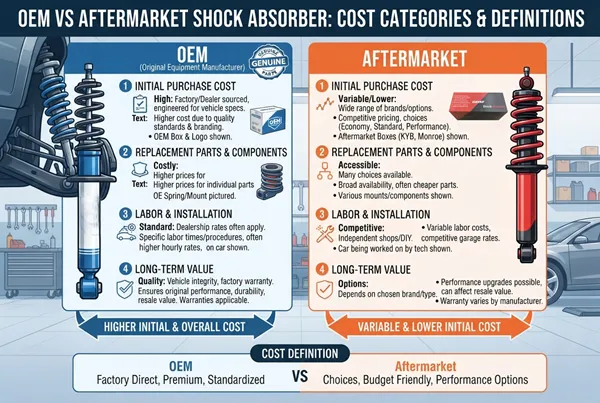
For a practical cost comparison, you can separate the market into at least three categories:
-
Genuine dealer-channel parts
These normally carry the vehicle manufacturer’s brand and part number. Their premium may reflect brand assurance, established fitment information, dealer support, controlled distribution, and warranty administration. -
OE-supplier replacement parts
These are sold under a component manufacturer’s own brand. The manufacturer may supply original equipment for some applications, but that fact does not automatically prove that every replacement product has the same design, materials, tuning, or production location as a genuine part. -
Aftermarket shock absorbers
These include recognized global brands, regional brands, private-label products, and unbranded options. Their specifications and production controls vary widely, so the word “aftermarket” does not describe one quality level.
You should also treat “OEM quality” as a marketing statement until evidence supports it. The phrase may refer to dimensions, appearance, performance targets, or simply the seller’s intended market position. It is not a universally defined technical standard.
Why labels cannot complete the comparison
A brand or sales channel can reduce uncertainty, but it cannot replace a normalized product review. Two units that fit the same vehicle may differ in:1
- Piston rod material and surface treatment
- Oil seal construction and supplier
- Shock absorber fluid characteristics
- Tube dimensions and wall thickness
- Valve design and damping curve
- Welding method and process control
- Bracket position and dimensional tolerance
- Corrosion-protection system
- Inspection frequency
- Packaging and handling protection
In my quotation work, I have seen apparently similar requests produce different costs after the buyer clarified the seal, coating, and performance requirements. The original request used only an application number and product photo. Once the specifications became clear, the quotation had to reflect a different material and process package.
You should never assume that two products are equivalent simply because their catalog descriptions reference the same vehicle.
This definition stage gives your OEM vs aftermarket shock absorber cost analysis a valid starting point. Without it, you may be comparing channel positioning rather than comparable products.
How Should You Normalize OEM vs Aftermarket Shock Absorber Cost?
A low quote creates pressure to act quickly, especially when you need to protect margin. However, an incomplete specification can make the quote misleading. If one supplier includes tighter dimensional control, stronger packaging, and documented damping checks while another does not, their unit prices do not represent the same purchase.
You should normalize each quotation around materials, manufacturing processes, fitment, performance checks, batch consistency, warranty terms, and supporting records. You do not need every supplier to use identical methods. You do need enough evidence to decide whether each product can meet the same commercial and quality target.
Use a reusable comparison checklist
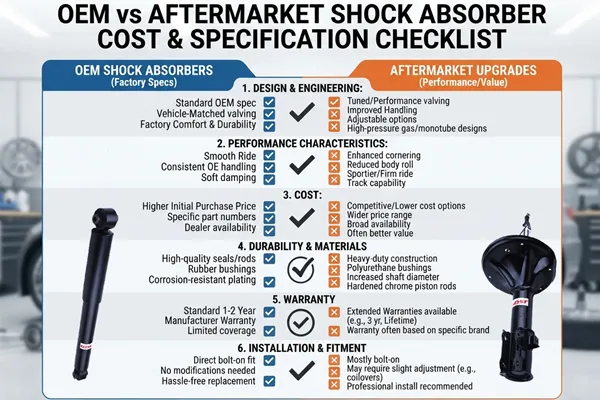
The following table helps you turn a vague price comparison into a structured review.
| Comparison area | What you should request | Why it affects cost |
|---|---|---|
| Product identity | Part number, application list, drawings, samples | Reduces wrong-product and fitment risk |
| Piston rod | Material, diameter, surface treatment, finish control | Influences sealing contact and process cost |
| Oil seal | Seal design, material, supplier category, assembly controls | Weak sealing control can increase leakage risk |
| Internal fluid | Fluid specification and temperature-related performance evidence2 | Influences damping stability under different conditions |
| Valving | Damping targets or acceptable force ranges | Determines whether performance is controlled |
| Welding | Welding method, fixture control, inspection records | Helps reduce structural and alignment defects |
| Dimensions | Critical-dimension drawing and tolerance checks | Supports correct installation and bracket alignment |
| Coating | Preparation method, coating system, corrosion-test basis | Affects appearance and corrosion resistance |
| Final testing | Damping, dimensional, leakage, or functional checks | Shows how nonconforming products are detected |
| Traceability | Batch codes and production records | Supports claim investigation |
| Warranty | Coverage, exclusions, evidence requirements, claim process | Changes the financial value of the offer |
| Packaging | Internal protection, box strength, labels, pallet method | Influences damage rates and landed cost |
Focus on evidence rather than impressive wording
You can ask for several forms of evidence:
- A controlled product drawing
- A critical-dimension inspection report
- Damping dynamometer results
- Sample approval records
- Material or component specifications
- Coating or salt-spray test records
- Batch traceability examples
- Packaging drop or compression-test information
- A written warranty and claim procedure
- Relevant management-system certificates
Certificates should be treated as documents to verify, not as proof that every shipped part meets your requirements. You can check the issuing body, scope, site address, certificate status, and expiration date. If IATF 16949 or another standard matters to your approval process, you should verify that the certificate applies to the manufacturing site and relevant scope.
Look beyond isolated technical features
A premium oil seal can be valuable, but the seal alone does not guarantee a reliable shock absorber. The rod finish, seal-seat dimensions, cleanliness, assembly method, fluid compatibility, and process consistency all affect the result.
The same principle applies to a damping test. A supplier may show one attractive test curve, but you still need to understand:3
- Whether the result came from the offered model
- Whether the sample was production-representative
- What test speed and temperature were used
- What tolerance range was accepted
- How often production units are checked
- How failed units are isolated and recorded
At our factory, welding and oil-seal assembly receive close attention because problems in these stages can lead to structural defects, abnormal noise, leakage, or damping loss. That is a manufacturing observation, not an independent laboratory conclusion. You should still have qualified professionals evaluate application-specific performance and validate samples under your own approval process.
What Costs Belong in an OEM vs Aftermarket Shock Absorber Cost Calculation?
Purchase price is visible, so it often dominates the decision. Less visible expenses can be more difficult to track. Packaging changes, slow-moving stock, split shipments, claims, and emergency replenishment can reduce the apparent saving after the products enter your supply chain.
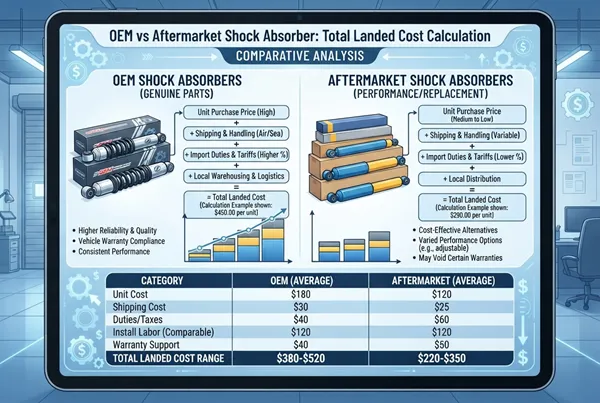
Your calculation should include the unit price, minimum order quantity, tooling or setup, private-label work, packaging, inspection, freight, duties, lead time, inventory exposure, replenishment flexibility, and expected claim-handling cost. This total landed and risk-adjusted view is more useful than comparing supplier invoices alone.
Build a landed-cost model
You can use the following structure:
Total landed cost = product cost + customization + inspection + packaging + inland transport + international freight + insurance + duties and taxes + warehousing + financing + expected claim cost
You may need to adapt the formula to your country and contract terms. Duties, tax treatment, and regulatory requirements should be confirmed with qualified customs and legal professionals.
A useful spreadsheet should show at least these fields:
| Cost category | Questions to ask |
|---|---|
| Unit price | Which materials, inspections, and packaging are included? |
| MOQ | Is the minimum applied per SKU, per order, or per packaging design? |
| Branding | Are labels, laser marking, color, and artwork setup included? |
| Packaging | Is the quoted box suitable for export handling and retail display? |
| Inspection | Is pre-shipment or third-party inspection included? |
| Freight | Is the comparison based on the same Incoterm and shipment type? |
| Lead time | Does the schedule include artwork and sample approval? |
| Inventory | How many months of stock will the order create for each SKU? |
| Claims | Who pays for replacements, freight, sorting, and local handling? |
| Replenishment | Can fast-moving references be reordered without carrying slow stock? |
MOQ and SKU mix can change the economics
An attractive per-piece price can become expensive when you apply it to a broad catalog. For example, a factory may set an MOQ per SKU rather than allowing one total quantity across the order. That condition can create excess inventory in slow-moving applications.4
In our current business context, a typical minimum is 100 pieces per SKU, with a standard production and delivery cycle of around 50–60 days. Those terms are examples, not universal benchmarks. They show why you must place price inside an order-planning model.
You should ask whether the supplier can:
- Consolidate multiple references into one shipment
- Support mixed-SKU container planning
- Phase production or delivery
- Hold approved packaging materials
- Reuse printing plates or artwork setups
- Separate urgent and standard replenishment
- Provide clear production milestones
I once reviewed an order in which private-label packaging appeared to add only a modest line-item cost. However, the packaging MOQ was higher than the product quantity for several references. The unused boxes created hidden inventory and tied the buyer to future orders. A plain export box with standardized labels produced a different cost structure, even though the shock absorber itself did not change.
Lead time has a financial value
Lead time is not only a calendar issue. A long or unreliable schedule can create:5
- Additional safety stock
- Emergency airfreight
- Lost sales from stockouts
- Higher working-capital requirements
- Unbalanced inventory across related applications
- Pressure to approve production before testing is complete
A shorter lead time is not automatically better if it results from skipped controls. Instead, you should evaluate whether the promised schedule is realistic and supported by material planning, production capacity, inspection time, and shipment booking.
When Is a Genuine or Aftermarket Shock Absorber Premium Justified?
You may feel that a higher price must mean better quality, or that a lower factory quote must create more margin. Neither assumption is reliable. A premium is justified only when it reduces a risk or adds support that matters to your specific product strategy.
A genuine-part premium may pay for brand confidence, established fitment data, controlled distribution, or channel-backed warranty support. An aftermarket premium may pay for stronger materials, testing, customization, or supply service. You should identify the benefit, verify it where possible, and decide whether its value exceeds its cost.
Ask what the premium actually reduces
Every premium should answer a practical question. Does it reduce:
- Fitment uncertainty?
- Batch variation?
- Product validation work?
- Warranty administration?
- Stockout risk?
- Packaging damage?
- Brand-building costs?
- Customer resistance?
- Claim investigation time?
A genuine dealer-channel part may offer stronger market recognition and fitment confidence. That benefit can matter when you need a specific part urgently or when the end user expects the vehicle manufacturer’s branding. However, you should not assume that the dealer price reflects only manufacturing cost. Distribution structure, brand position, availability, and support can also contribute.
An aftermarket product can have a lower quotation for several reasons. The supplier may operate a different distribution model, use different packaging, accept a different margin, manufacture at another scale, or use a different specification. Some reasons create efficiency. Other reasons create risk. You need evidence to distinguish between them.
Evaluate the cost of failure
The full cost of a product problem can include much more than a replacement unit.6 Depending on your market and contract, a claim may involve:
- Technical review and documentation
- Local labor discussions
- Return freight
- Replacement freight
- Warehouse sorting
- Batch quarantine
- Sales credits
- Customer-service time
- Damage to your brand’s reputation
You should not insert a generic failure-rate percentage into your model without reliable data. Instead, you can run scenarios using your own historical claims, supplier records, sample results, and verified field information.
For example, your model can compare:
- A base case using the quoted purchase and logistics costs
- A low-claim scenario based on documented history
- A stress case that includes sorting and expedited replacements
- A stockout case caused by delayed replenishment
This approach strengthens an OEM vs aftermarket shock absorber cost decision without pretending that uncertain risks are exact.
Use samples and controlled approval steps
For an unfamiliar supply source, you can reduce uncertainty through staged approval:
- Confirm the application and cross-reference.
- Approve drawings and critical dimensions.
- Review the component and process specifications.
- Test representative samples.
- Inspect a pilot batch.
- Review packaging and labels.
- Approve mass production.
- Monitor early batches and document claims.
Qualified engineers or testing organizations should assess vehicle-specific safety and performance where necessary. A supplier’s internal test report can support procurement, but it should not be treated automatically as independent validation.
How Can You Compare Shock Absorber Quotations More Reliably?
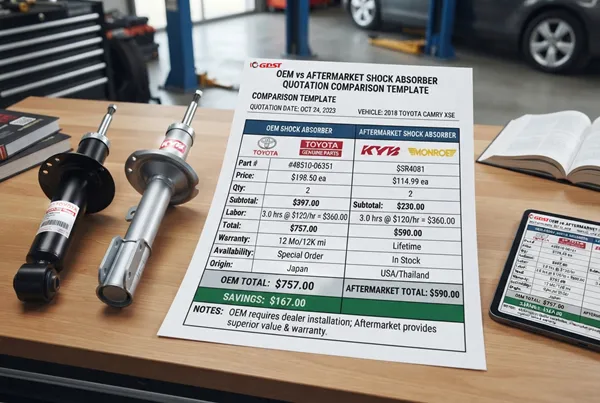
When quotations arrive in different formats, it is easy to compare the bold price at the bottom and overlook exclusions. That shortcut creates uncertainty later. A structured request for quotation makes supplier responses easier to evaluate and reduces changes after sample approval or production planning.
You should send each supplier the same application list, technical requirements, packaging instructions, inspection expectations, order quantities, Incoterm, and delivery destination. You should also request a list of assumptions and exclusions so that hidden differences become visible before you select an offer.
Include these items in your RFQ
A practical shock absorber request for quotation should include:
- Vehicle make, model, year, and relevant chassis details
- OE cross-reference numbers for identification
- Front or rear position
- Left, right, or universal fitment
- Shock absorber or complete strut requirement
- Technical drawing requirements
- Damping target or approved benchmark
- Coating color and corrosion requirement
- Label, logo, and laser-marking instructions
- Individual and master-carton specifications
- Quantity per SKU
- Total order quantity
- Required test documents
- Third-party inspection requirements
- Delivery destination and Incoterm
- Target production and shipment dates
- Warranty and claim expectations
You should also ask suppliers to state any deviations. A supplier may be unable to meet one requirement but offer a reasonable alternative. A clear deviation is easier to assess than a silent substitution.
Create a weighted scorecard
Price should remain important, but it should not be the only factor. You can assign weights that reflect your priorities.
| Evaluation area | What you can score |
|---|---|
| Product match | Fitment, dimensions, configuration, application accuracy |
| Quality evidence | Test records, process controls, traceability, sample results |
| Commercial terms | Price, MOQ, payment, tooling, customization |
| Landed cost | Freight efficiency, packaging, duties, inventory exposure |
| Supply reliability | Capacity planning, lead time, communication, replenishment |
| Claim support | Warranty clarity, investigation process, corrective action |
| Documentation | Drawings, certificates, reports, labeling compliance |
You should set the weights before opening the final quotations. That step reduces the temptation to adjust the decision method around whichever offer has the lowest visible price.
A factory audit can also help if the order value and risk justify it. During an audit, you can review welding fixtures, oil-seal assembly controls, measuring equipment, damping test benches, nonconforming-product handling, calibration, traceability, and packaging operations. You should verify certificate documents and, where appropriate, use an independent auditor.
Frequently Asked Questions
Are OEM shock absorbers always more expensive than aftermarket shock absorbers?
No. Pricing depends on the application, market, availability, distribution channel, specification, order quantity, and supplier terms. You should compare current quotations on the same commercial basis. You should not rely on a fixed percentage or assume that one category is always cheaper.
Does “OEM quality” mean the same as a genuine shock absorber?
No. “OEM quality” is not a consistently defined product category. A genuine part usually carries the vehicle manufacturer’s brand and follows its authorized channel. You should ask what “OEM quality” means in measurable terms, including materials, dimensions, damping targets, testing, and warranty support.
Which test documents should you request from an aftermarket supplier?
You can request dimensional reports, damping dynamometer results, material or component specifications, coating-test records, traceability examples, and final inspection records. You should confirm that each document applies to the quoted model and production site. Independent testing may be appropriate for critical or unfamiliar applications.
How does MOQ affect OEM vs aftermarket shock absorber cost?
MOQ affects inventory value, warehouse space, financing, and exposure to slow-moving SKUs. A low unit price may not be economical if the per-SKU minimum forces you to buy several years of stock. You should calculate order economics by application, not only by total shipment value.
Should you choose the quotation with the longest warranty?
Not automatically. You should review what the warranty covers, which evidence is required, how claims are investigated, and who pays for freight, labor, sorting, or replacement handling. A shorter but clear and workable warranty may have more commercial value than a long warranty with restrictive exclusions.
Conclusion
OEM vs aftermarket shock absorber cost is a comparison of specification, evidence, supply terms, and risk, not just unit price. You should define genuine, OE-supplier, and aftermarket products clearly, normalize every quotation, and calculate landed cost across the full order. You should then judge what each premium genuinely reduces, from fitment uncertainty to claim exposure. If you are preparing a sourcing decision, use the checklist above to structure your RFQ, verify supplier documents, and request a transparent quotation based on your exact SKU mix and quality requirements.
"[PDF] computational fluid dynamic study of variable bypass shock", https://scholars.csus.edu/esploro/fulltext/graduate/Computational-fluid-dynamic-study-of-variable/99258207017801671?repId=12287616760001671&mId=13287616750001671&institution=01CALS_USL. Vehicle-suspension research shows that shock-absorber force characteristics depend on internal hydraulic, valving, frictional, and geometric parameters, meaning that common mounting compatibility does not establish equivalent dynamic performance. Evidence role: mechanism; source type: paper. Supports: Engineering research should demonstrate that damper behavior is governed by internal valving, fluid, geometry, friction, and other design variables that are not established by vehicle fitment alone.. ↩
"[PDF] Chapter 2 Background - VTechWorks", https://vtechworks.lib.vt.edu/server/api/core/bitstreams/3995ad20-1546-4126-97b4-22e5d933d78a/content. Experimental studies of hydraulic automotive dampers report that fluid temperature and temperature-dependent viscosity alter pressure-flow behavior and can change measured damping force. Evidence role: mechanism; source type: paper. Supports: Experimental or modeling research should show that damper-fluid viscosity and internal temperature influence pressure-flow behavior and generated damping force.. ↩
"Sensing methodologies to determine automotive damper condition ...", https://www.academia.edu/14033344/Sensing_methodologies_to_determine_automotive_damper_condition_under_vehicle_normal_operation. Damper-characterization studies show that measured force curves depend on controlled test variables such as piston velocity, displacement, temperature, and conditioning; an isolated curve therefore has limited evidentiary value without its procedure, tolerances, and sample provenance. Evidence role: mechanism; source type: paper. Supports: A testing study should document the effects of excitation velocity, displacement, temperature, conditioning, and specimen variability on measured damper force curves.. Scope note: This supports the need for test context but does not determine the appropriate production sampling frequency for a particular supplier. ↩
"[PDF] Raw Material Minimum Order Quantity Optimization - DSpace@MIT", https://dspace.mit.edu/bitstream/handle/1721.1/121302/1240293813-MIT.pdf?sequence=1. Inventory models with minimum-order constraints show that a binding order minimum can require purchases above near-term demand, increasing average stock and exposure to excess inventory, particularly for low-volume items. Evidence role: mechanism; source type: paper. Supports: Inventory research should show that binding minimum order quantities can force replenishment above expected item-level demand and increase average or excess inventory.. Scope note: The size of the effect depends on demand variability, replenishment frequency, carrying cost, and whether quantities can be pooled across SKUs. ↩
"[PDF] Rapid Replenishment at a Consumer Product Goods Manufacturer", https://dspace.mit.edu/bitstreams/c5ac1d0f-33cc-4a71-84e2-d5b19c8a1323/download. Inventory-control research treats demand during replenishment lead time and uncertainty in that lead time as key determinants of reorder points and safety stock; longer or less reliable replenishment can consequently increase inventory investment or stockout risk. Evidence role: mechanism; source type: paper. Supports: Operations research should establish that expected demand during lead time and lead-time variability influence reorder points, safety stock, service levels, and capital tied up in inventory.. Scope note: Emergency freight and lost-sales effects depend on the buyer's service policy and cannot be inferred from lead time alone. ↩
"Brand Reputation and Product Recall - Scholar Commons", https://scholarcommons.sc.edu/cgi/viewcontent.cgi?article=1454&context=etd. Cost-of-quality literature classifies warranty work, returns, complaint handling, corrective action, and loss of customer goodwill as external failure costs, demonstrating that the economic impact of a defect can exceed the replacement item's purchase price. Evidence role: general_support; source type: research. Supports: A cost-of-quality or product-failure source should identify external failure costs such as warranty processing, returns, complaint handling, logistics, lost goodwill, and corrective action.. Scope note: The presence and magnitude of labor, freight, reputational, or lost-sales costs vary with contracts, market conditions, and the severity of the failure. ↩