
Knowing when to replace tie rod and rack end components can prevent unsafe steering, but replacing them based on mileage or one vague symptom can waste money. Noise, looseness, or vibration may have several causes. You need a condition-based inspection that confirms excessive play, physical damage, or wear beyond the vehicle manufacturer’s limits.
You should replace a tie rod end or rack end when a qualified inspection confirms excessive joint play, boot or seal failure with contamination, physical damage, or a verified connection between the component and steering symptoms. Mileage alone is not a reliable replacement rule. Always compare inspection results with vehicle-specific service information.
The difficult part is separating warning signs from proof of failure. Once you understand where each joint sits, how technicians inspect it, and why durability varies, you can make safer repair decisions and communicate more responsibly with workshops, distributors, and customers.
What Is the Difference Between a Tie Rod End and a Rack End?
Steering parts are often described with overlapping names, which can cause confusion during diagnosis and ordering. If you mistake an inner joint for an outer joint, you may inspect the wrong area or order the wrong part. A simple location check helps you start correctly.
A tie rod end usually refers to the outer steering joint connected to the steering knuckle. A rack end, also called an inner tie rod or axial joint, connects the steering rack to the outer tie rod assembly. Both transfer steering force, but their locations and inspection points are different.
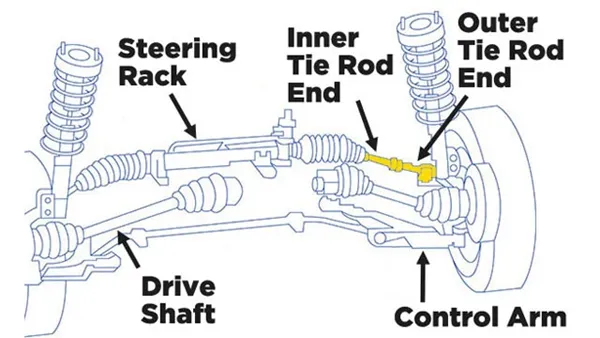
Outer Tie Rod End
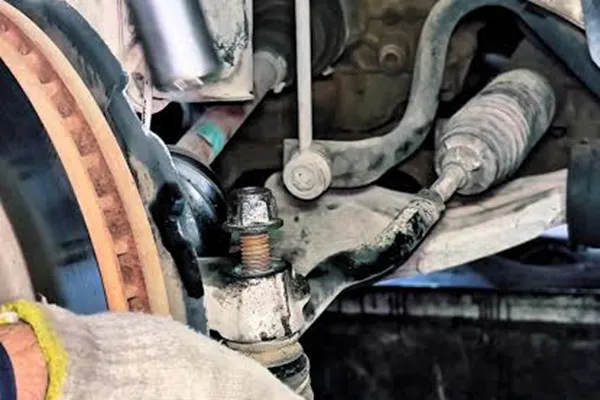
The outer tie rod end is normally visible near the wheel and steering knuckle. It contains a ball stud, bearing surface, lubricant, housing, and protective boot. The joint must articulate as the wheel steers and the suspension moves.
During inspection, a technician typically checks the outer joint for:
- Movement between the ball stud and housing
- A torn, displaced, hardened, or missing dust boot
- Rust, water, dirt, or other signs of contamination
- A bent stud or damaged housing
- Loose or damaged mounting hardware
- Movement that exceeds the applicable manufacturer limit
A damaged boot does not always prove that the joint already has excessive play. However, it removes an important barrier against water and road debris.1 The technician should inspect the joint closely and follow the vehicle manufacturer’s service guidance.
Inner Rack End
The rack end sits inside the steering rack boot, which is also called a bellows boot. You cannot usually assess it as easily from a quick visual check near the wheel. A technician may need to isolate the movement and determine whether looseness comes from the outer tie rod end, the rack end, the steering rack, or another suspension component.
Typical rack end inspection points include:
- Axial or radial movement in the inner joint
- Resistance through the joint’s working angle
- Damage to the rack boot or retaining clamps
- Water, grease leakage, or contamination inside the boot
- Bending or thread damage
- Movement at the steering rack that could be mistaken for inner-joint wear
The distinction matters because movement at the wheel does not automatically identify the failed part2. Wheel bearings, ball joints, control arm bushings, rack mounts, and steering gear components can create similar sensations.
Symptoms tell you where to begin looking. Isolated component movement tells you what may need replacement.
For repair decisions, you should apply the same basic framework to both components: identify the symptom, inspect the system, isolate the movement, compare it with approved limits, and replace only the implicated part.
What Symptoms Suggest You May Need to Replace Tie Rod and Rack End Components?
Steering looseness, clunking, vibration, or instability can feel alarming. However, these symptoms are not exclusive to tie rod or rack end wear. If you replace parts based only on a road sensation, you may leave the real fault unresolved and create unnecessary repair costs.
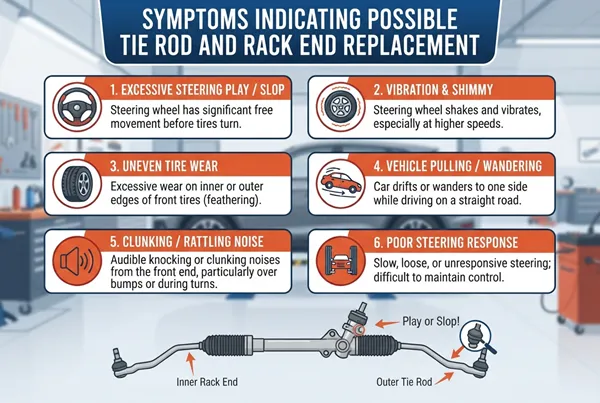
You should arrange a timely steering and suspension inspection when you notice free play, wandering, uneven steering response, relevant knocking sounds, abnormal tire wear, or vibration. These signs may involve a tie rod or rack end, but replacement is justified only after the technician confirms the source and evaluates it against applicable specifications.
Steering Play or Delayed Response
A worn steering joint can create a delay between steering-wheel input and wheel movement. You may describe the vehicle as vague, loose, or difficult to keep in a straight line.
However, similar symptoms can come from:
- Steering rack wear
- Loose rack mountings
- Worn control arm bushings
- Ball joint movement
- Wheel bearing play
- Incorrect tire pressure
- Tire construction or damage
- Poor wheel alignment
A technician needs to observe where the lost motion occurs. The inspection should ideally involve controlled steering input while the relevant joints are watched or felt for movement.
Knocking or Clunking
A worn joint may produce a knock when you steer, travel over uneven roads, or change direction. Yet noise travels through a vehicle’s body and chassis. A sound that appears to come from the tie rod area may originate elsewhere.
You should avoid treating noise as a diagnosis. Instead, note:
- Whether the sound occurs while stationary or moving
- Whether it appears during steering, braking, or suspension movement
- Whether it is stronger on one side
- Whether road temperature or weather changes it
- Whether recent repairs may have affected fasteners or alignment
These details help a qualified technician reproduce and isolate the complaint.
Irregular Tire Wear or Pulling
Tie rod or rack end wear can affect toe stability, which may contribute to abnormal tire wear or unstable tracking. However, incorrect alignment, damaged tires, ride-height changes, or worn suspension bushes can produce the same result.
An alignment reading can provide useful evidence, but alignment alone does not confirm joint failure. If a joint cannot hold its position under normal inspection load, the technician should address that mechanical looseness before completing the final alignment.
Visible Boot Damage
A cracked boot deserves attention because the joint depends on controlled lubrication and protection from contamination. In our production and quality-control experience, small differences in sealing, grease condition, and contamination can significantly affect joint behavior during durability testing.
Still, you cannot diagnose the remaining life of an installed joint remotely. If you find a damaged boot, ask a qualified technician to inspect the joint for corrosion, lost lubricant, rough articulation, and excessive clearance. The correct response depends on the joint’s actual condition and the applicable repair procedure.
When Should You Actually Replace Tie Rod and Rack End Parts?
Waiting for severe steering instability creates an unnecessary safety risk. Replacing every joint after a certain mileage is also poor practice. The sound decision lies between those extremes: you should replace a component when inspection establishes that it is damaged, excessively worn, or responsible for the verified complaint.
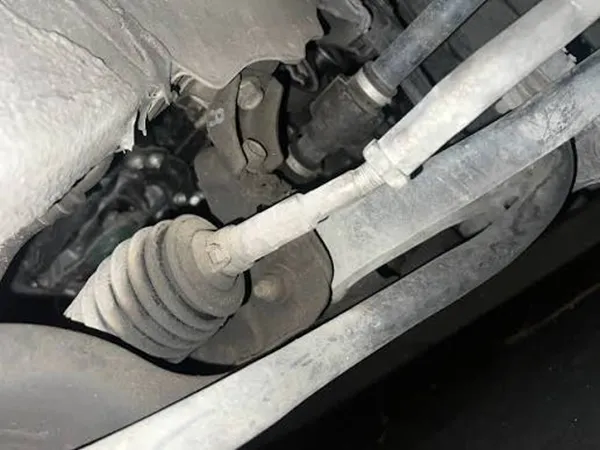
You should replace tie rod and rack end parts when confirmed play exceeds the vehicle manufacturer’s allowable limit, the joint is physically damaged, or contamination and corrosion have made safe operation doubtful under approved service guidance. A qualified technician should isolate the faulty component and consult model-specific repair information before replacement.
Use a Condition-Based Decision Process
A practical assessment follows a clear sequence:
- Record the complaint. Note looseness, noise, vibration, pulling, or changes in steering response.
- Check basic causes. Inspect tires, wheel fasteners, tire pressure, and visible steering or suspension damage.
- Raise the vehicle correctly. The lifting method can affect how joint play appears, so the technician should follow the relevant service procedure.
- Isolate each component. The technician should distinguish outer tie rod movement from rack end, wheel bearing, ball joint, and steering rack movement.
- Measure or assess play. The result should be compared with the vehicle manufacturer’s published limit or inspection method.
- Inspect boots and lubrication. Tears, displaced seals, water entry, grease loss, and corrosion can change the replacement decision.
- Replace the confirmed component. Installation should follow the specified procedure, fastener requirements, and safety precautions.
- Check wheel alignment. Tie rod work changes or disturbs toe adjustment, so alignment should be checked and corrected as required.
Do Not Use Mileage as the Main Rule
There is no responsible universal mileage for tie rod end or rack end replacement.3 Two vehicles with the same odometer reading may have very different joint conditions.
| Durability factor | How it can affect joint life |
|---|---|
| Vehicle weight and axle load | Higher loads can increase stress on steering joints |
| Road conditions | Potholes, rough roads, and repeated impacts can accelerate wear |
| Driving environment | Water, salt, sand, and mud can challenge boots and seals4 |
| Boot integrity | Damage can allow lubricant loss and contamination |
| Joint clearance | Poorly controlled clearance can affect steering feel and wear |
| Lubrication | Incorrect type, amount, or distribution can reduce durability |
| Part quality | Material, machining, heat treatment, and assembly consistency matter5 |
| Vehicle design | Joint angle, leverage, and suspension geometry influence loading |
| Installation | Incorrect fitting or damaged threads can create early problems |
From a manufacturing perspective, we see why mileage cannot provide a complete answer. Clearance checks, pull-out and compression-force tests, articulation checks, and fatigue testing can reveal meaningful differences between product batches. Those tests help manufacturers and buyers assess consistency, but they do not determine whether a specific part on a specific vehicle must be replaced today.
Avoid Replacing Parts Without Confirming the Cause
Sometimes both inner and outer joints are replaced together for practical reasons, such as similar wear, labor access, or a broader steering overhaul. However, this should not become an automatic rule. The technician should inspect both sides and explain the evidence behind the recommendation.
If only one component has confirmed excessive play, replacement scope should follow the vehicle’s service information, the condition of related parts, and a professional risk assessment. Safety-critical steering work should never rely only on online descriptions or a remote diagnosis.
How Can Buyers Reduce Premature Tie Rod and Rack End Replacement?
For aftermarket buyers, premature wear is more than a technical problem. It can lead to warranty claims, repeat labor, distributor complaints, and loss of customer trust. A low purchase price offers little value if joint consistency, sealing, lubrication, or fatigue performance varies between production batches.
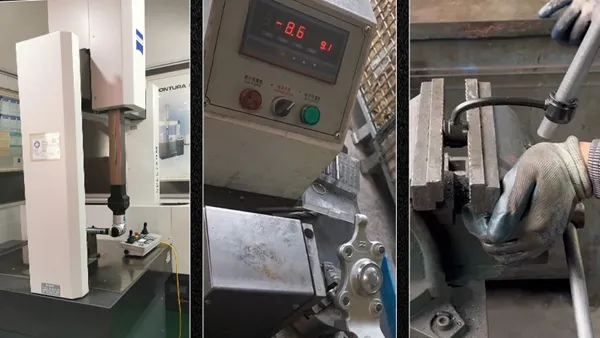
You can reduce premature tie rod and rack end replacement by evaluating the supplier’s material controls, joint-clearance process, sealing system, lubrication method, dimensional inspection, force testing, and fatigue validation. You should also verify traceable records, approved specifications, quality-management documents, packaging controls, and batch-to-batch consistency before placing large orders.
Review the Joint, Not Just the Catalogue
Vehicle coverage and competitive pricing matter, but neither proves durability. Your technical review should examine how the supplier controls the characteristics that influence joint performance.
A useful supplier checklist includes:
- Steel source and incoming material inspection
- Chemical composition or material verification
- Forging or casting control, where applicable
- Heat-treatment and hardness records
- Ball stud surface quality
- Housing and thread dimensions
- Joint clearance and articulation consistency
- Grease type, quantity, and filling process
- Boot material and sealing design
- Pull-out and compression-force testing
- Torque or rotational resistance checks
- Fatigue-test methods and acceptance criteria
- Corrosion and salt-spray test conditions
- Product traceability and nonconformance handling
At GDST Auto Parts, our manufacturing context includes casting, forging, CNC machining, assembly, and surface treatment. Our QC work also includes clearance-related checks, pull-out and compression-force testing, torque testing, fatigue testing, ozone resistance, and salt-spray evaluation. These experiences show us that durability depends on a controlled system rather than one attractive test result.
Ask for Evidence Behind Test Claims
A test report becomes more useful when you understand the method behind it. You should ask:
- Which part number and production batch were tested?
- How many samples were included?
- Which specification defined acceptance?
- What load, cycle count, angle, and environmental conditions were used?
- Was the sample taken from normal production?
- How are failed results investigated?
- Can the supplier connect the report to raw materials and process records?
You should treat IATF 16949, ISO 9001, and similar certificates as documents to verify. Check the issuing body, scope, site address, validity period, and covered activities. Certification supports a quality-management framework, but it does not guarantee that every individual steering part is suitable for every market or application.
Evaluate Warranty Risk as a System
Premature returns may come from product defects, application errors, poor installation, damaged packaging, incorrect storage, or severe operating conditions. Your warranty process should collect enough evidence to separate these causes.
Useful return data includes vehicle application, installation date, mileage at failure, road conditions, photographs, boot condition, alignment records, and the specific type of play or damage. This information helps you improve sourcing decisions without making unsupported conclusions from one returned part.
Frequently Asked Questions
Is there a standard mileage for replacing tie rods and rack ends?
No. There is no universal replacement mileage that applies to every vehicle. Joint life varies with vehicle design, load, road conditions, sealing, lubrication, contamination, installation, and component quality. You should base replacement on a qualified inspection and the limits in the applicable vehicle service information.
Can you drive with a loose tie rod end?
A loose steering joint can affect directional control and may become a serious safety risk.6 You should avoid guessing how much driving remains. Arrange a prompt inspection by a qualified technician. If steering feels severely loose, unstable, or unpredictable, stop driving and seek professional recovery advice.
Does a torn boot mean the whole joint must be replaced?
Not automatically in every application, but a torn boot exposes the joint to lubricant loss and contamination. A technician should inspect for excessive play, corrosion, rough movement, and internal damage. The correct repair depends on the component design and the vehicle manufacturer’s service procedure.
Should inner and outer tie rods be replaced together?
They do not always need to be replaced together. Both components should be inspected, and the confirmed faulty part should be replaced according to service guidance. A technician may recommend broader replacement when related joints show wear, but the recommendation should be supported by inspection findings.
Is wheel alignment necessary after tie rod or rack end replacement?
Yes, wheel alignment should normally be checked after replacing or disturbing tie rod components because they directly affect toe adjustment. The technician should first complete the mechanical repair, follow the correct installation procedure, and then set alignment to the applicable vehicle specification.
Conclusion
You should replace tie rod and rack end components based on confirmed condition, not a universal mileage or a single steering symptom. Noise, vibration, pulling, and looseness should trigger inspection, while excessive play, damage, contamination, or verified loss of function supports replacement. Always use a qualified technician and vehicle-specific service information for the final decision. If you source aftermarket steering parts, you can also contact our team to discuss drawings, inspection records, test methods, and supplier-quality evaluation for your application.
"Inside of School Bus", https://dpsaft.ade.arkansas.gov/Files/Chapter_1_-_Inside_Criteria_201020132606.pdf. Research on lubricated automotive ball joints describes protective boots as barriers that retain grease and restrict the entry of water and abrasive contaminants, both of which can accelerate wear after seal failure. Evidence role: mechanism; source type: paper. Supports: The source should explain that an intact elastomeric boot retains lubricant and limits the ingress of water and abrasive contaminants into a spherical steering joint.. Scope note: General ball-joint evidence explains the mechanism but does not establish the remaining service life of a particular tie rod end. ↩
"19VAC30-70-110. Steering and suspension. - Virginia Law", https://law.lis.virginia.gov/admincode/title19/agency30/chapter70/section110/. Official roadworthiness inspection procedures treat wheel play as a symptom requiring component-level isolation because looseness may arise from steering joints, suspension joints, bearings, or steering-gear mountings. Evidence role: general_support; source type: government. Supports: The source should show that steering and suspension inspections separately assess tie-rod joints, ball joints, wheel bearings, and steering-gear attachment when wheel play is detected.. Scope note: Inspection procedures establish the need for differential diagnosis but do not identify the cause in any individual vehicle. ↩
"Steering Maintenance", https://www.govinfo.gov/content/pkg/GOVPUB-PR32_4900-47e59b843672c14b074c964ac103a8e2/html/GOVPUB-PR32_4900-47e59b843672c14b074c964ac103a8e2.htm. Vehicle inspection standards generally assess tie-rod serviceability by security, damage, boot condition, and excessive play rather than by a universal odometer threshold. Evidence role: expert_consensus; source type: government. Supports: The source should show that roadworthiness or maintenance guidance evaluates tie rods through condition, security, damage, and excessive play rather than prescribing one mileage for all vehicles.. Scope note: The absence of a universal interval does not exclude model-specific inspection or replacement requirements in an individual manufacturer's maintenance schedule. ↩
"Measuring Corrosion on Vehicles, in Real-Time, Using Digital ...", https://pmc.ncbi.nlm.nih.gov/articles/PMC9105723/. Corrosion and tribology research shows that chloride-bearing moisture accelerates corrosion, while water and particulate ingress can compromise lubricant performance and increase abrasive wear in sealed mechanical joints. Evidence role: mechanism; source type: research. Supports: The source should document how chloride exposure promotes automotive-component corrosion and how particulate or water ingress affects lubricated joints and seals.. Scope note: These environmental mechanisms are general and do not quantify the service-life reduction for a specific tie rod design. ↩
"Characterization and Failure Analysis of an Automotive ...", https://www.academia.edu/86760381/Characterization_and_Failure_Analysis_of_an_Automotive_Ball_Joint. Failure-analysis and fatigue studies of steering-linkage components identify material properties, heat-treatment condition, geometric or machining defects, and assembly quality as factors that can influence crack initiation, load capacity, and service durability. Evidence role: mechanism; source type: paper. Supports: The source should show that material properties, surface condition, dimensional accuracy, heat treatment, and assembly-induced variation influence fatigue strength or joint wear.. Scope note: Such studies establish relevant failure mechanisms but do not rank the quality of any supplier or predict the life of every production part. ↩
"Part 573 Safety Recall Report 23V-693", https://static.nhtsa.gov/odi/rcl/2023/RCLRPT-23V693-4492.PDF. Government safety investigations and recall notices have documented that tie-rod fracture or separation can cause loss of directional control and increase crash risk. Evidence role: case_reference; source type: government. Supports: The source should document that tie-rod fracture, separation, or severe looseness can cause partial or complete loss of steering control.. Scope note: Recall cases demonstrate the potential consequence of structural failure; they do not determine how rapidly a merely loose joint will progress or whether a specific vehicle is safe to drive. ↩