Every suspension system has a weak point. When that weak point fails, you get warranty claims, customer complaints, and lost accounts. The lower ball joint is often that weak point.1
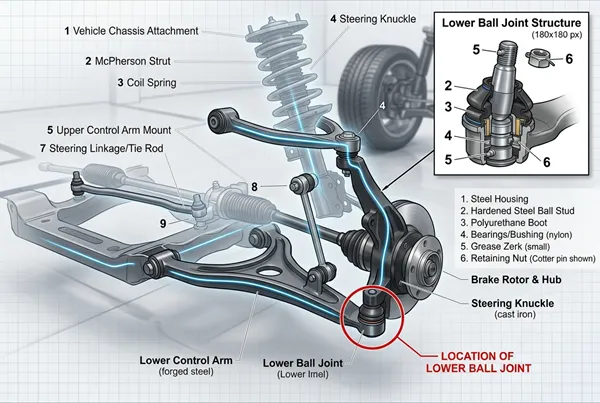
A lower ball joint is a pivoting connector between the lower control arm and the steering knuckle.2 It allows the wheel to move up and down with the road while also rotating left and right for steering. Without it, the wheel cannot stay aligned or move correctly.
Most buyers searching this question already know the basics. What they actually need to know is how to evaluate quality, spot supplier risk, and avoid the failures that come back as warranty claims. That is what this article focuses on.
How Does a Lower Ball Joint Actually Work?
Most suspension parts have one job. A lower ball joint has two jobs at the same time, and that is what makes it difficult to manufacture well.
A lower ball joint carries vertical load from the vehicle's weight while allowing multi-directional movement for steering and suspension travel. It must handle static load, dynamic shock, and rotational movement simultaneously. This combination puts constant stress on the joint's internal components.
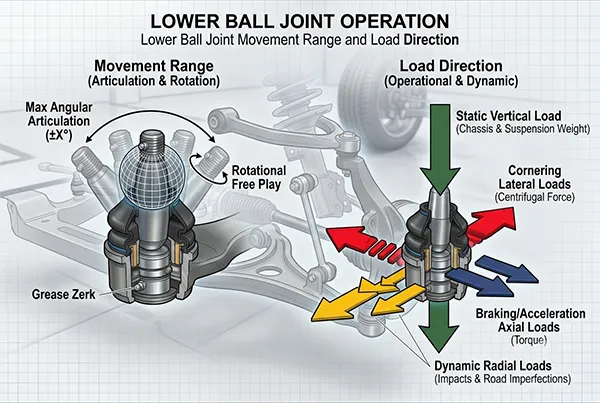
The joint itself has a ball stud sitting inside a housing filled with a bearing seat, usually made of polymer or metal. A rubber or polyurethane boot seals the assembly to hold grease in and keep contaminants out. The stud connects to the steering knuckle, and the housing connects to the control arm.
What this means in practice is that three things have to work together: the stud has to fit precisely inside the housing, the bearing seat has to absorb load without deforming, and the boot has to stay sealed under flexing and temperature change.
When any one of these three fails, the joint fails. From our production experience, most premature failures we hear about from customers trace back to one of these root causes.
What Controls Performance at the Component Level?
| Component | Function | Common Failure Mode |
|---|---|---|
| Ball stud | Load transfer and pivot | Surface wear, incorrect hardness |
| Bearing seat | Load distribution and smooth movement | Deformation under overload, poor material |
| Dust boot | Seal protection | Cracking, poor fit, ozone degradation |
| Housing | Structural integrity and fitment | Dimensional inaccuracy, casting porosity |
| Grease | Lubrication retention | Leakage from failed boot, wrong grease spec |
Each of these variables depends on manufacturing decisions, not just design specifications. A supplier can produce a ball joint that matches every dimension on a drawing but still uses a bearing seat material that degrades faster under heat. This is the kind of gap that specification sheets do not show.
What Is the Difference Between OEM and Aftermarket Ball Joints?
This is one of the most common questions we hear from procurement managers. The honest answer is more complicated than most suppliers will tell you.
OEM ball joints are manufactured to the exact tolerances, materials, and testing standards of the vehicle's original design. Aftermarket ball joints are designed to fit and perform within acceptable ranges, but material choices, testing requirements, and production controls vary widely between suppliers.
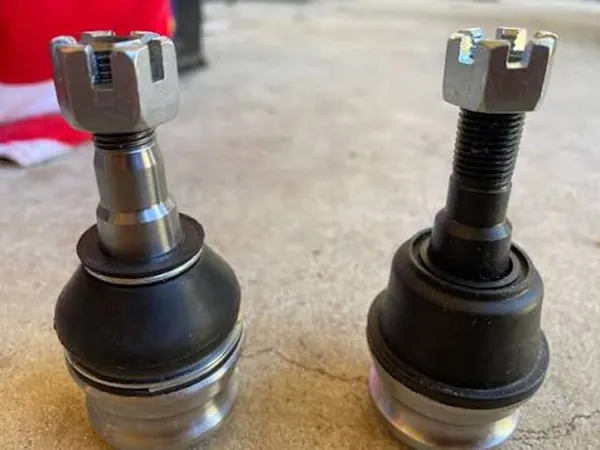
The word "aftermarket" covers a huge range of quality levels. It includes parts that meet or exceed OEM performance, parts that perform adequately for most driving conditions, and parts that fail early because production shortcuts reduced cost.
The challenge for buyers is that all three levels often look the same at the time of purchase.
Where the Differences Actually Come From
From our side of production, the differences come from four main areas:
Material sourcing. OEM manufacturers specify material grades and source from approved suppliers. Aftermarket manufacturers make their own sourcing decisions. Some use equivalent materials. Some substitute lower grades to reduce cost. We source our steel from suppliers like Baosteel, Shagang, and Yuanli, and test every batch for chemical composition. Not every aftermarket manufacturer does this.
Mold precision. Every ball joint housing we produce is made from molds developed to OE specifications with dimensional tolerances controlled within ±0.2 mm. Molds that are worn or originally produced to looser tolerances create fitment problems. A housing that is slightly oversized or undersized will affect stud preload and joint play.
Testing requirements. OEM parts go through extensive validation testing. For aftermarket, testing requirements depend on what the manufacturer has decided to run. Our QC includes pull-out force testing, compression force testing, salt spray testing, fatigue testing, torque testing, and ozone resistance testing for boots. These tests cost money. Not every supplier runs all of them.
Batch consistency. OEM production runs under tight process controls because the vehicle manufacturer audits the supplier. Aftermarket production controls depend entirely on the supplier's internal systems. One batch can be good. The next batch from the same supplier can use substituted materials or come from a different mold without any notification.
| Variable | OEM | Quality Aftermarket | Low-Cost Aftermarket |
|---|---|---|---|
| Material specification | Fixed by vehicle OEM | Defined internally, consistent | Variable, cost-driven |
| Mold tolerance | Strict | Controlled | Often loose |
| Testing scope | Full validation | Selective but documented | Minimal |
| Batch consistency | Audited | System-dependent | Unreliable |
| Price | High | Moderate | Low |
This table shows why price alone is not a reliable signal. A quality aftermarket supplier with documented processes and real testing can produce parts that perform well at a competitive price. A low-cost supplier with inconsistent processes creates warranty risk that costs more than the savings.
Why Do Lower Ball Joints Fail Prematurely?
Premature failure is the core risk that procurement managers are managing. After-sales feedback from our customers over the years has shown us that most early failures share common causes.
Lower ball joints fail prematurely because of boot failure, insufficient bearing seat hardness, incorrect grease, or dimensional inaccuracy in the housing. Boot failure is the most common entry point because once contaminants enter the joint, wear accelerates rapidly.3
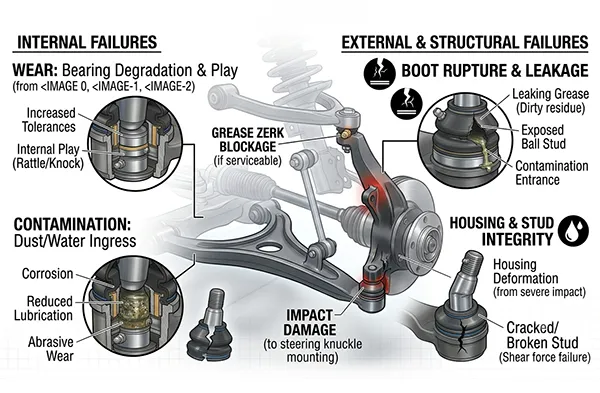
When a customer reports early failure, the first question we ask is about the boot. A boot that cracks, tears, or separates from the housing lets water, dirt, and road debris into the grease cavity. Once that happens, the bearing seat and ball stud wear out quickly. The joint develops play, and the driver feels looseness or hears knocking.
Breaking Down Failure Causes
Boot material quality. Rubber boots degrade from ozone exposure, heat cycling, and mechanical flexing4. A boot made from lower-grade rubber will crack sooner. We run ozone resistance testing specifically because this is a documented failure mode. If a supplier cannot describe how they test boot durability, that is a risk signal.
Bearing seat deformation. The bearing seat, often made from nylon or PTFE-based polymer, must maintain contact pressure against the ball stud over time. If the material is too soft or was produced with the wrong formulation, it deforms under load and creates joint play. This failure is harder to detect before purchase because the part looks fine at first.
Stud hardness. The ball stud surface needs to be hard enough to resist wear but not so brittle that it cracks under impact. Incorrect heat treatment creates studs that wear too fast or fracture unexpectedly.5 We test hardness on every production batch. A supplier who cannot show hardness test records is asking you to take this on trust.
Housing dimensional accuracy. A housing that is slightly out of spec changes the preload on the bearing seat. Too loose and the joint has play from the start. Too tight and the joint stiffens, fights against the suspension, and wears the bearing seat faster through friction.
| Failure Type | Root Cause | How to Verify Before Purchase |
|---|---|---|
| Boot cracking | Low-grade rubber, no ozone testing | Ask for ozone resistance test reports |
| Joint play developing early | Bearing seat deformation | Ask for material spec and compression testing data |
| Stud surface wear | Incorrect hardness | Ask for hardness test records per batch |
| Poor fitment | Housing dimensional inaccuracy | Ask for mold tolerance standards and CMM reports |
| Grease leakage | Boot separation or wrong seal design | Request sample inspection and boot pull test data |
How Do You Verify Supplier Quality Without Testing It Yourself?
This is the practical problem. Most procurement managers cannot run a fatigue test or a salt spray test in their office. They have to make decisions based on available signals. The question is which signals actually matter.
To verify supplier quality without direct testing, request batch-specific test reports rather than generic certificates, ask for mold inspection records, check whether QC staff have documented experience, and request sample parts for third-party dimensional inspection. Generic quality claims without documentation are not verifiable.
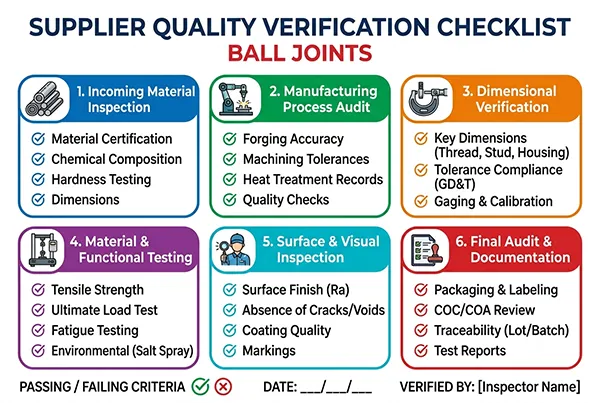
From our own experience working with procurement managers across more than 100 countries, the buyers who avoid quality problems are the ones who ask specific questions early. The buyers who run into trouble are usually the ones who accepted a certificate and a low price without digging further.
Verifiable Signals vs. Unverifiable Claims
Certifications. IATF 16949 and ISO 9001 certifications indicate that a quality management system exists. They do not guarantee product quality on their own. A certified factory can still produce poor parts if its actual process controls are weak. Treat certifications as a baseline filter, not a final answer.
Material traceability. Ask whether the supplier can provide material inspection reports tied to specific production batches. We test every batch of steel we receive from our material suppliers and keep records by batch number. If a supplier cannot show batch-level material records, they cannot trace quality problems back to their source.
Test reports. Ask for test reports specific to the part number you are buying, not generic reports from a different product. The report should show test date, part number, test method, and result. A report that does not include these details was probably not run on your specific product.
QC staff experience. Ask how long the quality control team has been working in the industry. Our QC staff have more than 5 years of experience each. This matters because experienced QC people recognize problems that newer staff miss.
Production line structure. Ask how many production lines the factory operates and how batch consistency is monitored. A factory with standardized procedures across multiple lines is less likely to have variance between batches.
Sample inspection. Request physical samples before committing to a large order. Have the samples measured dimensionally, either in your own facility or through a third-party inspection service. Dimensional accuracy is one thing you can verify without specialized equipment.
| Verification Method | What It Tells You | Limitation |
|---|---|---|
| IATF/ISO certification | QMS exists | Does not guarantee product quality |
| Batch material reports | Material sourcing discipline | Requires supplier transparency |
| Part-specific test reports | Testing was actually done | Must check report is for your part |
| Sample dimensional check | Housing and stud accuracy | Does not test durability |
| QC staff background | Process knowledge level | Hard to verify remotely |
| Factory audit | Process and capacity reality | Requires travel or third-party auditor |
The combination of these signals gives you a more complete picture than any single certificate or claim. No signal is perfect on its own.
Conclusion
A lower ball joint is a simple concept but a complex procurement decision. Quality depends on materials, mold precision, testing discipline, and batch consistency—all of which require documentation to verify, not just promises.
"[PDF] Durability Analysis of Helical Coil Spring in Vehicle Suspension ...", https://vtechworks.lib.vt.edu/bitstream/handle/10919/106624/Kumar_D_T_2021.pdf. Automotive repair data or engineering studies on suspension system reliability can provide statistics on the failure rates of various components, often highlighting ball joints as a common item requiring replacement. Evidence role: statistic; source type: research. Supports: The claim that lower ball joints are a frequent point of failure in vehicle suspension systems.. Scope note: Failure rates can vary significantly by vehicle model, age, and operating conditions. ↩
"What Are Ball Joints?", https://www.uti.edu/blog/automotive/ball-joints. Automotive engineering resources define the ball joint as a spherical bearing that connects the control arm to the steering knuckle, forming a critical pivot point in the suspension system. Evidence role: definition; source type: encyclopedia. Supports: The definition of a lower ball joint and its location connecting the control arm and steering knuckle.. ↩
"Characterization and Failure Analysis of an Automotive Ball Joint", https://www.academia.edu/86760381/Characterization_and_Failure_Analysis_of_an_Automotive_Ball_Joint. Failure analysis studies of suspension components frequently identify the failure of the protective dust boot as the primary initiating event for premature ball joint wear, as it allows for the ingress of water and abrasive particles. Evidence role: case_reference; source type: paper. Supports: The claim that boot failure is a primary initiator of overall joint failure.. ↩
"Ozone cracking - Wikipedia", https://en.wikipedia.org/wiki/Ozone_cracking. Materials science literature explains that elastomers like rubber are susceptible to degradation from environmental factors, including chain scission caused by ozone exposure (ozone cracking), and material fatigue from repeated mechanical flexing and thermal cycling. Evidence role: mechanism; source type: education. Supports: The mechanisms by which rubber degrades.. ↩
"federal mine safety and health review commission", https://www.fmshrc.gov/sites/default/files/decisions/alj/ALJd_10172014-VA%202013-511%20Extra%20Energy%20Decision.htm. Metallurgical resources explain that heat treatment processes like case hardening are critical for creating a hard, wear-resistant surface on a steel component while maintaining a tougher, less brittle core. Improper execution can result in a surface that is too soft and wears quickly, or too brittle and prone to fracture. Evidence role: mechanism; source type: education. Supports: The claim that incorrect heat treatment leads to specific failure modes in steel parts.. ↩