
Every procurement manager eventually asks us for a ball joint maintenance guide. But after 20 years of supplying the global aftermarket, I've learned that the question itself points to a deeper problem.
The biggest driver of ball joint failure isn't a missed maintenance schedule. It's a bad purchasing decision made before the part ever ships.1 The right question isn't "How do I maintain this ball joint?" It's "Did I buy the right ball joint for this application in the first place?"
Most buyers come to us after a quality problem. They've had warranty claims pile up. Their customers are complaining. Their brand reputation is taking a hit. And when we dig into the root cause together, it almost never comes down to how the end-user maintained the part. It comes down to what was in the box when the part left the factory. This guide is about fixing the problem at the source, which means starting with how you select a supplier and a product, not how you schedule a grease interval.
Is the Manufacturing Process More Important Than the Material Spec?
A frequent question we get from new importers is: "What material are your ball joints made from?" It's a fair starting point. But it's not the right finishing point.
The material grade matters far less than what happens to that material during production. Two ball joints can be made from the same steel specification. One is forged and heat-treated under tightly controlled conditions. The other is cast with inconsistent process monitoring. Their real-world performance will be completely different.
When experienced brand owners evaluate a supplier, they push past the spec sheet quickly. Here's why the manufacturing process deserves more of your attention than the material certificate alone.
Forging vs. Casting: Why the Difference Matters
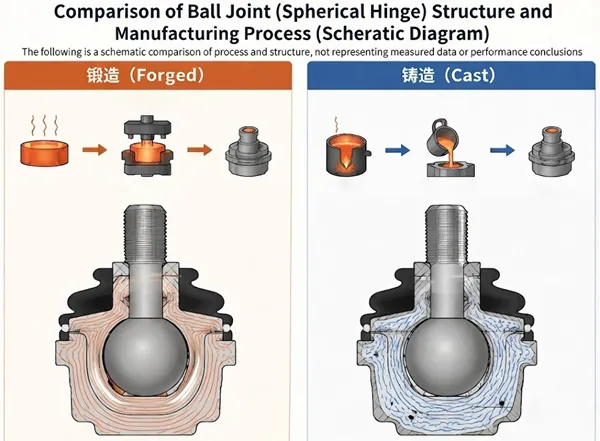
Forging aligns the grain structure of the steel. This makes the part denser and more resistant to impact and fatigue stress.2 Casting introduces micro-voids and uneven grain flow. Under repeated load cycles, those micro-voids become cracks.3 For a passenger car on smooth roads, this difference might only show up at very high mileage. For a light truck on rough terrain, it can show up in months.
Heat Treatment Consistency
Heat treatment determines the hardness and toughness balance of the stud and housing.4 If the process temperature or timing drifts between batches, you get inconsistent hardness. Parts from Batch A perform fine. Parts from Batch B fail early. The end-user and your customer service team have no way to predict which batch caused the problem.
The Questions You Should Be Asking
| Process Step | Weak Supplier Answer | Strong Supplier Answer |
|---|---|---|
| Material sourcing | "We use CR steel" | "We source from Baosteel with per-batch inspection reports and random composition testing" |
| Forming method | "Machined and assembled" | "Forged stud with documented forging die specifications" |
| Heat treatment | "We heat treat all parts" | "Controlled furnace temperature with batch records and hardness testing per lot" |
| Dimensional control | "We follow OE design" | "Tolerances held within ±0.2mm, verified with CMM per production run" |
The goal of these questions is not to trip up the supplier. The goal is to understand whether their process produces consistent output. Consistency is what protects your brand.
Does the Operating Environment Change the Right Ball Joint Choice?
We often have to correct the misconception that there is one correct ball joint specification for all markets. There isn't. The right product is always a function of the part's design meeting the specific demands of its operating environment.
A ball joint that performs well on a passenger car in a dry inland climate will wear out far faster on a light truck operating in a coastal or high-humidity environment.5 Salt exposure, road contamination, and load cycles all interact with the product's design. Ignoring this leads to predictable warranty problems.
Part of what we do when working with procurement managers is help them map the product specification to the actual end-use conditions in their target market. This is a risk assessment conversation, not a catalog selection exercise.
Corrosion Resistance Is Not Just a Surface Finish Decision
Salt spray testing is one of the standard tests we run on all products.6 But what the test result means for your market depends on your vehicle application and climate. A 500-hour salt spray result might be perfectly acceptable for an inland European passenger car application. For a heavy-duty truck operating in a coastal South American market, a buyer should be pushing for higher-rated results and asking about the seal and boot material, not just the surface finish.
Load and Fatigue Testing Tells You the Real Story
Fatigue testing simulates repeated load cycles to a defined failure point. This number tells you something meaningful about where the part will sit in the distribution of real-world service life. Pull-out force and compression force testing tell you about structural integrity under extreme load. These numbers should not just appear on a supplier's brochure. You should ask to see the actual test data and understand what test standard was used to generate it.
Mapping Your Market to the Right Specification
| Market Condition | Key Risk Factor | What to Prioritize in Spec |
|---|---|---|
| Coastal / high humidity | Corrosion of housing and boot | Salt spray rating, seal material quality |
| Heavy-duty truck / off-road | Impact and fatigue stress | Forged stud, high pull-out force rating |
| Dry / inland passenger car | General wear over mileage | Dimensional accuracy, hardness consistency |
| Mixed urban / rural | Contamination entry | Boot durability, grease retention design |
A supplier who helps you think through this matrix is a supplier who understands your business risk. A supplier who just sends you a catalog and a price list does not.
Greasable or Sealed-for-Life: Which One Actually Reduces Your Risk?
This is one of the most common product decisions procurement managers face. And the honest answer is that neither option is universally better. The right choice depends on two things: the end-user's maintenance behavior and the vehicle's typical usage pattern.
Greasable ball joints can outlast sealed units when they are lubricated on schedule. But "when they are maintained" is a condition that introduces human error into your quality equation. Sealed units remove that variable entirely. The trade-off is a fixed service life ceiling that no amount of maintenance can extend.7
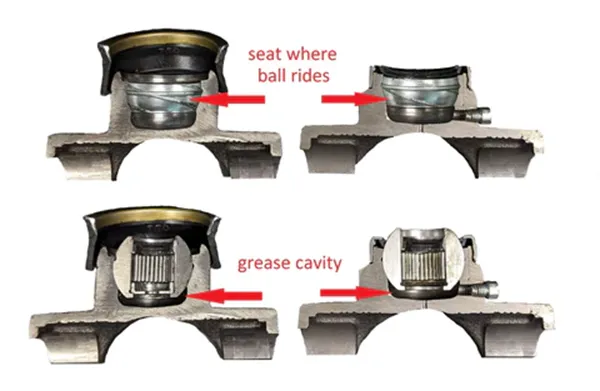
What experienced brand owners look for is not the technically superior option in isolation. They look for the option that performs most predictably across their actual customer base.
The Human Error Variable in Greasable Joints
A greasable ball joint relies on the end-user or a technician adding grease at defined intervals. In markets with strong service culture and professional workshop networks, this is a reasonable assumption. In markets where vehicles are owner-maintained or where workshop access is limited, this assumption breaks down.8 When the grease is not added, or when the wrong grease is used, the joint wears faster than a sealed unit would have. The warranty claim lands in your lap, not the end-user's.
The Finite Ceiling of Sealed Units
Sealed-for-life ball joints are factory-filled with grease and closed permanently. They do not require any maintenance input. This makes them predictable in service life terms, which is useful for your warranty program design. The limit is that the service life is fixed at the factory level. A better-maintained vehicle cannot extend it. For high-mileage commercial applications, this ceiling may be reached sooner than the operator expects.
How to Match the Product to Your Market
| Factor | Points Toward Greasable | Points Toward Sealed |
|---|---|---|
| End-user maintenance culture | Professional workshop access | Owner-maintained or irregular servicing |
| Vehicle application | Heavy-duty, off-road, high-load | Passenger car, light-duty, urban |
| Market warranty expectations | Longer life if maintained | Predictable, defined replacement interval |
| Your quality control preference | Relies on downstream behavior | Controlled entirely at manufacturing stage |
The decision is a risk allocation choice. Understanding your market's maintenance behavior is as important as understanding the part's technical specification.
Does IATF16949 Certification Actually Mean Anything for Your Supply Chain?
A lot of buyers see an IATF16949 certificate and move on. We understand why. Certificates can feel like paper exercises. But the standard itself, when it is genuinely implemented, changes the way a factory manages its production and quality processes in ways that directly protect your supply chain.
IATF16949 is not just a quality certificate. It is a process management framework that requires documented control plans, defined reaction procedures for out-of-specification production, and traceable records from raw material to finished product.9 For a buyer managing large-volume procurement, this traceability is what makes quality problems solvable instead of catastrophic.
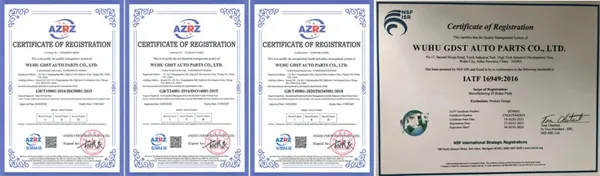
When we work through supplier evaluations with procurement managers, we push them to go beyond verifying the certificate exists. The certificate tells you the system was audited. It does not tell you how the supplier actually uses it day to day.
What Traceability Actually Gives You
If you receive a quality complaint from your customer, the first question is: which batch? The second question is: what happened in that batch? A supplier with genuine IATF16949 implementation can trace a defective part back to the raw material heat number, the production date, the machine it was processed on, and the QC inspection record. This means you can isolate a problem to a specific batch instead of treating it as a systemic failure across all inventory. That isolation protects your brand and limits your financial exposure.
The QC Process Behind the Certificate
At GDST, QC staff with more than five years of industry experience monitor every production process. We source steel from major Chinese mills including Baosteel, Shagang, and Yuanli, and we verify each batch with material inspection reports and random chemical composition testing. Every finished product goes through 100% final inspection before shipment. This includes product inspection, quantity verification, packaging condition, shipping marks, and pallet condition. The certificate reflects a system that is actually in use.
Questions to Ask Any Certified Supplier
| What to Ask | What a Meaningful Answer Looks Like |
|---|---|
| "Can you show me a control plan for this product?" | They produce a document with defined process parameters and inspection points |
| "What happens when a batch fails in-process inspection?" | They describe a documented non-conformance and hold procedure |
| "How do you trace raw material to finished product?" | They show a heat number or batch tracking system linked to material certs |
| "How do you handle a field quality complaint?" | They describe a root cause analysis process with corrective action records |
The goal of these questions is not to audit the supplier. The goal is to understand whether their quality management system is a living process or a framed certificate on the wall.
Conclusion
Ball joint maintenance starts before the part ships. Choose the right supplier, match the product to the application, and understand the trade-offs before you place the order. That is where warranty claims are prevented.
"Characterization and Failure Analysis of an Automotive Ball Joint", https://www.academia.edu/86760381/Characterization_and_Failure_Analysis_of_an_Automotive_Ball_Joint. Studies on automotive component failure frequently identify root causes in manufacturing processes, material defects, or design specifications that are ill-suited to the application, often outweighing maintenance lapses as a cause of premature failure. Evidence role: general_support; source type: paper. Supports: The claim that manufacturing defects, material choice, and incorrect design for the operating conditions are primary drivers of premature failure in automotive components.. ↩
"[PDF] effect of forging surface on fatigue behavoir of steels: a literature ...", https://www.nrc.gov/docs/ML1516/ML15161A221.pdf. In metallurgy, forging is understood to be a process that shapes metal using compressive forces, which refines the crystalline structure and aligns the grain flow, typically resulting in superior mechanical properties such as fatigue resistance and impact strength compared to casting. Evidence role: mechanism; source type: education. Supports: The claim that forging refines and directs the grain flow of metal to follow the part's contour, which enhances its strength, ductility, and resistance to impact and fatigue.. ↩
"Characterization and Analysis of Porosities in High Pressure Die ...", https://pmc.ncbi.nlm.nih.gov/articles/PMC7412358/. Research in materials science demonstrates that casting defects, such as gas porosity and shrinkage cavities, act as stress risers within the material, significantly reducing fatigue life by serving as initiation points for cracks. Evidence role: mechanism; source type: paper. Supports: The claim that casting can result in defects like porosity (micro-voids), which act as stress concentrators and are common initiation sites for fatigue cracks under cyclic loading.. ↩
"Heat treating", https://en.wikipedia.org/wiki/Heat_treating. Heat treatment is a group of industrial thermal processes used to intentionally alter the microstructure of materials like steel to achieve desirable mechanical properties, such as optimizing the balance between hardness, strength, and toughness for a specific application. Evidence role: definition; source type: education. Supports: The claim that heat treatment is a crucial process used to alter the microstructure of steel to achieve a desired balance between properties like hardness (wear resistance) and toughness (fracture resistance).. ↩
"Corrosion Risk Assessment in Coastal Environments Using Machine ...", https://pmc.ncbi.nlm.nih.gov/articles/PMC12252465/. Studies on vehicle corrosion, often conducted by transportation agencies or automotive research institutes, confirm that exposure to atmospheric salinity and de-icing salts dramatically accelerates the corrosion of underbody and suspension components, leading to a reduced service life. Evidence role: general_support; source type: government. Supports: The claim that environmental factors like high humidity and salt exposure, common in coastal areas or regions with winter road treatment, significantly accelerate the corrosion and degradation of automotive chassis components.. ↩
"Salt spray test - Wikipedia", https://en.wikipedia.org/wiki/Salt_spray_test. The neutral salt spray (NSS) test, governed by standards such as ASTM B117 and ISO 9227, is an accelerated corrosion test method used to evaluate the suitability of coatings and materials for use in corrosive environments. Evidence role: definition; source type: institution. Supports: The claim that salt spray testing is a standardized, widely used method for checking the comparative corrosion resistance of materials and surface coatings.. ↩
"[PDF] Joint and Sealant Design Optimization", https://www.engineering.pitt.edu/contentassets/90f53cc6fd294d10ae8a41d45e28b017/rba-joint_design_opt_final_re.pdf. The operational life of 'sealed-for-life' components is determined by the finite lifespan of the internal lubricant and the integrity of the seals. Once the grease degrades or the seals fail, allowing contamination, the component's wear accelerates toward inevitable failure. Evidence role: mechanism; source type: education. Supports: The claim that the service life of a sealed-for-life component is ultimately limited by the degradation of its initial grease charge and the eventual failure of its seals.. ↩
"Automotive industry trends and prospects for investment in ...", https://documents.worldbank.org/en/publication/documents-reports/documentdetail/736491468781507045. Market research on the global automotive aftermarket often highlights regional differences in service behavior, noting that in some markets, a higher percentage of vehicle owners perform their own maintenance or delay professional service, which can affect the lifespan of serviceable components. Evidence role: general_support; source type: research. Supports: The claim that vehicle maintenance practices vary significantly between markets, with a higher prevalence of do-it-yourself (DIY) or deferred maintenance in some regions.. Scope note: The source may provide general market trends rather than specific data on ball joint lubrication practices. ↩
"IATF 16949 - Wikipedia", https://en.wikipedia.org/wiki/IATF_16949. Published by the International Automotive Task Force (IATF), the IATF 16949 standard defines the requirements for a quality management system for organizations in the automotive industry, with core tenets including risk-based thinking, process control, and product traceability. Evidence role: definition; source type: institution. Supports: The claim that IATF 16949 is a technical specification for automotive quality management systems that emphasizes defect prevention, supply chain management, and continual improvement.. ↩