
If your customer calls with a knocking sound or a pulling steering wheel, the first instinct is to blame the ball joint. That instinct is often wrong.
A faulty ball joint typically shows four warning signs: unusual knocking or clunking noise during low-speed turns, excessive play or looseness in the joint, uneven or accelerated tire wear on one side, and a torn or cracked dust boot. Each of these signals a different stage of failure and points to a different root cause.
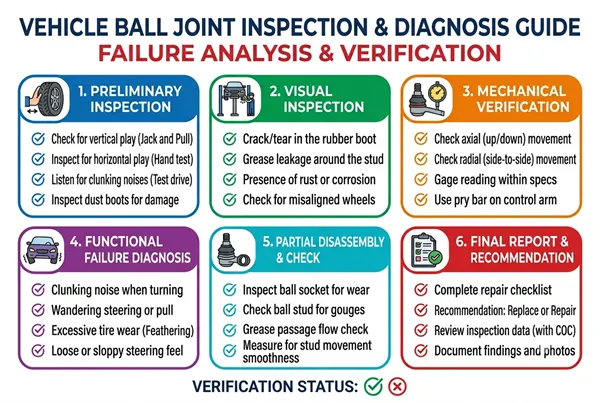
The real problem for a distributor is not spotting the symptom. It is figuring out what actually caused it. Based on the complaint patterns we receive from distributors worldwide, the same four symptoms show up repeatedly — but they come from very different root causes. Getting that wrong means absorbing returns you do not owe, or missing ones you do.
Is That Knocking Sound Actually Coming From the Ball Joint?
Your customer hears a knock. They say it is the ball joint. But is it?
Knocking or clunking sounds from a worn ball joint follow a specific pattern. They appear at low speeds, during direction changes, or when the steering is turned near full lock. If the noise is consistent at highway speeds or over straight-road bumps only, the ball joint is often not the source.
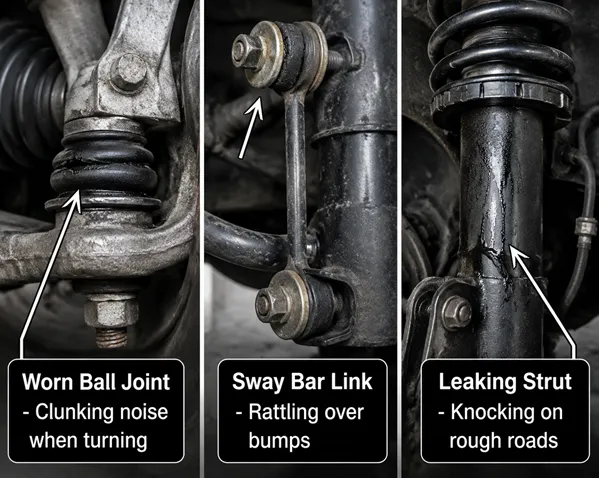
This distinction matters because struts, sway bar links, and worn bushings all produce knocking sounds too. Without the right frame for reading the complaint, your customer replaces the wrong part and comes back to you.
Here is how to separate ball joint noise from other common sources:
What makes ball joint noise different from other suspension noise?
A ball joint carries load at the pivot point between the control arm and the steering knuckle.1 When the joint has worn clearance, it produces play under directional load change. That is what creates the knock — not road vibration alone, but load shifting through the joint during a turn or a weight transfer.2
Sway bar links, by contrast, produce noise more consistently over bumps in a straight line, because their function is lateral stability, not directional pivot. Strut noise tends to be louder on compression — going over a speed bump or a pothole — and less related to steering angle.
| Noise Source | When It Typically Appears | Related Movement |
|---|---|---|
| Ball joint wear | Low-speed turns, direction change | Steering input, weight transfer |
| Sway bar link wear | Straight-line bumps, body roll | Lateral load, bump travel |
| Strut wear | Compression over bumps | Vertical impact |
| Worn bushing | General noise at varied speeds | Multiple load directions |
When your customer describes a knock that gets worse during parking-lot-speed turns or when pulling out of a junction, that pattern points toward the ball joint. When the knock is random or tied to road surface only, redirect the diagnosis first.
This is the language your customer needs before they start replacing parts. Giving them this frame reduces misdiagnosis — and reduces the chance they replace your product when the fault is somewhere else.
What Does Measurable Play Actually Tell You?
Your customer says the ball joint feels loose. But loose compared to what?
Excessive play in a ball joint means axial or radial movement beyond the acceptable tolerance for that joint.3 A joint within specification will have a defined and limited range of movement. Once wear pushes play beyond that range, the joint can no longer maintain accurate steering geometry or stable load transfer.
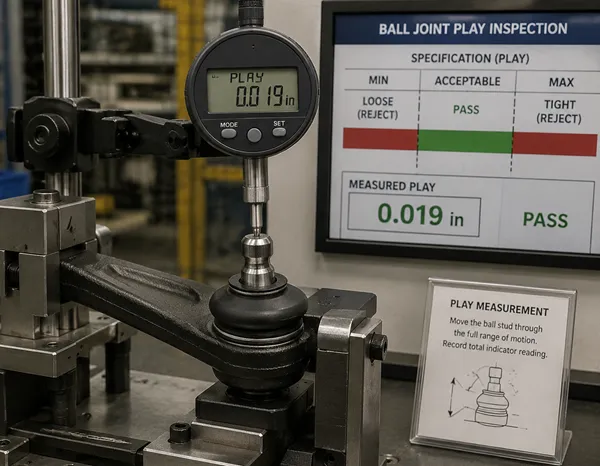
At GDST, our QC process measures play at final inspection for every production batch. Joints that exceed our internal tolerance range are rejected before shipment. This gives us a clear baseline for what "in spec" looks like when a product leaves the factory.
How do you use play measurement to triage a complaint?
The reason play measurement matters for distributors is not just technical. It is a triage tool. When a customer reports a failed joint, the play condition tells you something specific about when and how the failure happened.
A joint that shipped in spec but shows heavy play after a short service period points toward one of two things: either the operating environment accelerated wear — contamination, overloading, or pre-existing hub wear — or the installation introduced stress that damaged the joint early. A joint that shows play consistent with a manufacturing defect would typically present across a batch, not as an isolated unit failure.
| Condition | Likely Explanation |
|---|---|
| Play within spec at installation, excessive after short use | Installation error, contamination, or pre-worn mating component |
| Play excessive immediately after installation | Possible manufacturing defect — check batch |
| Play within spec, other symptoms present | Look at other components before accepting a return |
| Multiple units from same batch showing excessive play | Escalate as a quality batch issue |
The most common mistake we see in return claims is that a distributor accepts a single-unit return without checking the installation conditions. One unit failing early does not confirm a product defect. It opens the question. The investigation needs to go further before the root cause is confirmed.
This is not about protecting the supplier by default. It is about making an accurate call. If the root cause is a manufacturing defect, we want to know. If the root cause is installation, that needs to be documented — because the same installation error will happen again on the next unit too.
Why Does the Dust Boot Matter Before Anything Else?
Most customers ignore the dust boot until the noise starts. By then, the damage is already done.
The dust boot on a ball joint seals the grease inside and keeps contamination out.4 Once the boot tears or cracks, dirt, moisture, and road debris enter the joint. This accelerates internal wear significantly and shortens the service life of even a correctly installed, good-quality ball joint.
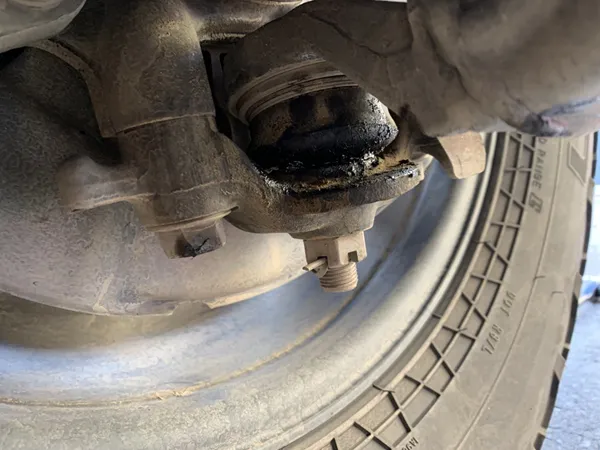
The boot condition is a leading indicator. It shows you the joint is heading toward failure before the joint itself gives any obvious symptom. For distributors, this is an important checkpoint to give your downstream customers — because catching a torn boot early is far cheaper than replacing the whole joint after contamination damage has occurred.
How should distributors communicate boot condition to their customers?
The challenge is that end customers do not inspect the boot routinely. They wait for noise or instability, which means the boot failure has already done weeks or months of damage before anyone looks at it.
There are two practical situations where boot condition comes up in a return or complaint scenario:
The first is at installation. A ball joint that arrives with a damaged boot — due to mishandling during shipping or storage — should be flagged before installation. Installing a joint with a compromised boot shortens its service life immediately. If the customer installs it anyway and the joint fails early, the root cause is the damaged boot, not a defect in the joint itself.
The second is during a wear or noise complaint. If a customer reports early failure and inspection shows a torn boot and contaminated grease, that explains the wear pattern. It shifts the investigation toward handling or installation conditions rather than product quality.
| Boot Condition | What It Indicates |
|---|---|
| Intact, grease sealed | Normal condition, joint protected |
| Small crack or pinhole | Early contamination risk — monitor or replace boot |
| Torn or collapsed | Contamination likely already present — inspect joint for wear |
| Boot intact but grease discolored or gritty | Possible previous contamination — assess joint play |
The practical message for distributors is this: train your customers to check the boot as part of their standard pre-installation inspection. It takes ten seconds. Catching a damaged boot at that stage prevents a premature failure complaint six months later.
Does a Short Service Life Always Mean a Product Defect?
This is the most contested return scenario. The customer installed the ball joint recently and it has already failed. They want a replacement. But is the fault in the product?
Short service life after ball joint installation does not automatically mean a manufacturing defect. The most common causes of early failure include overtorquing during installation, use of an impact tool on the stud, failure to inspect the pre-existing condition of the hub bore or control arm, and contaminated or damaged boots at the time of installation.
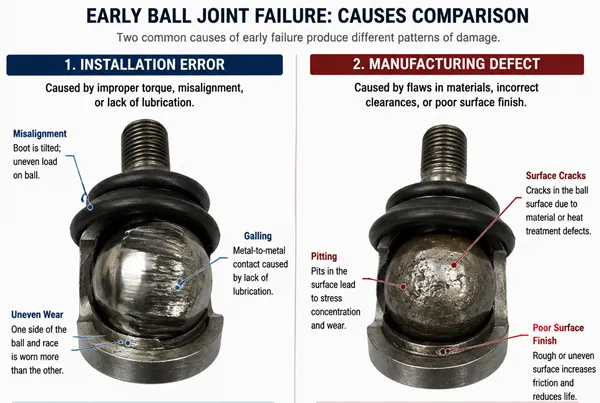
This is a difficult conversation for distributors. The customer is unhappy. The failure is real. But accepting every early failure as a product quality claim without triage is costly — and it does not solve the actual problem if the real cause is installation practice.
How do you triage an early ball joint failure honestly?
The honest triage starts with gathering information, not assigning blame. There are specific conditions that point toward installation error and specific conditions that point toward manufacturing defect. Neither conclusion should be assumed by default.
Installation error is more likely when:
- The failure is a single unit, not a batch pattern
- The stud shows deformation consistent with impact tool use
- The hub bore or control arm socket shows pre-existing wear or corrosion
- The boot is torn or the grease is already contaminated at the time of the complaint
- The joint was installed without following the torque specification
Manufacturing defect is more likely when:
- Multiple units from the same batch show the same failure pattern
- The failure mode is consistent — for example, stud fracture at the same point across units
- The failure appears before any significant load or wear could realistically have occurred
- The joint was installed correctly and the mating components were in good condition
| Indicator | Points Toward Installation Error | Points Toward Manufacturing Defect |
|---|---|---|
| Number of units affected | Single unit | Multiple units, same batch |
| Stud condition | Deformation, thread damage | Clean fracture at consistent point |
| Boot condition at complaint | Torn, contaminated | Intact |
| Mating component condition | Worn hub bore, corroded socket | Normal condition |
| Failure timing | After heavy use or misuse | Very early, before significant load |
The point is not to default to protecting the supplier. The point is to get the root cause right. If it is a manufacturing defect, it needs to be addressed at the batch level. If it is an installation issue, the customer needs accurate information — because they will repeat the same error on the next unit otherwise.
We recommend that distributors document these conditions for every early failure claim before making a replacement decision. That documentation protects all parties and builds a clearer picture of where problems actually originate.
Conclusion
A faulty ball joint shows specific, readable signs — but correct diagnosis requires separating the symptom from the cause. Noise patterns, measurable play, boot condition, and installation history each tell a different part of the story.
"What Are Ball Joints? | UTI - Universal Technical Institute", https://www.uti.edu/blog/automotive/ball-joints. Automotive engineering texts define the ball joint as a spherical bearing that connects the control arm to the steering knuckle, serving as a critical pivot point that accommodates steering and suspension movement while supporting vehicle loads. Evidence role: definition; source type: encyclopedia. Supports: The mechanical role of a ball joint in a vehicle's suspension system.. ↩
"Car suspension - Wikipedia", https://en.wikipedia.org/wiki/Car_suspension. Research on vehicle component wear shows that as a ball joint wears, the clearance (play) between the ball stud and socket increases. When the direction of force changes, such as during a turn, the stud moves rapidly across this gap, creating an impact that is heard as a knock or clunk. Evidence role: mechanism; source type: research. Supports: The mechanism by which wear-induced play in a ball joint results in a knocking sound.. ↩
"BALL JOINT WEAR 2", https://www.mshp.dps.missouri.gov/MSHPWeb/Publications/OtherPublications/documents/ballJointTolerances.pdf. Vehicle manufacturers and standards organizations like the SAE (Society of Automotive Engineers) define specific tolerances for axial and radial play in suspension components. Movement exceeding these specifications is considered excessive and indicates a worn joint. Evidence role: definition; source type: institution. Supports: The definition of excessive play in a ball joint relative to manufacturer specifications.. Scope note: While the concept of tolerances is universal, the exact numerical values are specific to the vehicle model and component design. ↩
"Process Design of a Ball Joint, Considering Caulking and Pull-Out ...", https://pmc.ncbi.nlm.nih.gov/articles/PMC4106181/. Automotive engineering resources describe the dust boot as a critical sealing component. Its purpose is twofold: to retain the lubricating grease within the joint's articulating surfaces and to prevent the ingress of abrasive contaminants like dirt, water, and road salt. Evidence role: definition; source type: education. Supports: The primary function of a ball joint's dust boot.. ↩