Most buyers ask this question after receiving warranty complaints. By then, the damage to their brand is already done.
Ball joints fail because of three supplier-controlled factors: material quality, manufacturing process, and quality verification.1 When any one of these is compromised, the result is premature wear, loss of stiffness, or structural failure — all of which lead to warranty claims and customer complaints in the field.
We have worked with procurement managers and aftermarket distributors in over 100 countries for more than 20 years. The question "why do ball joints fail?" comes up in almost every serious sourcing conversation. But the real question behind it is always the same: "How do I choose a supplier that keeps failures from happening in the first place?"
This article answers that question directly.
Does a Ball Joint Warn You Before It Fails?
Most buyers expect a failed ball joint to announce itself with a loud noise or obvious vibration. That expectation is dangerous.
A ball joint can lose its required stiffness and still feel quiet during normal driving.2 The first sign is often a subtle change in steering response. By the time a driver notices clunking or play, the joint has already been operating outside its design range for some time.3
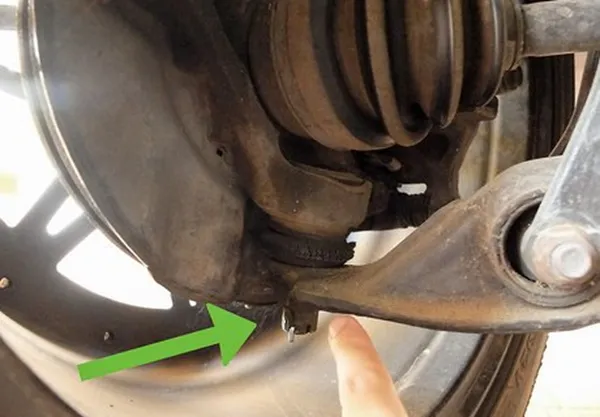
Failure is a process, not a single event. We often tell buyers that the failures they see in the field — noise, loose steering, separation — are just the final stage of a much longer degradation process. That process usually starts with something invisible.
What does early-stage failure actually look like?
The three most common early-stage failure modes we see in returned parts are grease degradation, dust boot cracking, and stud swing torque loss.4 None of these are visible during a quick inspection. All of them directly reduce the service life of the joint.
| Early Failure Mode | What Causes It | What the Driver Notices |
|---|---|---|
| Grease degradation | Poor grease grade or seal quality | Nothing at first |
| Dust boot cracking | Low-quality rubber compound | Visible crack, dirt entry |
| Stud torque loss | Inconsistent material hardness | Soft steering feel |
Buyers who only track "broken" units in warranty data miss the full picture. A joint that causes a handling complaint and gets replaced is still a warranty event, even if it never fully separated. When procurement managers focus only on catastrophic failure rates, they tend to underestimate the true cost of a poor-quality supply.
The key point is this: the "no noise means no problem" assumption leads buyers to accept parts that are already failing slowly. A better measure is certified fatigue life and torque specifications — these predict long-term field performance in a way that a quick inspection never can.
Does the Steel Really Make That Much Difference?
We get this question often, especially from buyers comparing quotes from multiple suppliers. The short answer is yes. The longer answer is that the steel choice affects not just strength, but consistency across every batch.
The difference between certified alloy steel and untraceable low-grade steel is not just mechanical strength. It is batch consistency. Parts made from unverified steel can pass a single prototype test and still show wide variation in hardness and fatigue life across a production run.5
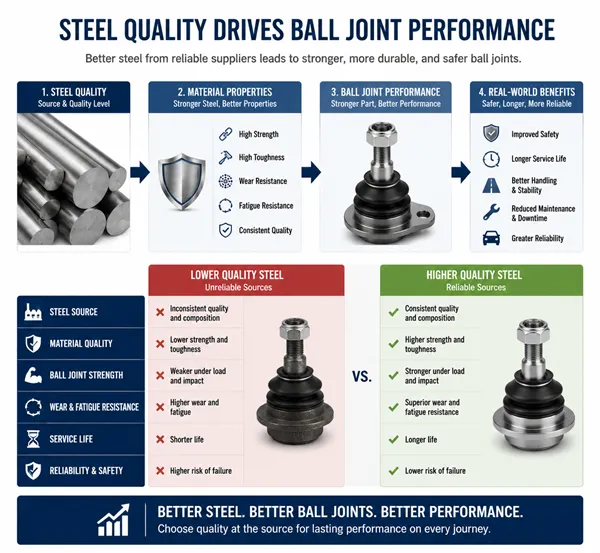
At our factory, we source steel from suppliers like Baosteel, Shagang, and Yuanli. Every batch comes with a material inspection report. Our QC team also conducts random chemical composition tests independently. This is not just a quality procedure — it is a risk management step for our buyers.
What business risk does steel quality actually control?
When a buyer receives 5,000 ball joints from a supplier using unverified steel, they may not see a problem in the first shipment, or even the second. The problem appears six months after the parts are installed, when failure rates in one batch are suddenly higher than in another. That variation is almost always traced back to inconsistent raw material.
| Steel Type | Traceability | Hardness Consistency | Fatigue Life Predictability |
|---|---|---|---|
| Certified 40Cr alloy steel6 | Full batch reports available | High | High |
| Generic carbon steel (unverified) | No documentation | Variable | Low |
| Recycled or mixed grade steel | None | Very variable | Unreliable |
The business impact of this is straightforward. Inconsistent parts mean inconsistent warranty rates. Inconsistent warranty rates mean your customers lose confidence in your brand. We have seen buyers switch suppliers after a single bad batch because the brand damage in their local market took years to repair. Choosing a supplier that documents and tests every steel batch is not a premium feature — it is the minimum standard for protecting your business.
Does the Manufacturing Process Affect Failure Rates?
Two ball joints can be made from the same grade of steel and still have very different service lives. The difference is in how they are manufactured.
Forging and casting produce structurally different housings. A forged housing has a continuous grain structure that resists cracking under repeated stress.7 A cast housing has internal porosity that can become a failure point under load.8 For high-stress applications, this difference directly affects field failure rates.
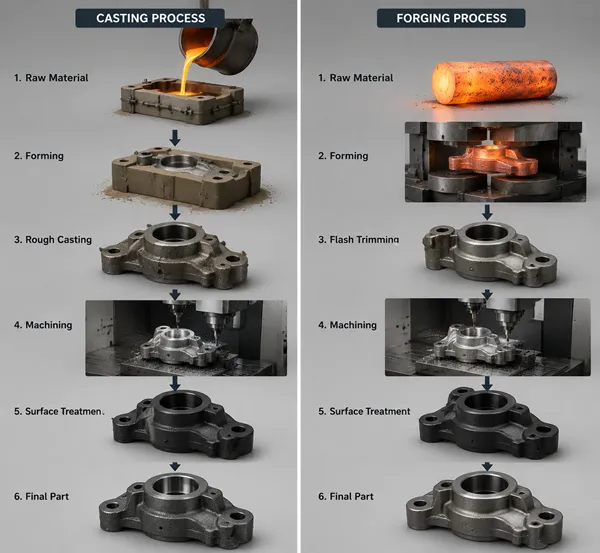
We manufacture using casting, forging, CNC machining, and surface treatment depending on the application requirement. The process is not chosen by cost alone. It is chosen by the load conditions and vehicle application that the part is designed for.
How do specific manufacturing choices translate to buyer risk?
This is the area where we see the most confusion in sourcing decisions. Buyers often compare specifications on paper — diameter, thread pitch, material grade — without asking how the housing was formed or how the stud was hardened. Two parts with identical dimensions can perform very differently in the field.
| Manufacturing Variable | Lower-Quality Approach | Higher-Quality Approach | Buyer Impact |
|---|---|---|---|
| Housing formation | Casting (potential porosity) | Forging (dense grain structure) | Affects fatigue life under stress |
| Stud hardness control | Batch heat treatment, no individual check | Controlled hardness range, tested per batch | Affects torque consistency |
| Dimensional tolerance | ±0.5 mm or wider | ±0.2 mm | Affects fitment and noise on installation |
| Surface treatment | Basic coating | Salt spray tested (500+ hours) | Affects corrosion resistance in wet markets |
When a procurement manager asks us about failure rates for a specific vehicle application, we do not give a single answer. We ask about the target market climate, road conditions, and typical vehicle loads first. Then we recommend the appropriate process. A light passenger car application in a temperate climate has different requirements than a heavy-duty truck part sold in a high-humidity coastal market. The manufacturing process must match the end application. A supplier who offers the same process for every part regardless of application is not controlling failure risk — they are ignoring it.
Does a Quality Certification Actually Reduce Your Risk?
Certifications like IATF16949 and ISO9001 appear on almost every supplier's profile. Buyers often treat them as a checkbox rather than a meaningful differentiator. That is a mistake.
IATF16949 certification means the supplier has a documented system to control every step from raw material sourcing to final shipment.9 It does not guarantee a perfect product. It does mean that when a problem occurs, there is a traceable process to identify the source and prevent it from repeating.10
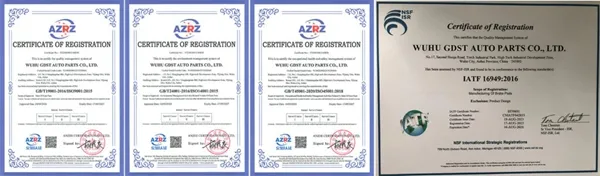
The practical meaning of IATF16949 for a buyer is this: you are not relying on the supplier's word that quality is consistent. You are relying on a system that is regularly audited by a third party. That system covers material documentation, process control, inspection records, and corrective action procedures.
What does the quality system look like in practice?
At our factory, every production batch goes through a defined set of quality tests before it leaves. These tests are not optional and they are not sampled selectively. They are part of the production process.
| Test Type | What It Checks | Why It Matters to the Buyer |
|---|---|---|
| Pull-out and compression force | Structural integrity of stud retention | Predicts failure under load in the field |
| Torque and angle testing | Stud swing resistance within spec range | Predicts steering feel and handling consistency |
| Salt spray testing11 | Corrosion resistance of surface treatment | Relevant for humid and coastal markets |
| Fatigue testing12 | Service life under repeated stress cycles | Predicts warranty rates over time |
| 100% final inspection | Quantity, packaging, labeling, pallet condition | Prevents shipment errors and packaging damage claims |
A supplier who cannot show you their testing records for a specific part number is asking you to trust their word. A supplier with a certified quality system can show you the data. For a procurement manager managing millions of dollars in annual purchasing, that data is not a formality — it is the foundation of supply chain risk management. Every warranty claim you avoid is a direct saving in after-sales costs and a direct protection of your market reputation.
Conclusion
Ball joint failure is not random. It is the result of specific choices a supplier makes in materials, manufacturing, and quality control. Understanding those choices is how you protect your business.
"Suspension Damage: What To Look For - Universal Technical Institute", https://www.uti.edu/blog/collision/suspension-damage. Studies on automotive component failure analysis often identify material defects, improper manufacturing techniques, and inadequate quality control as the primary root causes for the premature failure of critical suspension parts like ball joints. Evidence role: general_support; source type: paper. Supports: That ball joint failures are commonly traced back to deficiencies in material selection, manufacturing methods, and quality assurance processes.. ↩
"Symptoms of Bad Ball Joints - MOOG Parts", https://www.moogparts.com/parts-matter/symptoms-of-bad-ball-joints.html. Vehicle inspection guides and automotive safety resources note that early ball joint wear can manifest as a degradation in performance, such as reduced stiffness, before progressing to more obvious symptoms like clunking noises or excessive play. Evidence role: mechanism; source type: government. Supports: That the initial stages of ball joint wear, such as a loss of preload or stiffness, may not produce audible or tactile feedback for the driver.. ↩
"What happens if a ball joint breaks while driving? - Quora", https://www.quora.com/What-happens-if-a-ball-joint-breaks-while-driving. Automotive technology programs teach that by the time a ball joint produces audible clunking, the internal components have often worn to the point of creating excessive clearance, representing a late stage of failure. Evidence role: mechanism; source type: education. Supports: That audible noises like 'clunking' are typically symptoms of advanced wear in a ball joint, indicating that the component has been operating in a degraded state for a period.. ↩
"Characterization and Failure Analysis of an Automotive Ball Joint", https://www.academia.edu/86760381/Characterization_and_Failure_Analysis_of_an_Automotive_Ball_Joint. Failure analysis reports on suspension components often identify dust boot integrity and lubricant quality as critical factors, with cracks or grease degradation leading to accelerated wear and eventual failure. Evidence role: case_reference; source type: paper. Supports: That analysis of failed ball joints frequently reveals that initial degradation begins with the compromise of the dust boot, contamination or breakdown of the lubricating grease, or a loss of internal preload (torque).. Scope note: The source may not rank these as the top three but should confirm they are common and critical early failure modes. ↩
"Influence of Different Alloying Strategies on the Mechanical ... - PMC", https://pmc.ncbi.nlm.nih.gov/articles/PMC8233732/. Research in materials engineering demonstrates that batch-to-batch inconsistency in the properties of steel products is often attributable to a lack of control over the composition and processing of the raw material, which may not be detected by single-prototype testing. Evidence role: mechanism; source type: paper. Supports: That without strict control and traceability of raw materials, significant variations in chemical composition and microstructure can occur between production batches, leading to inconsistent mechanical properties like hardness and fatigue resistance.. ↩
"40Cr Steel Material Sheet Plate Round Bar", https://songshunsteel.com/product/40cr-steel-material-sheet-plate-round-bar/. 40Cr is a medium-carbon chromium alloy steel, specified under standards like China's GB/T 3077. Its composition provides a good balance of hardness, strength, and toughness after heat treatment, making it suitable for manufacturing various mechanical parts, including shafts, gears, and connecting rods. Evidence role: definition; source type: other. Supports: That 40Cr is a grade of alloy steel with specific chemical composition and mechanical properties suitable for quenched and tempered parts requiring good strength and toughness.. Scope note: The source will be a materials database or supplier datasheet rather than a peer-reviewed paper, but it provides standard technical data. ↩
"[PDF] effect of forging surface on fatigue behavoir of steels: a literature ...", https://www.nrc.gov/docs/ML1516/ML15161A221.pdf. Materials engineering principles state that the forging process produces a refined and continuous grain structure that follows the contour of the component, which significantly improves its mechanical properties, particularly toughness and fatigue strength, compared to casting. Evidence role: mechanism; source type: education. Supports: That the forging process aligns the metal's internal grain structure with the shape of the part, creating a continuous grain flow that enhances strength and resistance to fatigue and cracking.. ↩
"[PDF] Fatigue of 8630 cast steel in the presence of porosity", https://beckermann.lab.uiowa.edu/sites/beckermann.lab.uiowa.edu/files/2023-10/Sigl.pdf. Metallurgical studies show that porosity, an inherent potential defect in cast components, acts as a stress concentrator that can significantly reduce the fatigue life of a part by providing initiation points for cracks under cyclic load. Evidence role: mechanism; source type: paper. Supports: That porosity is a common defect in metal casting, and these internal voids can act as stress risers, becoming initiation sites for fatigue cracks when the component is subjected to cyclic loading.. ↩
"IATF 16949 - Wikipedia", https://en.wikipedia.org/wiki/IATF_16949. The International Automotive Task Force (IATF) defines IATF 16949 as a global quality management system standard for the automotive industry, which outlines processes for continuous improvement, defect prevention, and the reduction of variation and waste throughout the supply chain. Evidence role: definition; source type: institution. Supports: That the IATF 16949 standard specifies the requirements for a quality management system for organizations in the automotive supply chain.. ↩
"IATF 16949:2016 Clause 8.5.2.1 Identification and traceability", https://preteshbiswas.com/2023/08/01/iatf-169492016-clause-8-5-2-1-identification-and-traceability/. Key clauses within the IATF 16949 standard mandate that certified organizations must maintain robust systems for product traceability and implement a disciplined corrective action process to address nonconformities, identify root causes, and prevent future occurrences. Evidence role: general_support; source type: institution. Supports: That the IATF 16949 standard includes specific requirements for product traceability and a structured process for problem-solving, including root cause analysis and the implementation of corrective actions to prevent recurrence.. ↩
"Salt spray test - Wikipedia", https://en.wikipedia.org/wiki/Salt_spray_test. Standardized test methods, such as ASTM B117, describe the use of a salt spray (or fog) apparatus to create a highly corrosive environment. This test is used to assess the relative corrosion resistance of coated metal parts, with performance often measured in the number of hours before corrosion appears. Evidence role: definition; source type: institution. Supports: That salt spray testing is an accelerated corrosion test used to evaluate the effectiveness of protective coatings on materials.. ↩
"Fatigue Testing Services | ITS", https://its-inc.com/services/mechanical-testing/fatigue-testing/. Fatigue testing is a method used in materials science and engineering to determine how a component behaves under cyclic loading. It is used to generate data on the lifespan of a part before it fails due to fatigue, which is critical for ensuring the reliability of components like vehicle suspension parts. Evidence role: definition; source type: encyclopedia. Supports: That fatigue testing subjects a material or component to repeated cyclic loading to determine its structural life and predict its durability under real-world service conditions.. ↩