
Ball joints fail quietly — until they don't. When they go, the results can be dangerous and expensive1. Here is what most buyers never do to prevent it.
Extending ball joint lifespan comes down to three things: proper installation, regular greasing, and early detection of wear. Ball joints that are correctly installed, kept lubricated, and inspected at regular intervals consistently outlast those that are not. Most premature failures are preventable.2
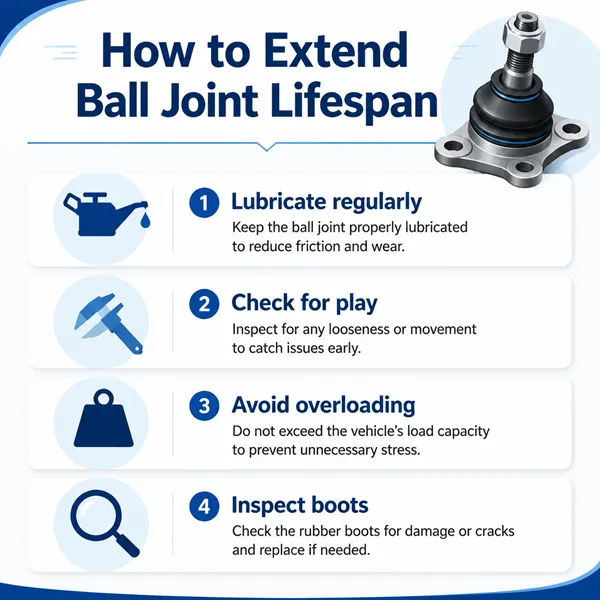
Most people only think about ball joints after something goes wrong. A clunking noise. Uneven tire wear. A vehicle that pulls to one side. By that point, the damage is already done. But after more than 20 years of manufacturing suspension parts at GDST, I have seen the same patterns repeat. The fixes are not complicated. Let me walk you through what actually works.
Does Installation Quality Affect How Long a Ball Joint Lasts?
A bad install can destroy a quality ball joint in months. This is one of the most common causes of early failure — and it is entirely avoidable.
Yes, installation quality directly affects ball joint lifespan. Common mistakes include over-torquing the castle nut, using heat on the joint during fitting, and forcing a misaligned taper. Any of these can damage the internal components or compromise the boot seal before the vehicle even leaves the workshop.
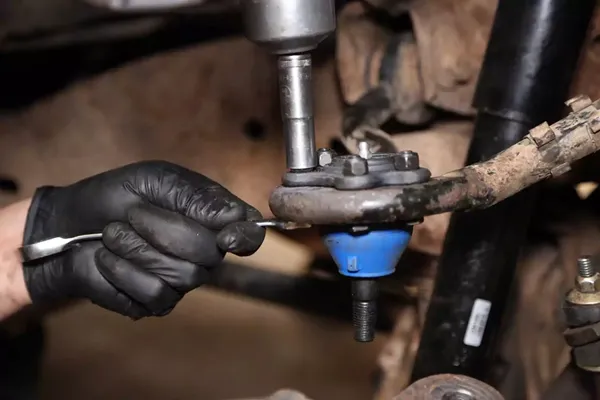
I have spoken with distributors who received warranty claims from their customers — and after investigating, most of the failures traced back to how the parts were installed, not the parts themselves3. This is a real problem in the aftermarket, and it affects brand reputation unfairly.
Here are the most critical installation points to get right every time:
What are the most common installation mistakes?
| Mistake | Why It Causes Failure |
|---|---|
| Over-torquing the castle nut4 | Compresses the bearing cartridge and restricts movement |
| Using an open flame to heat the knuckle | Damages the boot and internal grease packing |
| Hammering the stud instead of using a press | Creates micro-fractures in the taper seat |
| Reusing a worn knuckle bore | The loose fit causes the joint to move and wear rapidly |
| Skipping alignment after installation | Creates uneven load distribution on the joint |
The taper fit is particularly important. The ball joint stud should seat fully into the knuckle bore with no gap. If the bore is worn or out of round, even a brand-new joint will fail early. A simple check with a taper gauge before installation can save a lot of problems later.
At GDST, we manufacture all ball joint tapers to OE dimensional specifications. OE-level taper geometry control and strict fitment accuracy. But even the most precise part cannot perform well if it is installed incorrectly. Proper tooling — specifically a ball joint press kit — is not optional. It is necessary.
One more thing: always torque the castle nut to the vehicle manufacturer's specification. Finger-tight is not enough. Over-tight is damaging. Use a calibrated torque wrench, and always fit a new cotter pin after torquing.
How Does Lubrication Impact Ball Joint Lifespan?
Friction is the enemy of any moving metal component. Ball joints are no exception. The right lubrication, applied at the right intervals, can double the service life of a joint5.
Regular greasing significantly extends ball joint lifespan by reducing friction between the ball stud and bearing socket. For greaseable ball joints, lubrication every 10,000 to 15,000 km is a general guideline6. Using the wrong grease type, or skipping lubrication entirely, leads to accelerated wear and premature failure.
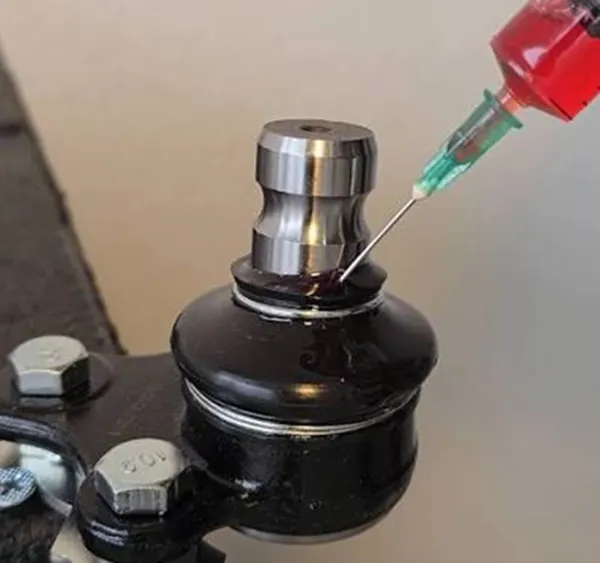
There are two types of ball joints in the market: sealed for life and greaseable. Each has its place. Sealed joints are convenient and work well in normal driving conditions. Greaseable joints are better suited for heavy-duty or off-road applications where contamination risk is higher.
What type of grease works best for ball joints?
Not all grease is the same. Using the wrong type can be as damaging as using no grease at all.
| Grease Type | Suitable For | Notes |
|---|---|---|
| NLGI #2 Lithium Complex | General passenger car use | Most widely used, good temperature range |
| NLGI #2 Moly (Molybdenum Disulfide)7 | Heavy-duty trucks, off-road | Better extreme pressure performance |
| Polyurea Grease | High-heat environments | Do not mix with lithium-based grease |
| Silicone Grease | Boot preservation only | Not suitable for metal-to-metal contact |
Always use a grease gun with a needle tip adaptor for greaseable fittings. Apply grease slowly until you see the boot slightly expand — this shows the joint cavity is full. Do not over-grease. Excess pressure can split the boot, which removes the protection entirely.
In our production process at GDST, we pack all sealed ball joints with high-quality grease during assembly and seal the boot under controlled conditions. The grease volume and boot integrity are part of our quality check before shipment. But for greaseable joints, the maintenance responsibility sits with the end user or workshop.
Remind your customers of this. A simple instruction sheet in the packaging — specifying grease type, interval, and procedure — reduces warranty claims and improves customer satisfaction. It is a small investment that protects your brand.
Can Driving Conditions Shorten Ball Joint Life?
Two identical ball joints installed on two different vehicles can have very different service lives. The difference is often how and where the vehicle is driven.
Yes, driving conditions have a major impact on ball joint lifespan. Rough roads, heavy loads, frequent off-road use, and aggressive driving habits all increase stress on the joint. Under these conditions, a ball joint rated for 100,000 km under normal use may wear out in a fraction of that distance8.
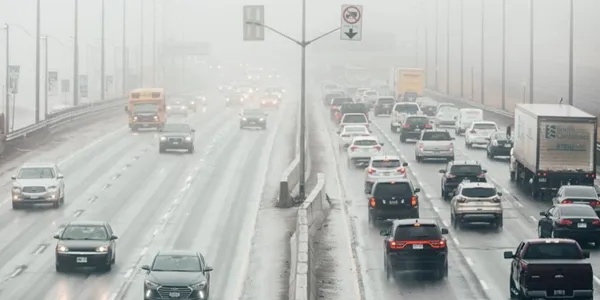
This is not just a theoretical concern. I have seen it firsthand in how different markets report failure rates. Customers in regions with poor road infrastructure — parts of Latin America, Southeast Asia, and Africa — report significantly shorter service intervals9 than customers in Western Europe or North America. Same parts. Different environments.
How do different driving conditions affect ball joint wear rates?
| Driving Condition | Impact on Ball Joint | Recommended Action |
|---|---|---|
| Potholed or unpaved roads | High shock loads on the joint stud | Choose heavy-duty spec joints, inspect more frequently |
| Frequent towing or overloading | Constant elevated stress on bearing surface | Use joints rated for higher axle load applications |
| Off-road use (mud, water, dust) | Contamination penetrates the boot | Use greaseable joints, re-grease after each off-road session |
| City driving (frequent turns, low speed) | High articulation angles, constant movement | Normal spec joints work, but grease intervals matter |
| Highway driving at constant speed | Relatively low stress, minimal articulation | Standard spec joints perform well over long distances |
When I work with procurement managers and distributors, I always ask about their primary market. A buyer sourcing for a fleet of trucks operating in rough terrain needs a different specification than someone sourcing for passenger car dealers in Germany. The product must match the application.
At GDST, we offer different performance grades for this reason. Standard, heavy-duty, and off-road specifications are available for many of our product lines. The right specification for the right application is not a marketing concept — it directly determines how long the part lasts in the field and how often your customers come back with problems.
How Do You Detect Ball Joint Wear Before It Becomes a Failure?
The best time to replace a ball joint is before it fails. Identifying wear early prevents accidents, protects your customers, and reduces warranty disputes.
Early signs of ball joint wear include clunking noises from the front suspension, uneven or rapid tire wear, vibration through the steering wheel, and a loose or wandering steering feel10. A physical inspection using the correct jacking and pry-bar method can confirm wear before the joint reaches the failure point.
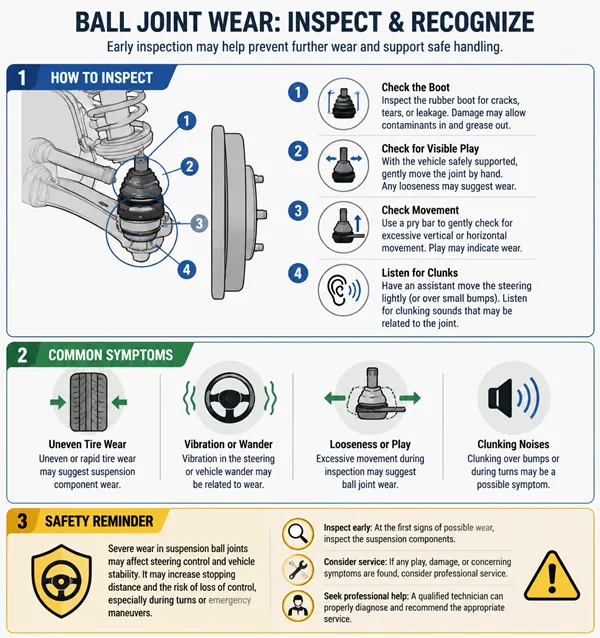
Many vehicle owners ignore early warning signs. The clunk gets louder. The tire wear gets worse. Then one day the joint separates completely. In some cases this results in loss of steering control.11 This is why early detection matters — not just for the part, but for safety.
What does a proper ball joint inspection involve?
| Inspection Step | Method | What to Look For |
|---|---|---|
| Visual check | Look at the boot | Cracked, torn, or missing boot means contamination has entered |
| Vertical play check | Jack under the lower control arm, pry vertically | Any vertical movement indicates wear |
| Horizontal play check | Grab the tire at 9 and 3 o'clock, rock back and forth | Excessive horizontal play may indicate tie rod or ball joint wear |
| Dial gauge measurement | Use a dial indicator on the stud | Compare reading against manufacturer's wear limit specification |
| Stud torque feel | Rotate the stud by hand (joint removed) | Movement should be smooth with consistent resistance — not loose, not stiff |
A worn boot does not always mean a worn joint, but it means the joint is exposed. If the grease has washed out or dirt has entered, wear will accelerate quickly. Replace the boot immediately if it is damaged, or replace the entire joint if contamination has already occurred.
We design the boots on GDST ball joints to resist ozone cracking and UV degradation12. They go through ozone resistance testing and salt spray testing as part of our standard quality protocol. But even a well-designed boot will not survive if it is torn during installation. This brings us back, again, to the importance of correct fitting procedures.
Conclusion
Proper installation, consistent lubrication, application-matched specifications, and regular inspection — these four practices determine how long a ball joint lasts in the real world.
"NTSB", https://www.ntsb.gov/Pages/home.aspx. A source from a national transportation safety authority could provide case studies or reports where catastrophic ball joint failure was identified as a cause or contributing factor in vehicle accidents, substantiating the claim of danger. Evidence role: case_reference; source type: government. Supports: The source should document instances where ball joint failure led to loss of vehicle control, accidents, or injuries.. ↩
"[PDF] National Motor Vehicle Crash Causation Survey - CrashStats - NHTSA", https://crashstats.nhtsa.dot.gov/Api/Public/ViewPublication/811059. A study or report from an automotive research institution could support this by analyzing failure data and showing that causes like installation error and lack of lubrication, rather than manufacturing defects, account for a majority of premature failures. Evidence role: statistic; source type: research. Supports: The source should provide data or expert consensus indicating that a majority of early ball joint failures are due to factors that can be controlled by technicians or vehicle owners.. ↩
"Suspension Damage: What To Look For - Universal Technical Institute", https://www.uti.edu/blog/collision/suspension-damage. A report from an automotive aftermarket association could corroborate this claim by presenting data from warranty claim analyses that identify incorrect installation procedures as a primary root cause of part failure, often exceeding the rate of true manufacturing defects. Evidence role: statistic; source type: institution. Supports: The source should provide industry-wide data showing that installation errors are a leading cause of aftermarket part failures, particularly for suspension components.. ↩
"Characterization and Failure Analysis of an Automotive Ball Joint", https://www.academia.edu/86760381/Characterization_and_Failure_Analysis_of_an_Automotive_Ball_Joint. An engineering paper or technical guide on suspension system assembly could explain that over-torquing the castle nut can preload the bearing beyond its design limits, leading to increased friction, restricted movement, and accelerated wear of the internal polymer or metal bearing surfaces. Evidence role: mechanism; source type: paper. Supports: The source should explain the mechanical effect of applying excessive torque to a ball joint's castle nut and how this leads to premature wear or failure.. ↩
"The effect of lubricant viscosity on the performance of full ceramic ...", https://ui.adsabs.harvard.edu/abs/2022MRE.....9a5201S/abstract. A research paper on tribology or mechanical wear could support this by presenting data from endurance testing that shows regular lubrication can reduce the wear rate of a spherical plain bearing by an order of magnitude, which would translate to a substantial increase in service life, potentially doubling it or more under certain conditions. Evidence role: statistic; source type: research. Supports: The source should provide data from a controlled study or simulation showing a significant, quantifiable increase in the operational life of a ball joint with regular, proper lubrication.. Scope note: The exact factor of 'doubling' is highly dependent on operating conditions, so the source may provide a range of lifespan improvements rather than a single number. ↩
"Greased or Sealed Ball Joint: Which Is Better? - Brake & Front End", https://www.brakeandfrontend.com/ball-joint-greased-or-sealed/. A source from a professional automotive training organization or a general maintenance guide could confirm that lubricating greaseable suspension components at intervals of approximately 10,000 km or in line with oil change schedules is a standard recommended practice to ensure longevity. Evidence role: general_support; source type: education. Supports: The source should state a commonly accepted service interval for lubricating greaseable chassis components like ball joints.. Scope note: The source would likely note that specific manufacturer recommendations and driving conditions (e.g., off-road use) can alter this general guideline. ↩
"Why Is Molybdenum Disulfide Used As a Lubricant", https://bisleyinternational.com/why-is-molybdenum-disulfide-used-as-a-lubricant/. A technical source on lubrication, such as a paper on solid lubricants or a guide from a lubrication engineering society, could explain that molybdenum disulfide forms a sacrificial layer on metal surfaces that prevents galling and seizure under extreme pressure, a property essential for heavily loaded components like ball joints in trucks and off-road vehicles. Evidence role: mechanism; source type: paper. Supports: The source should explain why molybdenum disulfide (Moly) is added to grease and how it improves performance under extreme pressure, making it suitable for heavy-duty ball joints.. ↩
"[PDF] THE IMPACT OF PAVEMENT ROUGHNESS ON VEHICLE ...", https://www.eng.auburn.edu/research/centers/ncat/files/technical-reports/rep15-02.pdf. A research paper in vehicle dynamics or a report from a transportation research institute could support this by demonstrating through simulation or field data that higher road roughness profiles induce significantly greater dynamic loads on suspension components, leading to accelerated fatigue and a substantial reduction in expected service life. Evidence role: general_support; source type: research. Supports: The source should provide evidence that increased dynamic loading from poor road surfaces significantly accelerates the wear and reduces the fatigue life of suspension components.. ↩
"[PDF] transport notes - World Bank Document", https://documents1.worldbank.org/curated/en/971161468314094302/pdf/339250rev.pdf. A report from an international development institution like the World Bank or a transportation research board could provide statistical evidence showing a strong correlation between poor road quality (as measured by the International Roughness Index) and increased vehicle operating costs, which includes accelerated wear and tear on suspension components like ball joints. Evidence role: statistic; source type: institution. Supports: The source should provide data linking poor road quality in specific regions to higher vehicle operating and maintenance costs, including more frequent replacement of suspension parts.. ↩
"[PDF] BALL JOINT WEAR 2", https://www.mshp.dps.missouri.gov/MSHPWeb/Publications/OtherPublications/documents/ballJointTolerances.pdf. A vehicle inspection manual or a diagnostic guide from a national transportation agency could confirm these symptoms, listing auditory clues (clunking), tire wear patterns, and steering feedback (vibration, wander) as primary indicators for technicians to inspect ball joints and other suspension components for wear. Evidence role: definition; source type: government. Supports: The source should officially list these symptoms as indicators of potential ball joint or suspension wear.. ↩
"[PDF] Part 573 Safety Recall Report 26V340 | NHTSA", https://static.nhtsa.gov/odi/rcl/2026/RCLRPT-26V340-0609.pdf. A safety recall notice or investigation report from a government body like the National Highway Traffic Safety Administration (NHTSA) would provide definitive evidence, often detailing the failure mechanism where a ball joint separation allows the steering knuckle to detach from the control arm, resulting in a sudden and complete loss of steering control for that wheel. Evidence role: case_reference; source type: government. Supports: The source should document that a mechanical separation of a ball joint can lead to a loss of vehicle control.. ↩
"Estimation of Synthetic Rubber Lifespan Based on Ozone ... - PMC", https://pmc.ncbi.nlm.nih.gov/articles/PMC11944956/. A standard from the Society of Automotive Engineers (SAE) or a materials science text could explain that external automotive elastomers, such as ball joint boots, must be compounded with materials resistant to ozone and UV radiation to prevent premature cracking and failure, which would compromise the sealed joint and lead to rapid wear. Evidence role: mechanism; source type: institution. Supports: The source should explain why resistance to ozone and UV light is a critical property for the elastomers used in automotive dust boots and seals.. ↩