
Confusing the difference between tie rod end and rack end is one of the most common sourcing mistakes I see in the automotive aftermarket. It looks like a small naming issue. In practice, it causes wrong fitment, installation complaints, and unnecessary returns — problems that cost real money.
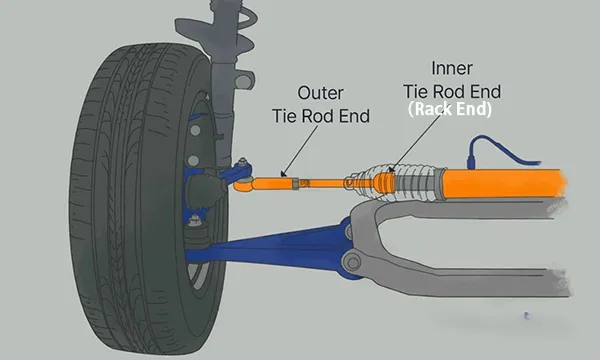
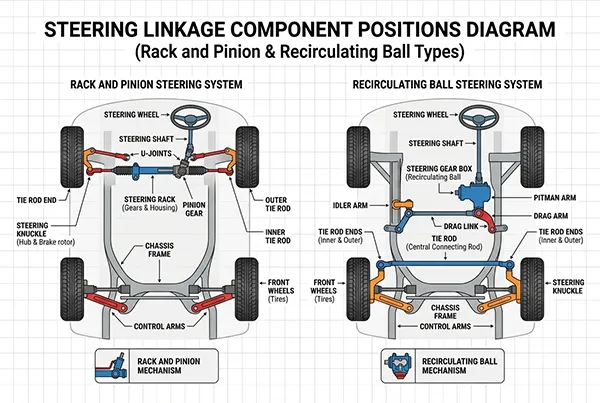
The difference between a tie rod end and a rack end comes down to position and interface. A tie rod end sits at the outer end of the steering linkage, connecting to the steering knuckle at the wheel. A rack end sits at the inner end, connecting the tie rod to the rack housing or center link. They share a similar ball joint design, but they are not interchangeable — thread type, thread direction, stud dimensions, and fitment logic are all different.

Understanding this distinction at a component level is the first step. But what really matters in B2B procurement is knowing why the confusion happens so often — and how to build a reliable selection process that prevents it.
What Does a Tie Rod End Actually Do?
Most steering complaints start at the wheel. And that is exactly where the tie rod end lives.
The tie rod end is the outer link in the steering system. It connects the tie rod shaft to the steering knuckle, which carries the wheel hub.1 When the steering rack moves left or right, the tie rod end is what translates that movement into wheel angle change.
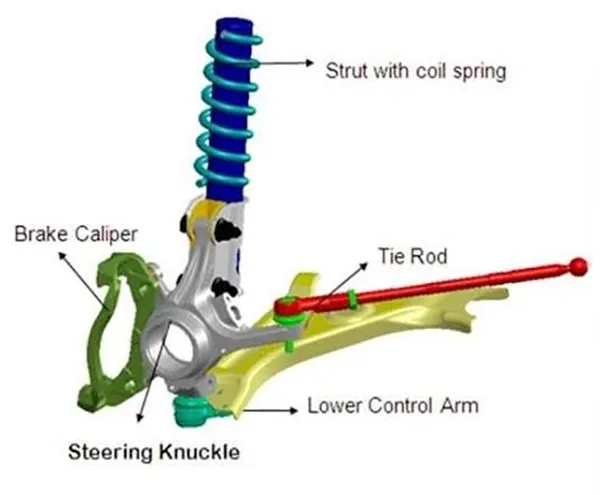

Because it sits at the wheel end of the linkage, the tie rod end absorbs road shock, handles constant angular movement, and must maintain precise joint geometry to keep the wheel aligned correctly.
What Makes a Tie Rod End Distinct?
The tie rod end has a few defining features that set it apart from a rack end:
- Tapered stud: The stud presses into a tapered bore on the steering knuckle. This taper design provides a tight, vibration-resistant connection that is critical for steering response.
- Castle nut and cotter pin fitment: The outer end is secured with a castle nut and cotter pin in most applications, though some modern designs use a standard nut with a specific torque spec.
- Threaded barrel: The body of the tie rod end threads onto the tie rod shaft. This threaded connection is what allows toe adjustment during wheel alignment.
- Left-hand or right-hand thread: Depending on the vehicle and the side of the car, the thread direction may differ. This is one of the most common specification errors in aftermarket ordering.
Why Tie Rod End Identification Goes Wrong in Procurement
In my experience handling inquiries from importers and brand owners, the most frequent mistake is treating left and right tie rod ends as mirror images with no other differences. On many Japanese vehicles, the driver-side and passenger-side outer tie rod ends have opposite thread directions specifically to prevent them from loosening during normal steering movement2.
Ordering the wrong thread direction means the part physically installs but gradually loosens in use — a warranty problem that is hard to trace back to the original mismatch.
Here is a quick reference for what to confirm when sourcing tie rod ends:
| Specification | Why It Matters |
|---|---|
| Left or right side | Determines thread direction on many vehicles |
| Thread size and pitch | Affects compatibility with tie rod shaft |
| Stud diameter and taper | Must match steering knuckle bore exactly |
| Overall length | Affects toe geometry and installation clearance |
| Vehicle application year/model | Rules out cross-application errors |
The tie rod end is not a universal part. Even within the same model line, changes in production year or trim level can affect stud dimensions or thread spec. Always verify by vehicle application — not just by visual comparison.
What Is a Rack End and How Is It Different?
The rack end is often called the inner tie rod end, and that name gives away its position. It sits at the rack side of the steering linkage, not the wheel side.
On rack-and-pinion steering systems, the rack end threads directly into the end of the rack housing or connects to the rack bar itself.3 On recirculating ball or older parallelogram steering systems, a similar inner connection point exists, though the terminology and component design may differ.
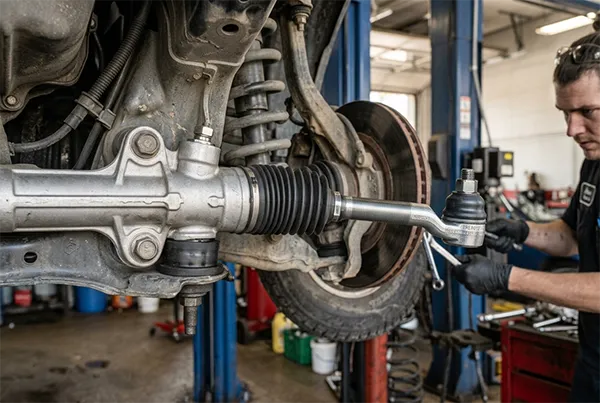

The rack end's job is to transfer the linear movement of the steering rack out to the tie rod shaft, which then runs to the outer tie rod end and wheel. It handles a different type of load and a different connection interface than the tie rod end.
How a Rack End Differs in Construction
- Ball socket design: Like a tie rod end, the rack end uses a ball and socket to allow angular movement. But the socket geometry is often different — designed for the range of motion required at the inner position rather than the outer.
- Rack interface thread: The rack end threads into the rack housing, not onto a tie rod shaft. This thread is typically a coarser pitch and a larger diameter than the barrel thread on a tie rod end.
- No tapered stud: A rack end does not connect to a tapered bore. It connects through its own threaded housing. This is the most immediate visual and functional difference from a tie rod end.
- Inner boot seat: In many designs, the rack end has a seat or groove to hold the steering rack boot (bellows). Incorrect fitment can damage the boot seal.
Rack End Selection: What Procurement Teams Get Wrong
The most common issue I see with rack ends in B2B procurement is part number substitution based on appearance. The ball housing of a rack end can look similar to a tie rod end when photographed in isolation. Without the vehicle-side interface details — particularly the rack thread size and pitch — a visually similar part will not fit.
Here is what to verify when sourcing rack ends:
| Specification | Why It Matters |
|---|---|
| Rack thread diameter and pitch | Direct fitment to rack housing — no adjustment possible |
| Ball socket angle range | Must match the range of motion at the inner position |
| Overall length | Affects tie rod geometry and boot fitment |
| Boot seat diameter | Required for correct boot sealing |
| Vehicle application | Confirms all specs together |
One more point worth flagging: on some vehicles, especially certain Japanese and Korean models, the rack end is sold as part of a complete inner tie rod assembly that includes a socket, shaft section, and locking collar. In these cases, sourcing only the ball socket end without the shaft will create installation problems in the field.
How Do You Tell Them Apart When Ordering?
This is the practical question for anyone building a catalog or placing an order.
Looking similar is not a sufficient reason to treat them as the same part. I have seen this exact shortcut create expensive return cycles for distributors who were stocking steering parts without a clear selection process.

Here is a clear framework for distinguishing between the two in procurement:
Step 1: Confirm Position in the Steering Linkage
- Outer position → tie rod end (connects to steering knuckle)
- Inner position → rack end (connects to rack housing or center link)
This is the primary filter. Position in the vehicle determines which part you need before any other spec is considered.
Step 2: Identify the Connection Interface
- Tapered stud + castle nut → almost certainly a tie rod end
- Threaded housing that connects into rack → rack end
- Internal socket with external thread → rack end (inner tie rod style)
Step 3: Verify by Vehicle Application
Use the vehicle year, make, model, engine, and sub-model to pull the correct part number. Cross-reference against OE numbers when available. On mixed-application catalogs, a single vehicle can have both a tie rod end and a rack end in the same steering assembly — they are both needed, and neither replaces the other.
Step 4: Check Thread Specification Independently
Do not assume thread compatibility based on catalog cross-references alone. For new applications or first-time orders on a specific vehicle line, confirm thread size and pitch directly with the supplier's technical team. This step alone eliminates most fitment disputes before they happen.
Frequently Asked Questions
Can a tie rod end replace a rack end if they look the same?
No. Even when a tie rod end and rack end appear similar in photos, the connection interface, thread specification, and fitment role are different. Substituting one for the other will result in incorrect installation, which creates steering looseness, alignment problems, and potential safety issues.
Why do some suppliers list both as "tie rod ends" in their catalog?
Catalog terminology is not always consistent across markets. Some suppliers use "tie rod end" as a broad category covering both inner and outer parts. Always check whether the part is specified as inner (rack-side) or outer (wheel-side) rather than relying on the category name alone.
How do I identify a rack end from a tie rod end by looking at the part?
A rack end typically has a threaded housing body designed to thread into the rack, without a tapered stud. A tie rod end has a tapered stud at one end and a threaded barrel at the other. If you see a tapered stud, it is an outer tie rod end. If you see a threaded housing only, it is most likely a rack end.
Does every vehicle have both a tie rod end and a rack end?
Most modern rack-and-pinion vehicles have both. The rack end sits at the inner position, and the tie rod end sits at the outer position on each side. Some older or heavy-duty vehicles use a different steering geometry (recirculating ball or drag link systems) where the component names and positions may differ.4
What causes the most returns related to tie rod end and rack end confusion?
In my experience, the most common causes are wrong thread direction on tie rod ends, wrong rack thread pitch on rack ends, and incorrect overall length due to cross-application substitution5. All three can be prevented with proper vehicle application verification before the order is placed.
Conclusion
The difference between tie rod end and rack end is not just a naming detail — it defines where each part sits in the steering system, how it connects, and what specifications it must match. A tie rod end connects at the wheel side through a tapered stud. A rack end connects at the rack side through a threaded housing. They look similar but serve different roles and cannot substitute for each other. For importers, wholesalers, and brand owners sourcing steering parts at volume, a clear selection process based on position, interface, and vehicle application is the most reliable way to reduce mismatch, minimize returns, and protect your brand's reputation in the field.
If you are building a steering parts catalog or need to verify fitment on specific vehicle applications, contact the GDST technical team — we work directly with procurement teams to confirm correct part specifications before orders are placed.
"Steering linkage", https://en.wikipedia.org/wiki/Steering_linkage. Encyclopedic and automotive engineering references consistently define the tie rod end as the outermost component of the steering linkage, interfacing between the tie rod shaft and the steering knuckle to translate rack displacement into wheel angle change. Evidence role: definition; source type: encyclopedia. Supports: The function and position of the tie rod end as the outer steering linkage component connecting to the steering knuckle. ↩
"Tie rod ends and threads", https://bobistheoilguy.com/forums/threads/tie-rod-ends-and-threads.199709/. Automotive engineering references describe the use of opposite thread conventions on left- and right-hand steering linkage components as a design measure to counteract torque-induced loosening during vehicle operation. Evidence role: mechanism; source type: research. Supports: That opposing thread directions on left and right tie rod ends are used to prevent self-loosening under steering loads. Scope note: General engineering literature may not specifically attribute this convention to Japanese vehicles; the claim's geographic specificity may require OEM service documentation for direct corroboration. ↩
"Rack and pinion", https://en.wikipedia.org/wiki/Rack_and_pinion. Automotive engineering and encyclopedia sources describe the inner tie rod end (rack end) on rack-and-pinion steering systems as a threaded ball socket assembly that connects directly to the rack housing, transmitting lateral rack movement to the outer tie rod and wheel assembly. Evidence role: definition; source type: encyclopedia. Supports: That the inner tie rod (rack end) on rack-and-pinion systems connects by threading into or onto the rack housing or bar. ↩
"Steering", https://en.wikipedia.org/wiki/Steering. Encyclopedic references on automotive steering systems document that recirculating ball steering, often paired with parallelogram linkage including drag links and idler arms, remains common in heavy-duty trucks and older vehicle platforms, presenting a different component topology from the rack-and-pinion configurations prevalent in modern passenger cars. Evidence role: historical_context; source type: encyclopedia. Supports: That recirculating ball and drag link steering systems are used in older and heavy-duty vehicles and employ a different component arrangement from rack-and-pinion systems. ↩
"Automotive Parts Ecommerce: The Fitment Data Return Problem", https://www.uncap.com/post/automotive-parts-ecommerce-fitment-data-returns. Industry analyses of automotive aftermarket supply chains identify incorrect part specification — including thread, dimension, and application mismatches — as a primary contributor to product returns and warranty claims in steering component categories. Evidence role: statistic; source type: institution. Supports: That fitment specification errors are a leading driver of returns in the automotive aftermarket steering parts category. Scope note: The specific ranking of thread direction, thread pitch, and overall length as the top three return causes reflects the author's practitioner experience; independent published data disaggregating return causes at this level of specificity for steering parts was not identified. ↩