Rear suspension parts support vehicle load, control wheel movement, and help isolate road vibration, but their names alone do not predict handling or comfort. When you overlook technical parameters and vehicle compatibility, they risk fitment problems and warranty claims. We recommend evaluating each component through OE references, drawings, material records, and verified test data.
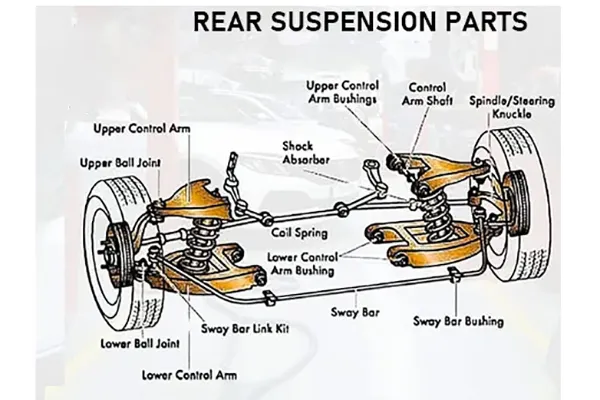
Rear suspension parts commonly include springs, shock absorbers, control arms, bushings, stabilizer links, ball joints, wheel hubs, trailing arms, lateral links, and mounting hardware. The exact arrangement depends on the suspension design and vehicle application.1 Together, these components manage wheel movement, maintain alignment, carry loads, and control vibration under defined operating conditions.2
In more than 20 years of OEM/ODM manufacturing and quality control at GDST Auto Parts, I have learned that component selection requires more than identifying a familiar part name. You need to understand how design, dimensions, materials, testing, and installation specifications work together.
What Are the Main Rear Suspension Parts?
Buyers sometimes expect every vehicle to use the same basic rear suspension parts. That assumption can create incorrect quotations, inventory errors, and failed installations. We start by identifying the suspension architecture and then confirm every part by application data, OE reference, sample, or technical drawing.
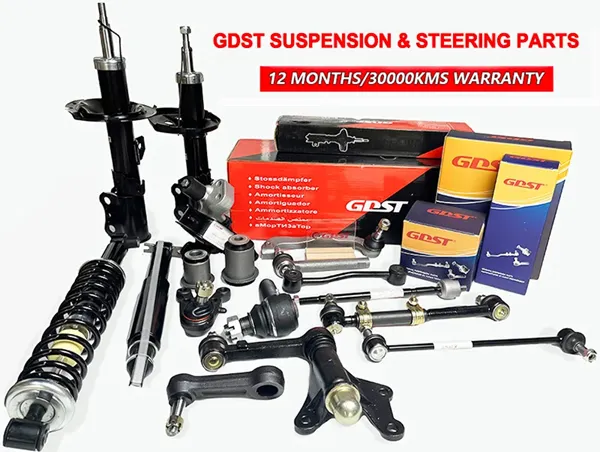
The main components can include coil or leaf springs, shock absorbers, struts, upper and lower control arms, trailing arms, lateral links, stabilizer bars, stabilizer links, bushings, ball joints, wheel carriers, hubs, subframes, and mounting hardware. A vehicle may use only some of these parts, depending on its rear suspension design.
A Simple Component Overview
The following list provides a practical introduction. It does not mean that every vehicle contains every listed component.
- Springs: Carry defined loads and allow controlled vertical movement.
- Shock absorbers or dampers: Control the rate of suspension movement.
- Control arms and links: Guide wheel movement within the designed geometry.
- Bushings: Provide compliant connections between metal components.
- Ball joints: Allow angular movement at specific suspension connections.
- Stabilizer bars and links: Transfer force between the left and right sides under certain conditions.
- Wheel carriers and hubs: Support wheel attachment and related rotating assemblies.
- Subframes and brackets: Provide structural mounting points.
- Fasteners: Maintain clamping force when installed to the specified procedure.
Why the Suspension Layout Matters
We treat the component list as a starting point rather than a selection guide. Different rear suspension layouts use different movement paths, mounting points, and load distributions.
A torsion-beam arrangement, for example, does not use the same link configuration as a multi-link system. A leaf-spring truck application also differs substantially from a passenger car with independent rear suspension. Even when two components have similar names, they may have different:
- Hole spacing and mounting geometry
- Ball pin or stud dimensions
- Bushing hardness and sleeve dimensions
- Joint articulation angles
- Material grades and heat-treatment requirements
- Surface coatings
- Specified installation torque
- Fatigue and load requirements
From my quality-control perspective, visual similarity provides weak evidence of interchangeability3. We have seen samples that appeared identical at first inspection but failed dimensional comparison at a mounting surface or taper. A small difference can change assembly fit, joint movement, or fastener seating.
For procurement, we recommend building a product record around vehicle make, model, production year, chassis code, engine or axle configuration, OE reference, and confirmed dimensions. Regional variations may also matter. The same model name can refer to different technical configurations in different markets.
How Do Rear Suspension Parts Affect Vehicle Performance?
Customers often connect a component name directly with comfort, handling, or stability. We avoid making that shortcut. Vehicle performance results from the interaction of component geometry, spring rate, damping characteristics, bushing properties, tire condition, alignment, load, and installation quality.
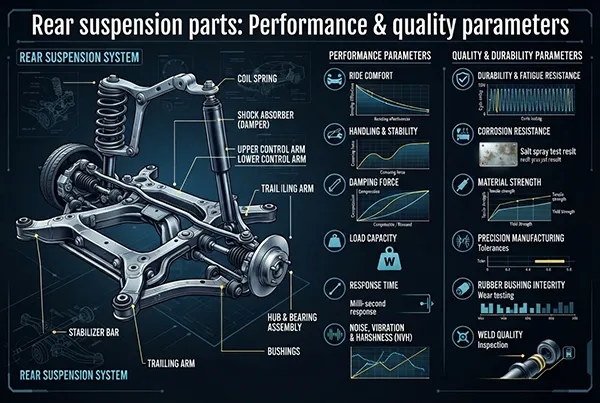
Rear suspension parts influence wheel control, load support, alignment retention, vibration isolation, and body movement. However, no single component guarantees a specific performance result. We assess performance expectations against measurable parameters, such as dimensions, material properties, articulation, hardness, torque requirements, and applicable fatigue or force-test data.
Component Function Is Not a Performance Guarantee
A shock absorber controls motion, but its presence alone does not mean that a vehicle will feel comfortable. A stabilizer link transfers force within a stabilizer system, but its name does not prove that the vehicle will corner in a particular way. A bushing provides compliance, but its effect depends on compound properties, geometry, preload, and surrounding components.
We use the same reasoning when reviewing suspension and steering joints. A ball joint must meet its defined dimensional and movement requirements, but the final vehicle response also depends on installation position, mating parts, wheel alignment, and the overall suspension design.
This distinction is important for aftermarket brand owners. Marketing claims can become risky when they connect one replacement part to a broad result without supporting test data. A more reliable product description identifies what has actually been controlled or verified.
Parameters Buyers Should Review
| Parameter | Why I Review It | Possible Risk if Unverified |
|---|---|---|
| Critical dimensions | They determine mounting and fitment | Interference, looseness, or installation failure |
| [Material specification | It affects strength and production consistency](https://tsapps.nist.gov/publication/get_pdf.cfm?pub_id=910618)%%%FOOTNOTE_REF_4%%% | Variable durability between batches |
| Hardness or heat treatment | It supports the required mechanical properties | Premature wear or brittle behavior |
| Joint movement angle | It must suit the application geometry | Restricted movement or binding |
| Pull-out or compression force | It helps evaluate joint retention | Separation or inconsistent assembly |
| Rubber properties | They influence compliance and environmental resistance | Cracking, noise, or movement variation |
| Coating performance | It supports corrosion resistance | Early surface corrosion |
| Installation specification | It controls the assembled connection | Loose or overstressed fasteners |
At GDST, our inspection scope can include hardness, angle, torque, pull-out and compression force, fatigue, high- and low-temperature exposure, ozone resistance, and salt spray testing. The applicable test plan depends on the part and customer specification. We would not apply one acceptance value to every component or vehicle.
We also recommend checking how the supplier handles nonconforming test results. A test report has limited value if the supplier cannot link it to a material batch, production lot, inspection date, and corrective-action process.
Why Is Compatibility Critical When Selecting Rear Suspension Parts?
Compatibility is one of the largest procurement risks for rear suspension parts. Similar appearance, matching product names, or overlapping vehicle descriptions do not establish interchangeability. We have found that buyers reduce risk when they verify OE references, vehicle details, dimensions, materials, movement ranges, and installation requirements before approving mass production.
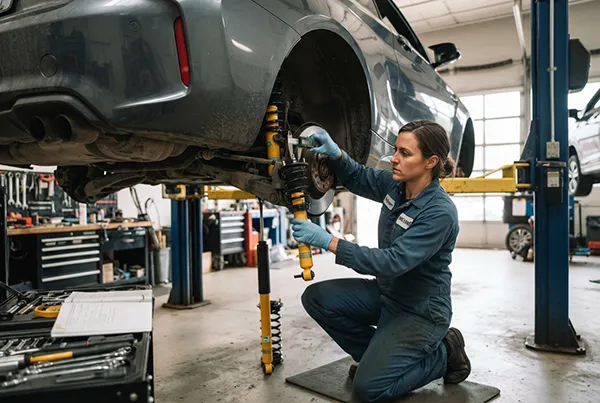
A compatible component must fit the intended vehicle and meet its defined technical requirements. Different brands, models, production years, markets, and chassis variants may use different designs. We recommend physical sample comparison or installation validation whenever catalog data does not provide enough evidence.
Where Compatibility Differences Appear
Compatibility problems often occur in details that a catalog image cannot show. These differences can include:
- Mounting dimensions: Hole diameter, spacing, bracket thickness, and offset may vary.
- Joint geometry: Stud taper, thread, pin length, and articulation range may differ.
- Bushing construction: Outer diameter, inner sleeve, rubber profile, and hardness may change.
- Vehicle configuration: Drivetrain, axle load, body style, and regional specification may affect the part.
- Installation requirements: Fastener type, tightening sequence, and specified torque may not be the same.
- Production revisions: A manufacturer may change a component during a model’s production cycle.5
Our molds are developed according to confirmed OE specifications, and we control relevant product dimensions within defined inspection requirements. GDST commonly applies dimensional tolerances within ±0.2 mm where the approved specification requires that control. However, I do not treat ±0.2 mm as a universal rule for every feature. Critical tapers, threads, fits, or customer-defined characteristics may need their own tolerances.
How We Verify an Application
We normally use a staged verification process:
- We confirm the complete vehicle application.
- We cross-check the OE and aftermarket reference numbers.
- We compare the customer’s sample or drawing with our technical records.
- We measure critical mounting and functional dimensions.
- We verify material and process requirements.
- We review the part’s movement or assembly characteristics.
- We confirm packaging labels and application descriptions.
- We request trial fitting or qualified vehicle validation when uncertainty remains.
Installation torque deserves particular care. We do not recommend transferring a torque value from a similar-looking part. At GDST, torque-related conclusions must come from the approved drawing, customer specification, validated inspection standard, or confirmed application document. Installers should follow the applicable vehicle service information and use qualified professional judgment.
This process also supports inventory planning. Accurate application data reduces duplicate stock, incorrect consolidation, and returns caused by catalog errors. For distributors serving several markets, we suggest separating confirmed regional applications rather than assuming that one SKU fits every version of a model.
How Should Buyers Evaluate Rear Suspension Parts and Suppliers?
A low quotation does not show whether rear suspension parts will remain consistent across production batches. At the same time, a higher price does not prove better manufacturing. We advise buyers to examine process controls, material traceability, test capability, capacity, change management, and application verification before comparing commercial terms.
Buyers should evaluate both the product and the manufacturing system behind it. We look for controlled drawings, approved materials, documented processes, calibrated inspection equipment, traceable test records, final inspection, and clear responses to nonconformities. Certifications should support due diligence, but buyers should verify their validity and scope.
Review the Manufacturing Process
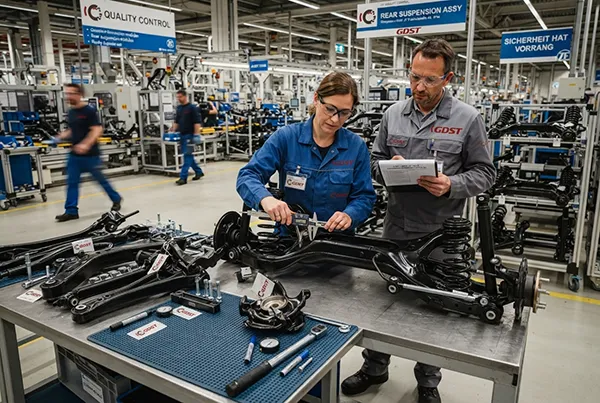
Different components require different production methods. A supplier may use casting, forging, welding, CNC machining, assembly, rubber processing, or surface treatment. We recommend checking whether the manufacturer controls the critical stages rather than only inspecting finished goods.
At GDST, our manufacturing capabilities include casting, forging, welding, CNC machining, assembly, and surface treatment. Our quality team monitors production across 20 lines. Our QC personnel have more than five years of relevant industry experience, and we use material inspection reports and random chemical-composition checks for incoming steel.
For a supplier audit, We would ask for evidence covering:
- Approved product drawings and revision control
- Incoming material inspection and batch identification
- Mold, fixture, and tool maintenance
- In-process dimensional records
- Heat-treatment or hardness records where applicable
- Assembly force and torque controls
- Surface-treatment inspection
- Functional and durability test reports
- Nonconforming-product segregation
- Final quantity, packaging, labeling, and pallet checks
Verify Quality-System Documents
GDST operates under IATF 16949 and ISO 9001 quality management standards. However, we always tell buyers to treat certifications as documents that require verification, not as automatic proof that every shipment meets every requirement.
A buyer should check:
- The certificate issuer and current validity
- The legal company and factory address
- The certified activity and product scope
- The expiration date
- Whether the audited location manufactures the quoted product
- Whether lot-specific records support the actual order
We also recommend requesting a control plan or inspection summary for the selected SKU. A general factory presentation cannot replace product-specific evidence.
Separate Technical Quality from Price
Quality control creates measurable requirements, but it does not create a simple price ranking. Material grade, production volume, tooling, testing frequency, tolerances, coating, packaging, and customization can all affect cost.
We compare quotations only after the technical scope is aligned. Otherwise, one supplier may quote a tested, traceable product while another quotes a visually similar part under a different specification. The prices then describe different products.
For OEM/ODM projects, buyers should define the drawing, sample status, test plan, labeling, packaging, order volume, and change-approval process before final commercial comparison. This approach makes price evaluation more meaningful and reduces disputes after production begins.
Frequently Asked Questions
Do all cars use the same rear suspension parts?
No. I find that component arrangements vary by suspension design, vehicle platform, model year, drivetrain, axle load, and regional specification. Some vehicles use torsion beams, while others use multi-link, trailing-arm, leaf-spring, or other layouts. Buyers should verify the exact vehicle application before ordering.
Can two similar-looking rear suspension components be interchangeable?
Not necessarily. I check mounting dimensions, offsets, stud tapers, threads, bushing construction, movement angles, materials, and installation specifications. Even a small dimensional difference can prevent correct assembly. When application data is uncertain, I recommend sample comparison and qualified installation validation.
Which tests are relevant to rear suspension parts?
The test plan depends on the component and approved specification. I commonly review dimensional inspection, hardness, torque, angle, fatigue, pull-out or compression force, temperature exposure, ozone resistance, and salt spray results. Buyers should ask for lot-linked reports rather than relying only on general testing claims.
Does IATF 16949 certification guarantee product quality?
No certification guarantees that every individual part conforms. IATF 16949 shows that a documented automotive quality-management system has been assessed within a defined scope. I recommend verifying the certificate and then reviewing product drawings, control plans, material records, test reports, and shipment inspections.
How can distributors reduce rear suspension inventory risk?
I suggest organizing SKUs by confirmed OE number, chassis code, model year, market, and technical revision. Distributors should avoid merging applications based only on appearance or product names. Sample approval, structured catalog data, packaging checks, and supplier change notifications can further reduce returns and incorrect stock.
Conclusion
Understanding rear suspension parts requires more than learning a list of component names. I evaluate how dimensions, materials, joint movement, testing, installation requirements, and vehicle design work together. Compatibility should always be confirmed for the exact brand, model, chassis, production year, and market. Quality-system certificates should also be verified alongside product-specific records. If you need OEM/ODM suspension components, application verification, private labeling, or a manufacturing-quality review, contact GDST Auto Parts to discuss your drawings, samples, and procurement requirements.
"Car suspension", https://en.wikipedia.org/wiki/Car_suspension. Standard classifications distinguish dependent, semi-independent, and independent suspension architectures, each of which constrains and guides wheel motion through a different arrangement of axles, beams, arms, or links. Evidence role: definition; source type: encyclopedia. Supports: A reference should distinguish common dependent, semi-independent, and independent suspension designs and show that they use different structural arrangements.. Scope note: The classification does not determine the exact parts used by a particular model year or vehicle variant. ↩
"A STUDY OF PARAMETERS INFLUENCING THE ...", https://ninercommons.charlotte.edu/record/746/files/Patel_uncc_0694N_11115.pdf. Automotive-engineering references describe suspension systems as supporting the vehicle body while guiding wheel motion and moderating the transmission of road disturbances; the contribution of each component varies with the suspension architecture. Evidence role: general_support; source type: education. Supports: An automotive-engineering source should describe the suspension system's roles in supporting load, controlling wheel motion, maintaining tire or wheel geometry, and isolating road disturbances.. Scope note: This supports the general functional description, not the performance of any specific component or product. ↩
"North Point Suspension Inspection & Bump Stop Installation", https://static.nhtsa.gov/odi/rcl/2020/RCRIT-20V385-3298.pdf. Engineering interchangeability is based on conformity to specified dimensions, tolerances, interfaces, and functional characteristics rather than external appearance alone. Evidence role: general_support; source type: education. Supports: An engineering source should establish that interchangeability requires conformance to specified dimensions, tolerances, interfaces, and functional requirements.. Scope note: This is a general engineering principle and does not prove that any two particular suspension parts are or are not interchangeable. ↩
"Mechanical Properties Testing for Metal Parts Made via ...", https://tsapps.nist.gov/publication/get_pdf.cfm?pub_id=910618. Materials-engineering guidance establishes that chemical composition and processing history influence properties such as strength, hardness, and toughness, while specification controls are used to limit production variability. Evidence role: mechanism; source type: government. Supports: A materials-engineering source should explain that composition and processing influence mechanical properties and that specification limits help control variability.. Scope note: A compliant material specification alone does not establish the durability of a finished suspension component, which also depends on design and manufacturing quality. ↩
"SERVICE BULLETIN", https://static.nhtsa.gov/odi/tsbs/2025/MC-11017432-0001.pdf. Official vehicle service and recall records document production-date and VIN-range distinctions for some components, illustrating that specifications and applicable part numbers can change during a model run. Evidence role: case_reference; source type: government. Supports: An official service bulletin or recall document should provide a concrete example of a component, part number, or repair procedure differing by production date or vehicle identification range.. Scope note: A documented running change for one vehicle or component does not show that every model undergoes such a revision. ↩