Choosing a shock absorber for a bulk order can look simple until incorrect applications, oil leakage, abnormal noise, or inconsistent damping create expensive returns. A matching part number or attractive sample may hide production risks. You need a structured evaluation process that confirms both vehicle fitment and repeatable manufacturing quality.
To choose a shock absorber, first verify the exact vehicle application, OE reference, dimensions, mounting points, and intended use. Then evaluate seal control, welding quality, damping-force data, batch consistency, testing records, and traceability. The right product must fit correctly and remain within the agreed specification across repeated production batches.
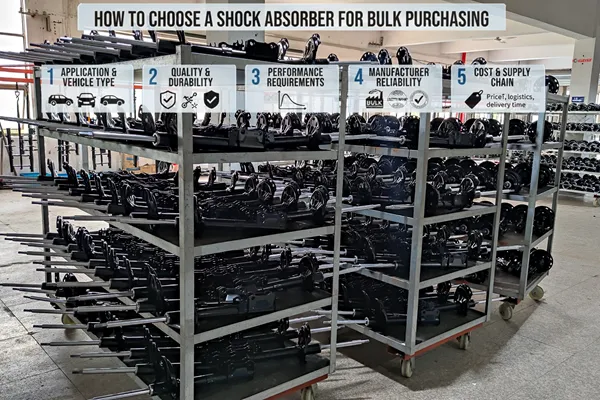
This distinction matters because application errors and manufacturing defects can create similar complaints. A component may perform poorly because it is wrong for the vehicle, or because its production was not controlled. The steps below help you separate these risks before approving an order.
How Do You Confirm That a Shock Absorber Fits the Application?
A product can look identical to the original part and still be unsuitable for the intended vehicle. If you approve it through appearance alone, you may discover bracket interference, incorrect travel, or unsuitable damping after shipment. A complete application review gives you a safer starting point.
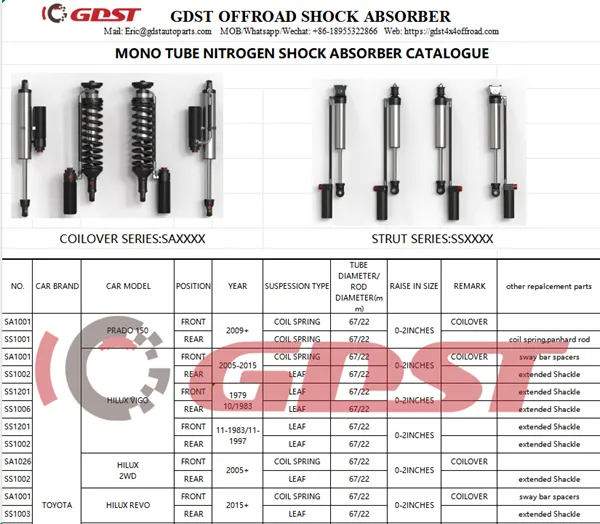
You should confirm the vehicle make, model, year, chassis or platform, axle position, OE reference, mounting dimensions, extended and compressed lengths, and intended operating conditions. You should resolve fitment before comparing manufacturing quality because even a well-made shock absorber cannot compensate for an incorrect application.
Start With the Vehicle, Not the Supplier’s Catalog
A catalog reference is useful, but it should not be your only evidence. Vehicle applications sometimes vary by market, production year, engine, suspension package, body configuration, or axle load. Two components may share a general shape while having different internal settings or installation dimensions.
Your application confirmation should include:
- Vehicle manufacturer and model
- Model year or production range
- Chassis, platform, or VIN range when relevant
- Engine and body configuration
- Front or rear axle position
- Left-hand, right-hand, or non-directional position
- OE and recognized cross-reference numbers
- Standard, sport, heavy-duty, or modified suspension use
- Passenger vehicle, light commercial vehicle, or truck application
- Regional application differences
A recognized part number narrows the search, but it does not automatically prove that every catalog entry is correct. You should ask how the supplier created and maintains its application data. You should also check whether the drawing, physical sample, and catalog record refer to the same version.
Compare Critical Dimensions
A dimensional drawing provides more useful evidence than a product photograph. At minimum, the drawing should identify the dimensions that affect installation and suspension movement.
| Inspection item | Why it matters | Evidence to request |
|---|---|---|
| Extended length | Affects available suspension travel | Controlled drawing and inspection record |
| Compressed length | Helps prevent bottoming or interference | Drawing and sample measurement |
| Upper mount | Determines installation compatibility | Mount details, thread, or hole dimensions |
| Lower mount | Affects bracket or bushing fit | Bracket geometry and dimensional report |
| Tube diameter | May affect clearance and construction | Drawing and measured sample |
| Bracket position | Influences hose, cable, or knuckle alignment | Fixture or coordinate inspection record |
| Spring seat position on struts | Affects spring and vehicle geometry | Height, angle, and orientation checks |
| Piston rod dimensions | Affect mounting and seal compatibility | Diameter, thread, and finish requirements |
When we review new references in production, bracket orientation and mounting dimensions receive attention before damping approval. A bracket that is welded at the wrong angle is not corrected by excellent paint or stable force data.
Separate Intended Use From Basic Fitment
Physical fit does not prove suitability for every use.1 A standard replacement, a modified performance unit, and a heavy-duty product can share mounting points while using different internal specifications.
You should define the intended use in the purchase specification. If the application involves unusual loads, modified ride height, extreme temperatures, or special vehicle dynamics, you should obtain an evaluation from a qualified vehicle or suspension engineer. A component manufacturer can provide drawings and test data, but application-specific approval may require expertise beyond normal sourcing review.
Procurement rule: Confirm what the product is for before deciding how well it has been made.
How Do You Evaluate Shock Absorber Sealing and Leakage Prevention?
Oil-seal quality is difficult to judge from the outside. A clean weld and smooth coating may create confidence, but neither shows how the seal was stored, installed, lubricated, or protected from damage. You need process evidence that addresses leakage prevention directly.
You should evaluate the oil-seal specification, piston rod surface, seal-seat dimensions, component cleanliness, assembly method, and in-process inspection controls. You should also confirm that records relate to the actual shock absorber model and production batch rather than relying on a generic seal certificate or factory presentation.
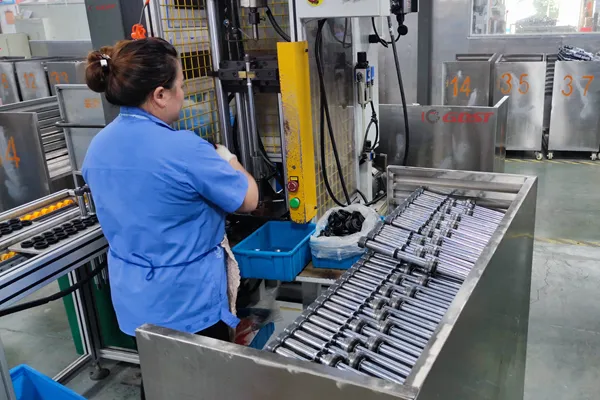
Why the Seal Cannot Be Evaluated Alone
The oil seal is important, but leakage prevention is a system. A premium seal can still fail to perform as intended if the surrounding dimensions or assembly process are incorrect. The piston rod, seal seat, guide, fluid, cleanliness, and installation method all interact.
From direct production observation, seal assembly deserves more attention than buyers often give it. Small process deviations may not be visible during a sample review. For example, an unsuitable tool, contaminated component, damaged sealing lip, or out-of-specification seat can create hidden risk. This does not mean every deviation will cause leakage. It means visual inspection alone cannot establish adequate control.
You should review the following areas:
-
Seal identification and specification
The supplier should be able to identify the approved seal for the model. If an imported or branded multi-lip seal is claimed, you should verify the purchasing document, specification, and incoming inspection record. -
Piston rod quality
The rod should conform to the agreed dimensional and surface requirements. You should request records for diameter, straightness, finish, coating, or hardness when those characteristics are part of the approved specification. -
Seal-seat dimensions
The relevant seat dimensions should be controlled against a drawing. A seal certificate cannot compensate for an incorrectly machined housing. -
Cleanliness during assembly
Dirt, metal particles, or damaged components can compromise the sealing system.2 You should ask how parts are cleaned, stored, handled, and released to assembly. -
Assembly tooling and work instructions
Controlled tooling can reduce the chance of lip damage or incorrect installation. The supplier should have a clear procedure rather than depending only on operator experience. -
In-process checks
Records should show what inspectors check, how often they check it, and what happens when a result falls outside the limit.
Ask for Evidence, Not Reassurance
A statement such as “we use high-quality seals” is not enough. A practical evidence package may include:
- Approved component specification
- Incoming material inspection record
- Seal supplier traceability
- Piston rod inspection report
- Seal-seat dimensional record
- Assembly work instruction
- Tooling maintenance or verification record
- In-process inspection checklist
- Batch identification and nonconformity procedure
- Leakage or endurance test method, where agreed
The test conditions matter. If a supplier presents a leakage or durability result, you should ask for the model, sample quantity, test procedure, temperature, cycle conditions, acceptance criteria, and report date. You should not treat an isolated result as a universal lifespan claim.
Price alone does not determine sealing quality. A lower quotation may come from efficient manufacturing, simpler packaging, material choices, commercial strategy, or many other factors. Your task is not to assume that an inexpensive product is defective. Your task is to determine whether the quoted product has a defined and verifiable sealing process.
How Should You Compare Shock Absorber Damping Performance?
A shock absorber may fit correctly and remain dry while still delivering the wrong damping behavior. One sample can also pass a test without representing the next batch.3 You need comparable force data, defined test conditions, and clear acceptance limits before you can judge consistency.
You should compare damping-force curves or measured force values at agreed test conditions, including velocity, direction, temperature, and test setup. You should then review variation among multiple samples and production batches. The main question is whether the manufacturer can repeatedly produce the approved damping specification, not whether one sample produces an attractive graph.
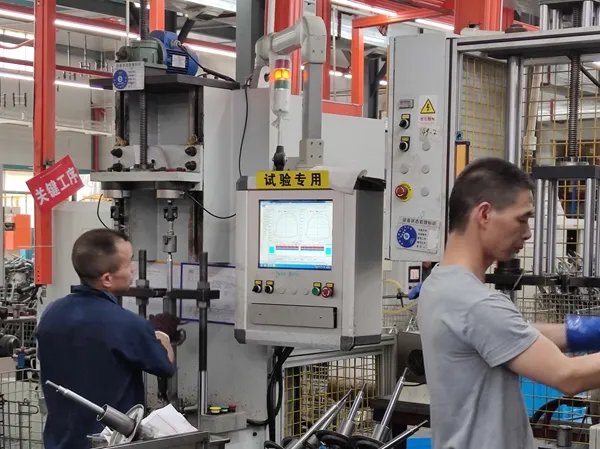
Make Test Reports Comparable
Damping data has limited value when the report lacks context. Two graphs cannot be compared fairly if they were generated under different temperatures, velocities, mounting conditions, or conditioning procedures.4
Your specification should define, as applicable:
- Test equipment or approved test method
- Test velocity points
- Compression and rebound directions
- Fluid or unit temperature
- Preconditioning procedure
- Stroke and mounting arrangement
- Target force or approved curve
- Permitted tolerance
- Number of samples
- Sampling stage
- Retest and rejection rules
Application-specific limits should come from an approved drawing, validated reference, customer specification, or qualified engineering assessment. You should not copy a force value from an unrelated product because it appears similar.
Review Multiple Units, Not One Best Result
A sample report answers a narrow question: Did this tested unit produce these results under the stated conditions? It does not answer whether every production unit will perform identically or whether future orders will remain stable.
For a bulk order, you should request records that allow three comparisons:
-
Sample-to-sample consistency
Do several pre-production samples fall within the agreed range? -
Sample-to-production consistency
Does the first production batch reproduce the approved sample specification? -
Batch-to-batch consistency
Do later orders remain within the same controlled limits?
A manufacturer that conducts 100% damping-force checks can provide stronger unit-level screening than one that tests only an occasional sample. However, the phrase “100% tested” still needs clarification. You should ask which parameters are checked, what limits are used, whether results are stored, and how rejected units are controlled.
At GDST Auto Parts, for example, the stated control process includes damping-force consistency checks and structural dimensional inspection for each unit. That statement becomes useful to a buyer only when it is supported by model-specific criteria, equipment records, operator procedures, and traceable batch results.
Read Curves With Caution
A smooth curve can help you assess behavior, but presentation quality is not the same as product quality. You should verify:
- Whether the report identifies the exact part number
- Whether the sample belongs to the quoted construction
- Whether the axes and units are clearly shown
- Whether compression and rebound are identified
- Whether the tested units were selected normally
- Whether failed results were excluded
- Whether the report can be linked to a production batch
If your team lacks the expertise to approve a damping curve, you should use a qualified suspension engineer or independent laboratory. A factory can explain its process and provide test records, but it should not replace an application-specific engineering decision.
How Can You Verify Consistent Shock Absorber Production?
A strong pre-production sample can create false confidence when the factory does not control material changes, welding, assembly, or final testing. Your real commercial exposure begins after approval, when hundreds or thousands of units must match the agreed construction and performance.
You can verify consistent shock absorber production by reviewing the control plan, critical-process instructions, inspection frequency, equipment verification, batch traceability, change-control procedure, and nonconforming-product records. You should connect these documents to the approved sample, purchase specification, and actual production lot rather than accepting generic quality-system claims.
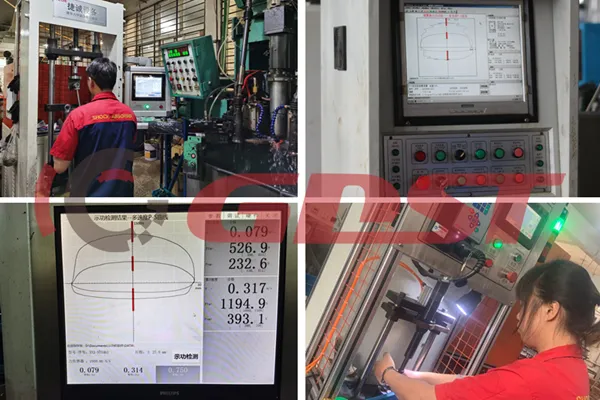
Follow the Product Through the Factory
A useful factory review follows the actual manufacturing sequence. It does not stay in the meeting room. A typical full-process operation may include:
- Raw material inspection
- Pipe cutting and machining
- Robotic or manual welding
- Component cleaning
- Seal and internal-part assembly
- Fluid filling and closing
- Coating or painting
- Dimensional inspection
- Damping performance testing
- Marking, packaging, and batch release
Each stage creates different risks. Incoming inspection concerns material identity and dimensions. Welding control concerns strength, position, penetration, distortion, and repeatability.5 Assembly control focuses on cleanliness, correct components, seal protection, fluid quantity, and process sequence. Final testing checks whether the completed unit meets the defined criteria.
Our production experience puts special attention on welding and seal assembly because defects in these stages can be difficult or costly to correct after final assembly. However, you should verify the controls instead of accepting that priority as proof.
Understand What Factory Scale Proves
Capacity can matter when you need stable delivery, but it does not prove product quality by itself. GDST’s stated production context includes a 22,000-square-meter facility, approximately 110 employees, 11 production lines, and a reported monthly capacity of 200,000 pieces. These details may help you assess whether the operation can support your forecast.
You should still verify:
- Actual line loading
- Capacity for your specific product family
- Tooling availability
- Component lead times
- Bottleneck processes
- Planned maintenance
- Order scheduling
- Final-inspection capacity
- Packaging and warehouse control
A quoted lead time of 50–60 days should be evaluated against raw-material availability, customization needs, order mix, and production schedule. A capacity statement does not guarantee an individual delivery date.
Use Certifications Correctly
Quality and management certifications can support your supplier review, but they are documents to verify rather than substitutes for product evidence.
| Document | What it may indicate | What it does not prove |
|---|---|---|
| IATF 16949 | Automotive quality-management framework | That a specific unit meets your damping target |
| ISO 9001 | General quality-management controls | That every batch is free from defects |
| ISO 14001 | Environmental management system | Product durability or application fit |
| ISO 45001 | Occupational health and safety system | Shock absorber performance |
| Third-party test report | Results for identified samples and conditions | Performance outside the stated test scope |
| Factory audit | Observed systems and processes at a given time | Permanent compliance without follow-up |
You should confirm the certificate holder, site address, scope, issuing body, validity dates, and current status. You should also check whether the audited location is the site that will manufacture your order.
Examine Change Control
An approved sample loses value if the manufacturer can change its seal, fluid, piston valve, rod, tube, welding process, or sub-supplier without review. Your purchasing agreement should define which changes require advance notification and approval.
Useful change-control questions include:
- Which components are classified as critical?
- Can a material or sub-supplier change without written approval?
- How is a revised drawing released?
- How are old and new components separated?
- Does a change require new dimensional and damping tests?
- How can you identify which batch contains the change?
This process protects both sides. It gives the manufacturer a clear approval route, and it gives you a stable reference for future orders.
What Should You Check Before Approving a Bulk Shock Absorber Order?
Quotations, samples, reports, and packaging files often arrive at different times. If you review them separately, you may approve a sample that does not match the final quotation or order specification. A single approval checklist keeps the commercial and technical details connected.
Before approving a bulk shock absorber order, you should freeze the application, drawing, internal construction, critical components, damping criteria, appearance, branding, packaging, inspection plan, and traceability rules. You should also define how deviations will be reported and approved before production or shipment.
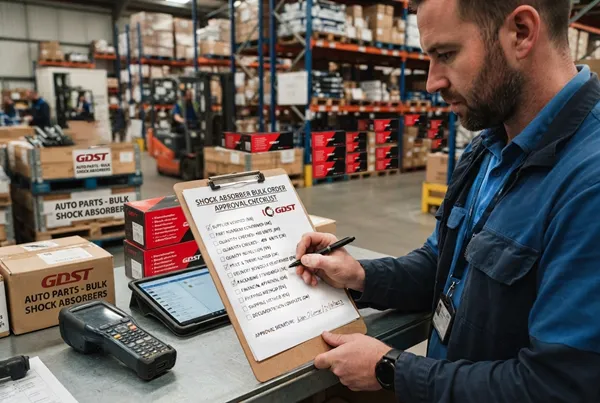
Build an Approval Package
Your approval should identify the exact version of the product. A vague instruction such as “same as sample” creates uncertainty because samples can be lost, damaged, or interpreted differently.
A controlled package can include:
- Customer and supplier part numbers
- Vehicle application list
- OE cross-references
- Signed dimensional drawing
- Approved physical sample identification
- Bill of material or agreed critical-component list
- Seal and piston rod requirements
- Damping-force specification
- Welding and bracket criteria
- Coating color and corrosion-test requirement
- Laser marking or label artwork
- Box, carton, and pallet specifications
- Inspection and sampling plan
- Required production records
- Change-notification agreement
- Pre-shipment inspection terms
If you request a corrosion test, you should define the test standard, duration, preparation, acceptance criteria, and reporting format. The presence of a salt spray tester does not establish a corrosion rating by itself.6 The same logic applies to hardness testers, microstructure analyzers, spring testing machines, and damping dynamometers: equipment proves testing capability only when the method, calibration status, operator control, sample identity, and result are verifiable.
Match Customization to Order Reality
Private branding may involve body color, labels, laser marking, color boxes, cartons, or product instructions. You should approve artwork and placement before mass production. You should also confirm that branding does not hide batch codes or product identification.
GDST’s current commercial terms include a stated MOQ of 100 pieces per SKU, with support for custom branding and packaging. That information can help with assortment planning, especially when the available catalog covers more than 5,000 active models. However, a broad SKU range does not mean every reference is continuously stocked or ready for immediate production.
For each selected SKU, you should confirm:
- Tooling status
- Technical-document availability
- Component availability
- Minimum production quantity
- Sample timing
- Production lead time
- Packaging MOQ
- Consolidation options
- Model-specific inspection requirements
Use a Simple Decision Matrix
A decision matrix prevents price from becoming the only clear comparison point.
| Evaluation area | Suggested evidence | Decision question |
|---|---|---|
| Application fit | Catalog, drawing, sample measurement | Is this the correct product for the vehicle? |
| Sealing control | Seal specification and assembly records | Is leakage risk actively controlled? |
| Damping consistency | Multi-unit and batch-level test data | Can the approved performance be repeated? |
| Welding and dimensions | Process records and inspection reports | Are mounts and structures consistently produced? |
| Traceability | Batch code and material records | Can a problem be traced and contained? |
| Change control | Written notification procedure | Will the approved construction remain stable? |
| Capacity and lead time | Schedule and line-capacity review | Can the order be delivered as planned? |
| Quality system | Verified certificates and audit findings | Is the process managed systematically? |
| Commercial terms | Quotation and packaging details | Are all costs and responsibilities clear? |
You do not need to choose the highest-priced option. You need to choose the option with the clearest relationship between specification, process control, evidence, and total commercial risk.
Frequently Asked Questions
Is matching the OE number enough to choose a shock absorber?
No. An OE number is an important starting point, but you should also confirm the vehicle version, axle position, mounting dimensions, extended and compressed lengths, bracket orientation, and intended use. You should resolve conflicting catalog information before approving samples or placing a production order.
Can you judge shock absorber quality from appearance?
Appearance can reveal coating defects, poor weld presentation, damaged threads, or incorrect brackets, but it cannot confirm internal cleanliness, oil-seal assembly, fluid specification, valve construction, or damping consistency. You should combine visual inspection with dimensional records, process evidence, and controlled performance testing.
Does one approved sample prove bulk-order quality?
No. One sample only provides evidence about that unit under the conditions in which it was inspected or tested. You should compare several samples, first-batch results, and later production data. You should also confirm that the approved materials and internal components cannot be changed without notification.
What shock absorber test records should you request?
You should request model-specific dimensional and damping results, plus relevant sealing, welding, coating, or durability records required by your specification. Each report should identify the part number, batch, date, equipment, method, conditions, acceptance limits, tested quantity, and result.
Does IATF 16949 guarantee shock absorber performance?
No. IATF 16949 can indicate that an automotive quality-management system has been audited within a stated scope. It does not guarantee that a particular product fits your application or meets your performance target. You should verify the certificate and review product-specific records.
Conclusion: How Should You Choose a Shock Absorber?
To choose a shock absorber, you should separate two decisions: whether the product fits the intended application and whether the manufacturer can reproduce it consistently. You should verify dimensions, sealing controls, damping data, welding, traceability, testing conditions, and change management before approving a bulk order. A part number, polished sample, certificate, or low quotation cannot answer every question alone. If you are evaluating a new program, request a model-specific drawing, testing package, quality-control plan, and traceable sample review before discussing final production approval.
"[PDF] Integrating Experimental Testing and Simulation-Based Validation", https://scholarsjunction.msstate.edu/cgi/viewcontent.cgi?article=1139&context=honorstheses. Vehicle-dynamics models show that ride and handling responses depend on damper characteristics together with sprung mass, unsprung mass, tire stiffness, and spring rate, so dimensional interchangeability alone does not establish dynamic suitability. Evidence role: mechanism; source type: paper. Supports: Vehicle ride and handling depend on damping characteristics in combination with sprung mass, unsprung mass, spring rate, and suspension geometry.. Scope note: General vehicle models explain the dependency but do not validate any particular replacement part or tuning specification. ↩
"[PDF] Dry Gas Seal Contamination During Operation and Pressurized Hold", https://oaktrust.library.tamu.edu/bitstreams/f8b67071-9040-43c3-b027-2fef071a587d/download. Tribological studies of hydraulic and reciprocating seals report that particulate contamination can enter the contact interface, produce abrasive damage, and increase wear or leakage. Evidence role: mechanism; source type: paper. Supports: Particles entering a sealing contact can abrade the seal or rod surface, disturb the sealing interface, and increase leakage or wear.. Scope note: The severity of contamination damage varies with particle size, hardness, concentration, seal material, surface finish, and operating conditions. ↩
"What kinds of Lot Acceptance Sampling Plans (LASPs) are there?", https://www.itl.nist.gov/div898/handbook/pmc/section2/pmc22.htm. Statistical quality-control guidance distinguishes the result for an individual item from inferences about a production lot or process; reliable lot or process conclusions require an appropriate sampling design and evidence of variation over time. Evidence role: general_support; source type: government. Supports: Statistical quality control distinguishes an individual measurement from evidence about lot quality or ongoing process stability.. Scope note: The source supports the statistical principle but does not prescribe a shock-absorber-specific sample size or acceptance criterion. ↩
"Characterizing a Racing Damper's Frequency Dependent ...", https://vtechworks.lib.vt.edu/bitstream/handle/10919/42109/Shawn_Emmons_Thesis_ETD.pdf?sequence=1. Experimental damper studies show that force–velocity behavior changes with excitation velocity and temperature and that conditioning and fixture arrangements influence repeatability, making comparisons valid only when test conditions are defined consistently. Evidence role: mechanism; source type: paper. Supports: Measured damper force varies with piston velocity and operating temperature, while test setup and conditioning affect repeatability.. Scope note: The magnitude of each effect depends on damper construction, fluid, gas pressure, test equipment, and the selected procedure. ↩
"[PDF] Control of gas-metal-arc welding using arc-light sensing", https://nvlpubs.nist.gov/nistpubs/Legacy/IR/nistir5037.pdf. Welding-engineering references explain that heat input, joint preparation, positioning, and process parameters influence fusion and penetration as well as residual stress and distortion, thereby affecting both structural performance and dimensional consistency. Evidence role: mechanism; source type: education. Supports: Welding parameters and heat input influence fusion, penetration, residual stress, distortion, and the resulting quality of a welded joint.. Scope note: General welding principles do not establish the adequacy of a particular shock absorber weld without design requirements, procedure qualification, and inspection results. ↩
"[PDF] Letter Circular 530: salt spray test", https://nvlpubs.nist.gov/nistpubs/Legacy/LC/nbslettercircular530.pdf. Standards for salt-spray testing specify chamber conditions, solution preparation, specimen handling, exposure, and evaluation procedures, so possession of the apparatus alone does not establish a corrosion-resistance rating. Evidence role: definition; source type: institution. Supports: Standardized salt-spray testing requires controlled apparatus, specimen preparation, exposure conditions, duration, and evaluation; the test chamber alone does not establish a performance rating.. Scope note: Salt-spray results are method-specific and do not necessarily predict service life in a particular real-world environment. ↩