Sourcing ball joints from India sounds promising. But is the quality consistent enough? Can Indian manufacturers truly meet global aftermarket standards? Here is what I found.
Ball joint manufacturers in India produce a wide range of suspension parts for both domestic and export markets. While some suppliers offer competitive pricing, quality and production consistency vary significantly between manufacturers.1 Buyers must carefully evaluate each supplier before committing to long-term procurement.
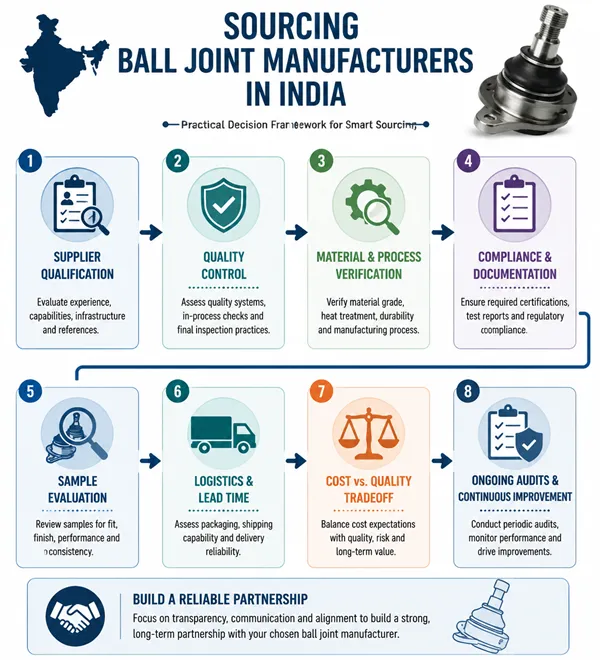
India has become a notable name in automotive parts sourcing.2 Many procurement managers I speak with have explored Indian suppliers at some point. Some had good experiences. Others ran into serious quality issues. The reality is more complex than a simple yes or no. Let me break this down for you so you can make a smarter sourcing decision.
Is the Quality of Indian Ball Joints Good Enough for Global Markets?
You need reliable parts. Your customers depend on them. So before anything else, you want to know if Indian ball joints can actually hold up in real-world conditions.
Indian ball joint manufacturers range from small workshops to mid-sized factories. A few meet international quality standards such as ISO9001.3 However, many lack the testing infrastructure and process controls required by global aftermarket brands. Quality consistency remains the biggest concern reported by international buyers.4
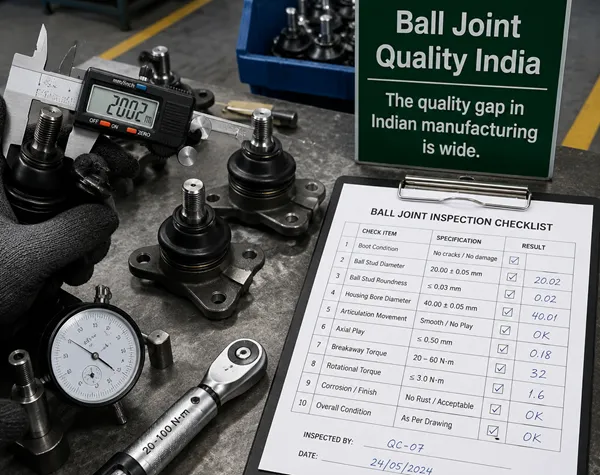
The quality gap in Indian manufacturing is wide.5 I have seen this firsthand when comparing samples from different suppliers. Some factories invest in proper tooling and QC processes. Others rely on manual checks with limited equipment. Here is a breakdown of what to look for when evaluating quality from any Indian supplier.
What Quality Checks Should You Require from Any Supplier?
| Test Type | What It Checks | Why It Matters |
|---|---|---|
| Salt spray test | Corrosion resistance of surface coating | Parts exposed to road conditions must resist rust |
| Torque test | Rotational resistance of the ball stud | Affects steering feel and control |
| Pull-out force test | Axial load resistance of the ball stud | Ensures the stud does not pull out under stress |
| Fatigue test | Long-term durability under repeated load | Predicts real-world service life |
| Dimensional inspection | Fitment accuracy against OE specs | Prevents installation issues in the field |
| Hardness test | Material hardness of housing and stud | Reflects the quality of raw materials used |
If a supplier cannot provide documented results for all of these tests, that is a red flag. Quality is not something you can judge by looking at a photo of a finished part. It must be proven through structured testing with traceable records.
My own team conducts all of the tests listed above for every production batch. We control dimensional tolerances within ±0.2 mm and source steel only from certified mills with material inspection reports. That is the standard I believe every serious supplier should meet.
What Are the Typical Products Offered by Ball Joint Manufacturers in India?
Not all suppliers carry the same product range. Before you even ask for a quote, you need to know if the factory can actually cover your vehicle applications.
Indian ball joint manufacturers typically produce parts for Japanese, Korean, and domestic Indian vehicle applications.6 Coverage for European and American vehicles is more limited.7 Most factories focus on a narrow product range and may not offer full suspension line coverage8 including tie rod ends, stabilizer links, or control arm bushings.
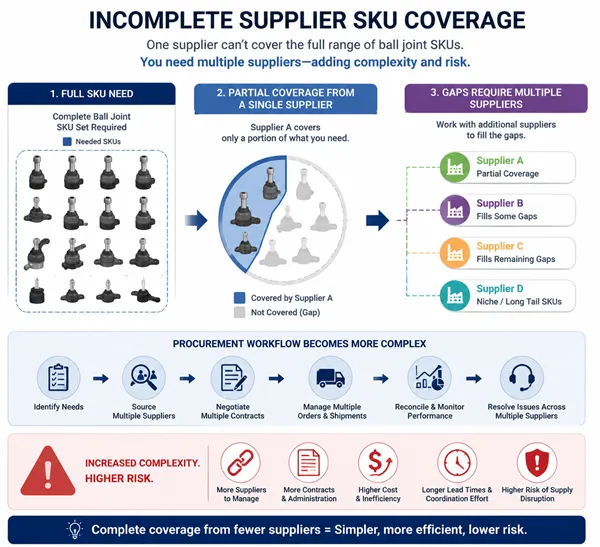
This is one of the most common pain points I hear from procurement managers. They find a supplier with acceptable pricing, then discover the factory only covers 30% of the SKUs they need. That forces them to manage multiple suppliers, which increases complexity and risk.
How Does Product Coverage Compare Between Sourcing Regions?
| Category | Indian Manufacturers | Chinese Manufacturers |
|---|---|---|
| Japanese vehicle coverage | Good | Excellent |
| Korean vehicle coverage | Moderate | Excellent |
| American vehicle coverage | Limited | Good to Excellent |
| European vehicle coverage | Limited | Good |
| Heavy-duty truck parts | Limited | Good |
| Full suspension line (ball joints + tie rods + links) | Rare | Common |
| OEM/ODM customization | Limited | Widely available |
| Private label support | Limited | Widely available |
When your business needs to cover multiple vehicle applications and suspension part categories, a supplier with narrow product coverage creates gaps. Those gaps mean you need backup suppliers, which increases your sourcing workload and reduces your bargaining position.
I work with customers who source over 500 SKUs across Japanese, Korean, American, and European vehicle applications. A supplier needs to be able to grow with that kind of demand, not force the buyer to manage five separate factories for five product categories.
How Do Indian Ball Joint Prices Compare to Other Sourcing Options?
Price is always part of the conversation. But price alone never tells the full story of your total sourcing cost.
Indian ball joint manufacturers often quote lower unit prices than some competitors9, but the total cost of sourcing includes tooling, sampling, quality failures, shipping, and after-sales support. Buyers who focus only on unit price often discover that the real cost of sourcing from low-quality suppliers is much higher.10
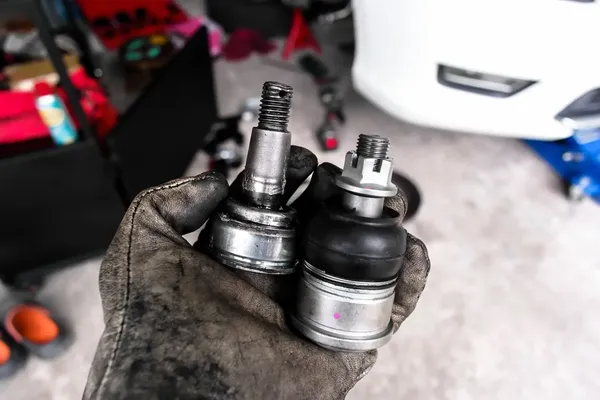
I have talked to many buyers who switched suppliers based on price alone and later came back to us after dealing with quality rejections, warranty claims, and delayed shipments. The math rarely works in their favor. Here is how I think about total sourcing cost.
What Makes Up the True Cost of Sourcing Ball Joints?
| Cost Factor | Low-Price Supplier Risk | Stable Supplier Advantage |
|---|---|---|
| Unit price | Appears lower | Slightly higher, but consistent |
| Tooling and sampling cost | Often hidden or poorly managed | Transparent and clearly documented |
| Rejection rate | High, leads to reruns and delays | Low, due to strict QC processes |
| Warranty claims | Frequent, damages your brand reputation | Rare, protects your market position |
| Shipping delays | Common with smaller factories | Managed through production scheduling |
| Communication efficiency | Often slow and unclear | Fast, responsive, technically capable |
| Long-term price stability | Unpredictable | More stable with contract pricing |
The total cost picture often makes a mid-priced, high-quality supplier more profitable than a cheap one. Your warranty claim rate alone can eat up any savings on unit price. I have seen it happen too many times.
Can Indian Ball Joint Manufacturers Support OEM and Private Label Requirements?
Many of my customers are brand owners or wholesalers who sell under their own label. They need more than just parts. They need a manufacturing partner who can build their brand.
Most Indian ball joint manufacturers have limited OEM and private label capabilities.11 Custom packaging, branded labeling, and product development support are not widely available across the industry.12 Buyers with specific branding or customization requirements may find Indian suppliers unable to meet those needs consistently.
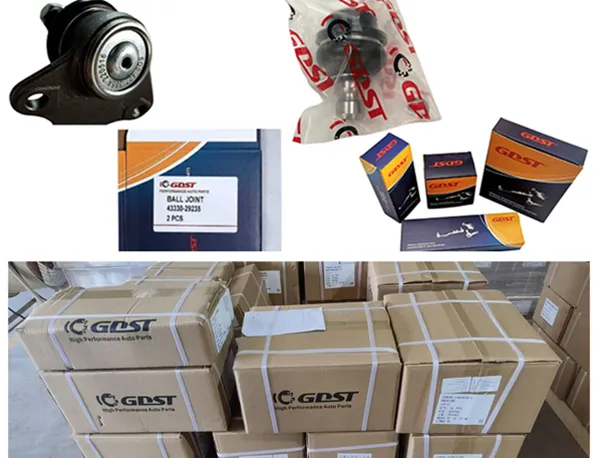
This matters a lot for brand owners. If you are building a product line, you need a factory that can handle your packaging specs, print your logo correctly, and ship parts that match your brand standards every single time. That requires investment in tooling, design capability, and process discipline.
What OEM/ODM Capabilities Should You Expect from a Serious Manufacturer?
| Capability | What It Means for You |
|---|---|
| Custom packaging design | Your brand identity is protected and consistent |
| Private label printing and labeling | Parts arrive shelf-ready for your customers |
| Sample development from drawings or specs | You can develop new SKUs without owning a factory |
| Mold ownership and management | Your product design is protected |
| Flexible MOQ for new product launches | You can test new SKUs without high inventory risk |
| In-house design team support | Faster turnaround on packaging and labeling changes |
At GDST, we support all of the above for our customers. Our in-house design team handles packaging and labeling. Our engineering team can develop new SKUs from customer samples or drawings. This is the level of support that brand owners and distributors need to grow their product lines without building their own factory.
Conclusion
Indian ball joint manufacturers offer options, but quality, coverage, and OEM support vary widely. Evaluate carefully, compare total costs, and choose a partner built for long-term reliability.
"a study of select Indian auto component SMEs - Academia.edu", https://www.academia.edu/12210868/Quality_management_in_new_automotive_supply_chains_a_study_of_select_Indian_auto_component_SMEs. Industry analyses of India's small and medium-sized enterprise (SME) manufacturing sector often highlight the significant disparity in technology adoption, quality control processes, and production consistency between different firms. Evidence role: general_support; source type: research. Supports: The claim that quality varies significantly across Indian suppliers.. Scope note: The source would likely discuss the manufacturing sector in general, not specifically ball joint manufacturers, but the principle of quality variance would be supported. ↩
"India: auto components export value 2025 - Statista", https://www.statista.com/statistics/1445372/india-auto-components-exports-value/?srsltid=AfmBOooc58k42vIGoUe84mpWQfH9SFevF-BWW97UeIq6bprmxj4xyw6W. Data from India's Automotive Component Manufacturers Association (ACMA) or Ministry of Commerce can provide statistics on the value and growth of automotive component exports, supporting the country's rising prominence in the global supply chain. Evidence role: statistic; source type: government. Supports: The claim that India is a notable source for automotive parts.. ↩
"Relationship between ISO 9001:2015 and operational and business ...", https://pmc.ncbi.nlm.nih.gov/articles/PMC7814109/. Reports from industry bodies or quality certification organizations can provide data on the adoption rate of ISO 9001 among Indian SMEs in the automotive sector, which can substantiate the claim about the prevalence of such standards. Evidence role: statistic; source type: institution. Supports: The claim that few Indian manufacturers have international quality certifications.. ↩
"India - Market Challenges", https://www.trade.gov/country-commercial-guides/india-market-challenges. Surveys and market research reports on global sourcing often identify quality consistency and reliability as primary challenges reported by international firms when procuring manufactured goods from India. Evidence role: expert_consensus; source type: research. Supports: The claim that quality consistency is a top concern for international buyers.. ↩
"India's Manufacturing Gap: 5 Priority Actions for Rapid Growth", https://www.linkedin.com/posts/alpesh-shah-7232311_manufacturing-in-india-an-idea-whose-time-activity-7437799294402990080-aVRI. Research on the Indian manufacturing landscape often describes a dualistic structure, with a small number of highly advanced, globally competitive firms and a large base of smaller enterprises that lag in technology and process maturity, creating a significant quality gap. Evidence role: general_support; source type: paper. Supports: The claim that a wide quality gap exists in Indian manufacturing.. ↩
"List of countries by automotive component exports - Wikipedia", https://en.wikipedia.org/wiki/List_of_countries_by_automotive_component_exports. Reports from the Automotive Component Manufacturers Association of India (ACMA) often provide breakdowns of production and export data, which can confirm the industry's focus on components for Japanese, Korean, and domestic vehicle models. Evidence role: statistic; source type: institution. Supports: The claim about the primary vehicle markets served by Indian parts manufacturers.. ↩
"Automotive Trade Data - International Trade Administration", https://www.trade.gov/automotive-trade-data. Export data from governmental bodies like the Ministry of Commerce and Industry in India can show the relative value and volume of auto components exported to different regions, which may indicate a smaller focus on European and American markets compared to Asian and domestic ones. Evidence role: statistic; source type: government. Supports: The claim that parts coverage for European and American vehicles is limited.. Scope note: Export value does not directly prove product catalog coverage but can serve as a strong proxy for market focus. ↩
"Automotive industry in India - Wikipedia", https://en.wikipedia.org/wiki/Automotive_industry_in_India. Analyses of the Indian auto component industry often note that the sector is highly fragmented, with many small and medium-sized enterprises (SMEs) that tend to specialize in a limited number of products rather than offering comprehensive product lines. Evidence role: general_support; source type: research. Supports: The claim that most Indian factories have a narrow product focus.. ↩
"A comparison of automobile industries in India and China", https://www.ideasforindia.in/topics/macroeconomics/a-comparison-of-automobile-industries-in-india-and-china. Comparative studies on global manufacturing costs often highlight India's labor cost advantages, which contribute to the price competitiveness of its manufactured goods, including automotive components, relative to suppliers in other countries. Evidence role: general_support; source type: research. Supports: The claim that Indian manufacturers are often price-competitive.. Scope note: This provides context for price competitiveness but does not prove that unit prices are always lower. ↩
"12 Key Elements Of Total Cost Of Ownership - Supply Technologies", https://www.supplytechnologies.com/resources/blog/12-key-elements-of-total-cost-of-ownership. Academic and business literature on supply chain management explains the Total Cost of Ownership (TCO) model, which demonstrates how factors like quality defects, rework, warranty claims, and shipping delays can make a supplier with a low unit price more costly in the long run. Evidence role: mechanism; source type: paper. Supports: The claim that low unit prices can hide higher total costs.. ↩
"India's Retailers Are Stocking Up on Private Label Brands", https://knowledge.wharton.upenn.edu/article/more-choices-in-store-indias-retailers-are-stocking-up-on-private-label-brands/. Reports on the Indian manufacturing sector often indicate that while basic production capabilities are widespread, the provision of value-added services such as original design manufacturing (ODM), product development, and comprehensive private label support is less common, particularly among smaller firms. Evidence role: general_support; source type: research. Supports: The claim that most Indian manufacturers have limited OEM/private label capabilities.. ↩
"(PDF) "Emergence of Private Labels in India" - Academia.edu", https://www.academia.edu/50345236/_Emergence_of_Private_Labels_in_India_. Market analyses from trade institutions may find that while Indian manufacturers are proficient in core production, ancillary services like bespoke packaging design, complex labeling, and integrated product development are capabilities more commonly found in larger, export-oriented firms rather than across the industry as a whole. Evidence role: general_support; source type: institution. Supports: The claim that specific value-added services are not widely available.. ↩