
Types of strut mounts can look confusing because similar parts often have different internal structures, functions, and package contents. That confusion can lead to catalog errors, incorrect orders, and costly returns. A better approach is to classify each mount by its suspension function, bearing arrangement, structural design, and confirmed vehicle application.
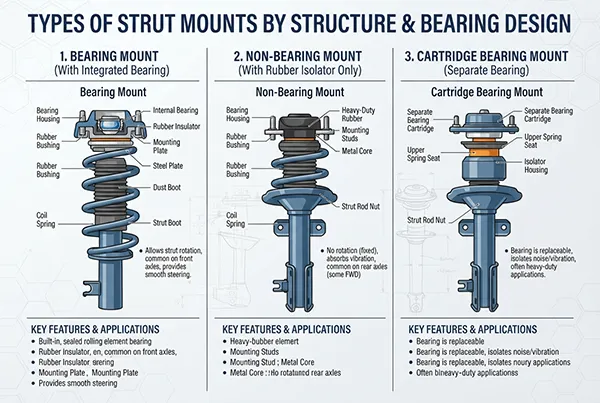
The main types of strut mounts include bearing-integrated mounts, mounts designed for separate bearings, and non-bearing mounts used where steering rotation is not required. However, this is not a universal interchangeability list. The correct type must be verified through the vehicle configuration, model year, chassis information, OE reference, and package contents.
In my experience comparing physical samples and reviewing quality feedback, most disputes do not begin with a completely wrong-looking part. They begin with a small structural or specification difference that was missed. Understanding the classifications below can make product comparison and purchasing verification much more reliable.
What Are the Main Types of Strut Mounts?
A simple visual list may seem convenient, but it can hide important functional differences. Two mounts may share a round shape, similar bolt positions, and comparable dimensions while supporting different spring loads or steering arrangements. That is why I avoid classifying them by appearance alone.
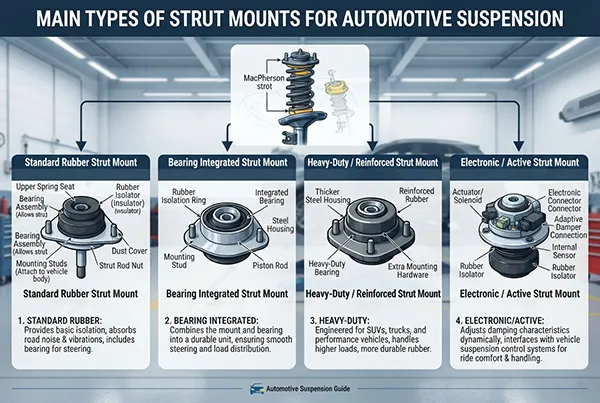
The main types of strut mounts can be grouped by bearing integration, steering function, spring-load path, and installation position. Common groups include mounts with integrated bearings, mounts using separate bearings, and fixed non-bearing mounts. Some designs also integrate spring seats, insulators, spacers, or related hardware, depending on the suspension system.
Bearing-integrated strut mounts
A bearing-integrated mount contains a bearing within the mount assembly. This arrangement is often associated with front suspension systems in which the strut must rotate as the vehicle steers.
However, the presence of a bearing does not mean that the product is automatically better or more durable. It means that the suspension design requires a particular rotational function. The bearing’s dimensions, sealing arrangement, internal geometry, and relationship with the rubber and metal components must match the application.
During sample inspections, I check whether the bearing is:
- Permanently integrated into the mount
- Removable but supplied in the same package
- Installed in a defined upper or lower orientation
- Protected by an appropriate seal or cover
- Compatible with the spring seat and surrounding components
A bearing can sometimes be difficult to identify from a catalog photo. Cross-sectional drawings, physical samples, and supplier specifications are more useful than appearance alone.
Strut mounts with separate bearings
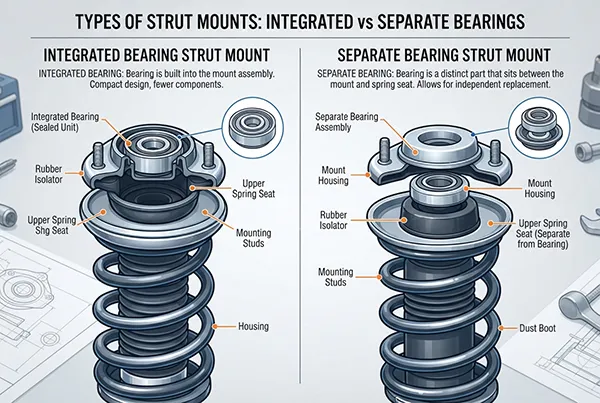
Some suspension layouts use a mount and bearing as separate components.1 The bearing may sit below the mount, above the spring seat, or in another position defined by the assembly design.
This creates a common catalog problem. One supplier may list only the mount, while another may list the mount and bearing as a kit under a similar description. The products may appear to have different prices even though the quoted component scope is not the same.
When comparing offers, I recommend confirming:
- Whether a bearing is required for the application
- Whether it is included in the quoted package
- Whether it has a separate part or OE reference
- Whether it arrives assembled or loose
- Whether installation hardware is included
Non-bearing or fixed strut mounts
A non-bearing mount does not provide the same steering rotation function as a bearing-equipped design. Such mounts may be used in non-steering positions or in suspension systems where rotation is handled elsewhere.
A missing bearing is therefore not automatically evidence of an incomplete or lower-grade product. The intended suspension position determines whether a bearing is necessary.
Designs with additional integrated components
Some mounts incorporate more than a rubber element and metal plate. Depending on the application, a product may include:
- A spring seat
- A rubber spring insulator
- A spacer or washer
- A dust cover interface
- Studs, nuts, or other hardware
- A separate or integrated bearing
These configurations are useful commercial categories, but they are not universal engineering classes. The exact product scope must still be defined for each part number.
How Do Types of Strut Mounts Differ by Bearing Design?
Bearing terminology often creates unnecessary confusion. A mount with a bearing and one without a bearing are sometimes presented as two quality grades. That comparison is misleading because the difference usually reflects suspension function and assembly design rather than a simple quality ranking.
Types of strut mounts differ by whether the bearing is integrated, supplied separately, or not required. Bearing-equipped designs generally support steering-related rotation, while non-bearing mounts serve layouts where that function occurs elsewhere. The correct configuration depends on the complete suspension system, not on a preference for more components.
What the bearing actually changes
The bearing allows relative rotational movement between parts of the strut assembly.2 In an applicable front suspension design, that movement helps the strut and spring assembly respond as the steering system changes direction.
The mount still performs other jobs. It connects the strut assembly to the vehicle body, supports defined loads, and uses rubber or another isolating structure to manage movement and vibration. The bearing does not replace those functions.
From a manufacturing and inspection perspective, I treat the bearing as one part of a larger system. I look at:
- Bearing dimensions and installation position
- Rotational smoothness during basic product inspection
- Seal and cover arrangement
- Contact surfaces around the bearing
- Fit between the bearing, mount, and spring seat
- Assembly direction and locating features
These checks can reveal obvious product or assembly differences. They do not replace application-specific engineering validation or qualified vehicle inspection.
Why “bearing included” can be ambiguous
A catalog description may say “with bearing,” but that phrase can mean several things:
| Description | Possible package content | Verification needed |
|---|---|---|
| Mount with bearing | Bearing integrated into the mount | Confirm structure and OE reference |
| Mount and bearing | Two separate components in one package | Confirm both part numbers |
| Strut mount kit | Mount, bearing, and selected accessories | Request a full contents list |
| Complete upper assembly | Multiple preassembled upper components | Confirm assembly boundary |
| Top mount | Could refer to rubber-metal mount only | Check drawing and package photo |
A product title should never be the only purchasing specification. I prefer a bill of contents, dimensional drawing, assembly image, and physical sample when the terminology is unclear.
Why a bearing-equipped design is not always superior
More components do not automatically create better performance. A bearing-equipped product can be wrong for an application that requires a fixed mount. A non-bearing mount can be correct and complete when the suspension design does not require bearing integration.
The same caution applies to weight and rubber hardness. A heavier mount is not necessarily stronger, and harder rubber is not automatically more durable.3 Material formulation, geometry, bonding, load direction, and vehicle requirements all matter. Application-specific conclusions should be reviewed by qualified technical professionals.
How Should Types of Strut Mounts Be Separated From Kits and Related Parts?
Naming differences can make one item appear to be several different products. Terms such as top mount, strut bearing, rubber insulator, repair kit, and complete assembly are sometimes used loosely. If the actual package scope remains unclear, quotation and inventory comparisons can become unreliable.
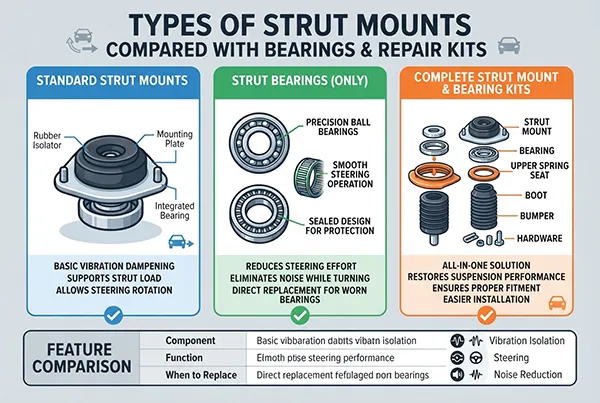
Types of strut mounts describe structural or functional designs, while package terms describe what is sold together. The mount, bearing, rubber insulator, spring seat, hardware set, and complete assembly are related but distinct. Each quotation and catalog record should identify the exact components included rather than relying on a general product name.
The strut mount itself
The strut mount is generally the upper mounting component that connects the strut assembly to the vehicle structure. Its exact construction varies. Many designs use bonded rubber and metal parts, while others include a bearing or additional structural features.
The term should not automatically be extended to every component located at the top of the strut.
The strut bearing
The strut bearing is the component that provides rotational movement where the suspension design requires it. It may be:
- Integrated into the mount
- Attached to the mount
- Supplied as a separate part
- Included in a kit
- Sold under its own reference
A bearing with a similar outside diameter is not necessarily interchangeable. Internal geometry, height, contact surfaces, and installation orientation may differ.
The rubber insulator or top rubber
A rubber insulator may isolate the spring or another part of the upper assembly. In some markets, “top rubber” is also used as a broad name for the mount. That language can cause errors because a separate spring insulator is not always the same component as the structural strut mount.4
I have found that labeled photos are particularly helpful here. Each visible component should be marked with its name and package status.
Repair kits and complete assemblies
A repair kit is a commercial package, not one fixed technical configuration. It may contain two parts in one market and several parts in another. A complete assembly may also have different boundaries depending on the supplier.
A clear component comparison can prevent misunderstandings:
| Item | Typical role | May include other parts? |
|---|---|---|
| Strut mount | Connects the upper strut area to the body | Sometimes includes a bearing |
| Strut bearing | Supports required rotational movement | Usually a separate or integrated component |
| Spring insulator | Isolates the spring contact area | Usually supplied separately |
| Repair kit | Groups selected replacement components | Contents vary by supplier |
| Complete assembly | Combines multiple upper strut components | Assembly scope must be defined |
For procurement records, I recommend recording both the product type and the package content. This keeps structural classification separate from sales terminology.
How Can Types of Strut Mounts Be Verified Before Purchasing?
A wrong selection may still look convincing in a photograph. Bolt patterns, plate shapes, and rubber profiles can appear nearly identical. The mismatch may only become clear when the bearing position, installation height, spring-seat interface, or chassis configuration is compared.
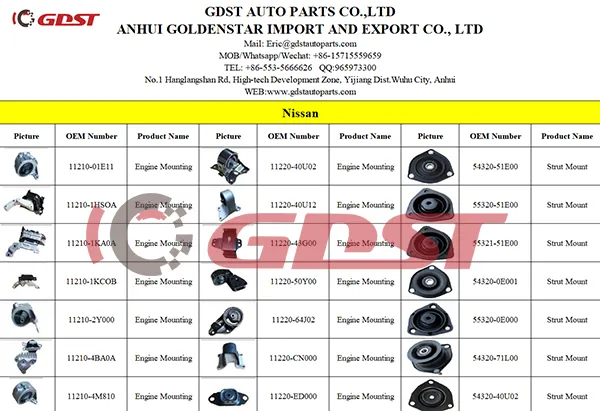
Types of strut mounts should be verified by matching the full vehicle configuration, model year, chassis or platform code, installation position, OE reference, and component scope. Buyers should also confirm bearing integration, key dimensions, material specifications, package contents, labeling, and sample conformity before approving mass production.
Start with complete vehicle information
Vehicle names alone are often too broad. The same model name may cover different generations, regional specifications, suspension packages, or production changes.
A useful fitment record should include:
- Vehicle manufacturer and model
- Model year or production range
- Chassis, platform, or generation code
- Engine or drivetrain information when relevant
- Front or rear installation position
- Left, right, or common-side application
- Suspension configuration
- OE number and supersession information
OE information is highly useful, but it should also be checked carefully. A superseded number may indicate a design update, package change, or consolidated application. It does not always mean that every earlier-looking version is interchangeable.
Confirm structure with drawings and samples
For a new item, I prefer to compare more than a product photo. A practical review can include:
- Overall dimensions: Check height, outside diameter, and mounting locations.
- Stud or hole pattern: Confirm spacing, orientation, thread details, and projection.
- Bearing arrangement: Identify whether it is integrated, separate, or absent.
- Rubber geometry: Compare shape, voids, bonding area, and locating features.
- Metal construction: Review plate shape, thickness specifications, and surface treatment requirements.
- Assembly interface: Check contact with the spring seat, strut rod, and related hardware.
- Package contents: Record every supplied component.
Dimensional similarity supports comparison, but it does not prove fitment. The product still needs to match the intended OE and vehicle configuration.
Turn sample approval into production control
A correct sample does not help if later batches drift from the approved specification. The approved reference should connect to production drawings, material requirements, process controls, inspection instructions, packaging, and labeling.
At GDST Auto Parts, our manufacturing work includes sample comparison, product development, process monitoring, and final inspection. In practice, customer feedback has taught me to investigate structural and specification differences before assuming that a complaint comes from general product quality. Sometimes the supplied part and the expected part belong to different package definitions or vehicle configurations.
Relevant supplier records may include:
- Material inspection documentation
- Dimensional inspection reports
- Rubber and metal specification records
- Bonding and assembly process controls
- Bearing-source and batch traceability
- Packaging and label approval records
- Final inspection criteria
Quality-management certificates such as IATF 16949 or ISO 9001 should be treated as documents to verify. Their validity, issuing body, company name, address, scope, and covered activities should be checked rather than assumed from a logo.
Frequently Asked Questions
Are bearing-equipped strut mounts better than non-bearing mounts?
No. A bearing-equipped mount is not automatically better. It serves a suspension layout that requires rotational movement at that location. A non-bearing mount may be the correct design for another position or suspension system. Quality should be judged against the application specification, materials, construction, and process controls.
Can two similar-looking strut mounts be interchangeable?
Visual similarity does not prove interchangeability.5 Two mounts may differ in bearing position, installation height, stud orientation, rubber geometry, spring-seat interface, or internal construction. Fitment should be confirmed with the vehicle configuration, OE reference, technical drawing, package scope, and, when necessary, physical samples.
Is a strut mount kit the same as a strut mount?
Not always. A strut mount is a specific component, while a kit is a package that may include the mount, bearing, insulator, washers, nuts, or other hardware. Kit contents vary between suppliers, so every included component should be listed before prices or part numbers are compared.
Does harder rubber make a strut mount last longer?
Not necessarily. Rubber hardness is only one specification. Geometry, compound formulation, bonding quality, load direction, temperature exposure, and suspension design also affect performance. A harder material can change isolation or movement characteristics.6 The correct specification should follow validated application requirements rather than a simple harder-is-better rule.
What information is needed when requesting a strut mount quotation?
A useful request includes the OE number, vehicle make and model, model year, chassis code, installation position, suspension configuration, sample or drawing, bearing requirement, package contents, expected labeling, and packaging details. Clear information reduces the risk of quoting a visually similar but structurally different item.
Conclusion
The useful way to understand types of strut mounts is to classify them by structure, suspension function, bearing integration, and vehicle application—not by appearance alone. It is equally important to separate the mount from the bearing, insulator, repair kit, and complete assembly. Before purchasing, verify the vehicle configuration, OE reference, drawings, samples, package contents, and supplier control records. For application-specific decisions, seek qualified technical evaluation. Contact GDST Auto Parts to discuss sample comparison, OEM/ODM requirements, packaging, and strut-mount manufacturing verification.
"Course Descriptions | NWTC Auto Tech Class", https://nwtech.edu/rader/course-descriptions/. Technical descriptions of strut suspensions show that the resilient upper mount and the bearing that accommodates steering rotation may be separate elements within the upper assembly. Evidence role: general_support; source type: education. Supports: A suspension-system reference should document an upper strut assembly in which the elastic mount and rotational bearing are distinct parts.. Scope note: The precise position and packaging of the bearing vary by suspension design and vehicle application. ↩
"Glossary of bridge terminology--R", http://sdrc.lib.uiowa.edu/eng/bridges/WaddellGlossary/glossr.htm. In a steerable strut assembly, the upper bearing provides a low-friction interface for relative rotation while transmitting loads through the upper suspension connection. Evidence role: definition; source type: education. Supports: An engineering source should define the upper strut bearing as the element that permits relative rotational motion while transmitting axial or suspension loads.. Scope note: The bearing type, load capacity, and exact load path differ among suspension architectures. ↩
"Research Progress on Fatigue Life of Rubber Materials - PMC", https://pmc.ncbi.nlm.nih.gov/articles/PMC9654122/. Elastomer durability research treats fatigue life as a function of compound formulation, geometry, strain history, temperature, aging, and loading conditions; hardness alone is therefore not a sufficient predictor of service life, just as component mass alone does not establish structural strength. Evidence role: expert_consensus; source type: paper. Supports: Elastomer-fatigue and structural-design literature should show that durability depends on formulation, strain state, geometry, temperature, aging, bonding, and cyclic loading, not hardness or mass alone.. Scope note: General elastomer and structural principles do not quantify the durability of a particular strut mount without application-specific testing. ↩
"1967 Mustang rear suspension redesign", https://drc.libraries.uc.edu/bitstreams/c87f6168-87f4-441e-b097-3e9bc169298d/download. Suspension component descriptions distinguish a spring insulator at the spring-seat contact surface from the structural upper mount that connects the strut assembly to the vehicle body. Evidence role: definition; source type: education. Supports: A suspension reference should distinguish the spring insulator, which cushions or isolates the spring at its seat, from the mount that attaches the strut assembly to the body.. Scope note: Some assemblies integrate these functions or use overlapping commercial terminology, so the distinction must be checked for the specific design. ↩
"Hollander Auto Parts Interchange Manual Mazda", https://emergency.jacksonms.gov/fulldisplay/lB5rOt/7OK141/hollander_auto-parts__interchange_manual__mazda.pdf. Engineering definitions of interchangeability require compatible dimensions, tolerances, interfaces, and functional performance; visual resemblance alone does not demonstrate that two components can be substituted safely or correctly. Evidence role: general_support; source type: education. Supports: An engineering source should explain that interchangeability requires conformity of mating dimensions, tolerances, interfaces, and functional requirements rather than superficial resemblance.. Scope note: This general engineering principle does not determine whether any particular pair of strut mounts is interchangeable. ↩
"Introduction to Designing Elastomeric Vibration Isolators ...", https://wp.optics.arizona.edu/optomech/wp-content/uploads/sites/53/2016/10/521_Tutoral_Hopkins.pdf. Vibration-isolation theory and elastomer-mount studies show that changes in mount stiffness alter system natural frequency, relative displacement, and force transmissibility, so a harder or dynamically stiffer material can change both isolation and movement. Evidence role: mechanism; source type: paper. Supports: A vibration-engineering source should establish that isolator stiffness affects natural frequency, displacement, force transmission, and vibration transmissibility.. Scope note: Hardness is not identical to dynamic stiffness, and the resulting vehicle response depends on geometry, preload, frequency, and damping. ↩