
A strut mount is easy to confuse with the spring seat, strut tower, or strut itself. That confusion can lead you to inspect or order the wrong component. Once you understand how the suspension assembly connects to the vehicle body, you can locate the mount more accurately and verify the correct replacement.
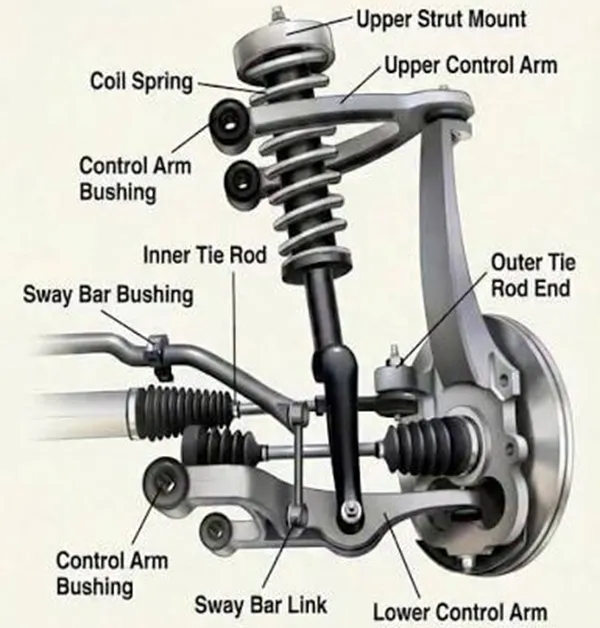
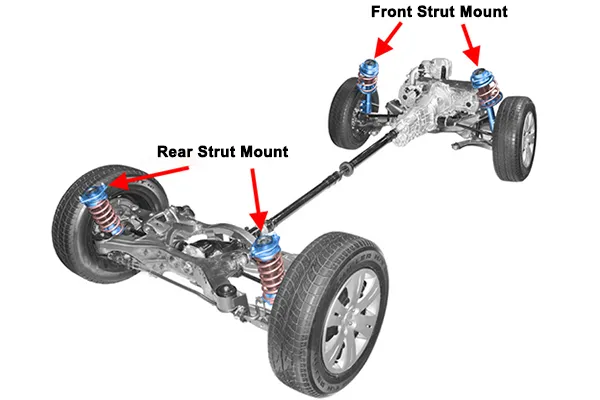
A strut mount is typically located at the upper end of a strut assembly, between the strut and the vehicle body mounting area. A front mount may be accessible from the engine bay, while a rear mount may sit behind trunk lining, cargo-area trim, a rear seat panel, or another body structure.
That basic answer applies to many vehicles, but it is not a universal fitment diagram. The exact position and visibility depend on the vehicle model, production year, axle, side, and suspension design. You should confirm all of those details before identifying or purchasing the part.
Where Is a Front Strut Mount Located?
Finding a front suspension mount may look simple because many engine bays show several nuts near each side. However, not every visible fastener belongs to the mount, and covers or cowl panels can hide the real mounting point. A generic photograph can easily send you to the wrong area.
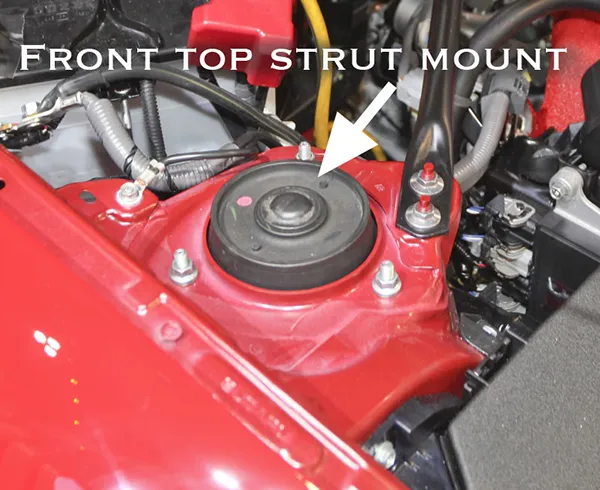
A front strut mount is typically positioned at the top of the front strut assembly, where the assembly attaches to the vehicle body. You can often find its upper mounting area inside the engine compartment, near the left or right strut tower. Its exact visibility depends on the body and suspension design.
Follow the suspension upward
You can understand the location by starting at the wheel area and following the assembly upward. On a typical strut-type front suspension, you may see the following general order:
- The steering knuckle or wheel carrier connects near the lower section.
- The strut body extends upward from the wheel area.
- The coil spring surrounds part of the strut assembly.
- The upper spring seat supports the top of the coil spring.
- The mount sits near the upper end of the assembly.
- The vehicle body provides the structural mounting area above it.
This sequence is useful for orientation, but the components may overlap when viewed from outside. Some parts also remain hidden inside the assembled unit.
Do not confuse the mount with the strut tower
The strut tower is part of the vehicle body. The mount is a separate suspension component that connects the assembly to that body structure. When you look under the hood, the metal dome or reinforced body area is generally the tower. The fasteners around it may secure the upper mount below.
You should also distinguish the mount from nearby components:
| Component | General function | How it differs from the mount |
|---|---|---|
| Strut | Provides structural support and damping | Extends downward toward the wheel assembly |
| Coil spring | Supports vehicle weight and absorbs movement | Usually wraps around the strut body |
| Spring seat | Supports and positions the spring | Contacts the end of the coil spring |
| Strut mount | Connects the upper assembly to the body | Sits at or near the top of the assembly |
| Strut tower | Reinforced vehicle-body structure | Belongs to the body rather than the replaceable assembly |
On some front suspensions, the upper mount includes a bearing that allows movement as the steering turns. However, construction varies. You should not assume that every upper mount contains the same internal parts or has the same shape.
From a manufacturing perspective, physical samples often make the mounting relationship clear. Studs, bolt holes, a central opening, rubber isolation material, and a bearing arrangement can indicate how the component interfaces with the body and strut. Even so, appearance alone does not establish vehicle fitment.
Where Is a Rear Strut Mount Located?
A rear mount can be harder to find because the vehicle body may conceal it. You may see the lower damper connection near the wheel without seeing where the upper section attaches. Removing random trim based on an online photograph can waste time and may not reveal the correct point.
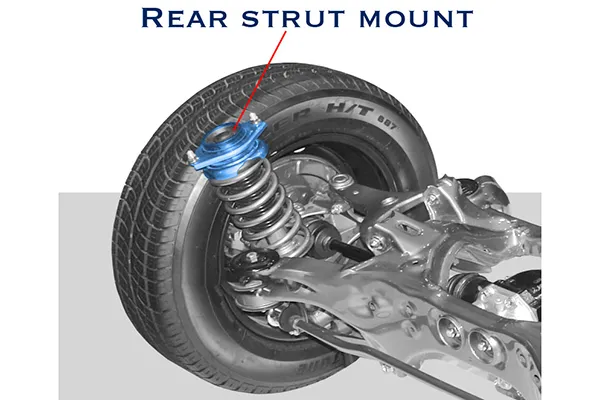
A rear strut mount is generally located at the upper end of a rear strut assembly where it connects to the body. Depending on the vehicle, the upper mounting area may be behind trunk lining, cargo-area trim, a side panel, a rear seat structure, or an exterior body section near the wheel housing.
First confirm that the vehicle uses rear struts
Not every rear suspension uses a complete strut assembly. Some vehicles use a separate coil spring and shock absorber.1 In that design, the upper shock attachment may be described as a shock mount rather than a strut mount.
That difference matters because similar-looking rubber-and-metal parts may have different functions, dimensions, and load paths. You should verify the suspension design before using a product name from a generic catalog.
A practical identification sequence includes:
- Confirm whether the rear suspension uses a strut or a separate shock and spring.
- Check whether the vehicle has independent or another type of rear suspension.
- Verify the exact model, year, and production version.
- Confirm whether the catalog describes the component as a strut mount, shock mount, support, bearing, or upper mounting kit.
- Compare verified OE references, drawings, and dimensions.
Why does rear visibility vary?
Vehicle packaging controls where the upper attachment appears. Engineers must arrange the suspension around the cargo floor, rear seats, fuel system, wheel housings, structural reinforcement, and interior trim. As a result, one vehicle may expose upper fasteners inside the trunk, while another may cover them completely.
The following table shows common possibilities, not universal rules:
| Vehicle layout | Possible upper mounting area | What may conceal it |
|---|---|---|
| Sedan | Side of the trunk or below the rear parcel area | Trunk carpet, side lining, structural panel |
| Hatchback | Rear cargo compartment | Side trim or floor panels |
| SUV or crossover | Cargo-area side structure | Molded trim, storage compartments |
| Pickup or light truck | Frame or body area near the wheel housing | Bed structure, liner, chassis components |
These examples should help you understand where to look conceptually. They should not replace service information for a specific vehicle.
You should also avoid using noise or vibration as proof that a hidden component has failed. Several suspension, steering, wheel, and body parts can create similar symptoms.2 A qualified technician should evaluate application-specific concerns with the correct vehicle data and inspection procedures.
What Parts Surround the Strut Mount?
Adjacent components can make identification difficult. A catalog photograph may show only one rubber-and-metal piece, while the vehicle uses an assembled support, bearing, spring seat, insulator, washer, and hardware. If you treat every upper component as the same part, you may select an incomplete or incompatible product.
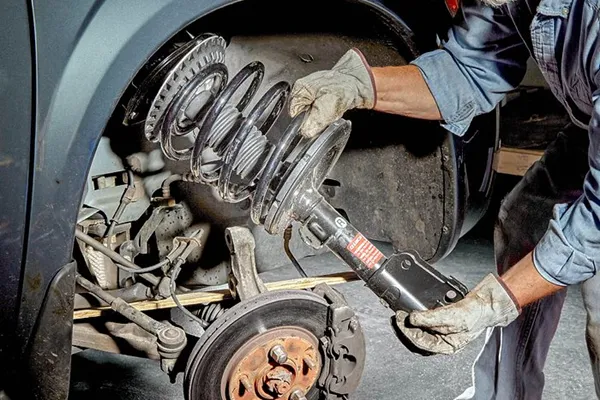
The strut mount generally interfaces with the upper strut area and the vehicle body. Depending on the design, nearby parts may include an upper spring seat, bearing, dust cover, bump stop, insulator, retaining nut, washer, and mounting hardware. Some products combine several of these items into one mount or kit.
The mount and spring seat are not automatically the same part
The spring seat supports the end of the coil spring. The upper mounting component connects the assembly to the body. Some designs integrate these functions closely, while others use separate pieces.
You should examine an exploded drawing whenever possible. It shows the order of components more clearly than a photograph of an assembled strut. The drawing may also reveal whether a bearing is separate, integrated, or not used in that application.
Common features visible on a physical sample
When our manufacturing team examines samples and technical drawings, several features help define the component’s structural role:
- Body attachment points: Studs or bolt holes show how the part connects to the vehicle.
- Central opening: This area may accommodate the strut rod and related hardware.
- Rubber element: The elastomer can isolate vibration and allow controlled movement.3
- Metal reinforcement: Steel sections help transfer loads between the assembly and body.4
- Bearing interface: Some front designs include or accept a rotational bearing.
- Spring-seat interface: The shape may align with a separate seat or an integrated support.
These observations support structural identification, but they do not confirm fitment on their own. Two mounts can look nearly identical while using different stud spacing, center-hole dimensions, rubber hardness, bearing construction, or installation orientation.
Assembly terminology also varies
Different catalogs may use terms such as:
- Upper strut mount
- Suspension strut support
- Top mount
- Strut mounting
- Strut bearing
- Upper mounting kit
- Shock absorber mount
These names are not always interchangeable. For example, a listing described as a “strut bearing” may contain only the bearing, while another listing may use the same term for a complete support assembly. You should check the product contents instead of relying only on the title.
A useful rule is to compare the part’s function, position, drawing, and reference number—not just its shape or catalog name.
How Can You Confirm the Correct Strut Mount Location and Fitment?
A general location explains where the component sits, but it cannot identify the correct replacement for every vehicle. Small differences between production years, trim levels, engines, and suspension packages can change the mounting design. Visual similarity alone creates a serious risk of incorrect selection.
To confirm a strut mount, you should verify the exact vehicle model, year, version, axle, side, and suspension design. You should then compare reliable catalog data, OE references, dimensional drawings, and sample details. This process is more dependable than copying a universal diagram or choosing the closest-looking photograph.
Check three essential variables
Before making an inquiry or placing an order, confirm these three groups of information.
1. Vehicle identity
Record the details as precisely as possible:
- Vehicle make and model
- Model year or production date
- Engine or trim version when relevant
- Market or regional version
- VIN information when supported by a verified catalog5
A model name alone may not be enough. Manufacturers can use different suspension configurations within the same model generation.
2. Axle and side
Confirm whether the part is for:
- Front or rear
- Left or right
- A side-specific or interchangeable application
Some mounts fit both sides, while others have different stud patterns, angles, or body interfaces.6 You should not assume symmetry without catalog confirmation.
3. Suspension design
Determine whether the application uses:
- A complete strut assembly
- A separate shock absorber and coil spring
- An adaptive or electronically controlled damper
- A standard or heavy-duty suspension package
- A mount with an integrated or separate bearing
These details can affect both location and product configuration.
Use a verification hierarchy
Reliable information should take priority over convenience. A useful hierarchy is:
- Verified OE part number or vehicle catalog
- Vehicle-specific technical drawing
- Accurate sample with traceable application data
- Measured dimensions and mounting pattern
- Clear photographs showing all sides
- Generic online image
A generic image belongs at the bottom because it often lacks scale, application data, and hidden construction details.
For commercial sourcing, you can also review material specifications, dimensional tolerances, testing records, production consistency, packaging requirements, and quality-management documents. Certifications such as IATF 16949 and ISO 9001 should be treated as documents to verify rather than automatic proof that every part fits or performs correctly.
At GDST Auto Parts, strut-mount development can be supported by samples, drawings, OE references, and technical requirements. However, accurate vehicle information must come first. A factory cannot correct an uncertain application by relying on appearance alone.
Frequently Asked Questions
Can you see a strut mount under the hood?
You can often see the upper mounting area of a front mount under the hood, usually near a body strut tower. However, a cowl panel, plastic cover, brace, or other component may obstruct it. You should verify the layout for the exact vehicle rather than assuming that all mounting fasteners are exposed.
Is a strut mount the same as a strut tower?
No. The mount is a suspension component that helps connect the upper strut assembly to the vehicle. The strut tower is the reinforced body structure surrounding or supporting that connection. One is generally a replaceable component, while the other is part of the vehicle body.
Is a strut mount the same as a spring seat?
Not necessarily. A spring seat supports and positions the coil spring, while the mount connects the upper assembly to the body. Some designs integrate the two functions, but other designs use separate parts. An exploded vehicle-specific drawing can clarify the arrangement.
Are front and rear strut mounts interchangeable?
Front and rear mounts are generally not interchangeable because they can use different dimensions, load requirements, attachment patterns, and bearing arrangements. Left and right parts may also differ. You should confirm the axle, side, suspension type, and verified reference number before selection.
Can noise confirm that a strut mount has failed?
No. Noise, vibration, or steering changes can come from several suspension, steering, wheel, or body components. Location and symptoms alone cannot confirm failure. A qualified technician should inspect the vehicle using the correct technical information and application-specific procedures.
Conclusion
A strut mount is typically located between the upper end of the strut assembly and the vehicle body mounting area. Front mounting points may appear in the engine bay, while rear points may remain behind interior trim or body structures. You should always distinguish the mount from the strut, spring seat, coil spring, and strut tower. Before purchasing or requesting a quotation, confirm the vehicle model, production year, version, axle, side, suspension design, and OE reference. Contact GDST Auto Parts with verified application data, samples, or drawings for OEM/ODM manufacturing and fitment review.
"Shocks vs Struts: Differences, Functions and Replacement", https://www.uti.edu/blog/automotive/struts-vs-shocks. Suspension-design references distinguish strut layouts from arrangements in which the coil spring and telescopic damper are mounted separately. Evidence role: general_support; source type: education. Supports: A suspension-design source should document that springs and dampers may be integrated into a strut assembly or installed as separate components, depending on architecture.. ↩
"Noises at front axle when steering", https://static.nhtsa.gov/odi/tsbs/2024/MC-11012061-0001.pdf. Automotive noise-and-vibration diagnostic guidance notes that similar symptoms may originate in multiple chassis and body interfaces, so symptom location alone is not a definitive component diagnosis. Evidence role: expert_consensus; source type: education. Supports: A diagnostic or NVH reference should explain that similar noises or vibrations can arise from several suspension, steering, wheel, fastening, or body interfaces.. Scope note: This supports the need for differential diagnosis but does not identify the cause of symptoms on any individual vehicle. ↩
"Barry-isolators-selection-guide.pdf", https://wp.optics.arizona.edu/optomech/wp-content/uploads/sites/53/2016/08/Barry-isolators-selection-guide.pdf. Research on elastomeric mounts shows that their compliance and damping can reduce vibration transmission while accommodating limited relative displacement under load. Evidence role: mechanism; source type: paper. Supports: Research on elastomeric mounts should describe how material compliance and damping reduce transmitted vibration while allowing bounded deformation under load.. Scope note: The amount of isolation and movement depends on geometry, material properties, loading, frequency, and temperature; the general mechanism does not establish the performance of a specific mount. ↩
"Structural Topology Optimization of Multilink Suspension ...", https://imechanica.egr.uh.edu/sites/default/files/Twu_GM_final_3232012.pdf. Structural analyses of strut suspensions treat the upper mount and surrounding reinforced body attachment as part of the load path by which suspension forces enter the vehicle structure. Evidence role: mechanism; source type: paper. Supports: An engineering source should describe the upper mount and its rigid reinforcement as part of the structural path carrying suspension forces into the body.. Scope note: This supports the general load-transfer role but does not specify the material, thickness, or capacity required for a particular mount. ↩
"VIN Decoder", https://www.nhtsa.gov/vin-decoder. Government VIN guidance explains that the vehicle identification number provides standardized identifying information about a vehicle and can therefore assist application verification when interpreted through an authoritative database. Evidence role: general_support; source type: government. Supports: A government VIN resource should establish that the VIN encodes or links to identifying vehicle attributes that can help distinguish a specific application.. Scope note: A VIN does not necessarily encode every suspension option directly, and parts accuracy still depends on the completeness of the linked catalog. ↩
"SAE Baja Front Suspension | GW ScholarSpace", https://scholarspace.library.gwu.edu/downloads/9880vr219?disposition. Vehicle-specific parts catalogs and technical drawings document both shared left-right upper mounts and side-specific mounts, with applicability determined by the attachment geometry of the particular suspension. Evidence role: case_reference; source type: institution. Supports: An official parts catalog or vehicle-specific technical drawing should show either a shared mount for both sides or distinct left- and right-hand mounts with different references or geometry.. Scope note: The cited application would illustrate design variation rather than establish interchangeability rules for vehicles not covered by that source. ↩