Center link failure can create expensive warranty decisions because noise, looseness, and abnormal steering behavior do not automatically prove that the part is defective. If you classify every complaint as a manufacturing problem, you may replace parts without stopping recurrence. A structured investigation helps you separate product quality from fitment, installation, connected components, and operating conditions.
Center link failure may result from incorrect application, installation or fastening issues, poor wheel alignment, wear in connected steering parts, severe operating conditions, or a genuine product-quality problem. You should verify the vehicle application and inspect the complete steering linkage before approving a warranty claim or treating one returned part as evidence of a batch defect.
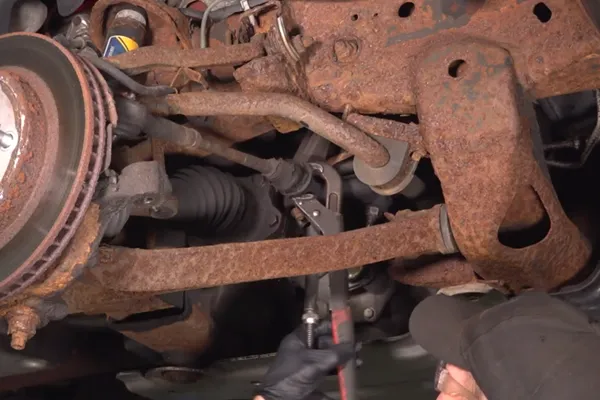
In my experience handling complaints and returned steering parts, the most useful question is not simply, “Did the center link fail?” You should ask, “What evidence shows why the complaint occurred?” That change in approach can prevent repeat failures, unsupported supplier claims, and incorrect warranty conclusions.
Which Symptoms May Indicate Center Link Failure?
A complaint often begins with a symptom such as steering noise, looseness, uneven tire wear, or unstable handling. The problem is that these symptoms can come from several steering and suspension components. If you focus on the reported symptom alone, you may reach a conclusion before you have enough evidence.
A possible center link failure should be investigated when inspection finds abnormal movement, wear, deformation, damaged joints, or another condition involving the center link. However, noise, steering play, or irregular tire wear cannot confirm a defective center link by themselves. A qualified professional should inspect the vehicle and document the actual condition.
You Should Separate Symptoms From Causes
I use three separate categories when reviewing a complaint:
- The symptom describes what the driver or customer noticed.
- A contributor describes a condition that may have created or increased the problem.
- A verified cause requires supporting evidence.
This distinction matters because a customer may report “the center link is loose,” while the available evidence consists only of steering noise. In that situation, the complaint identifies a symptom, but it does not yet identify the affected component or root cause.
| Evidence category | Example | What you can reasonably conclude |
|---|---|---|
| Reported symptom | The driver hears a knocking noise. | A steering or suspension inspection is needed. |
| Observed condition | A technician finds movement in the linkage. | The source and location of the movement should be documented. |
| Possible contributor | A connected idler arm also shows wear. | The idler arm may contribute to abnormal linkage movement. |
| Verified cause | Inspection records clearly connect damage to a documented condition. | You can make a more evidence-based warranty decision. |
| Insufficient evidence | A returned part arrives without vehicle or installation information. | The root cause cannot be confirmed from the complaint alone. |
Commonly Reported Symptoms
You may receive complaints involving:
- The driver notices excessive steering play.
- The vehicle produces knocking or clunking sounds.
- The steering response feels inconsistent.
- The tires show uneven or unexpected wear.
- The replacement part appears to wear prematurely.
- The steering linkage requires repeated attention.
Each symptom should trigger investigation rather than an immediate defect judgment. A loose tie-rod end, worn idler arm, pitman-arm issue, ball-joint condition, wheel-alignment problem, or incorrect application can produce overlapping symptoms.
I once reviewed an anonymized complaint in which looseness was attributed to the center link. The application information appeared consistent, but the available records did not document alignment, fastening conditions, or the state of the connected linkage components. The returned part established that a complaint existed, but it did not establish why the condition developed. The appropriate conclusion was cause unconfirmed, not “supplier defect” or “installer error.”
That difference protects both sides. You can keep a legitimate quality concern open while avoiding a conclusion that the evidence does not support.
How Can Fitment and Installation Cause Center Link Failure?
You can install a well-made steering part and still experience premature wear if the application, installation, or alignment condition is incorrect. These factors may create abnormal loads or movement.1 However, you should not assume that every complaint is an installation problem. You should review records and physical evidence first.
When investigating center link failure, you should begin by verifying the part number, vehicle application, steering configuration, installation records, fastening condition, and wheel-alignment information. Incorrect fitment or installation may cause abnormal loading, but you cannot confirm either cause without vehicle-specific evidence and qualified inspection.
Start With the Vehicle Application
Many aftermarket complaints become difficult to evaluate because the initial claim contains only a part number and a brief symptom. You should request enough application information to determine whether the selected part belongs on the vehicle.
Useful information includes:
- You should record the vehicle make, model, year, and relevant configuration.
- You should confirm the engine or chassis details when they affect application.
- You should compare the supplied part number with the approved catalog application.
- You should review OE cross-references carefully rather than relying on appearance.
- You should compare key dimensions and mounting positions when identification remains uncertain.
Two center links may look similar while having different geometry, tapers, lengths, or mounting relationships.2 A part that can physically be installed is not necessarily the correct application.
Review Installation Evidence
Installation records should show more than the statement “fitted by a mechanic.” You should ask whether a qualified professional inspected the mating parts, fastening points, and steering movement during installation. You should also determine whether the installer followed the applicable vehicle and component specifications.
The review may include:
- The technician should document the condition of mating tapers and mounting points.
- The records should identify any damaged, contaminated, or previously modified interfaces.
- The installer should use the vehicle-specific fastening specifications and procedures.
- The technician should confirm that the linkage moves through its intended range without interference.
- The inspection should record whether protective boots or sealing areas were damaged during handling.
I do not recommend using photographs alone to make a final installation judgment. Photos can reveal obvious interference, damaged threads, or incorrect positioning, but they rarely establish every fastening and alignment condition.
Do Not Ignore Wheel Alignment
Wheel alignment does not prove or disprove a center link defect.3 However, missing alignment information leaves an important gap, especially when a complaint involves uneven tire wear, steering position, or recurring linkage wear.
You should ask whether alignment was checked after steering work and whether the vehicle had pre-existing steering or suspension damage. A professional inspection may also identify bent or worn parts that prevent a stable alignment.
The key principle is simple: fitment, installation, and alignment are evidence categories, not convenient excuses. You should investigate them with the same discipline that you apply to product quality.
Why Must You Inspect the Complete Steering Linkage?
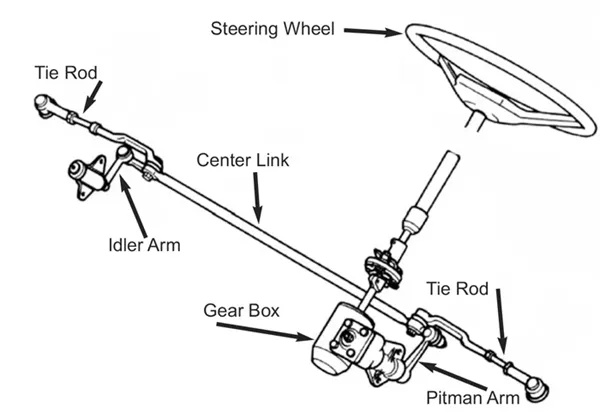
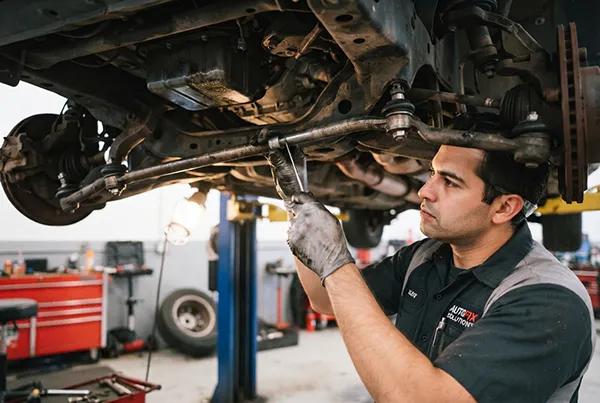
A center link works as part of a connected steering system.4 Depending on the vehicle design, it interacts with components such as the pitman arm, idler arm, tie-rod ends, and steering gear. Wear or incorrect movement in one area can affect loads and movement elsewhere.
You should inspect the complete steering linkage because replacing only the center link may not remove the condition that caused the complaint. Worn idler arms, pitman-arm connections, tie-rod ends, ball joints, mounting points, or alignment-related problems may contribute to looseness, unusual movement, or recurring wear.
Connected Parts Can Produce Similar Symptoms
The center link transfers steering movement across the linkage. It does not operate independently. If an idler arm fails to support the linkage correctly, for example, the customer may notice movement near the center link even though the center link is not the original source.
The following components may deserve inspection, depending on the vehicle design:
| Component or area | Why you should check it |
|---|---|
| Idler arm | Wear or mounting movement may allow unwanted linkage movement. |
| Pitman arm and connection | The connection may affect steering input and center-link movement. |
| Inner and outer tie-rod ends | Joint wear may create play, noise, or poor steering response. |
| Ball joints and control-arm areas | Wear may contribute to steering complaints or uneven tire wear. |
| Steering gear and mounting | Movement may be transmitted through the linkage. |
| Wheels, tires, and alignment | Their condition may influence symptoms and diagnostic conclusions. |
| Chassis mounting areas | Damage or modification may change component relationships. |
A qualified professional should determine which checks apply to the specific vehicle. You should not use a generic checklist as a substitute for vehicle-specific service information.
Repeat Complaints Often Need a Wider Review
A replacement that develops the same reported symptom can tempt you to conclude that both parts came from a bad batch. That conclusion may be correct in some cases, but repetition alone does not prove it.
You should ask several practical questions:
- Did both parts have the same verified damage pattern?
- Did both parts come from the same production batch?
- Did the parts operate on the same vehicle?
- Were the connected components inspected before each replacement?
- Was the vehicle alignment documented?
- Did the installer identify abnormal movement elsewhere?
- Do other customers using the same batch report a comparable condition?
If two center links fail on one vehicle while the remaining batch performs without similar reports, the vehicle system deserves close attention.5 If several independently installed parts from the same traceable batch show comparable, documented damage, the supplier investigation becomes more important.6
Neither pattern gives you an automatic answer. The pattern simply tells you where stronger evidence may exist.
You reduce recurrence risk when you inspect the system instead of treating the returned component as an isolated object.
This system-level view also improves communication. You can give your supplier a clearer complaint file, and your supplier can compare the returned product with drawings, production records, material documents, inspection data, and retained samples when available.
When Does Center Link Failure Support a Supplier or Batch Investigation?
A single returned part may justify supplier review, but it does not automatically prove a batch-wide problem.7 If you escalate every isolated complaint into a batch claim, you may create unnecessary stock holds and commercial disputes. If you dismiss a credible pattern, however, you may allow a real quality issue to continue.
A center link failure supports deeper supplier or batch investigation when traceable evidence shows comparable conditions across multiple parts, vehicles, or locations, or when product inspection identifies a possible nonconformity. You should match the scope of your decision to the strength, consistency, and traceability of the available evidence.
Build a Useful Complaint File
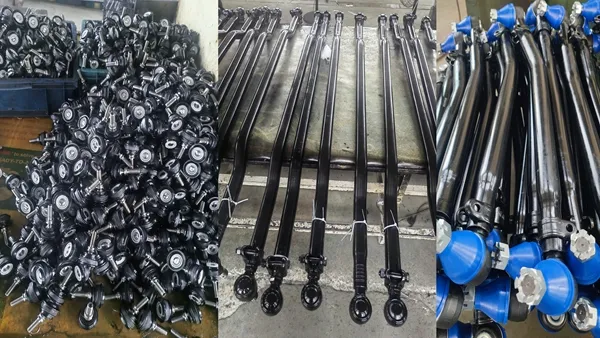
A supplier can investigate more effectively when you provide structured information. I recommend that buyers collect:
- You should provide the supplier’s part number and your internal SKU.
- You should record the vehicle application and relevant configuration.
- You should include the batch, date, or package traceability information.
- You should describe the reported symptom without presenting it as a confirmed cause.
- You should include clear photographs of the part, packaging, labels, and observed condition.
- You should provide installation and alignment records when available.
- You should document the condition of connected steering components.
- You should preserve the returned part rather than altering or discarding it.
- You should state whether similar complaints exist and how those cases compare.
A complaint such as “center link is bad” gives a quality team little to evaluate. A file that states, “The customer reported steering play; a professional inspection observed movement at this location; the application was verified; these connected parts were checked; and the returned part carries this batch code” supports a more focused investigation.
Match Your Decision to the Evidence
You can use an evidence ladder to guide warranty and inventory decisions:
| Evidence level | Suitable buyer response |
|---|---|
| A symptom exists, but no inspection evidence is available. | You should request more information and professional inspection. |
| The part has an observed issue, but the cause is unclear. | You may process the individual case according to warranty policy while keeping the cause open. |
| Fitment or connected-component concerns are documented. | You should investigate the vehicle system before making a supplier-quality conclusion. |
| A product nonconformity is supported by inspection evidence. | You should escalate the case to the supplier and review traceable production information. |
| Comparable cases form a traceable pattern. | You should consider a broader batch-risk review based on professional quality evaluation. |
You should also verify supplier quality documents rather than treating certification claims as guarantees. ISO 9001 and IATF 16949 certificates can show that a quality-management framework is in place, but buyers should verify certificate validity, scope, issuing body, and manufacturing-site coverage. A certificate does not replace product drawings, inspection records, traceability, or complaint analysis.
At GDST Auto Parts, I have seen how useful material records, dimensional controls, production traceability, and final inspection information can be during complaint communication. These records can support an investigation, but they do not predetermine its outcome. The available vehicle evidence and returned-part condition still matter.
Frequently Asked Questions
Can steering noise prove that the center link is defective?
No. Steering noise is a symptom that may involve the center link, tie-rod ends, idler arm, pitman arm, ball joints, steering gear, or other areas. You should arrange a qualified vehicle inspection and identify the location and conditions of the noise before making a warranty or supplier-quality conclusion.
Can incorrect wheel alignment cause center link failure?
Incorrect alignment may contribute to abnormal steering behavior, tire wear, or loading conditions, but it does not prove the cause of a specific failure. You should review alignment records together with fitment, installation, connected-component condition, and returned-part evidence.
Should you replace connected steering parts at the same time?
You should not replace parts automatically without inspection. A qualified professional should assess the idler arm, pitman arm, tie-rod ends, ball joints, mounting points, and other relevant components. The inspection should determine which parts require replacement for the specific vehicle.
Does one returned center link prove a defective production batch?
No. One returned part may justify investigation, but it usually cannot prove a batch defect by itself. You should review traceability, comparable complaints, installation information, vehicle conditions, inspection findings, and available production records before deciding whether the concern extends beyond an individual case.
What information should you send to a center-link supplier?
You should send the part number, vehicle application, batch information, complaint description, photographs, professional inspection findings, installation and alignment records, and details about connected steering components. You should also preserve the returned part so the supplier can examine it when necessary.
Conclusion
You should treat center link failure as a system-level investigation rather than a simple defect label. You need to separate symptoms from verified causes, confirm application and installation evidence, inspect the connected steering linkage, and match warranty or batch decisions to the strength of the evidence. If you need support evaluating center-link specifications, traceability, OEM/ODM requirements, or complaint documentation, contact GDST Auto Parts to discuss your procurement and quality-control needs.
"A STUDY OF PARAMETERS INFLUENCING THE ...", https://ninercommons.charlotte.edu/record/746/files/Patel_uncc_0694N_11115.pdf. Vehicle-dynamics and joint-mechanics research indicates that deviations from intended geometry or assembly conditions can alter steering-linkage motion and load distribution, providing a plausible mechanism for abnormal movement or accelerated wear. Evidence role: mechanism; source type: research. Supports: A research or engineering source should explain how geometric misalignment, incorrect fastening, or improper installation can change load paths, joint motion, or contact stresses in steering systems.. Scope note: The mechanism is contextual and does not demonstrate that any specific complaint resulted from installation or alignment. ↩
"MARTY: Suspension and Steering Modifications", https://ddl.stanford.edu/marty/suspension-and-steering. Steering-system engineering references support the distinction between visual similarity and functional interchangeability because linkage geometry, joint interfaces, and mounting relationships determine the motion and fit of the assembly. Evidence role: mechanism; source type: paper. Supports: A steering-system engineering source should explain how link dimensions, joint tapers, mounting locations, and geometry affect kinematics and vehicle-specific compatibility.. Scope note: General engineering evidence does not verify the compatibility of a particular part number without vehicle-specific application data. ↩
"Automotive Suspension and Alignment", https://sctcc.edu/node/835. Vehicle-maintenance guidance distinguishes wheel-alignment measurements from direct assessment of steering-component wear or damage; alignment data can identify geometric conditions but cannot independently confirm the condition of a center link. Evidence role: definition; source type: government. Supports: A vehicle-inspection or maintenance source should distinguish alignment measurements from direct inspection of steering-linkage components and identify alignment as one part of a broader diagnosis.. Scope note: The source may not use the term center link or address warranty determinations. ↩
"ASEP 104 - Suspension and Steering Level 1 -", https://catalog.delta.edu/preview_course_nopop.php?catoid=12&coid=24252. Technical references describe the center link as a member of a connected steering linkage that transmits motion among steering components such as the pitman arm, idler arm, and tie-rod assemblies. Evidence role: definition; source type: encyclopedia. Supports: A neutral technical reference should define the center link as a connecting member in vehicle steering linkage and identify its relationships with associated steering components.. Scope note: Definitions establish system relationships but do not prove that wear in one component caused a particular failure in another. ↩
"Assessment of failures in automobiles due to maintenance ...", https://www.academia.edu/84212765/Assessment_of_failures_in_automobiles_due_to_maintenance_errors. Reliability-investigation methods recommend comparing repeated events by unit, operating environment, configuration, and production population because concentration of failures in one operating context can indicate a system- or use-related factor rather than a population-wide defect. Evidence role: general_support; source type: research. Supports: A reliability or quality-engineering source should support comparing failure distributions across units, operating environments, and batches when distinguishing product-related causes from use- or system-related causes.. Scope note: Pattern concentration is an investigative signal, not proof that the vehicle system caused the failures. ↩
"Food Traceability: One Ingredient in a Safe and Efficient Food ...", http://www.ers.usda.gov/amber-waves/2004/april/food-traceability-one-ingredient-in-a-safe-and-efficient-food-supply. Quality-management guidance treats traceability, documented nonconformities, and analysis of recurring or comparable complaints as relevant inputs when determining whether a problem may extend beyond an isolated product case. Evidence role: expert_consensus; source type: institution. Supports: A quality-management or reliability source should support using traceability and comparable failure patterns to determine whether an issue warrants broader investigation beyond an individual complaint.. Scope note: Quality-management guidance does not establish that a shared batch is defective without technical confirmation of the failure mode and appropriate comparison data. ↩
"Investigating pharmaceutical product recalls due to ... - PMC", https://pmc.ncbi.nlm.nih.gov/articles/PMC12224731/. Quality-management guidance supports recording and investigating an individual nonconformity while requiring objective evidence, analysis, and appropriate scope determination before extending the finding to a wider production population. Evidence role: general_support; source type: institution. Supports: A recognized quality-management source should support investigating individual complaints while requiring broader evidence before generalizing a nonconformity to a production batch.. Scope note: The source may describe general quality systems rather than automotive steering components or a specific warranty policy. ↩