If you're sourcing stabilizer links for mixed vehicle coverage, "where is it located" is the wrong question. The right question is: which configuration, for which application, and does your supplier know the difference?
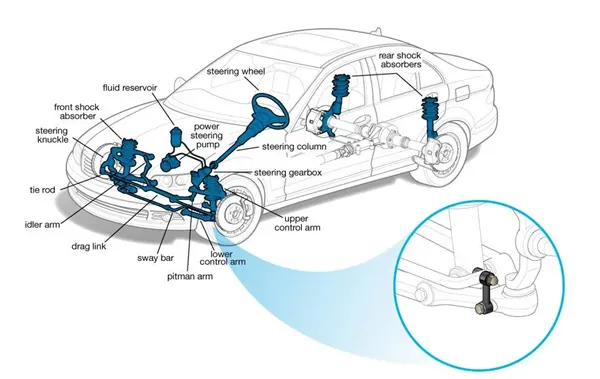
The sway bar link connects the stabilizer bar to either the suspension strut or the lower control arm, depending on the suspension design. On most passenger cars with MacPherson struts, it mounts between the strut body and the stabilizer bar. On trucks or multi-link systems, the mounting point shifts. Location is never universal.
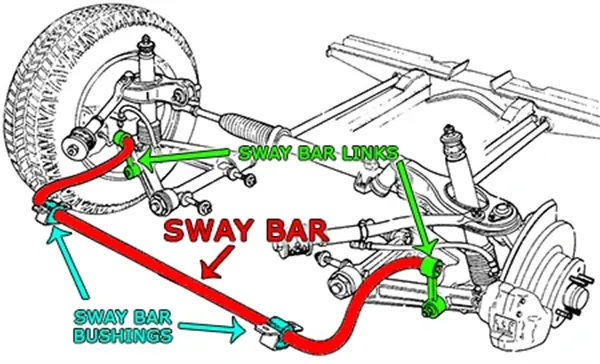
Most of the buyers we work with already know what a sway bar link does. What trips them up is assuming that "location" maps directly to a single part number. It doesn't. The variables that matter most — suspension type, axle position, joint configuration — differ across vehicle categories. If you get those wrong at the sourcing stage, the returns follow. Here is how we break it down.
Does the Sway Bar Link Location Change Depending on the Suspension Type?
A lot of buyers send us requests without specifying the suspension design. That's where most fitment mistakes start. The mounting geometry is not the same across suspension types, and treating it as if it were creates real downstream problems.
Yes, the location changes based on suspension design. On MacPherson strut systems, the link runs from the stabilizer bar to the strut body1. On double-wishbone or multi-link setups, it typically connects to the lower control arm2. On solid axle trucks, the link geometry and mounting angle differ entirely.
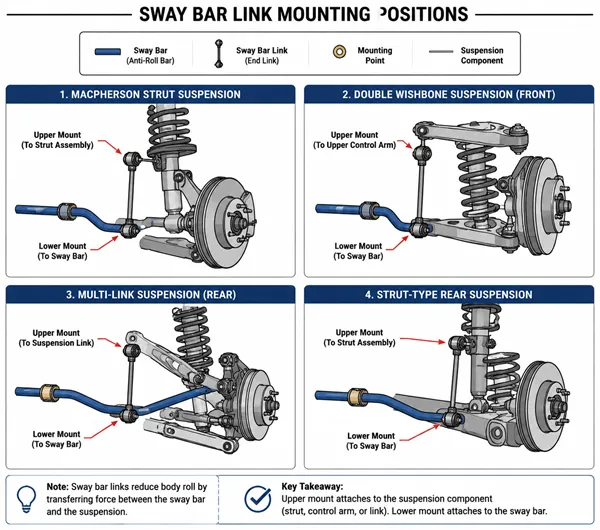
Let's be specific about what this means for sourcing.
MacPherson Strut Systems
This is the most common configuration for passenger cars and compact SUVs3. The stabilizer link mounts vertically or near-vertically between the outer end of the stabilizer bar and a bracket on the strut body. The link is usually short, with ball joints on both ends. Most of the catalog volume we produce for Japanese and Korean passenger car applications falls into this category.
Double-Wishbone and Multi-Link Systems
Here the link connects the stabilizer bar to the lower control arm. The angle and mounting direction shift, and the link length is often different. We see this frequently in larger SUVs and European platforms. Buyers sourcing for these applications sometimes send us a part number from a MacPherson fitment and ask if it crosses over. It usually doesn't, even if the stud thread spec looks the same.
Solid Axle Trucks
Light and medium-duty trucks with solid rear axles use a different configuration entirely. The stabilizer bar itself is positioned differently, the load conditions are higher, and the link design reflects that — heavier body, higher torque ratings, sometimes a bushing-and-bolt joint rather than a ball stud. When we get inquiries for this segment without a vehicle spec, this is the first clarification we ask for.
| Suspension Type | Typical Link Connection Points | Common Vehicle Segment |
|---|---|---|
| MacPherson Strut | Stabilizer bar to strut body | Passenger cars, compact SUVs |
| Double-Wishbone / Multi-Link | Stabilizer bar to lower control arm | Full-size SUVs, European platforms |
| Solid Axle | Stabilizer bar to axle bracket | Light trucks, medium-duty trucks |
Does the Sway Bar Link Location Differ Between Front and Rear Axles?
This is a question we hear more often now, because more vehicles are running active or semi-independent rear suspensions with their own stabilizer systems. The short answer is yes, and the difference matters more than most buyers expect.
Front and rear sway bar links are not interchangeable. The front link typically handles higher lateral loads and operates across a wider steering angle range. The rear link is often shorter and mounted in a tighter space. Stud length, joint angle rating, and body clearance specs all differ between axle positions.
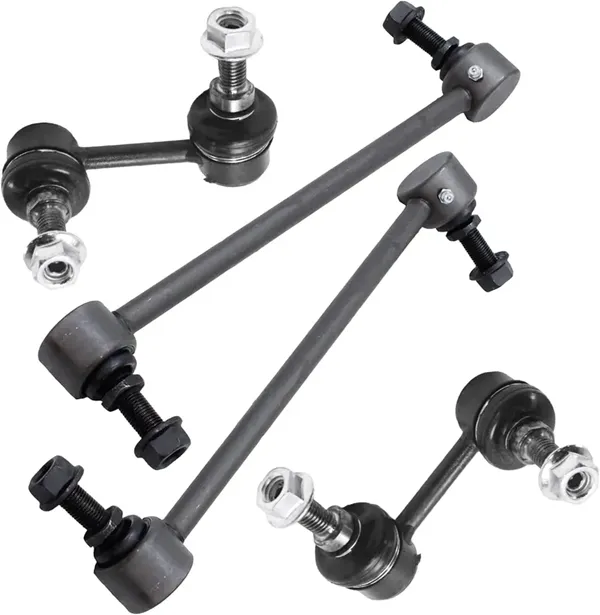
We have worked with distributors who initially catalog front and rear links under a single SKU for cost simplification. That approach does reduce inventory complexity, but it increases fitment complaints. Here is why the front-rear distinction is worth keeping separate.
Front Axle: Higher Load, Wider Angle Range
Front stabilizer links work under combined lateral and longitudinal stress. The ball joint on a front link needs to accommodate the steering sweep as well as the suspension travel. This means the operating angle range — how far the joint can articulate before binding or wearing — is a real spec that should be confirmed, not assumed. When we quote front links, we ask for the OE angle range spec if the buyer has it.
Rear Axle: Tighter Space, Different Mounting Logic
Rear sway bar links on multi-link rear suspensions are often shorter and work in a more constrained space. The loads are different, the stud orientation sometimes flips, and the replacement frequency is lower in most markets. A buyer covering a mixed fleet should not assume a rear link is just a "smaller version" of the front link. Physically similar links with different angle or torque specs will generate warranty returns.
What We Ask When a Request Comes In Without Axle Specification
When a customer sends us a request that says "stabilizer link for [vehicle model]" without specifying front or rear, we ask back:
- Is this for the front axle, rear axle, or both?
- Do you have the OE reference number for each position?
- What is the market this part will be sold into — and does the local climate require any specific surface treatment?
That last point matters because a link sold into a high-humidity coastal market, or a road-salt environment, has different coating requirements than one sold in a dry-climate aftermarket4.
| Axle Position | Load Profile | Joint Angle Demand | Typical Length Range |
|---|---|---|---|
| Front | High lateral + steering load | Wider operating angle | Medium to long |
| Rear | Moderate, constrained geometry | Narrower operating angle | Short to medium |
What Joint Type Is Used at Each Mounting Point?
This is the variable that causes the most confusion in our sales conversations. Buyers often focus on length and thread size. Joint type gets skipped. When it gets skipped, the wrong part gets ordered.
Sway bar links use either ball joint ends or bushing-and-bolt ends, depending on the vehicle design. Ball joint ends allow articulation in multiple axes, while bushing ends allow flex through rubber compression. Mixing these types — even on a geometrically similar link — will cause binding, noise, or premature failure.
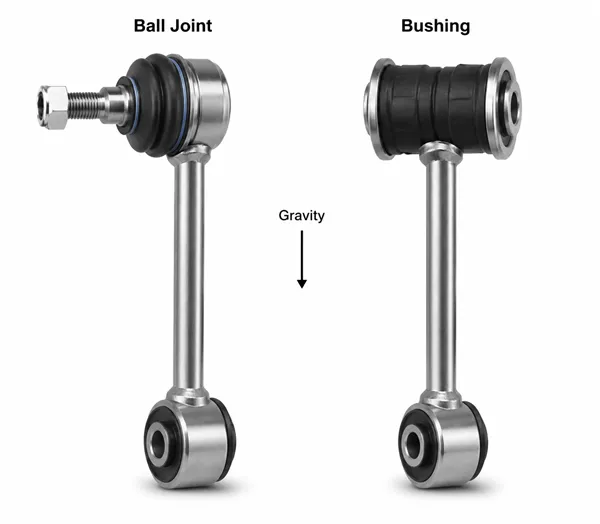
Here is the breakdown we use when reviewing a fitment request.
Ball Stud Ends (Both Ends)
This is the most common configuration on passenger cars and SUVs with MacPherson or multi-link suspension. Both ends of the link have a ball stud that threads into a bracket or strut body. The joint allows multi-directional movement and handles the articulation demand during suspension travel and steering. The quality of the ball joint — grease retention, socket material, stud hardness — is what separates a good link from a cheap one that fails early.
Bushing-and-Bolt Ends
Some truck and heavier-duty applications use a bolt-through-bushing design at one or both ends. The rubber bushing allows limited flex. This design is simpler but less articulated, and it is suited to applications where the angular demand is lower and load capacity matters more. We see this more often in light and medium-duty truck fitments than in passenger car coverage.
Adjustable Length Links
Some performance or lifted-vehicle applications use adjustable stabilizer links with a threaded body. These are a separate sourcing category. The manufacturing tolerances, thread quality, and locking mechanism matter significantly. Buyers targeting the off-road or performance aftermarket should treat these as a distinct SKU category, not a variation of a standard link.
| Joint Configuration | Articulation Type | Typical Application |
|---|---|---|
| Ball stud both ends | Multi-directional | Passenger cars, SUVs |
| Bushing-and-bolt ends | Single-axis flex | Light-duty and medium trucks |
| Adjustable threaded body | Adjustable length + ball ends | Off-road, lifted vehicle fitments |
How Do Vehicle Category Differences Affect the Sourcing Decision?
Buyers who cover multiple vehicle segments — passenger cars, SUVs, light trucks, heavy trucks — sometimes approach stabilizer links as a single product category. They're not. The sourcing logic, quality requirements, and failure risk profiles are different across segments.
Passenger car links prioritize noise-free performance and precise fitment. SUV and crossover links need higher load ratings and corrosion resistance. Light truck links face higher stress and sometimes mixed on-road and off-road use. Heavy-duty truck links have load and durability requirements that don't overlap with passenger car specs at all.
In our experience, the most frequent sourcing mistakes happen when a buyer expands from one vehicle segment into another without adjusting their evaluation criteria.
Passenger Cars
Noise is the top complaint driver in this segment. A link that is dimensionally correct but uses a lower-quality ball socket material will generate knock or rattle within months. Buyers in this segment often have high return rates on low-cost links that passed dimensional checks but failed on material quality. We recommend salt spray testing and torque retention testing as baseline QC requirements for this category5.
SUVs and Crossovers
Load range and corrosion resistance matter more here. SUVs carry more lateral load through the stabilizer system, and many operate in harsher environments. A link built to passenger car specs will wear faster under SUV load conditions. When we quote for SUV coverage, we pay close attention to the stud diameter, socket material grade, and surface coating spec.
Light and Medium Trucks
The priority here shifts to durability under variable load and terrain. Some light truck applications, particularly in markets where trucks double as commercial vehicles, see significantly higher cumulative stress than the same platform used as a personal vehicle. Buyers covering these markets should ask about fatigue testing data — how many load cycles the link is rated to before joint degradation begins.
Heavy-Duty Trucks
This is a separate product family. The link dimensions, load ratings, joint design, and quality standards are not comparable to passenger vehicle links. We treat heavy-duty truck inquiries as a distinct sourcing category and ask for more detailed vehicle application data before quoting.
| Vehicle Segment | Primary Quality Priority | Key QC Tests |
|---|---|---|
| Passenger cars | Noise-free performance | Torque retention, salt spray |
| SUVs / Crossovers | Load capacity + corrosion resistance | Pull-out force, salt spray, fatigue |
| Light / Medium trucks | Durability under variable load | Fatigue testing, angle range |
| Heavy-duty trucks | High load rating, joint integrity | Full structural testing suite |
Conclusion
Sway bar link location depends on suspension type, axle position, and vehicle segment. Sourcing the right link means asking the right questions before the order — not after the returns come in.
"Anti-roll bar", https://en.wikipedia.org/wiki/Anti-roll_bar. In MacPherson strut suspension systems, the stabilizer bar link connects the outer end of the stabilizer bar to a bracket on the strut body, a configuration described in standard automotive engineering references as characteristic of this suspension type. Evidence role: definition; source type: encyclopedia. Supports: The structural relationship between the stabilizer bar link and the strut body in MacPherson strut suspension systems. Scope note: General encyclopedic sources may describe the configuration without specifying the precise mounting bracket geometry that varies by manufacturer. ↩
"Double wishbone suspension", https://en.wikipedia.org/wiki/Double_wishbone_suspension. Automotive engineering references describe double-wishbone suspension systems as typically routing the stabilizer bar link to the lower control arm, distinguishing this geometry from the strut-body attachment used in MacPherson configurations. Evidence role: definition; source type: encyclopedia. Supports: The connection point of the stabilizer bar link to the lower control arm in double-wishbone suspension designs. Scope note: Specific mounting points can vary by manufacturer and platform; a general reference may not capture all multi-link variants. ↩
"MacPherson strut - Wikipedia", https://en.wikipedia.org/wiki/MacPherson_strut. The MacPherson strut is widely documented as the most prevalent front suspension design in passenger cars, noted for its compact packaging and low manufacturing cost relative to double-wishbone alternatives. Evidence role: general_support; source type: encyclopedia. Supports: MacPherson strut suspension is the predominant front suspension design used in passenger cars globally. Scope note: Prevalence figures vary by region and vehicle class; no single authoritative global statistic is consistently cited in the literature. ↩
"Corrosion Protection for Metal Connectors and Fasteners ...", https://www.fema.gov/sites/default/files/2020-07/tb8-corrosion_protection_metal_connectors_coastal_areas.pdf. Corrosion science research and automotive durability studies document that chloride ions from road deicing salts and marine atmospheric exposure substantially accelerate electrochemical corrosion of ferrous suspension components, a finding that underpins OEM and aftermarket coating specification differences by geographic market. Evidence role: mechanism; source type: research. Supports: Exposure to road deicing salts and high-humidity coastal environments significantly accelerates corrosion of automotive suspension components, necessitating enhanced surface protection. Scope note: Quantitative corrosion rate comparisons between environments depend on specific coating systems and exposure conditions not generalizable from a single study. ↩
"[PDF] usmc coatings and components corrosion evaluation", https://www.waru.edu/sites/default/files/Migrated/CopDocuments/USMC%20Coatings%20and%20Components%20Corrosion%20Evaluation%20Methodology.pdf. Industry standards bodies, including SAE International and ISO, specify salt spray corrosion testing (per ASTM B117 or equivalent) and torque retention protocols as accepted methods for evaluating the durability and joint integrity of automotive suspension linkage components. Evidence role: expert_consensus; source type: institution. Supports: Salt spray and torque retention tests are recognized quality control methods for automotive suspension components. Scope note: Specific pass/fail thresholds for stabilizer links are not universally standardized and may vary by OEM specification or regional market requirement. ↩