Choosing the wrong ball joint supplier can cost you more than money. It can damage your brand, increase warranty claims1, and break customer trust. Here is how to avoid that.
A reliable ball joint supplier is one who can prove consistent manufacturing quality, not just show certifications. Look for suppliers with traceable raw materials, OE-spec mold development, dedicated production lines, and IATF16949-compliant quality systems. These factors determine long-term supply stability and product performance in the field.
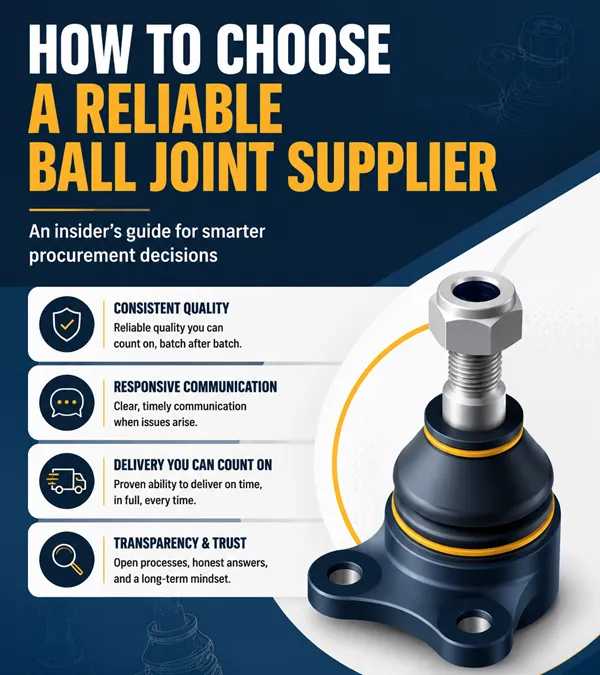
I have spoken with procurement managers from across South America, Europe, the Middle East, and Southeast Asia. Most of them came to us after a bad experience with a previous supplier. The problems they described were almost always the same: inconsistent product quality, poor communication after problems appeared, and suppliers who looked great on paper but could not deliver in practice. This guide is built from those conversations. It is an insider's view of what actually separates a reliable supplier from one that just looks reliable.
Does a Certificate Actually Tell You Anything About a Supplier's Quality?
Most buyers start by asking for certifications. That is a reasonable first step. But too many buyers stop there, and that is where the risk begins.
Certifications like IATF16949 and ISO90012 set a quality management baseline. They tell you a supplier has documented procedures. But they do not tell you how well those procedures are followed on the production floor every single day. The real question is: how does a supplier implement these standards in practice?
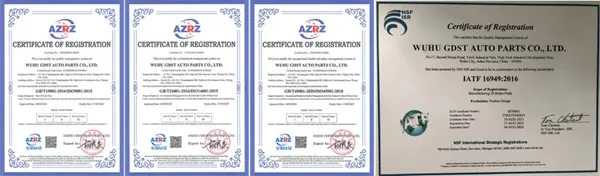
A common question we get from buyers is, "Are you certified?" We always say yes, and then we go further. We explain what those certifications mean inside our factory. We think that is the right approach, because a certificate on a wall and a functioning quality system are two different things.
What to Look for Beyond the Certificate
When you are evaluating a supplier, do not ask "Are you certified?" Ask a better question: "How do you handle a defect that is discovered mid-production?" A supplier with a real quality system will give you a specific answer. They will describe their corrective action process3, how they trace the defect back to its source, and how they prevent it from happening again.
Here are the specific things to verify:
| Verification Area | Weak Supplier Response | Strong Supplier Response |
|---|---|---|
| Raw material control | "We use high-quality steel" | "We source from Baosteel or Shagang and run chemical composition tests on every incoming batch" |
| Defect handling | "We do 100% inspection" | "We have a defined corrective action process tied to our IATF16949 documentation" |
| Batch consistency | "Our quality is stable" | "Our QC team has 5+ years of experience and monitors every production stage" |
| Mold development | "We follow OE specs" | "Our molds are developed from OE drawings with dimensional tolerance control within ±0.2 mm4" |
The answers a supplier gives to these questions will tell you more than any certificate ever will. In our factory, every batch of incoming steel comes with a material inspection report from the mill. Our QC team then runs its own random chemical composition test on top of that. That double-check process is what gives our customers confidence. Not the certificate alone.
Is Production Stability Something You Can Actually Measure?
This is one of the most overlooked areas in supplier evaluation. Buyers often focus on the product. They forget to look at the system that makes the product. If that system is unstable, the product will be unstable too.
Production stability means a supplier can deliver the same quality across every batch, not just the first sample. You can measure it by looking at the number of dedicated production lines, the experience level of QC staff, and whether the supplier has a documented process for each manufacturing stage from raw material to final shipment.
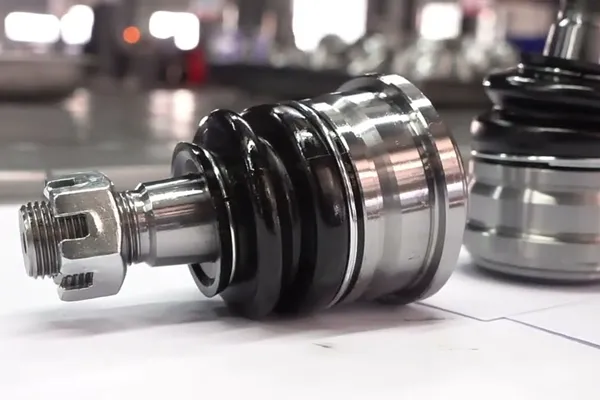
A mistake I see often is when buyers approve a supplier based on a single sample order. The sample is good. The first large order is also good. Then problems start appearing in the third or fourth shipment. This happens because the supplier does not have a stable process. They can produce good parts occasionally, but not consistently.
How to Evaluate a Supplier's Production Consistency
There are three dimensions to look at when assessing production stability.
1. Physical Production Capacity
A supplier running 20 dedicated production lines operates differently from one using shared or rented equipment. Dedicated lines mean fixed processes, fixed tooling, and fixed operator responsibilities. That structure reduces variation.5
2. Process Control at Each Stage
Ask the supplier to walk you through each production stage. Ball joints at GDST go through casting or forging, CNC machining, assembly, surface treatment, and then final inspection6. Each stage has its own quality checkpoint. If a supplier cannot describe their process at each stage, that is a red flag.
3. QC Team Depth and Experience
The experience of the quality control team matters more than most buyers realize. Our QC staff all have more than 5 years of industry experience. They know what to look for. An inexperienced QC team can pass parts that should be rejected, and those parts will eventually cause failures in the field.
| Stability Indicator | What to Ask | What a Good Answer Looks Like |
|---|---|---|
| Production lines | "How many dedicated lines do you run?" | A specific number with product-specific line assignments |
| Process documentation | "Can you share your production process flowchart?" | A detailed, stage-by-stage document tied to quality checkpoints |
| QC team | "What is the average experience level of your QC staff?" | Verifiable experience, not a vague claim |
| Batch-to-batch checks | "How do you ensure consistency across batches?" | Specific testing protocols and documentation per batch |
Are Technical Testing Capabilities a Real Differentiator?
Yes. And this is one area where suppliers differ significantly. Many suppliers can assemble a ball joint. Far fewer can test it properly before it leaves the factory.
Ball joint testing should include high and low temperature testing, pull-out and compression force testing, salt spray testing, fatigue testing, torque testing, angle testing, ozone resistance testing, and hardness testing7. A supplier who runs all of these tests has a much stronger quality assurance process than one relying on visual inspection alone.
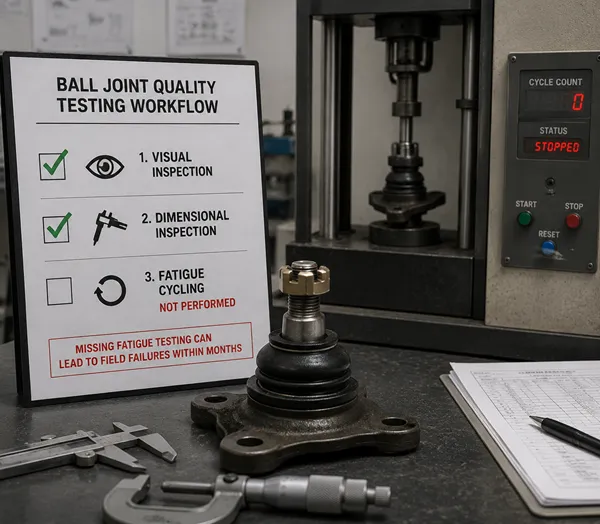
A buyer once told me they had received ball joints from a supplier that looked fine but began failing in the field within six months. When we discussed the failure mode, it pointed to inadequate fatigue testing. The supplier had done visual checks and basic dimensional inspection. They had not run fatigue cycles. That gap led to real-world failures and warranty claims.
Breaking Down the Testing Process
Different tests catch different failure modes. Here is how to think about what each test is actually for:
Structural and Force Testing
Pull-out force tests and compression force tests confirm that the ball joint can handle the mechanical loads it will face in operation. These are not optional. They are the core functional tests.
Environmental Testing
Salt spray testing8 checks corrosion resistance. This is especially important for markets with heavy road salt use, such as Northern Europe or Canada. Ozone resistance testing9 checks the rubber boots, which protect the internal components. If the boots degrade early, the ball joint fails early.
Durability Testing
Fatigue testing simulates long-term use under repeated load cycles. It is the test that most closely predicts real-world service life.10 A supplier who skips fatigue testing is selling you a product with an unknown lifespan.
Dimensional and Material Testing
Hardness testing confirms the steel meets its specification. Torque and angle testing confirm the joint moves within the correct range. These tests, combined with chemical composition checks on incoming raw materials, form a complete picture of product integrity.
| Test Type | What It Checks | Why It Matters for Buyers |
|---|---|---|
| Pull-out / Compression | Structural strength under load | Prevents field failures under normal driving conditions |
| Salt Spray | Corrosion resistance of coating | Critical for markets with road salt or coastal humidity |
| Fatigue | Long-term durability | Predicts actual service life and reduces warranty claims |
| Ozone Resistance | Boot and seal material integrity | Prevents premature boot cracking and joint contamination |
| Hardness | Steel material properties | Confirms raw material quality matches specifications |
| Torque / Angle | Joint movement range | Ensures correct fitment and handling behavior |
Can a Supplier Actually Support Your Brand, Not Just Fill Your Orders?
This is the question that separates a transactional supplier from a real manufacturing partner. For brand owners, wholesalers, and distributors, the supplier you choose is part of your product. Their quality becomes your reputation.
A supplier who supports your brand goes beyond shipping parts. They offer OEM/ODM development11, private label packaging, custom product development based on your samples or drawings, and responsive after-sales support. These capabilities directly affect your market competitiveness and your ability to reduce warranty costs over time.
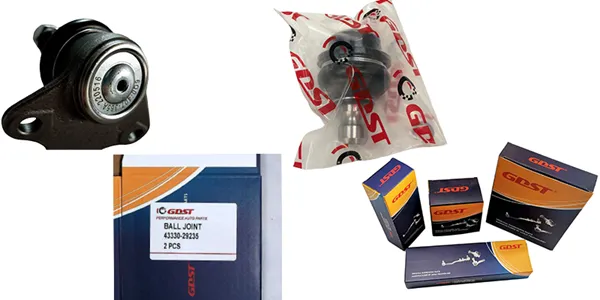
From our experience, the most common mistake buyers make is evaluating suppliers purely on unit price. Price matters, of course. But a supplier who cannot support your packaging requirements, who takes two weeks to respond to a quality complaint, or who cannot develop a new part number when you need it will cost you more in the long run than any price difference.
What Partnership Capability Actually Looks Like
OEM/ODM Development
A capable supplier can work from your sample, your drawing, or a technical specification. They have their own engineering team to develop molds and tooling. They can manage the development process from prototype through mass production without requiring you to manage every step.
Private Label and Packaging
For brand owners, packaging is part of the product. A supplier with an in-house design team can create custom packaging that matches your brand standards. This removes a step from your supply chain and speeds up your time to market.
After-Sales Responsiveness
When a quality issue appears in the field, response speed matters. Ask potential suppliers directly: "What is your process when a customer reports a quality issue?" A good answer will include a clear escalation path, a defined investigation timeline, and a documented corrective action process. A vague answer is a warning sign.
Geographic and Market Experience
A supplier who has been exporting to 100+ countries for over 20 years has seen the kind of problems that appear in different markets. They know that durability requirements in the Middle East differ from those in Northern Europe12. That experience translates into better advice and better products for your specific market.
| Partnership Capability | Why It Matters to You |
|---|---|
| OEM/ODM development | Faster product launches, less engineering burden on your side |
| Private label packaging | Stronger brand consistency, faster market entry |
| After-sales process | Lower warranty costs, faster issue resolution |
| Multi-market experience | Supplier understands your market's specific requirements |
| Flexible production | Ability to handle changing demand and custom orders |
What Questions Should You Actually Be Asking a Supplier?
Most buyers ask safe questions. Safe questions get rehearsed answers. If you want real information, you need to ask questions that require a supplier to describe their actual processes, not just confirm that they exist.
The best supplier evaluation questions focus on process details, not yes-or-no confirmations. Ask how they verify raw material quality, how they handle mid-production defects, how they ensure mold accuracy, and how they manage a quality complaint. Specific answers reveal real capability. Vague answers reveal risk.
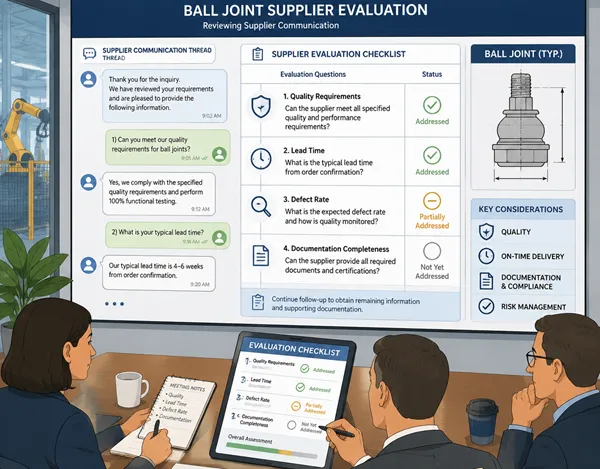
I have sat in on many customer evaluations at our factory. The buyers who asked the best questions were the ones who stayed the longest. They were not the most aggressive. They were the most specific. They wanted to understand the details, not just hear the right words.
A Practical Question Framework for Supplier Evaluation
Use these questions as a framework when you are comparing suppliers:
On Raw Materials:
- "Which steel mills do you source from?"
- "Do you receive material inspection reports with every delivery?"
- "Do you run your own incoming material tests, or do you rely only on the mill's report?"
On Production and Mold Development:
- "How do you develop molds for a new part number?"
- "What dimensional tolerance do you control molds to?"
- "How do you handle a tooling issue that appears during production?"
On Quality Testing:
- "Which specific tests do you run on ball joints before shipment?"
- "Can you share a test report from a recent production batch?"
- "What is your process when a test fails?"
On After-Sales and Partnership:
- "How do you handle a quality complaint from a customer in another country?"
- "Can you support private label packaging for our brand?"
- "What is your minimum order quantity for a custom part number?"
The answers to these questions will give you a clearer picture of a supplier's real capability than any product catalog or certificate package ever will.
Conclusion
Choosing a reliable ball joint supplier means evaluating manufacturing consistency, quality systems, testing capability, and partnership potential. Price alone is never enough. Ask better questions, and you will find better partners.
"The Importance of Corporate Reputation for Sustainable Supply ...", https://pmc.ncbi.nlm.nih.gov/articles/PMC9559133/. Studies on supply chain management and the 'cost of poor quality' (COPQ) demonstrate that defects originating from suppliers are a significant driver of warranty claims, which not only incur direct costs but also negatively affect customer satisfaction and brand loyalty. Evidence role: general_support; source type: paper. Supports: The source should provide evidence or analysis showing a direct correlation between the quality of supplied components and the frequency of warranty claims, repair costs, and damage to brand equity.. ↩
"IATF 16949 - Wikipedia", https://en.wikipedia.org/wiki/IATF_16949. The International Automotive Task Force (IATF) 16949 is the global technical specification and quality management standard for the automotive industry, based on ISO 9001 and customer-specific requirements. Evidence role: definition; source type: institution. Supports: The source should define the IATF 16949 standard as a technical specification for quality management systems in the automotive sector, building upon ISO 9001.. ↩
"Corrective action - HR Operations", https://hr.uw.edu/ops/performance-management/corrective-action/. A corrective action process is a key component of quality management systems like ISO 9001 and IATF 16949, involving root cause analysis and implementation of solutions to prevent the recurrence of defects. Evidence role: definition; source type: institution. Supports: The source should define a corrective action process as a systematic approach to identifying the root cause of a non-conformity or defect and implementing a solution to prevent its recurrence.. ↩
"Forging Design Dimensions and Tolerances - ASM Digital Library", https://dl.asminternational.org/handbooks/edited-volume/31/chapter/431036/Forging-Design-Dimensions-and-Tolerances. Sources on manufacturing engineering show that while tolerances vary by process and part complexity, a tolerance of ±0.2 mm for a forged and machined component is a common and achievable standard for non-critical dimensions. Evidence role: general_support; source type: education. Supports: The source should provide context on typical dimensional tolerances for machined or forged metal parts in the automotive industry, allowing the reader to assess the claimed ±0.2 mm tolerance.. Scope note: The ideal tolerance depends on the specific feature and function of the part, so a general standard may not be directly applicable to all aspects of a ball joint mold. ↩
"Job Shop vs. Production Manufacturing: Key Differences", https://www.ecisolutions.com/blog/manufacturing/jobboss2/job-shop-vs-production-manufacturing/. Industrial engineering principles indicate that dedicated production lines minimize process variation by reducing changeovers, standardizing workflows, and allowing for process optimization, which contributes to greater product consistency compared to job-shop or batch production environments. Evidence role: mechanism; source type: education. Supports: The source should explain that dedicated production lines, a feature of flow production, reduce process variability by standardizing equipment, tooling, and operator tasks, leading to more consistent output.. ↩
"Manufacturing Specificity of Vehicle's Independent Suspension ...", https://www.academia.edu/119056574/Manufacturing_Specificity_of_Vehicle_s_Independent_Suspension_System_Parts. The manufacturing of automotive ball joints typically involves hot or cold forging of the housing and stud, followed by CNC machining to achieve precise dimensions, assembly with internal components like bearings and seals, and a final surface treatment for corrosion resistance. Evidence role: general_support; source type: other. Supports: The source should outline the typical manufacturing process for a ball joint, confirming that it generally involves forming the main body (via forging or casting), precision machining of critical surfaces, assembly of components, and application of a protective surface treatment.. ↩
"[PDF] Integrating Experimental Testing and Simulation-Based Validation", https://scholarsjunction.msstate.edu/cgi/viewcontent.cgi?article=1139&context=honorstheses. Automotive industry standards, such as those from SAE International (e.g., SAE J193), specify a range of performance tests for ball joints, including fatigue, tensile, and compressive strength tests, to ensure safety and durability. Evidence role: case_reference; source type: institution. Supports: The source should be an industry standard or technical document that outlines the required performance and validation tests for automotive ball joints or similar suspension components.. Scope note: Specific test requirements may vary by vehicle manufacturer and application, but the listed test types represent a comprehensive approach to validation. ↩
"Salt spray test - Wikipedia", https://en.wikipedia.org/wiki/Salt_spray_test. The salt spray test, commonly performed according to standards like ASTM B117, is an accelerated corrosion test method used to check the effectiveness of protective coatings on materials, which is critical for automotive parts exposed to road salt and humidity. Evidence role: definition; source type: institution. Supports: The source should define the salt spray test as a standardized, accelerated corrosion test used to evaluate the resistance of coated materials to a corrosive environment.. ↩
"Ozone cracking - Wikipedia", https://en.wikipedia.org/wiki/Ozone_cracking. Ozone resistance testing, often conducted under standards like ASTM D1171, is critical for elastomeric components such as seals and boots, as atmospheric ozone can cause cracking and premature failure in unprotected rubber materials. Evidence role: mechanism; source type: institution. Supports: The source should explain that ozone in the atmosphere can degrade certain elastomers, causing cracks, and that ozone resistance testing is used to evaluate a rubber compound's ability to withstand this effect.. ↩
"Fatigue (material) - Wikipedia", https://en.wikipedia.org/wiki/Fatigue_(material). Fatigue testing is a crucial method in mechanical engineering used to determine how a component behaves under fluctuating loads, allowing engineers to estimate its service life by simulating real-world operating conditions over millions of cycles. Evidence role: mechanism; source type: paper. Supports: The source should explain that fatigue testing subjects a material or component to repeated cyclic loads to determine its structural durability and predict its service life before failure occurs.. ↩
"Original design manufacturer - Wikipedia", https://en.wikipedia.org/wiki/Original_design_manufacturer. An Original Equipment Manufacturer (OEM) builds products or components based on a design provided by the client, whereas an Original Design Manufacturer (ODM) is responsible for both designing and manufacturing the product, which is then sold under the client's brand name. Evidence role: definition; source type: encyclopedia. Supports: The source should define OEM (Original Equipment Manufacturer) as a company that produces parts for another company's end product, and ODM (Original Design Manufacturer) as a company that designs and manufactures a product that is then branded by another firm.. ↩
"Degradation of Components in Cars Due to Bimetallic Corrosion", https://pmc.ncbi.nlm.nih.gov/articles/PMC8235354/. Research in automotive engineering confirms that environmental conditions significantly impact component life; for example, high ambient temperatures can accelerate the aging of rubber components, while the use of de-icing salts in colder climates dramatically increases the rate of corrosion for metallic parts. Evidence role: general_support; source type: paper. Supports: The source should discuss how different environmental factors, such as high temperatures and dust in desert climates versus road salt and low temperatures in colder regions, necessitate different material specifications and testing protocols for automotive components.. ↩