
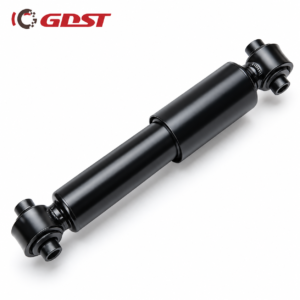
Vehicle Shock Absorbers for Cars, SUVs & Trucks | GDST
- MOQ
- 50PCS
- Price
- $6 - $25
- Warranty
- 1 Year From Receipt of Goods
- Delivery Time
- 45-55 Days
- Customization
-
- Customized Logo
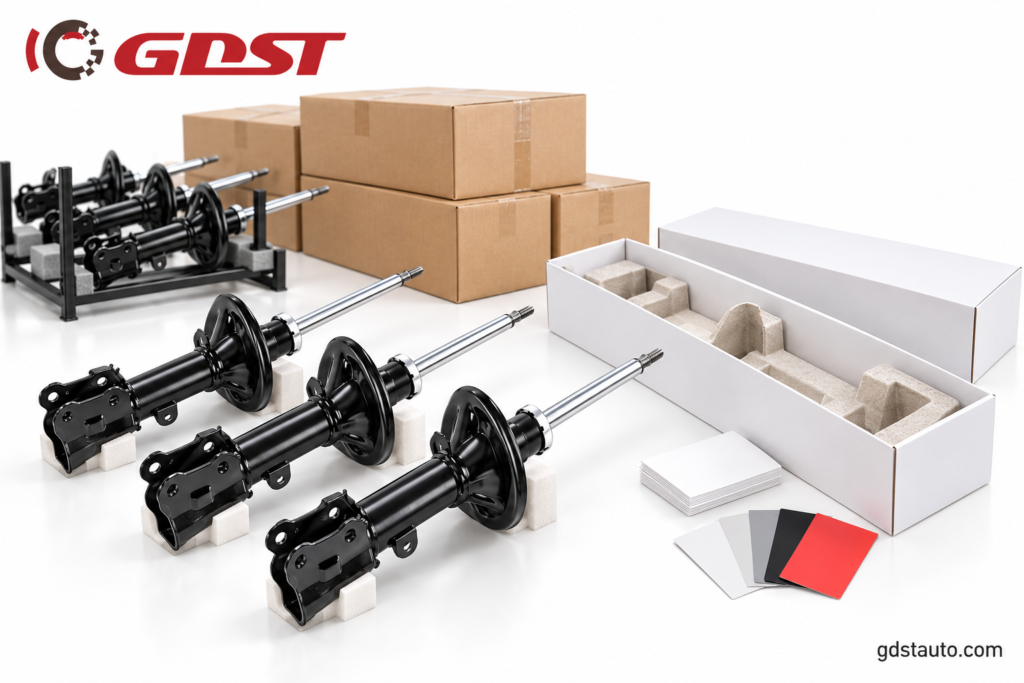
- Customized Packaging
- ODM/Sample Development
ISO9001 Certified
Fast Delivery
OEM/ODM
Automotive Replacement Shocks | 2,000+ Developed Models | Wholesale & Private Label Supply
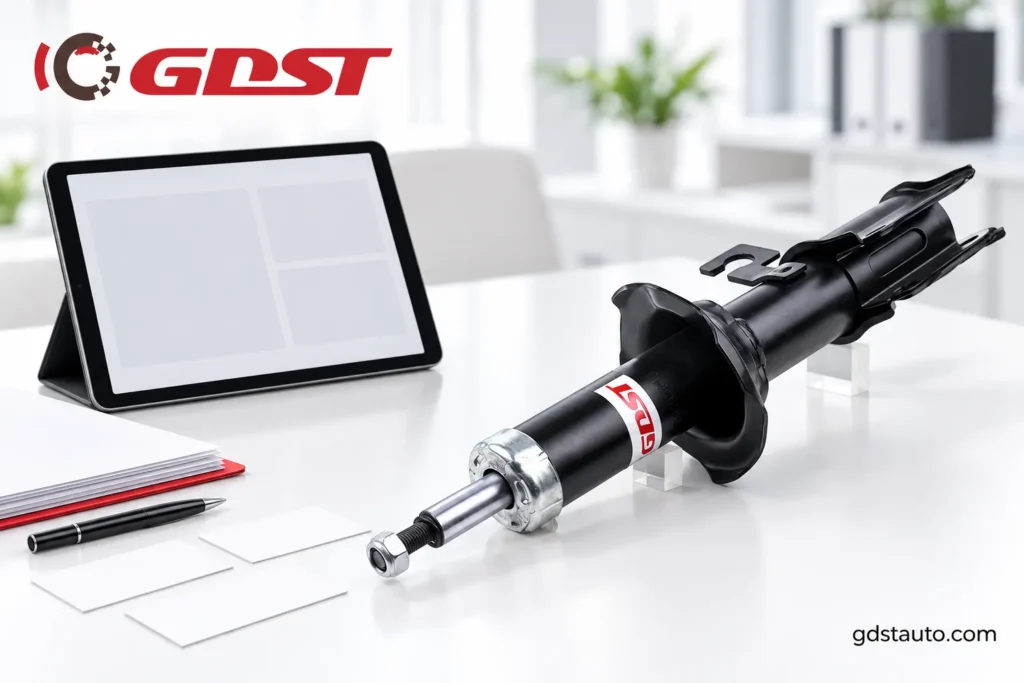
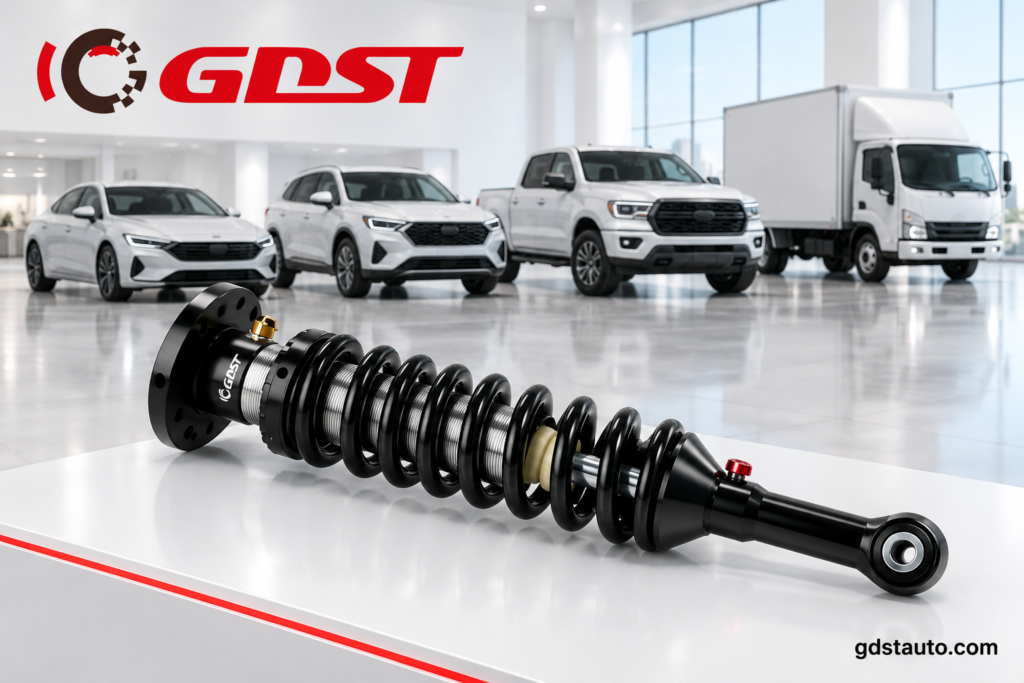
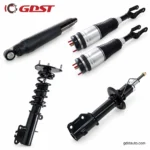
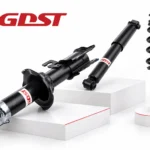
Wuhu GDST Auto Parts Co.,Ltd supplies vehicle shock absorbers for passenger cars, SUVs, pickups, and commercial vehicle applications. We support automotive aftermarket importers, wholesalers, distributors, and private-label brands seeking vehicle-specific suspension replacement parts.
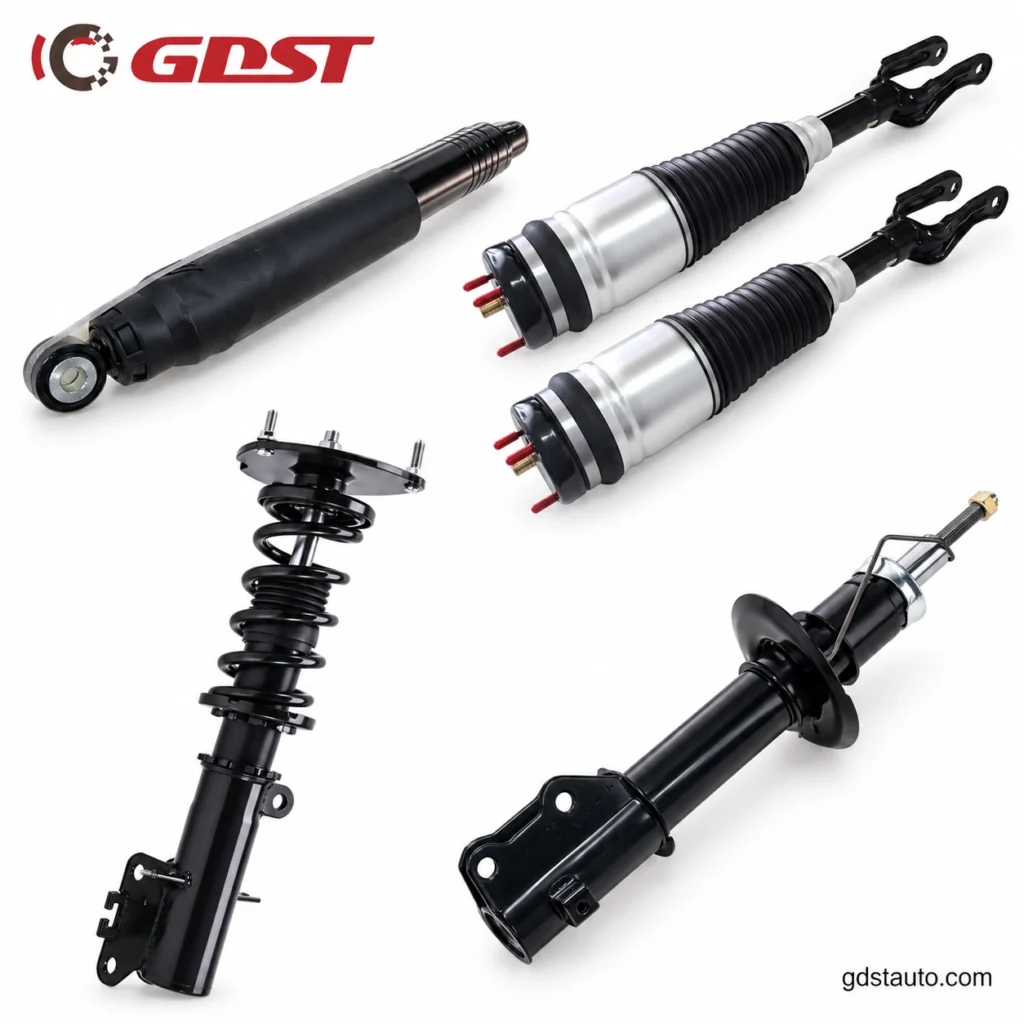
Our automotive shock absorber range includes hydraulic twin-tube, gas-charged, monotube, and applicable strut assembly designs. With more than 2,000 developed shock absorber models, GDST helps professional buyers source products by OE reference, vehicle application, installation requirements, and technical specifications.
For selected MF-series models, GDST also maintains technical data sheets containing specified compression and rebound damping forces, test velocities, and allowable force ranges.
Why Source Vehicle Shock Absorbers from GDST?
- More than 2,000 developed shock absorber models
- Front and rear replacement applications
- Passenger car, SUV, pickup, and commercial vehicle coverage
- Model-specific damping force specifications for selected products
- OE reference and vehicle application matching support
- OEM/ODM branding and customized packaging options
- Standard wholesale MOQ from 50 pieces per model
- Approximately 50-day lead time for standard container orders, subject to confirmation
|
Reference No. |
Application |
Position |
|
68029902AB |
JEEP GRAND CHEROKEE 2011-2015 |
Front |
|
68029903AE |
JEEP GRAND CHEROKEE 2011-2015 |
Front |
|
15195074 |
SAAB 9-7X 2005-2009 |
Front |
|
G86313E |
FORD EXPLORER 2006-2010 |
Rear |
|
48530A9690 |
TOYOTA VENZA 2009-2012 |
Rear |
|
4851080431 |
LEXUS GS350 2007-2011 |
Front |
|
48530A9680 |
TOYOTA TACOMA 2005-2022 |
Rear |
Download GDST Shock Absorber Catalog 2026
Automotive Shock Absorber Types for Different Vehicle Applications
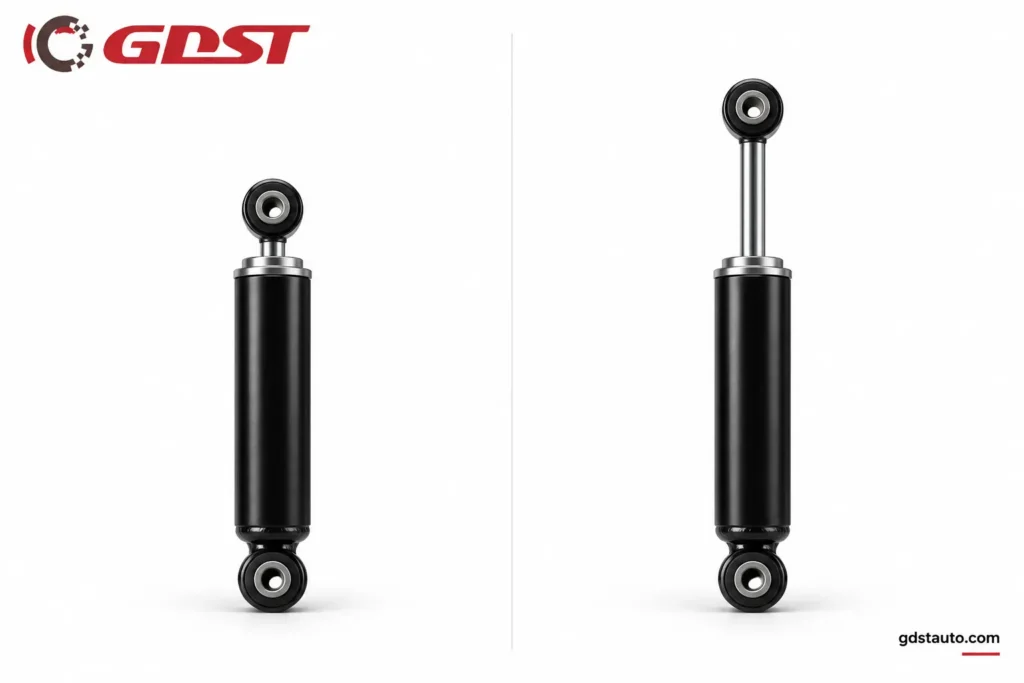
Different vehicle suspension systems require shock absorbers with suitable mounting dimensions, internal construction, stroke capability, and damping characteristics.
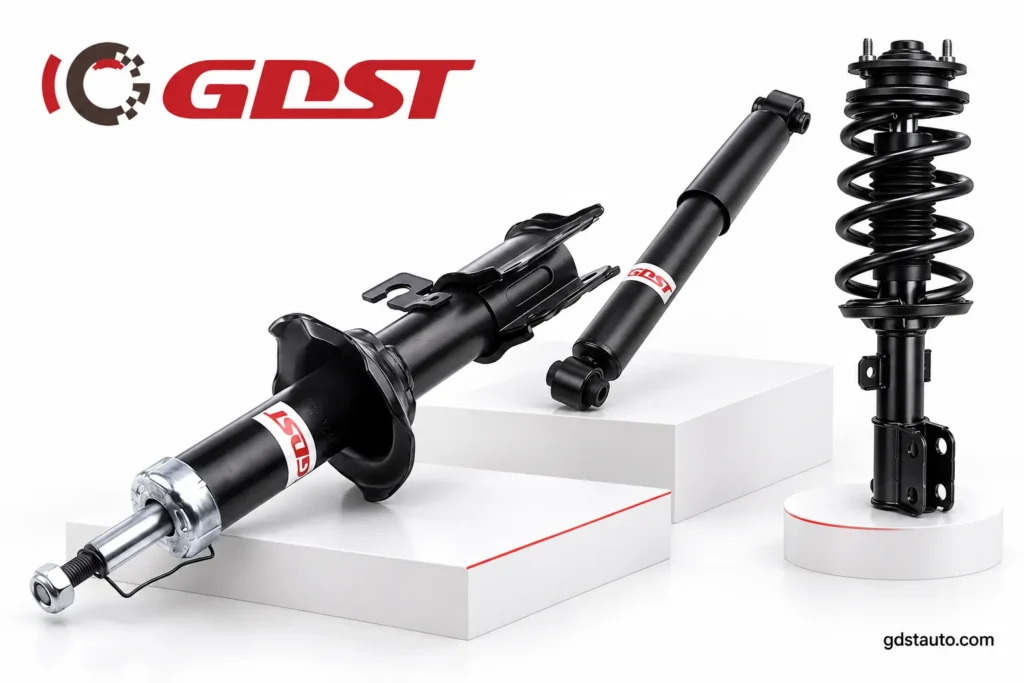
GDST supports multiple automotive shock absorber designs for compatible aftermarket replacement applications.
Selecting the correct product involves more than identifying its external appearance. Buyers should consider the original suspension configuration, technical specifications, installation position, and intended operating conditions.
|
Shock Absorber Type |
Technical Characteristics |
Typical Applications |
|
Hydraulic Twin-Tube Shock Absorbers |
Use an inner working cylinder and an outer reservoir, with hydraulic fluid flowing through piston and base-valve passages to control suspension movement. |
Conventional passenger car and light commercial vehicle suspension applications |
|
Gas-Charged Twin-Tube Shock Absorbers |
Combine hydraulic damping with pressurized gas. Depending on the design, the gas charge helps limit oil aeration and related changes in damping behavior. |
Compatible with passenger cars, SUVs, and light trucks |
|
Monotube Shock Absorbers |
Typically feature a single pressure tube, a working piston, and a floating piston separating hydraulic oil from a pressurized gas chamber. |
Selected OE replacement, SUV, pickup, and performance-oriented applications |
|
Front Shock Absorbers |
Designed for the mounting geometry and damping requirements of a specified front suspension application. |
Compatible front suspension systems |
|
Rear Shock Absorbers |
Configured for applicable rear suspension geometry, mounting requirements, and damping characteristics. |
Compatible rear suspension systems |
|
Suspension Struts & Complete Strut Assemblies |
Combine hydraulic damping with suspension-specific structural components. Complete assemblies may also include a coil spring and associated mounts. |
Vehicles designed to use strut-type suspension systems |
Which Design Is Best for Your Vehicle?
Neither monotube nor twin-tube construction is universally superior for every vehicle.
Their suitability depends on the original suspension design, operating conditions, available installation space, damping calibration, and product requirements.
Similarly, gas-charged shock absorbers are not automatically better than other hydraulic designs. Gas charging can help manage fluid aeration and pressure conditions, but overall performance depends on the complete damper system.
Buyers should select products according to verified vehicle applications and model-specific technical requirements.
How Do Automotive Shock Absorbers Work?
An automotive shock absorber is a damping component that controls suspension movement caused by road disturbances.
When a vehicle travels over uneven road surfaces, suspension springs compress and rebound. The springs store and release mechanical energy, while the shock absorber dissipates part of the associated motion energy to control continued oscillation.
Most conventional automotive shock absorbers generate damping resistance by forcing hydraulic fluid through valves and calibrated flow passages as a piston moves inside a working cylinder.
The resulting hydraulic resistance creates a force opposing the damper’s relative motion. Part of the mechanical energy is converted into heat and dissipated through the damper structure.
Research by Jugulkar, Singh, and Sawant demonstrated how hydraulic flow through orifices affects damping force at different movement velocities, providing experimental support for the importance of internal fluid passages in hydraulic damper behavior [1].
Compression Damping
Compression damping resists shock absorber shortening as the suspension compresses.
The required compression characteristics depend on the vehicle’s suspension design, operating conditions, and intended ride and handling objectives.
Rebound Damping
Rebound damping resists shock absorber extension when the suspension moves back from a compressed position.
It helps regulate spring-driven suspension movement and influences the vehicle’s response to repeated road disturbances.
Why Do Different Shock Absorbers Have Different Damping Characteristics?
Damping behavior depends on factors including:
- Piston movement velocity
- Hydraulic valve configuration
- Flow passage dimensions
- Oil viscosity and temperature
- Internal pressure conditions
- Mechanical friction and component characteristics
Schickhofer and Antonopoulos investigated the relationship between hydraulic damper design parameters and damping performance, demonstrating that changes in shim properties, flow passages, and other model parameters can substantially influence damping characteristics [2].
These findings explain why shock absorbers with similar external shapes may have different damping specifications.
The appropriate damping characteristics must be considered in the context of the complete suspension system rather than a single force value.
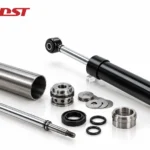
Key Shock Absorber Components & Hydraulic Damping Design
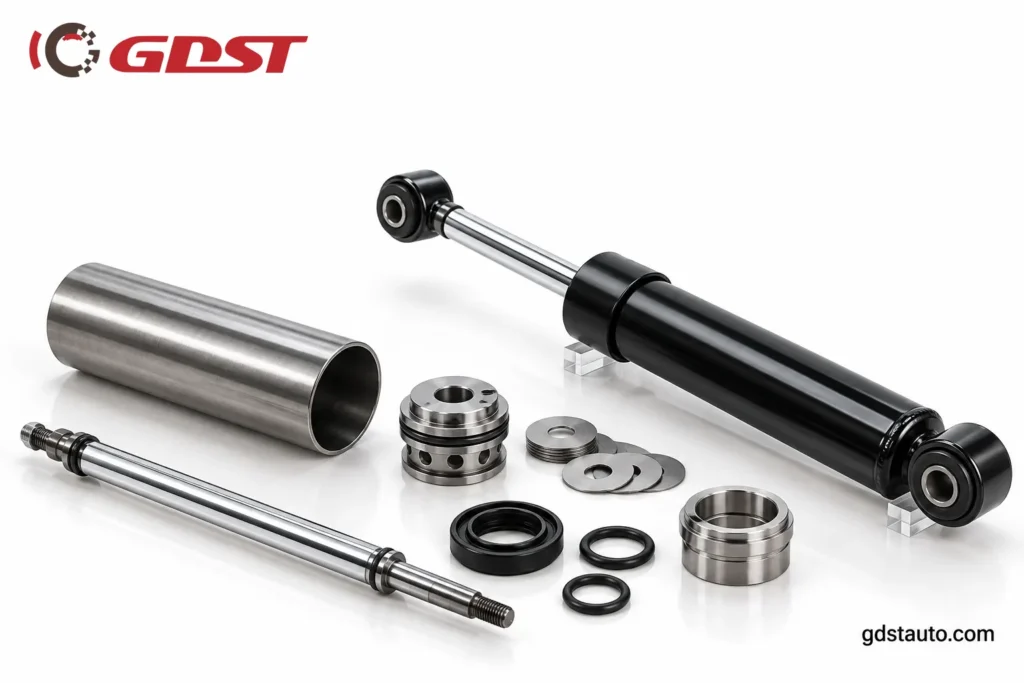
The damping behavior and mechanical reliability of a hydraulic shock absorber depend on the interaction of its internal and external components.
Different products may use different materials, geometries, and assembly configurations according to the intended vehicle application.
Piston Rod
The piston rod transfers relative suspension movement to the working piston.
Surface finish, dimensional accuracy, corrosion protection, and compatibility with the sealing system are important considerations in component selection and durability.
Piston and Valve Assembly
The piston and valve system control hydraulic fluid flow during compression and rebound.
Valve passages, shim arrangements, and opening characteristics influence how damping force develops as piston velocity changes.
Research on hydraulic damper design confirms that variations in valve-related parameters and flow geometry can produce different damping responses [2].
Working Cylinder
The working cylinder provides the operating surface for the hydraulic piston.
Its dimensional accuracy, surface condition, and alignment contribute to the mechanical operation of the damper assembly.
Oil Seals and Rod Guides
The sealing and guidance system supports piston rod movement while limiting fluid leakage and the entry of external contaminants.
Seal performance depends on material characteristics, component geometry, surface condition, lubrication, and operating conditions.
Hydraulic Fluid
Hydraulic fluid transmits pressure through the internal valve system.
Its viscosity and temperature-dependent characteristics influence hydraulic flow resistance and damper response.
Gas Chamber
Applicable gas-charged designs use pressurized gas to accommodate volume changes and help manage internal fluid pressure.
The gas chamber configuration and its functional contribution depend on the shock absorber’s internal design.
Mounting Components
Mounting eyes, brackets, pins, stems, bushings, and sleeves connect the damper to the suspension system.
These components must be compatible with the intended vehicle application and its mechanical installation requirements.
Specific component materials and configurations vary by product model. Buyers requiring detailed material or construction information can request available model-specific documentation.
GDST Automotive Shock Absorber Technical Specifications
Technical compatibility is a critical consideration when purchasing replacement shock absorbers.
Two shock absorbers may have comparable external appearances while differing in compressed length, extended length, mounting geometry, internal construction, or damping characteristics.
GDST supports model-specific technical review to help buyers assess product requirements before ordering.
The following table outlines common parameters used in automotive shock absorber identification and evaluation.
|
Technical Parameter |
Description / Specification Basis |
|
Product Type |
Hydraulic, gas-charged, twin-tube, monotube, or application-specific strut configuration |
|
Installation Position |
Front or rear, according to the vehicle application |
|
Extended Length |
Model-specific; requires applicable dimensional documentation |
|
Compressed Length |
Model-specific; requires applicable dimensional documentation |
|
Physical Working Stroke |
Model-specific; not equivalent to the damping test stroke |
|
Piston Rod Diameter |
Model-dependent |
|
Mounting Type |
Eye, pin, stem, bracket, or application-specific arrangement |
|
Compression Damping Force |
Model-specific force requirement under defined test conditions |
|
Rebound Damping Force |
Model-specific force requirement under defined test conditions |
|
Test Velocity |
Defined by the applicable technical data sheet |
|
Test Stroke |
Defined by the applicable technical data sheet |
|
Damping Force Tolerance |
Model-specific minimum and maximum force limits |
|
OE Reference |
Subject to cross-reference and fitment verification |
|
Protective Finish |
Depends on product design and specification |
|
Packaging |
GDST-branded or approved customized packaging |
Why Are Test Conditions Important?
Hydraulic shock absorbers do not necessarily produce a constant damping force across all operating velocities.
Basso’s experimental research demonstrated the value of analyzing damping force in relation to both movement velocity and displacement, highlighting the nonlinear nature of shock absorber behavior [4].
Therefore, a nominal damping force should be interpreted together with its defined test conditions.
Buyers evaluating detailed damper performance may also require additional force–velocity or force–displacement data.
Representative GDST Shock Absorber Models & Damping Force Specifications
GDST maintains technical documentation for selected automotive shock absorber models.
The following 17 MF-series references are taken from GDST’s manufacturer-issued shock absorber technical data sheets.
The documents identify 14 front and three rear shock absorber references, together with their nominal compression and rebound force requirements.
Documented Test Conditions
- Test stroke: 30 mm for each listed reference
- Test velocities: 0.300 m/s or 0.314 m/s, depending on the model
- Damping force unit: Newton (N)
- Documented values: nominal specifications and allowable tolerances
|
GDST Part Number |
Position |
Test Velocity (m/s) |
Nominal Rebound Force (N) |
Nominal Compression Force (N) |
|
MF10366741 |
Front |
0.314 |
1,000 ± 150 |
640 ± 122.4 |
|
MF10366742 |
Front |
0.314 |
1,000 ± 150 |
640 ± 122.4 |
|
MF10242405 |
Front |
0.300 |
1,100 ± 250 |
550 ± 150 |
|
MF10242085 |
Front |
0.300 |
1,100 ± 250 |
550 ± 150 |
|
MF543027096R |
Front |
0.314 |
940 ± 142.2 |
515 ± 102.4 |
|
MF8200663654 |
Front |
0.314 |
780 ± 121.4 |
670 ± 127.2 |
|
MF543023532R |
Front |
0.300 |
1,225 ± 225 |
550 ± 150 |
|
MF543026656R |
Front |
0.314 |
995 ± 149.35 |
635 ± 121.6 |
|
MF6001550751 |
Front |
0.314 |
1,015 ± 151.95 |
460 ± 93.6 |
|
MF10419961 |
Front |
0.300 |
1,100 ± 250 |
550 ± 150 |
|
MF10419962 |
Front |
0.300 |
1,100 ± 250 |
550 ± 150 |
|
MF543024EA3A |
Front |
0.300 |
1,100 ± 250 |
550 ± 150 |
|
MF543034EA3A |
Front |
0.300 |
1,100 ± 250 |
550 ± 150 |
|
MF543025451R |
Front |
0.300 |
1,100 ± 250 |
550 ± 150 |
|
MF8200953294 |
Rear |
0.314 |
680 ± 108.4 |
480 ± 96.8 |
|
MF562100664R |
Rear |
0.314 |
1,920 ± 269.6 |
520 ± 103.2 |
|
MF8200869345 |
Rear |
0.300 |
1,100 ± 250 |
550 ± 150 |
Important Technical Notes
The figures above represent manufacturer-specified nominal damping forces and allowable tolerance ranges. They are not individual production test measurements or independent third-party certifications.
The documented 30 mm test stroke must not be interpreted as the shock absorber’s full physical travel.
Identical damping force specifications do not establish that two products are interchangeable.
Because the specified test velocities are not identical for all models, comparisons should account for the applicable testing conditions.
The MF-series references are the part numbers used in GDST’s supplied technical documents. OE cross-references and vehicle compatibility must be verified separately.
Understanding Rebound and Compression Damping Force
Compression and rebound damping are important characteristics of hydraulic shock absorbers.
Their specified values describe the resistance associated with two different directions of suspension movement under defined test conditions.
Many automotive dampers use asymmetric damping characteristics, meaning compression and rebound forces are not identical.
Rajalingham and Rakheja examined the influence of suspension damper asymmetry on vehicle vibration response, discussing how different compression and rebound characteristics relate to ride, road-holding, handling, and vehicle control objectives [3].
However, a higher rebound force does not automatically indicate a better or more suitable shock absorber.
The appropriate damping relationship depends on the vehicle suspension system, intended application, and overall performance requirements.
Example: GDST MF562100664R Rear Shock Absorber
The manufacturer-issued technical data sheet specifies:
|
Parameter |
Specified Value |
|
Test Stroke |
30 mm |
|
Test Velocity |
0.314 m/s |
|
Nominal Rebound Force |
1,920 N |
|
Rebound Minimum |
1,650.4 N |
|
Rebound Maximum |
2,189.6 N |
|
Nominal Compression Force |
520 N |
|
Compression Minimum |
416.8 N |
|
Compression Maximum |
623.2 N |
Under the documented conditions, this model has a substantially higher nominal rebound force than compression force.
This difference describes its specified damping characteristics. It does not independently demonstrate superior handling, longer service life, or suitability for a particular vehicle.
What Does a Damping Force Tolerance Mean?
For example, GDST reference MF10366741 has a specified nominal rebound force of 1,000 N with a tolerance of ±150 N.
The documented allowable range is therefore 850–1,150 N under the stated test conditions.
These limits may be used as comparison criteria when corresponding measured values are available.
Why Is One Damping Force Value Not Enough to Describe Performance?
Damper characteristics can vary with piston velocity, displacement, valve response, and internal fluid behavior.
Experimental research by Basso [4] and Barethiye, Pohit, and Mitra [5] shows that automotive shock absorbers can exhibit nonlinear and hysteretic behavior.
A single force value at a specified test velocity is therefore a useful technical reference but does not fully characterize the damper’s response across its full operating range.
For more detailed engineering evaluation, buyers may request available force–velocity curves, force–displacement data, or additional measurements under defined conditions.
Vehicle Applications & OE Replacement Shock Absorber Selection
GDST supports aftermarket shock absorber requirements for vehicle platforms from Japanese, Korean, European, American, and other markets.
Correct application matching is essential because shock absorbers are designed for specific suspension configurations.
Passenger Car Shock Absorbers
GDST supplies replacement shock absorber options for compatible sedans, hatchbacks, and other passenger car applications.
Available front and rear configurations depend on the vehicle’s original suspension design.
SUV and Pickup Shock Absorbers
Our product range supports selected SUV, pickup, and utility vehicle suspension applications.
Buyers should verify the original suspension configuration, installation geometry, damping requirements, and any relevant vehicle modifications.
Commercial Vehicle Shock Absorbers
GDST supports selected commercial vehicle applications, including compatible light truck and utility vehicle shock absorber requirements.
The product must be matched to the relevant vehicle configuration and operating conditions.
Front and Rear Shock Absorbers
GDST’s representative MF-series technical documents include both front and rear shock absorber references.
These installation labels provide an initial identification point, but they do not establish full vehicle fitment.
How to Find the Correct Replacement Shock Absorber
For accurate matching, buyers should provide:
- Original equipment reference number
- Existing aftermarket part number
- Vehicle make and model
- Production year
- Engine or vehicle variant, where relevant
- Front or rear installation position
- Left- or right-side requirements, where applicable
- Drive configuration, where relevant
- Mounting type and installation dimensions
- Existing product photographs or drawings, if available
GDST can review available cross-reference and technical information to help identify potential replacement options.
OE references are used for parts identification and comparison. Their use does not imply affiliation with or approval by the original vehicle manufacturer.
GDST Shock Absorber Quality Control & Technical Verification
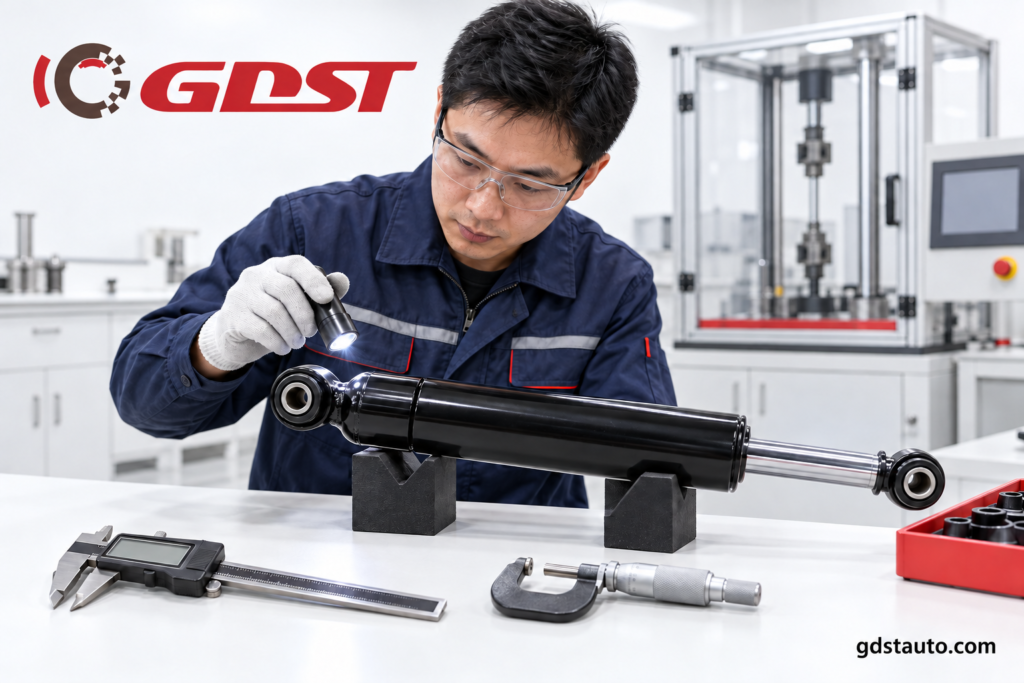
Consistent shock absorber production requires suitable material selection, dimensional control, manufacturing processes, and applicable functional inspection.
GDST’s published shock absorber manufacturing information describes activities including material inspection, dimensional inspection, damping force evaluation, and other product-related quality tests.
For selected MF-series models, GDST also provides manufacturer-issued technical data sheets defining nominal damping force specifications and allowable ranges.
These data sheets establish technical reference requirements. Separate measured test records are needed to demonstrate the performance of a particular production sample or batch.
Damping Force Evaluation
Compression and rebound forces can be evaluated under defined movement conditions using suitable testing equipment.
Actual measured results should be compared with the relevant model specification under matching test conditions.
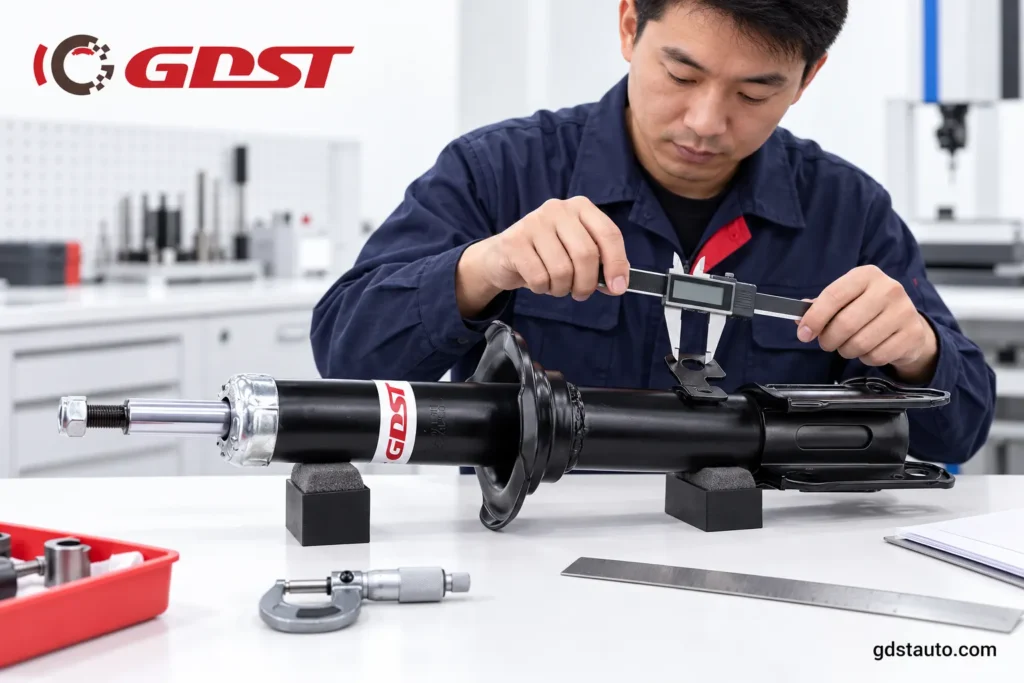
Dimensional Inspection
Mounting geometry, rod dimensions, assembly lengths, and other critical dimensions may be checked against applicable drawings or specifications.
Dimensional conformity is important because correct damping characteristics alone cannot establish vehicle fitment.
Sealing and Leakage Evaluation
Sealing-related inspection helps assess the ability of a damper assembly to retain its hydraulic fluid under the applicable inspection conditions.
Different test procedures may be required for different products or qualification requirements.
Durability and Repeated-Motion Evaluation
Repeated-motion testing can be used to examine changes in mechanical or damping behavior under defined cycles and loading conditions.
Results depend on the testing procedure, operating conditions, and specified acceptance criteria.
Temperature-Dependent Performance
Hydraulic damper characteristics can vary as oil viscosity and other material properties change with temperature.
Hryciów’s experimental research on hydraulic shock absorbers demonstrated that temperature and component condition can significantly influence damping force, with particularly notable changes under low-temperature conditions in the tested specimens [6].
These findings support the technical importance of evaluating damping behavior under relevant operating temperatures.
They do not establish that all GDST shock absorbers have identical temperature performance or have been tested across the same temperature range.
Corrosion-Related Evaluation
Applicable coating and component tests can help evaluate resistance to specified corrosion conditions.
The relevant procedures and acceptance criteria depend on the product specification and customer requirements.
Quality Documentation for Buyers
Customers may request available documentation for specific products, such as:
- Technical specification sheets
- Model-specific dimensional information
- Applicable inspection records
- Damping force test data, where available
- Product drawings and reference photographs
- Relevant quality management certificates
Any certificate should be reviewed according to its validity, certified legal entity, facility, and stated scope.
Technical Documentation Notice
GDST’s MF-series damping force sheets are manufacturer-issued technical specification documents. They should not be represented as independent laboratory certifications or as complete measured production test reports.
Technical Information for Accurate Shock Absorber Matching
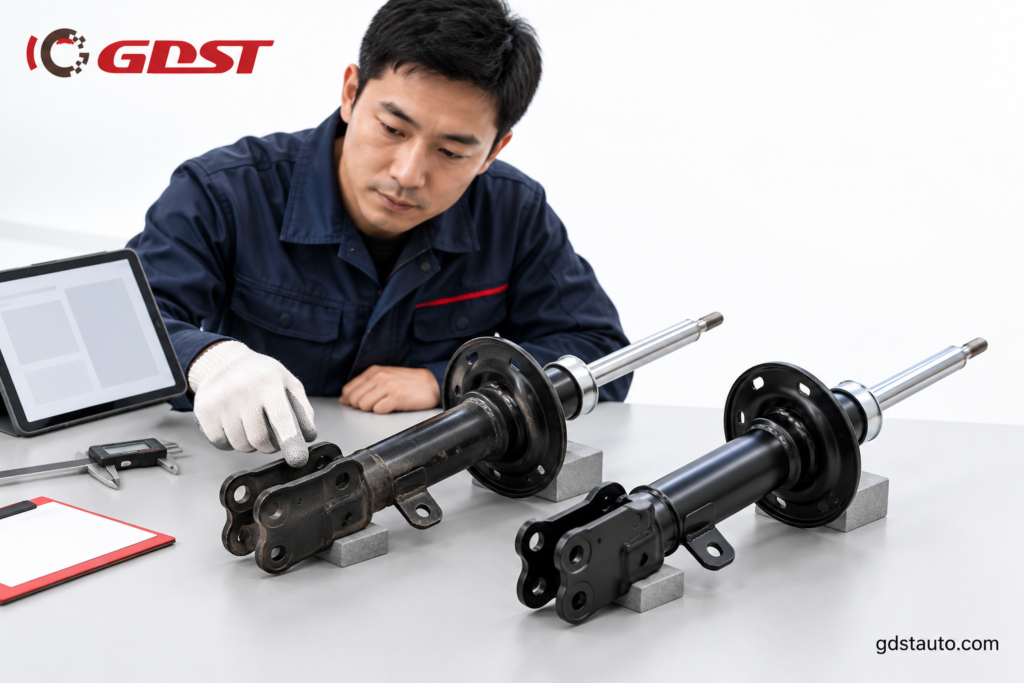
A technically suitable replacement shock absorber must meet the relevant vehicle installation and operating requirements.
Damping force is one consideration, but it cannot replace physical fitment verification.
|
Verification Item |
Why It Matters |
Recommended Information |
|
OE Reference |
Identifies the intended replacement application |
OE or validated cross-reference |
|
Vehicle Application |
Confirms the relevant vehicle configuration |
Make, model, year, and variant |
|
Installation Position |
Distinguishes front, rear, and side-specific products |
Application catalog or drawing |
|
Extended Length |
Relates to installation and extension limits |
Model-specific dimensional data |
|
Compressed Length |
Relates to installation and compression clearance |
Model-specific dimensional data |
|
Physical Working Stroke |
Defines the damper’s available mechanical travel |
Model-specific specification |
|
Mounting Type |
Determines mechanical connection compatibility |
Drawing or sample comparison |
|
Rebound Force |
Describes specified extension resistance |
Nominal value and tolerance |
|
Compression Force |
Describes specified compression resistance |
Nominal value and tolerance |
|
Test Conditions |
Provides context for interpreting damping force |
Velocity, test stroke, and relevant method details |
|
Product Construction |
Determines the applicable damper design |
Model-specific construction information |
The 17 example MF-series technical sheets do not contain all the information in this table.
Additional catalog records, drawings, or test documentation may be required before a replacement application can be confirmed.
Wholesale Automotive Shock Absorbers & OEM/ODM Supply
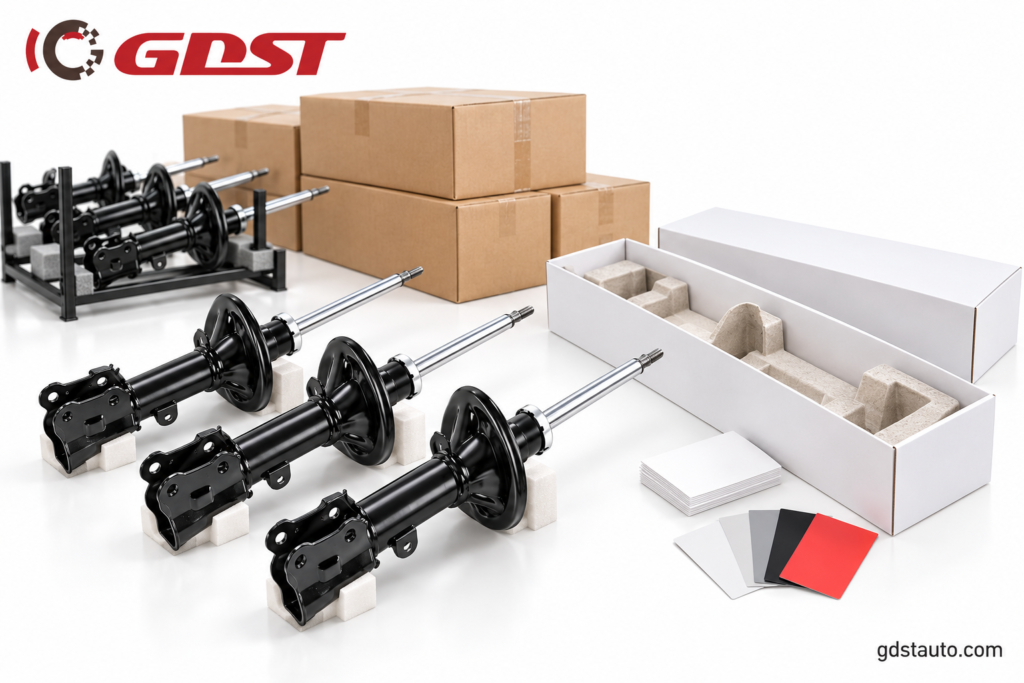
GDST supports automotive aftermarket importers, distributors, wholesalers, and private-label brands seeking coordinated vehicle shock absorber supply.
Our team can assist with product identification, technical communication, order quotation, packaging coordination, and export arrangements.
Wholesale Supply Information
|
Procurement Item |
GDST Supply Information |
|
Product Range |
More than 2,000 developed shock absorber models |
|
Standard MOQ |
From 50 pieces per model |
|
Standard Lead Time |
Approximately 50 days for standard container orders, subject to order confirmation |
|
Warranty |
Published coverage of 1 year / 30,000 km under applicable conditions and warranty terms |
|
Product Matching |
By OE reference, vehicle application, or part number |
|
Technical Documentation |
Model-specific information, subject to availability |
|
Private Label |
Supported for eligible products and orders |
|
Custom Branding |
Subject to technical and order requirements |
|
Custom Packaging |
Branded boxes, labels, and export cartons |
|
Wholesale Pricing |
Based on model, quantity, specifications, and packaging requirements |
|
Samples |
Subject to model availability and agreed evaluation terms |
OEM & Private Label Shock Absorber Solutions
GDST supports customization services for eligible aftermarket customers.
Depending on the selected products and order requirements, available options may include:
- Customer brand and logo marking
- Product identification labels
- Customized carton artwork
- Private-label retail packaging
- Export master carton designs
- Product information and labeling coordination
Customers may provide existing branding artwork or discuss packaging development requirements with GDST.
Customization feasibility, printing quantities, and applicable costs are confirmed before production.
How to Order Vehicle Shock Absorbers from GDST

GDST provides a structured inquiry and purchasing process for aftermarket shock absorber buyers.
Step 1 — Send Your Product List
Submit OE references, existing aftermarket numbers, GDST reference numbers, or vehicle applications.
Step 2 — Review Product Compatibility
Confirm the applicable vehicle, installation position, mounting dimensions, and product configuration.
Step 3 — Review Technical Requirements
Where required, discuss damping force specifications, available drawings, and other product documentation.
Step 4 — Confirm Order Requirements
Specify quantities, packaging preferences, target market, and delivery expectations.
Step 5 — Approve Samples and Commercial Terms
Confirm the quotation, samples where applicable, agreed product specifications, and order conditions.
Step 6 — Production & Inspection
Proceed with the agreed production arrangements and applicable inspection procedures.
Step 7 — Packaging & Export Shipment
Confirm packaging, shipment arrangements, and relevant export documents.
When Should Automotive Shock Absorbers Be Inspected or Replaced?
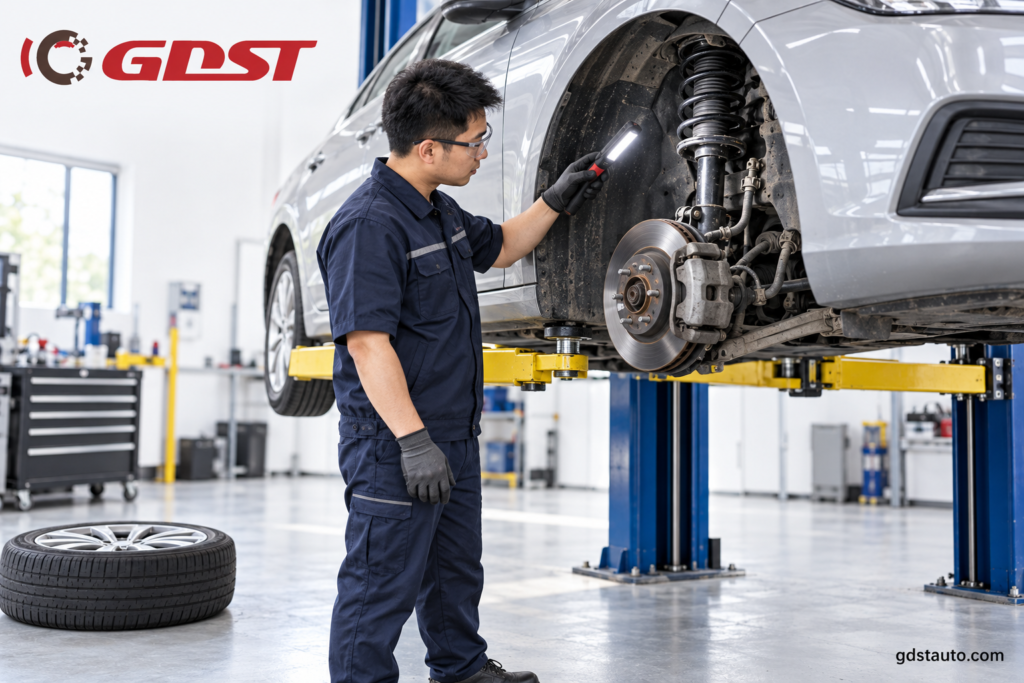
Automotive shock absorbers are subject to repeated movement, vibration, temperature changes, and environmental exposure during vehicle operation.
Their damping characteristics may change because of component wear, internal oil or gas loss, mechanical damage, or other deterioration mechanisms.
Schramm, Zwosta, and Prokop investigated degraded twin-tube shock absorbers and demonstrated that oil and gas losses can substantially change damping behavior under the studied conditions [7].
This research helps explain why shock absorber condition should not be assessed solely by external appearance.
Possible Signs of Shock Absorber or Suspension Problems
- Excessive bouncing after road disturbances
- Increased vehicle body movement during cornering or braking
- Changes in ride comfort or suspension response
- Visible mechanical damage
- Significant fluid leakage
- Abnormal suspension noises
- Irregular tire wear associated with suspension problems
These symptoms are not unique to defective shock absorbers.
Tires, springs, bushings, alignment, and other suspension components can cause similar symptoms.
A qualified technician should inspect the vehicle to determine the underlying cause.
How Often Should Shock Absorbers Be Replaced?
There is no universal mileage-based replacement interval suitable for all shock absorbers.
Service life depends on factors including vehicle application, road conditions, operating loads, maintenance, and component condition.
Inspection and replacement should follow relevant vehicle manufacturer guidance and confirmed component condition.
Frequently Asked Questions About Vehicle Shock Absorbers
1. What does a vehicle shock absorber do?
A vehicle shock absorber controls suspension movement, helping reduce excessive bouncing and manage vehicle body motion.
2. What is the difference between a shock absorber and a strut?
Both provide damping, but a strut also serves a structural role in certain vehicle suspension systems.
3. What types of automotive shock absorbers does GDST supply?
GDST offers hydraulic, gas-charged, twin-tube, monotube, and vehicle-specific shock absorber and strut solutions.
4. What is an automatic shock absorber?
The term often refers to electronically controlled or adaptive dampers. Unlike conventional passive shocks, these systems can adjust damping through electronic control.
5. How do I find the correct shock absorber for my vehicle?
Provide your OE number, vehicle make, model, year, and installation position. GDST can help verify compatible replacement options.
6. What is the difference between rebound and compression damping?
Rebound damping resists shock absorber extension, while compression damping resists shortening. Both are calibrated according to vehicle requirements.
7. What do GDST’s damping force specifications mean?
They indicate nominal compression and rebound force requirements with defined tolerances under specified test conditions, not individual measured results.
8. Can GDST provide shock absorber technical data or test reports?
Yes. Model-specific specifications are available for selected products. Additional test documentation can be requested subject to availability.
9. What are GDST’s minimum order quantity and lead time?
The standard MOQ starts at 50 pieces per model, with an approximate 50-day lead time for standard container orders, subject to confirmation.
10. Does GDST offer private-label shock absorber packaging?
Yes. GDST supports customized branding, labels, and packaging for eligible orders, subject to applicable minimum quantities and project requirements.
Request a Vehicle Shock Absorber Quote from GDST
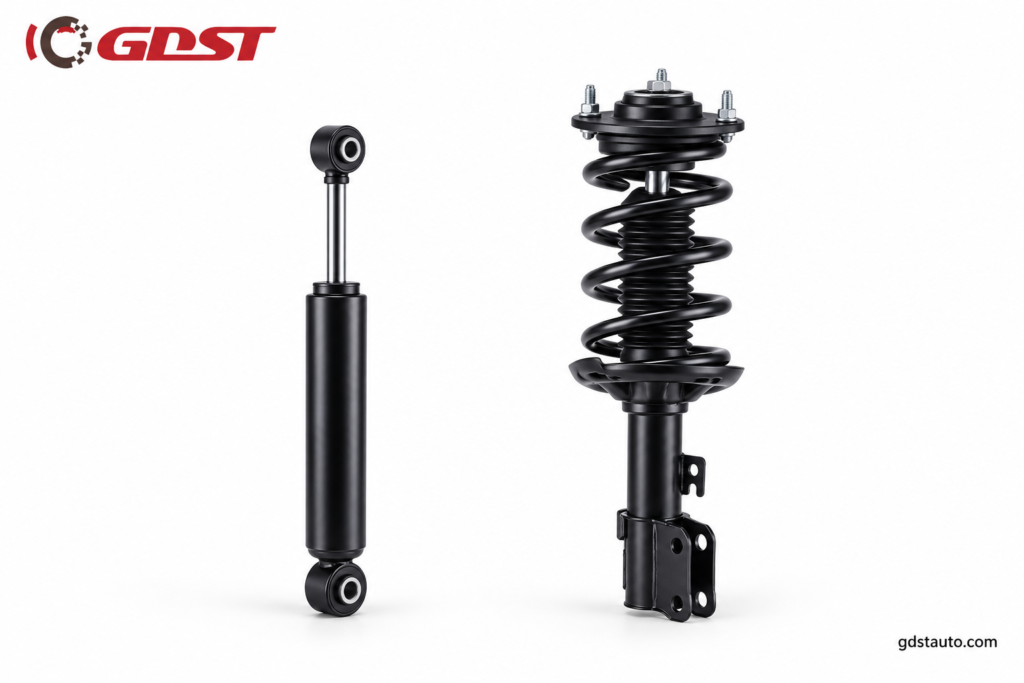
Looking for automotive shock absorbers for your aftermarket product range?
GDST supports professional buyers with product identification, technical specification review, OE reference matching, wholesale quotation, and private-label supply coordination.
Whether you are sourcing a specific replacement shock absorber or preparing a multi-model purchasing list, our team can help you review your requirements.
Tell Us What You Need
For an accurate quotation, please provide:
- Company name
- Contact name
- Business email
- Country or destination market
- OE number or GDST part number
- Vehicle make, model, and year, if known
- Front or rear installation position
- Required quantities per model
- Technical specifications, if applicable
- Branding and packaging requirements
- Drawings, photographs, or product list attachments
Contact GDST
Email: admin@gdstauto.com
WhatsApp: +86 185 5533 0281
Shock Absorber Manufacturing & Supply
Technical References & Research Sources
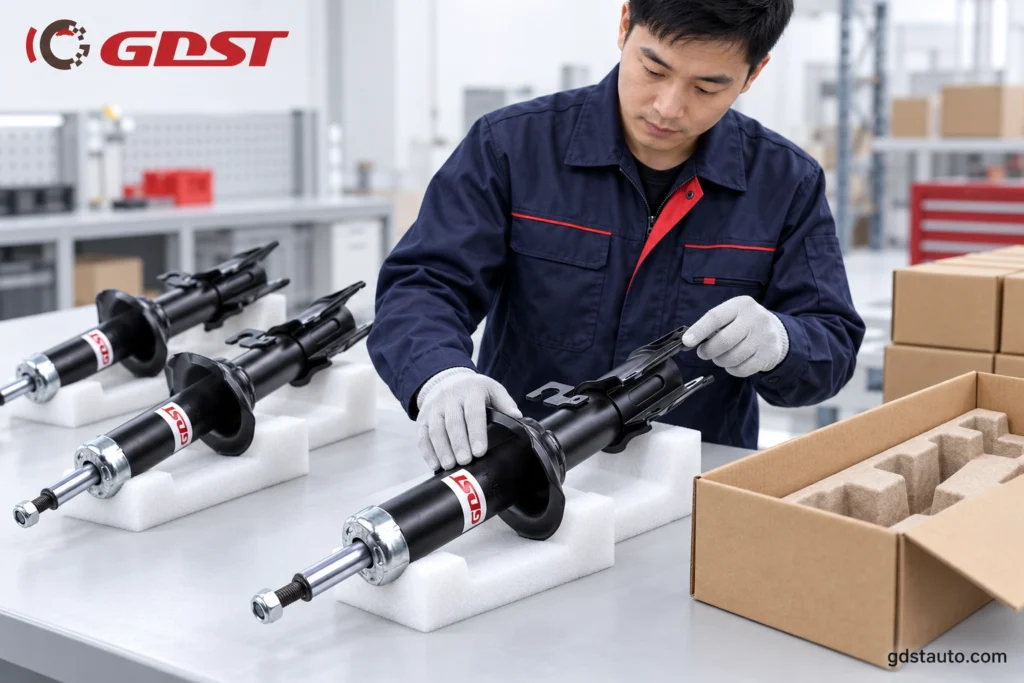
The following peer-reviewed research publications provide scientific background for the explanations of hydraulic damping, force characteristics, component design, degradation, and suspension technologies presented on this page.
These studies explain general engineering principles. They do not constitute independent testing or certification of GDST products.
[1] Hydraulic Flow & Damping Force
Jugulkar, L. M., Singh, S., & Sawant, S. M. (2016). Fluid flow modeling and experimental investigation on automobile damper. Construction and Building Materials, 119, 760–772.
https://doi.org/10.1016/j.conbuildmat.2016.05.142
Examines how hydraulic fluid flow through internal orifices influences shock absorber damping force.
[2] Damper Design Parameters & Performance
Schickhofer, L., & Antonopoulos, C. G. (2024). Cause–effect relationship between model parameters and damping performance of hydraulic shock absorbers. International Journal of Non-Linear Mechanics, 159, 104627.
https://doi.org/10.1016/j.ijnonlinmec.2023.104627
Explains how valve design, flow passages, and fluid properties affect hydraulic damping performance.
[3] Rebound & Compression Damping Asymmetry
Rajalingham, C., & Rakheja, S. (2003). Influence of suspension damper asymmetry on vehicle vibration response to ground excitation. Journal of Sound and Vibration, 266(5), 1117–1129.
https://doi.org/10.1016/S0022-460X(03)00054-3
Examines how differences between rebound and compression damping influence vehicle vibration response.
[4] Experimental Damping Force Characterization
Basso, R. (1998). Experimental Characterization of Damping Force in Shock Absorbers with Constant Velocity Excitation. Vehicle System Dynamics, 30(6), 431–442.
https://doi.org/10.1080/00423119808969459
Highlights the importance of velocity and displacement in evaluating shock absorber damping characteristics.
[5] Nonlinear & Hysteretic Damper Behavior
Barethiye, V., Pohit, G., & Mitra, A. (2017). A combined nonlinear and hysteresis model of shock absorber for quarter car simulation on the basis of experimental data. Engineering Science and Technology, an International Journal, 20(6), 1610–1622.
https://doi.org/10.1016/j.jestch.2017.12.003
Demonstrates the nonlinear and hysteretic behavior of automotive shock absorbers using experimental data.
[6] Temperature & Technical Condition
Hryciów, Z. (2022). An Investigation of the Influence of Temperature and Technical Condition on the Hydraulic Shock Absorber Characteristics. Applied Sciences, 12(24), 12765.
https://doi.org/10.3390/app122412765
Investigates how temperature and component condition affect hydraulic shock absorber damping performance.
[7] Oil & Gas Loss and Performance Degradation
Schramm, T., Zwosta, T., & Prokop, G. (2025). Investigation and Phenomenological Modeling of Degraded Twin-Tube Shock Absorbers for Oil and Gas Loss. Vehicles, 7(1), 26.
https://doi.org/10.3390/vehicles7010026
Examines how oil and gas loss can cause changes in twin-tube shock absorber performance.
[8] Active & Semi-Active Suspension Technologies
Adaptive control and reinforcement learning for vehicle suspension control: A review. (2024). Annual Reviews in Control, 58, 100974.
https://doi.org/10.1016/j.arcontrol.2024.100974
Reviews adaptive control technologies used in active and semi-active vehicle suspension systems.
Quality Assurance
Every product undergoes rigorous testing and inspection to ensure reliability and performance
Material Inspection
Premium steel from certified suppliers with full traceability
Performance Testing
Fatigue, torque, and stress testing per OE standards
Dimensional Control
Tolerance control for precise OE fitment
Final Inspection
100% inspection before shipment