
Automotive Rear Shock Absorbers for OEM Replacement and Aftermarket Supply
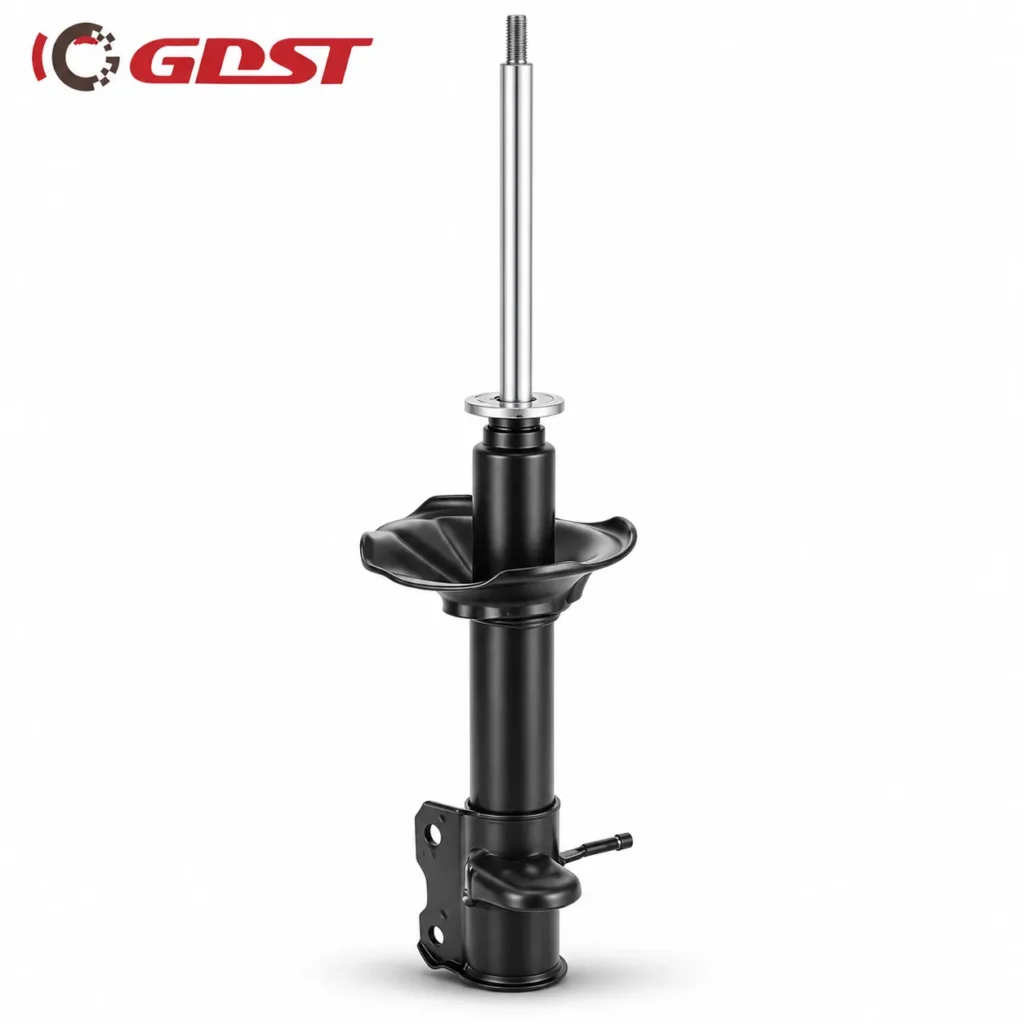





- Fitting Position
-
Rear Left Rear Right
- MOQ
- 50PCS
- Price
- $6 - $25
- Warranty
- 1 Year From Receipt of Goods
- Delivery Time
- 45-55 Days
- Customization
-
- Customized Logo
- Customized Packaging
- ODM/Sample Development
ISO9001 Certified
Fast Delivery
OEM/ODM

Wuhu GDST Auto Parts Co., Ltd supplies automotive rear shock absorbers for passenger cars, SUVs, pickup trucks and selected commercial vehicle applications. With shock absorber manufacturing capabilities, product development experience and aftermarket supply support, we help importers, wholesalers, distributors and automotive brands source reliable replacement suspension components.
Our rear shock absorber range covers different vehicle applications and structural designs, including twin-tube and mono-tube configurations. We provide product matching based on OE reference numbers, vehicle specifications, technical drawings and product samples.
For aftermarket buyers seeking consistent damping performance and reliable product fitment, GDST offers technical support, quality inspection, OEM customization and wholesale supply solutions.
- Rear Shock Absorbers for Passenger Cars, SUVs and Trucks
- Twin-Tube and Mono-Tube Product Configurations
- Damping Force Data and Technical Inspection
- OE Reference Matching and Aftermarket Replacement
- OEM Branding and Customized Packaging
| KYB/OE No. | Application | Position |
| 332056 | Nissan sentra | Rear |
| 332057 | Nissan sentra | Rear |
| 341448 | Toyota Corolla | Rear |
| 341322 | Toyota Fielder | Rear |
| 341357 | Nissan Ad 2000 4×4 | Rear |
| 341281 | Sonata Optima 2001-2005 | Rear |
| E6200-ET000 | Nissan Sentra 2.0 | Rear |
| 48530-0D570 | Toyota Yaris | Rear |
| 55300-3X100 | Hyundai | Rear |
| 348029 | Nissan Versa | Rear |
Rear Shock Absorbers for Automotive Suspension Systems
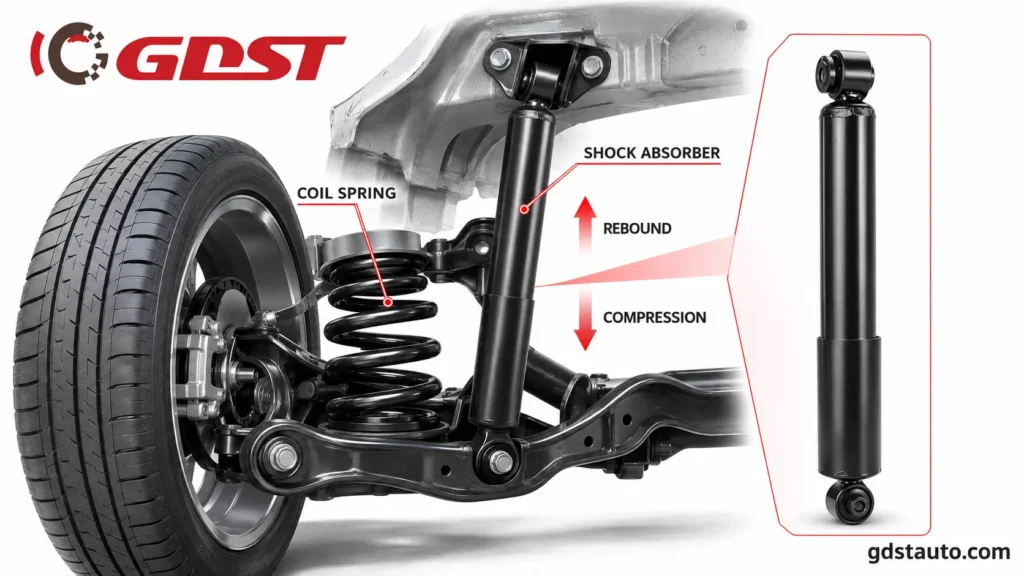
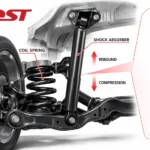
Rear shock absorbers are important components of a vehicle’s suspension system. Their primary function is to control suspension spring oscillation during compression and rebound, helping maintain tire contact with the road and supporting vehicle stability, handling and ride comfort.
When a vehicle travels over uneven surfaces, its suspension springs compress and rebound in response to road impacts. Without adequate damping, these movements can continue excessively, affecting vehicle control and driving comfort.
Rear shock absorbers regulate this movement through hydraulic resistance generated as oil passes through internal valves and piston assemblies.
Unlike suspension springs, shock absorbers do not independently support the vehicle’s weight. Instead, they control suspension movement and work together with springs, mounts, bushings and other suspension components.
For automotive aftermarket replacement, selecting the correct rear shock absorber requires more than matching its appearance. Vehicle application, mounting configuration, dimensions, damping characteristics and OE reference numbers must all be considered.
GDST supports rear shock absorber sourcing for different vehicle platforms, helping distributors and automotive parts buyers identify suitable products for their markets.
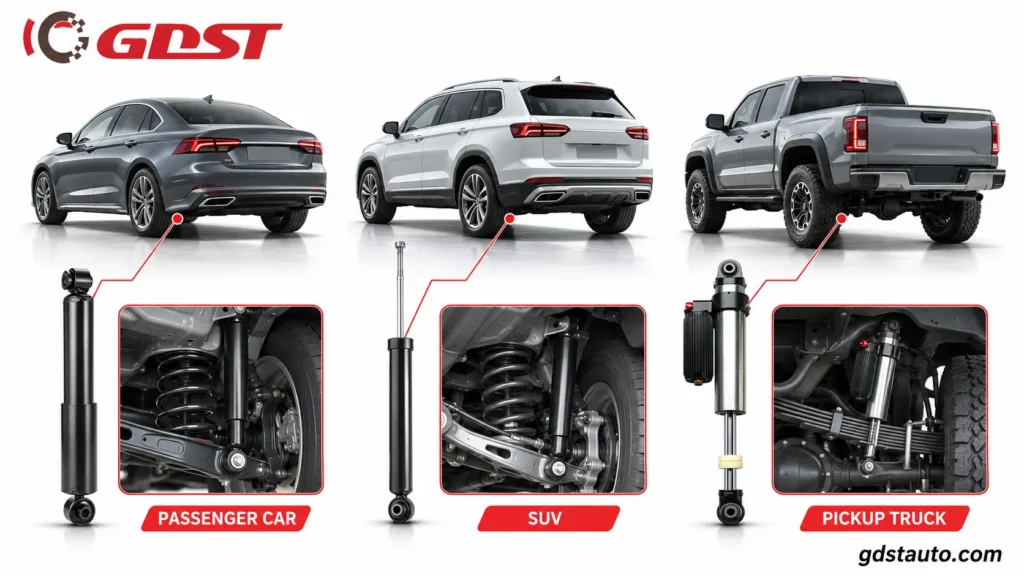
Rear Shock Absorber Applications for Passenger Cars, SUVs and Trucks
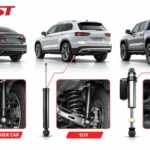
Different vehicle categories require different rear suspension configurations. Vehicle weight, suspension geometry, driving conditions and original equipment specifications all influence rear shock absorber selection.
GDST’s shock absorber product range covers passenger cars, SUVs and light- to medium-duty truck applications, with model availability depending on the specific vehicle and product configuration.
Passenger Car Rear Shock Absorbers
Passenger car rear shocks are designed to control rear suspension movement during everyday driving.
They are used across different vehicle categories, including:
- Compact and economy cars.
- Sedans and mid-size passenger cars.
- Full-size passenger vehicles.
- Selected performance-oriented passenger cars.
The appropriate product depends on the vehicle platform, production year, suspension design and original damping specifications.
SUV Rear Shock Absorbers
SUV rear shock absorbers are selected according to vehicle weight, suspension layout and intended driving conditions.
Important considerations include mounting dimensions, damping characteristics, suspension travel and compatibility with the original suspension system.
Truck Rear Shock Absorbers
Pickup trucks and light- to medium-duty commercial vehicles may experience varying loads and road conditions.
Their rear shock absorbers must be selected according to vehicle specifications, suspension geometry, operating requirements and mounting configuration.
For customers sourcing truck rear shocks or heavy-duty rear shock absorbers, GDST can review the required application and technical specifications before confirming product suitability.
Types and Construction of Automotive Rear Shock Absorbers
Rear shock absorbers can be classified according to their internal construction, damping configuration and adjustment functions. These classifications describe different product characteristics and should not be treated as interchangeable categories.
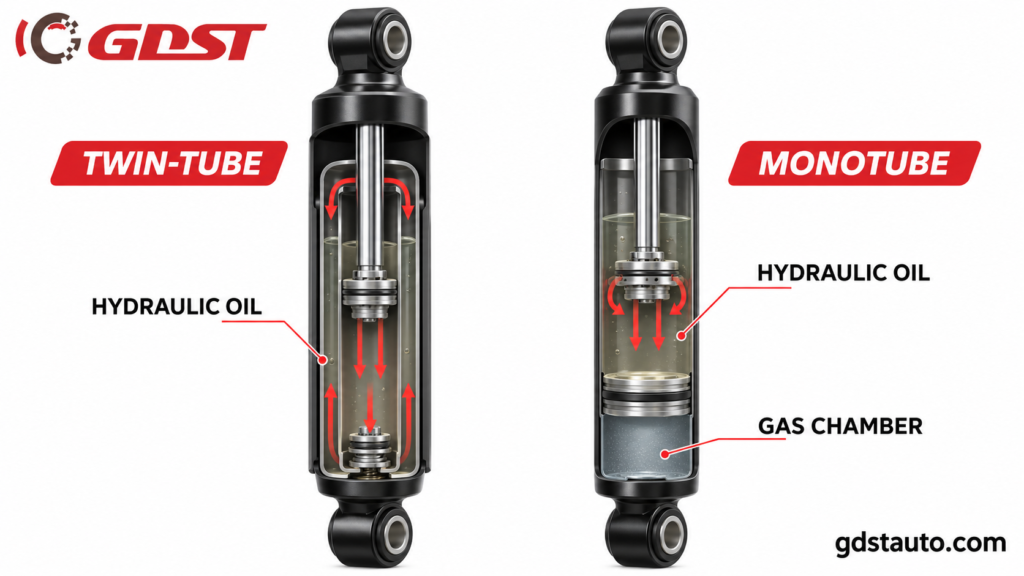
Twin-Tube Rear Shock Absorbers
Twin-tube shock absorbers feature an inner working cylinder and an outer reserve tube.
During operation, hydraulic oil moves between the chambers through internal valves to generate damping resistance.
This construction is widely used in conventional passenger vehicle suspension systems and is suitable for many standard aftermarket replacement applications.
Mono-Tube Rear Shock Absorbers
Mono-tube shock absorbers use a single pressure cylinder containing a working piston and a floating or dividing piston.
The floating piston separates the hydraulic oil from the pressurized gas chamber in applicable designs.
This construction provides a different internal pressure and heat-transfer arrangement compared with twin-tube designs. It is commonly used in selected performance and vehicle-specific applications.
Hydraulic Rear Shock Absorbers
Hydraulic rear shock absorbers generate damping force through the controlled movement of hydraulic oil across internal valve passages.
Their performance depends on valve design, piston configuration, oil properties and manufacturing tolerances.
Gas-Charged Rear Shock Absorbers
Gas-charged shock absorbers combine hydraulic damping with pressurized gas, commonly nitrogen, to help reduce oil aeration and maintain more consistent damping characteristics under suitable operating conditions.
Gas charging does not mean that the product has an externally adjustable air chamber or provides additional vehicle load support.
GDST supports different shock absorber construction and damping configurations according to vehicle requirements and product specifications. The exact construction of each rear shock absorber should be confirmed against its part number.
Rear Shock Absorber Damping Force and Technical Data
Damping force is one of the most important technical characteristics of an automotive shock absorber.
It describes the resistance generated by the shock absorber during suspension compression and rebound.
Rebound Force
Rebound force refers to the damping resistance generated when the shock absorber extends after compression.
It helps control suspension spring return movement and reduce excessive oscillation.
Compression Force
Compression force refers to the resistance generated when the shock absorber shortens under suspension loading.
It helps regulate suspension movement when the vehicle encounters road irregularities.
Different vehicle applications require different compression and rebound damping characteristics. A higher damping force does not automatically indicate a better shock absorber because the appropriate force depends on the suspension design, vehicle weight, spring characteristics and intended operating conditions.
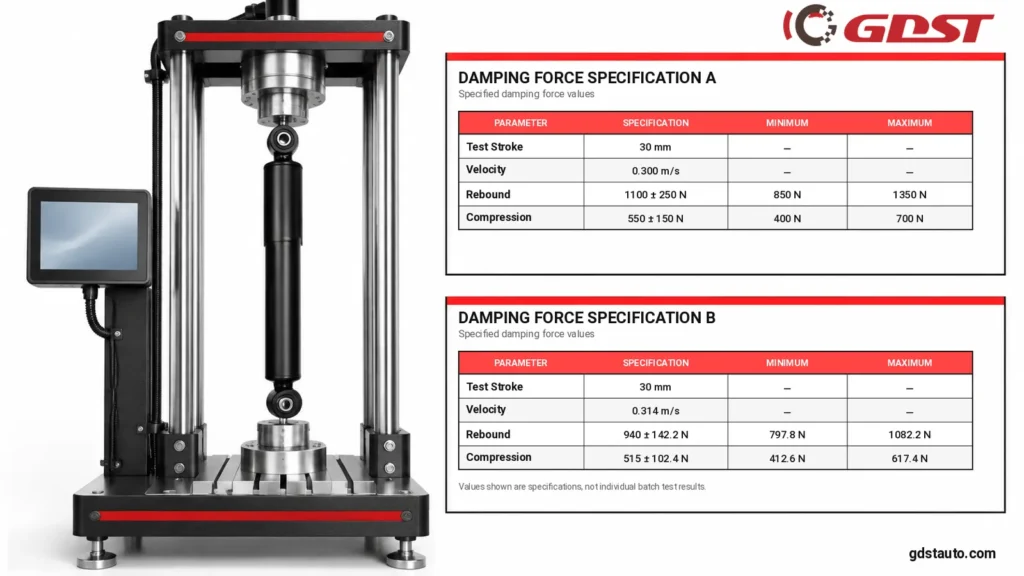
GDST Rear Shock Absorber Damping Force Test Data
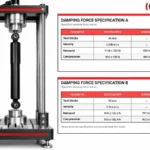
GDST’s technical data sheets provide damping force specifications for three rear shock absorber part numbers.
The following data are taken directly from the corresponding rear-position technical records.
| Part Number | Position | Test Velocity | Rebound Force | Compression Force |
| MF8200953294 | Rear | 0.314 m/s | 680 ± 108.4 N | 480 ± 96.8 N |
| MF562100664R | Rear | 0.314 m/s | 1,920 ± 269.6 N | 520 ± 103.2 N |
| MF8200869345 | Rear | 0.300 m/s | 1,100 ± 250 N | 550 ± 150 N |
Specified Damping Force Ranges
The same technical records provide the corresponding minimum and maximum force values.
| Part Number | Rebound Force Minimum | Rebound Force Maximum | Compression Force Minimum | Compression Force Maximum |
| MF8200953294 | 571.6 N | 788.4 N | 383.2 N | 576.8 N |
| MF562100664R | 1,650.4 N | 2,189.6 N | 416.8 N | 623.2 N |
| MF8200869345 | 850 N | 1,350 N | 400 N | 700 N |
Damping Test Conditions
All three rear shock absorber records specify a test stroke of 30 mm. The test velocities are 0.314 m/s for MF8200953294 and MF562100664R, and 0.300 m/s for MF8200869345.
These values represent the specified conditions of the damping force tests, not the actual mechanical stroke length or the vehicle’s road speed.
The different test velocities should also be considered when comparing damping force values between models.
These three part numbers demonstrate that GDST has documented damping force specifications for different rear shock absorber applications. They should not be interpreted as universal specifications for every rear shock absorber in the GDST catalog.
For vehicle-specific replacement projects, the approved damping force characteristics should be checked against the corresponding product drawing, OE reference and application requirements.
Rear Shock Absorber Components and Manufacturing Quality
The quality and consistency of a rear shock absorber depend on its internal components, material selection, machining accuracy, assembly processes and sealing performance.
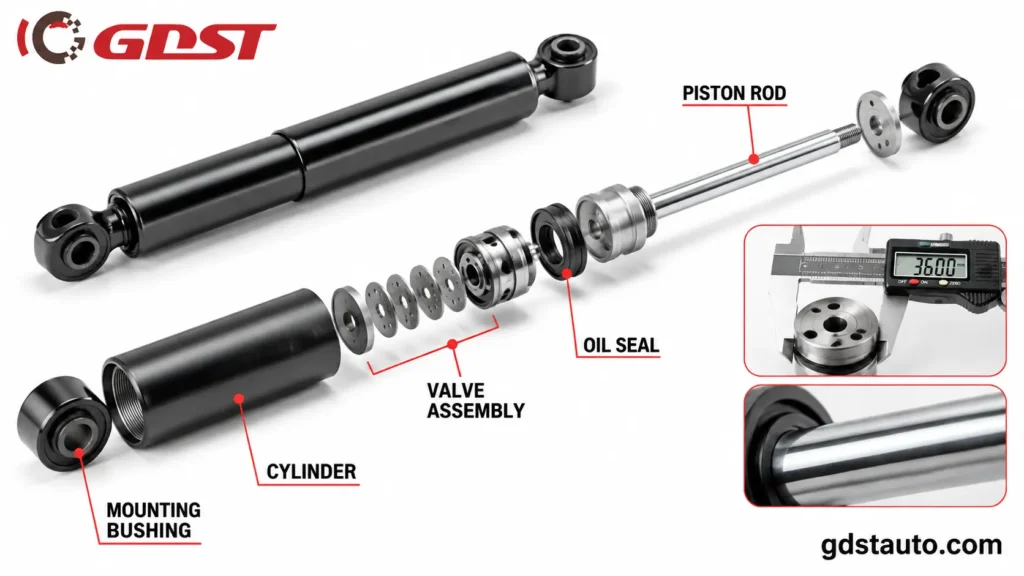
GDST’s shock absorber product information identifies several important components and material configurations used across its product range.
Piston Rod
The piston rod transfers movement between the shock absorber piston and the mounting assembly.
GDST’s published product information identifies Grade 45# and 35# steel as piston rod material options, with precision grinding and chrome plating used in applicable designs.
Piston Assembly and Damping Valve
The piston assembly regulates hydraulic oil flow through internal valve passages to generate the required compression and rebound damping forces.
Powder metallurgy components and valve disc configurations are among the manufacturing solutions described in GDST’s existing shock absorber product range.
Working Cylinder
The working cylinder houses the piston assembly and hydraulic oil.
GDST’s published material specifications include Q235B steel tube configurations for applicable shock absorber designs.
Oil Seals
Oil seals help prevent hydraulic fluid leakage around the piston rod while maintaining the internal working environment.
GDST’s existing shock absorber specifications identify NBR and FKM sealing material options for applicable products.
Reserve Cylinder and Mounting Components
The reserve cylinder provides additional space for hydraulic fluid in twin-tube designs, while mounting components connect the shock absorber to the vehicle suspension.
Their material, dimensions and manufacturing tolerances must match the specific product requirements.
The exact component materials and configurations may vary between models. Buyers requiring specific material grades, seal specifications or construction details should confirm them against the relevant part number and approved technical documentation.
Rear Shock Absorber Fitment and OE Number Matching
Correct vehicle fitment is essential when sourcing rear shock absorbers for OEM replacement and aftermarket distribution.
Vehicles sharing the same model name may use different rear suspension configurations depending on model year, engine, drivetrain, trim level and regional specifications.
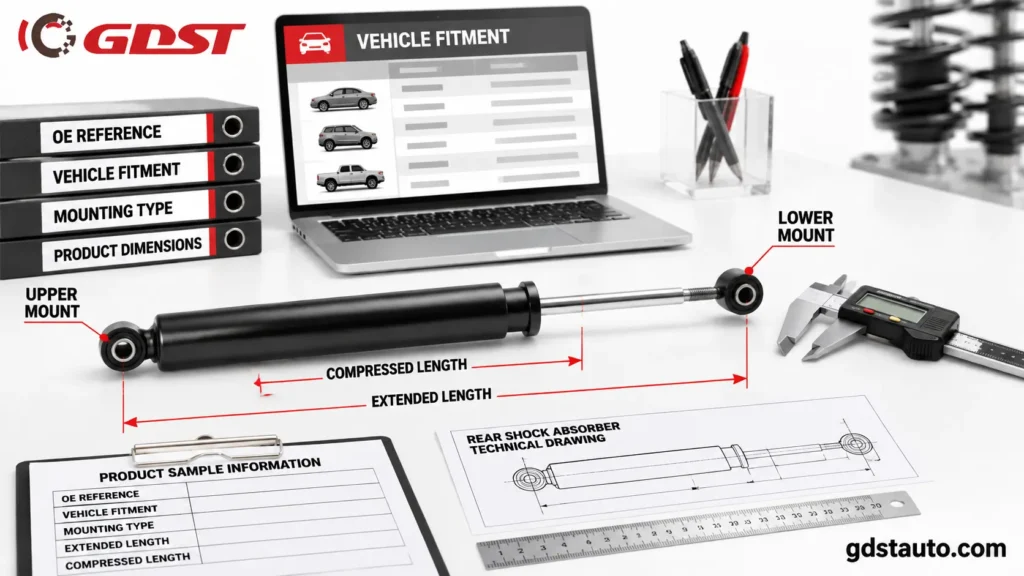
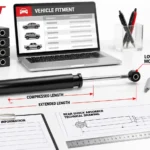
Rear shock absorbers may also differ in mounting design, extended length, compressed length, piston rod dimensions and damping characteristics.
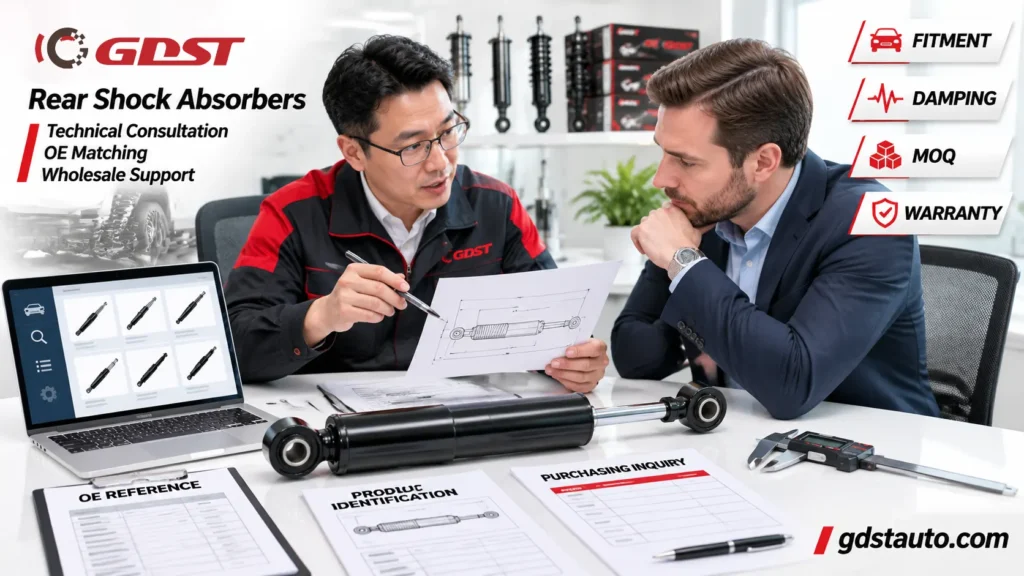
GDST supports product matching through OE reference numbers, vehicle information, technical drawings and existing product samples.
Information Required for Product Matching
| Required Information | Purpose |
| Vehicle Make | Identifies the vehicle manufacturer |
| Vehicle Model | Confirms the vehicle platform |
| Model Year | Distinguishes different production generations |
| Engine / Trim | Helps identify suspension variations |
| Drivetrain | Confirms relevant vehicle configuration |
| OE Part Number | Provides an original equipment reference |
| Product Sample | Supports physical and dimensional verification |
| Technical Drawing | Helps confirm mounting and dimensional requirements |
Important Dimensions for Rear Shock Absorber Fitment
- Extended Length: The specified distance between mounting references when the shock absorber is fully extended.
- Compressed Length: The specified distance between mounting references when the shock absorber is fully compressed.
- Stroke Length: The difference between the extended and compressed lengths.
- Piston Rod Diameter: The diameter of the piston rod.
- Mounting Configuration: The upper and lower connection designs.
- Damping Characteristics: The specified compression and rebound force requirements.
For lifted trucks and modified suspension systems, standard replacement shock absorber dimensions may not be suitable.
In these cases, available suspension travel, extended length, compressed length and mounting geometry must be checked before selecting a replacement.
Providing complete vehicle and product information helps GDST review compatibility and reduce incorrect part selection during wholesale purchasing.
Heavy-Duty, Adjustable and Air-Assisted Rear Shock Absorber Requirements
Some aftermarket buyers require more specialized rear shock absorber configurations for particular vehicle applications.
These requirements should be evaluated separately from conventional replacement shock absorbers because they involve different product structures and operating characteristics.
Heavy-Duty Rear Shock Absorbers
Heavy-duty rear shocks are intended for applications requiring damping performance and durability appropriate to more demanding operating conditions.
Product evaluation may involve shock absorber dimensions, damping force, piston rod specifications, mounting strength, working temperature and suspension travel.
A heavy-duty shock absorber does not independently increase the vehicle’s rated payload capacity. The vehicle’s load rating is determined by its complete suspension and structural design.
Adjustable Rear Shock Absorbers
Adjustable rear shock absorbers allow specific damping or suspension parameters to be changed according to their design.
Depending on the product, adjustment may involve rebound damping, compression damping or other engineered settings.
Buyers should identify the exact adjustment function required rather than assuming every adjustable shock absorber supports both compression and rebound adjustment.
Air-Adjustable Rear Shocks
Air-adjustable rear shocks incorporate an air-assisted structure that can allow pressure adjustment for specific vehicle applications.
They are different from conventional nitrogen gas-charged shock absorbers and should not be confused with complete air suspension systems.
For inquiries involving truck rear air shocks, adjustable rear shock absorbers or specialized heavy-duty configurations, GDST can evaluate the requirements based on the vehicle application, OE reference, product sample and technical drawing before confirming availability.
Rear Shock Absorber Manufacturing and Quality Control at GDST
Manufacturing consistency is important for aftermarket shock absorbers because variations in component dimensions, oil volume, valve assembly and sealing quality can affect damping performance.
GDST’s published shock absorber manufacturing process covers material preparation, component processing, assembly, gas charging, functional testing, surface treatment and final inspection.
Raw Material and Component Inspection
Incoming materials and key components are inspected according to applicable specifications before entering production.
Material composition and component dimensions are important factors in maintaining manufacturing consistency.
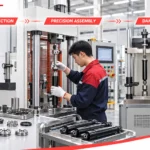
Precision Assembly and Oil Filling
Piston rods, valve assemblies, oil seals and related components are assembled according to product specifications.
Controlled oil filling helps maintain the required internal working conditions and damping characteristics.
Gas Charging and Functional Testing
For applicable gas-charged shock absorbers, nitrogen charging is performed according to the product design.
Functional testing evaluates damping response and operating characteristics against specified requirements.
Damping Force Testing
GDST’s published quality-control information identifies comprehensive shock absorber performance testing, including compression and rebound force evaluation.
The three rear shock absorber technical records provided for this product page demonstrate documented force specifications under stated test conditions.
Dimensional and Durability Inspection
Additional quality-control procedures described in GDST’s manufacturing information include:
- Precision dimensional measurement.
- Material composition analysis.
- Tensile strength testing.
- Fatigue and durability testing.
- Compression and rebound testing.
- High- and low-temperature evaluation.
- Salt spray and corrosion resistance testing.
- Final product inspection.
These processes help evaluate component consistency, damping performance and manufacturing quality across the shock absorber product range.
Applicable test records and inspection documentation can be discussed according to the specific model and customer requirements.
OEM Replacement, Private Label and Wholesale Rear Shock Absorber Supply
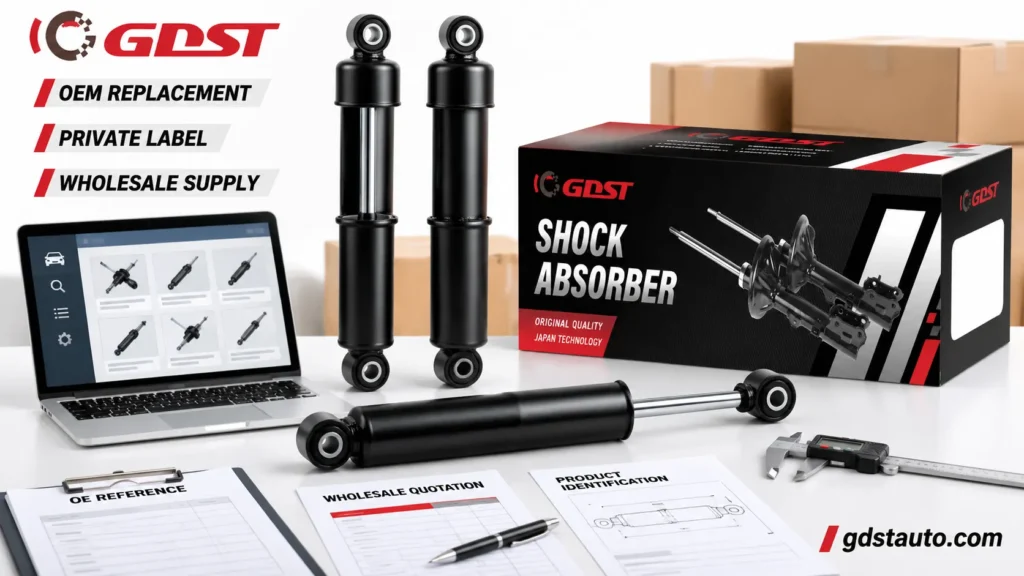
GDST supports automotive aftermarket distributors, importers, wholesalers and automotive brands seeking rear shock absorber sourcing and OEM cooperation.
Our existing shock absorber product range includes more than 2,000 model references across different vehicle applications. This figure represents the overall shock absorber range rather than rear shock absorbers alone.
OE Replacement Supply
For customers sourcing replacement rear shock absorbers, GDST can review OE numbers, vehicle information and technical specifications to identify corresponding aftermarket products.
Customized Product Branding
Depending on product feasibility and order requirements, customization services can include:
- Customer logo printing on the shock absorber cylinder.
- OE number and product identification marking.
- Customized product colors.
- Private-label product packaging.
- Customized color boxes.
- Shipping marks and master carton design.
Wholesale Order Support
GDST’s currently published shock absorber supply terms include:
| Item | Current Standard Information |
| Product Range | 2,000+ shock absorber model references |
| Minimum Order Quantity | 50 pcs per model |
| Typical Lead Time | Approximately 50 days after order confirmation |
| Warranty | 1 year / 30,000 km, subject to applicable terms |
| Sample Support | Available subject to product and quotation arrangements |
| Packaging | Standard and customized private-label options |
The above commercial terms are based on GDST’s published shock absorber product information. Final MOQ, production schedule, sample arrangements and warranty conditions should be confirmed for the specific part number and order.
Information Required for a Wholesale Quotation
To help GDST prepare an accurate quotation, buyers should provide:
- Required rear shock absorber part numbers or OE references.
- Vehicle make, model and production year.
- Estimated quantity per model.
- Required product specifications.
- Branding and packaging requirements.
- Destination market and shipping requirements.
Frequently Asked Questions About Automotive Rear Shock Absorbers
What is the function of a rear shock absorber?
A rear shock absorber controls suspension spring movement during compression and rebound, helping reduce excessive bouncing and maintain tire contact with the road.
Are rear shock absorbers different from front shock absorbers?
Yes. Front and rear shock absorbers may have different mounting structures, dimensions and damping specifications. They should only be interchanged when specifically designed for the same application.
What is the difference between twin-tube and mono-tube rear shock absorbers?
Twin-tube shocks use an inner working cylinder and an outer reserve tube, while mono-tube shocks use a single pressure cylinder with a working piston and floating piston arrangement.
What is the difference between hydraulic and gas-charged rear shocks?
Both use hydraulic oil to generate damping force. Gas-charged designs also incorporate pressurized gas to help reduce oil aeration under suitable operating conditions.
Are adjustable rear shock absorbers suitable for every vehicle?
No. Adjustable shock absorbers must match the vehicle’s suspension design and mounting requirements. The available adjustment functions also depend on the specific product.
Are heavy-duty rear shocks the same as air-adjustable rear shocks?
No. Heavy-duty describes an intended application and performance requirement, while air-adjustable describes a specific air-assisted adjustment function.
How do I find the correct rear shock absorber for my vehicle?
Provide the vehicle make, model, year, OE reference number and installation position. Product samples or technical drawings can also help verify dimensions and compatibility.
Can GDST supply rear shock absorbers with customized branding?
Yes. GDST supports private-label cooperation, including customized logos, product colors, packaging and shipping marks, subject to product feasibility and order requirements.
What is the MOQ for GDST rear shock absorbers?
GDST’s published standard shock absorber MOQ is 50 pieces per model. Final requirements should be confirmed for the selected product.
What warranty does GDST offer for shock absorbers?
GDST’s published shock absorber warranty is 1 year / 30,000 km, subject to the applicable warranty terms and product conditions.
Related Products
Explore more suspension and steering parts from GDST.
Quality Assurance
Every product undergoes rigorous testing and inspection to ensure reliability and performance
Material Inspection
Premium steel from certified suppliers with full traceability
Performance Testing
Fatigue, torque, and stress testing per OE standards
Dimensional Control
Tolerance control for precise OE fitment
Final Inspection
100% inspection before shipment