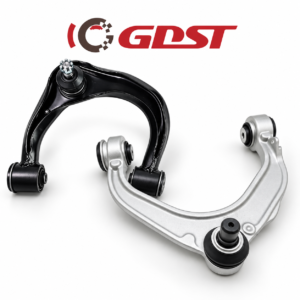
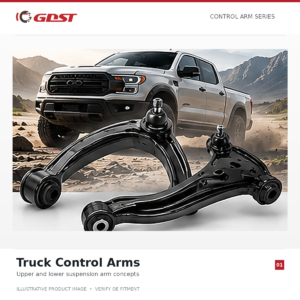
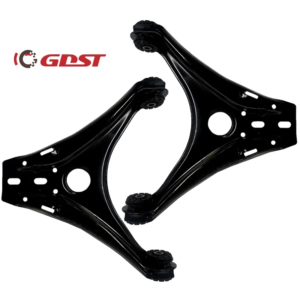
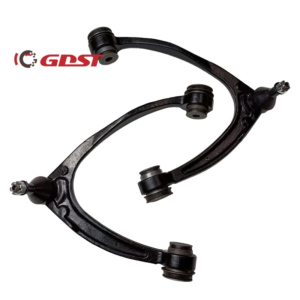
Aftermarket Control Arms Manufacturer for Upper & Lower Applications

Aftermarket Control Arms Manufacturer for Upper & Lower Applications
MOQ
50PCS
Price
$10-$30
Warranty
1 Year From Receipt of Goods
Delivery Time
45-55 Days
Customization
  • Customized Logo
  • Customized Packaging
  • ODM/Sample Development

ISO9001 Certified

Fast Delivery

OEM/ODM

Looking for a reliable aftermarket control arm supplier for your automotive parts business? Wuhu GDST Auto Parts Co.,Ltd supplies aftermarket upper and lower control arms for distributors, wholesalers, importers, and private-label automotive parts brands.

Our published product range includes stamped steel control arms, forged aluminum control arms, and complete control arm assemblies for selected vehicle applications. Product availability, materials, joint configurations, and package contents depend on the specific part number.

Whether you are expanding an existing suspension parts catalog or sourcing control arms for a new aftermarket program, our team can help review your requirements, confirm product specifications, and discuss a suitable sourcing solution.

  • 3,000+ control arm models listed in our published product range
  • Upper and lower control arm options
  • OEM/ODM and private-label support
  • MOQ from 50 pieces per model
  • Typical lead time of 45 days, subject to order confirmation
  • One-year warranty under the applicable warranty terms

Send us your OE numbers, vehicle details, reference photographs, or technical drawings to start a product inquiry.

Car Brand

Models

OEM NO.

NISSAN

SUNNY

54501-AX600

NISSAN

(D22)1997/01-

54525-2S686

MITSUBISHI

L00 GLS

18986/10-1996/10

MB527161

MB527162

MITSUBISHI

PRONTON EXORA PREVE

PW827041

MAZDA

M6 STRAIGHT ARM

GJ22-34-350A

TOYOTA

HIACE

48067-29075

TOYOTA

AVANZA(F602_F601)

48068-BZ010

SUZUKI

VITARA

45200-84000

SUZUK

SUPER CARRY BUS(ED)

45200-77500

Download GDST Control Arm Catalogue 2026

Aftermarket Upper and Lower Control Arms for Different Applications

Control arms are structural components within many vehicle suspension systems. Depending on the suspension architecture, they connect the chassis or subframe to the wheel carrier or steering knuckle through specified mounting points, ball joints, and bushings.

Their geometry and mounting interfaces influence how the wheel moves relative to the vehicle body. Research on double-wishbone and MacPherson strut suspension systems demonstrates that suspension kinematics depend on the mechanism’s geometry and the relationship between steering input and wheel movement. [1]

For aftermarket buyers, selecting a control arm requires more than matching a general product description. Installation position, vehicle application, mounting geometry, joint configuration, and the required assembly components must all be considered.

GDST’s published control arm catalog covers selected Japanese, Korean, American, European, and German vehicle applications. Exact availability and fitment should be confirmed against the relevant part number and vehicle specifications.

Aftermarket Upper Control Arms: Fitment and Product Configuration

Aftermarket upper control arms are designed for the upper mounting position of the specified suspension system. Their geometry, mounting interfaces, and ball joint configuration must correspond to the intended vehicle application.

Research into suspension kinematics shows why changes to suspension geometry must be evaluated within the relevant suspension design rather than treated as a universal adjustment. [1]

For distributors and wholesalers, key selection considerations include:

  • Vehicle make, model, and production year
  • Front or rear installation position, where applicable
  • Left-hand or right-hand configuration, if the application requires a specific side
  • Ball joint design and mounting interface
  • Bushing configuration and mounting dimensions
  • OE number or verified reference part number

Upper control arms are also available in performance-oriented aftermarket segments for certain lifted or modified vehicles. However, a standard OE-style replacement control arm should not automatically be assumed suitable for a lifted suspension.

Changing suspension height can alter the operating geometry of the suspension system. For a lifted or modified vehicle, compatibility should be reviewed against the specific vehicle configuration, lift height, suspension design, joint articulation requirements, and relevant manufacturer application information.

If your target application uses a leveling kit, suspension lift, or other chassis modifications, please provide the modification details so that the required product application can be reviewed.

Aftermarket Lower Control Arms: Replacement Parts and Complete Assemblies

Aftermarket lower control arms are used to replace components that are worn, damaged, or otherwise require replacement, provided the selected part matches the original application.

For aftermarket sourcing programs, the correct lower control arm must match the required mounting points, suspension geometry, and ball joint and bushing configuration.

Depending on the specific model, GDST may supply control arm assemblies with the corresponding ball joints and bushings. Included components must be confirmed for each part number before an order is placed.

For lower control arm sourcing, we recommend confirming:

  • OE number or reference part number
  • Vehicle make, model, year, and relevant drive configuration
  • Exact mounting position and side
  • Whether the order requires a bare control arm or a complete assembly
  • Required material and surface finish
  • Packaging and labeling requirements
  • Any special application or installation requirements

Upper vs. Lower Control Arms: How to Select the Right Product

Upper and lower control arms are not interchangeable simply because they belong to the same suspension system. Their geometry, mounting positions, and joint interfaces may differ substantially.

Selection factor

Upper control arm

Lower control arm

Installation position

Upper mounting position of the specified suspension design

Lower mounting position of the specified suspension design

Main selection requirement

Correct geometry, mounting interfaces, and joint configuration

Correct mounting dimensions, geometry, and joint configuration

Typical sourcing concerns

Ball joint design, bushing layout, and application-specific geometry

Assembly configuration, mounting interfaces, bushings, and ball joints

Fitment reference

OE number, vehicle details, and verified application

OE number, vehicle details, and verified application

Lifted or modified vehicles

Confirm application-specific geometry and compatibility

Confirm compatibility with the complete suspension configuration

Assembly options

Confirm whether ball joints and bushings are included

Confirm whether ball joints and bushings are included

The exact design and components depend on the vehicle application. Always confirm the required part number and specifications before ordering.

Aftermarket Control Arm Designs and Assembly Options

GDST’s published range includes different control arm designs intended for varying aftermarket requirements. Construction and available configurations should be verified against the specific product model.

Stamped Steel Control Arms

Stamped steel control arms are used in suitable suspension applications where the design and manufacturing process meet the required structural and dimensional specifications.

Research into lower control arm topology optimization has examined how structural requirements, load cases, stiffness, and manufacturing constraints can be considered together when developing a component intended for metal forming. [2]

This research supports the importance of evaluating both structural performance and manufacturability. It does not establish that every stamped steel control arm has the same strength or durability.

Forged Aluminum Control Arms

Forged aluminum control arms are available for selected applications where the specified design uses this construction.

The engineering advantages of a material depend on the component’s geometry, loading conditions, manufacturing process, and structural design. A published study of aluminum control arm optimization demonstrated that a particular optimized design could achieve substantial mass reduction while improving selected structural performance measures relative to its comparison design. [3]

These results are specific to that study. They should not be interpreted as a universal percentage advantage for all aluminum control arms or as measured performance data for GDST products.

Complete Control Arm Assemblies

Complete assemblies may include the control arm, ball joint, and bushings, depending on the part number.

This configuration can simplify downstream sourcing for distributors that prefer to purchase a more complete replacement component. Before ordering, confirm the included parts, installation hardware, and packaging contents.

Application-Specific Configurations

Material, joint design, bushing configuration, adjustability, surface treatment, and included hardware may vary by model.

If your business requires a particular configuration, please share the OE number, reference sample, technical drawing, or detailed product requirements for review.

Control Arm Specifications and Fitment Information

Accurate specifications are essential for aftermarket control arm sourcing. Structural optimization research shows that control arm performance depends on interacting design variables, including geometry, material properties, loading conditions, and the characteristics of connected components. [2][3]

For this reason, GDST recommends confirming the following information for each target part number.

Specification

Information to confirm

Product type

Upper control arm or lower control arm

Installation position

Front or rear, where applicable

Vehicle application

Make, model, year, and relevant engine or trim details

Reference number

OE number, aftermarket part number, or customer SKU

Side

Left, right, or pair, according to the application

Construction material

Stamped steel, forged aluminum, or the specified design

Ball joint

Included or excluded; joint type and mounting interface

Bushings

Included or excluded; configuration and material specification

Adjustability

Fixed or adjustable, if offered for the application

Surface treatment

Coating or corrosion-protection specification

Package contents

Individual arm, pair, or complete assembly

Technical documentation

Applicable drawings, inspection records, and agreed specifications

Not every configuration is available for every vehicle. Final specifications should be confirmed against the corresponding product documentation rather than inferred from the general product category.

Model-Specific Dimensional Inspection and Outgoing Quality Checks

GDST’s supplied outgoing inspection records for selected control arm models document checks covering several product and shipment requirements.

The inspection scope varies by part number and includes examples such as:

Inspection category

Examples recorded in the supplied reports

Purpose

Visual condition

Cleanliness and checks for impact marks, rust, or other visible defects

Identify visible product defects before release

Dust boot assembly

Correct installation and absence of visible damage

Verify the recorded assembly condition

Surface treatment

Specified black electrophoretic coating

Check the specified surface finish

Thread and taper features

Ball joint thread dimensions and taper-related checks

Verify relevant connection features

Bushing dimensions

Inner and outer diameters, as specified for the model

Check bushing dimensions against the applicable requirements

Mounting geometry

Bushing center distance, hole dimensions, and other model-specific dimensions

Verify selected mounting dimensions

Overall dimensions

Height and overall length, where specified

Check dimensional requirements

Torque

A specified torque range on applicable models

Check the recorded torque requirement

Packaging

Marking, labels, shipping marks, carton or pallet requirements, as applicable

Check agreed packaging and shipment identification

These examples are drawn from selected outgoing inspection records. They do not mean every model is subject to every listed check or that every report contains the same level of numerical detail.

Measurement Methods and Product-Specific Acceptance Criteria

The supplied reports identify inspection methods including visual inspection, calipers or dial calipers, height gauges, taper gauges, thread gauges, and torque gauges, depending on the inspection item.

Each model should be evaluated against its applicable drawing, technical requirements, and acceptance criteria. Where a measurement tolerance is specified, the recorded value must be assessed against that tolerance. Where a tolerance or inspection criterion is not stated, it should be confirmed before the result is used as formal evidence of compliance.

The reports supplied for review record that the respective inspected batches met their stated requirements and were approved for release. For customer-facing documentation, the relevant report should include complete and appropriate batch identification, inspection dates, and required authorization.

Ball Joint and Connection Features

Ball joint thread dimensions, taper-related features, and connection geometry are among the checks recorded for selected models.

Research into ball joint manufacturing has examined how caulking process parameters affect pull-out strength and structural response, supporting the importance of evaluating joint retention under defined requirements. [5]

However, checking a thread size or taper dimension is not the same as performing a ball joint pull-out test. Any claim about pull-out strength must be supported by the applicable test procedure and actual product-specific results.

Material Specifications and Traceability

Material selection should be confirmed against the specification applicable to the intended product. The material grade and mechanical properties of a particular steel batch should not be assumed to apply to every control arm model.

A material certificate can provide information about a specified supply batch, such as material designation, dimensions, mechanical test results, and the relevant supply condition.

For projects requiring material documentation or traceability, please discuss the required material specification and the availability of the applicable certificate with our team before placing an order.

Where material certificates are provided, the document should correspond to the relevant material batch and, where traceability is required, be linked to the applicable production records.

Quality Control for Aftermarket Control Arms

Consistent quality is important for automotive parts distributors and brands because product fitment, assembly quality, and material consistency affect downstream installation and customer satisfaction.

Research into lower control arm fatigue life has shown that predicted durability can be sensitive to material properties, geometric variables, and uncertainty in model inputs. [4] This supports the importance of evaluating fatigue behavior under defined loading conditions rather than inferring durability from appearance or material designation alone.

GDST’s supplied outgoing inspection records demonstrate selected model-specific checks for dimensional features, joint-related details, surface finish, and packaging. Other validation requirements should be confirmed against the actual product specification and available test documentation.

Fatigue and Structural Evaluation

Fatigue testing and structural analysis can help evaluate suspension components under defined loading conditions. However, fatigue-life prediction is not the same as a completed physical durability test, and neither alone establishes an exact real-world service life under every driving condition.

Where fatigue testing or structural analysis is required, the product specification, loading conditions, test method, acceptance criteria, and actual results should be reviewed together.

Bushing Properties and Suspension Performance

Bushings contribute to suspension compliance and influence the way loads and movement are transmitted through the suspension system.

Research on suspension bushing stiffness has demonstrated that bushing properties can affect handling stability and ride comfort, with the results depending on the suspension configuration and selected stiffness parameters. [6]

Other research has shown that rubber bushing dynamic stiffness depends on factors such as loading frequency and amplitude, which are relevant to vibration and noise modeling. [7]

These findings do not mean that every aftermarket bushing improves handling, comfort, or NVH. The outcome depends on the component design and vehicle application.

Corrosion Testing and Surface Protection

Corrosion testing can help evaluate the performance of specified surface treatments under controlled laboratory conditions.

However, research comparing accelerated coating tests with field exposure has found that some laboratory results correlate poorly with particular measures of outdoor corrosion performance. [8]

A salt spray test duration should therefore not automatically be converted into a claimed number of years of real-world service life. Test results should be interpreted according to the applicable test method, coating system, acceptance criteria, and supporting evidence.

Quality Management and Documentation

GDST lists IATF 16949 and ISO 9001 among its quality management certifications. Buyers can request the current applicable certificates and discuss the product-specific documentation required for their sourcing program.

Depending on the model and agreed quality requirements, relevant documentation may include drawings, outgoing inspection records, material information, and applicable test reports.

The availability of each document and the tests actually performed should be confirmed before being specified in an order.

OEM, ODM, and Private-Label Control Arm Programs

For distributors, importers, and automotive parts brands, private-label sourcing can help expand product coverage while maintaining a consistent brand identity.

GDST offers customization support for suitable control arm applications. Available requirements can be discussed in the following areas:

  • Product identification: OE number, customer part number, or approved product marking.
  • Branding: Custom logo or label, subject to the agreed marking method.
  • Packaging: Customized packaging according to approved artwork and applicable order requirements.
  • New product development: Review of reference samples, drawings, or technical specifications.
  • Product range expansion: Evaluation of additional part numbers for your aftermarket catalog.

To start a private-label project, please provide your product list, target vehicle applications, expected quantities, branding requirements, and packaging preferences.

Customization feasibility, MOQ, tooling, artwork approval, and lead time will be confirmed for the specific project.

Why Source Aftermarket Control Arms from GDST?

GDST focuses on automotive suspension, steering, braking, and related aftermarket parts, providing a broader sourcing scope for businesses managing multiple product categories.

For control arm buyers, the key considerations when working with GDST include:

  • Broad model coverage: A published catalog of more than 3,000 control arm models.
  • Application-focused sourcing: Product matching based on OE numbers and vehicle details.
  • Multiple product configurations: Upper and lower control arms, selected material designs, and complete assemblies.
  • Model-specific inspection records: Selected outgoing inspection records document dimensional, connection-related, surface-finish, and packaging checks.
  • Private-label support: Custom product identification and packaging options, subject to model and order requirements.
  • Quality management: Published IATF 16949 and ISO 9001 certification information.
  • Commercial coordination: MOQ, production schedule, packaging, and shipping requirements reviewed before order confirmation.

Our objective is to help automotive parts businesses establish a practical sourcing program based on their target applications, required specifications, and purchasing plans.

Control Arm Sourcing and Ordering Information

The following commercial information is based on GDST’s currently published control arm page. Please reconfirm the applicable terms when requesting a quotation.

Item

Published information

Order consideration

Product range

3,000+ listed control arm models

Confirm availability by part number

Minimum order quantity

50 pieces per model

Confirm whether special configurations require a different MOQ

Typical lead time

45 days

Final timing depends on the confirmed order and production schedule

Warranty

1 year

Confirm warranty terms and the applicable starting point

Quality certifications

IATF 16949 and ISO 9001

Confirm current certificate validity and scope

Inspection documentation

Available records depend on the model and order requirements

Confirm which inspection records and supporting documents can be provided

Private label

Available for suitable projects

Confirm logo, labeling, packaging, and order requirements

To obtain an accurate quotation, send your target part numbers, quantities, packaging requirements, and delivery destination.

Frequently Asked Questions About Aftermarket Control Arms

1. Does GDST supply both aftermarket upper and lower control arms?

Yes. GDST’s published control arm range includes upper and lower control arms. Availability and exact configuration must be confirmed for each application.

2. How can I confirm whether a control arm fits my target vehicle?

Provide the OE number or aftermarket part number, vehicle make, model, production year, and relevant configuration details. A reference photograph or technical drawing can also help when the part number is unavailable.

3. Are ball joints and bushings included with the control arm?

It depends on the specific part number. Some products are offered as complete assemblies, while other configurations may differ. Confirm the package contents before ordering.

4. What materials are available for aftermarket control arms?

GDST’s published range includes stamped steel and forged aluminum control arm designs. The material and construction available depend on the target application and should be confirmed against the relevant product specifications.

5. Can standard aftermarket control arms be used on lifted trucks?

Not automatically. Lifted or modified vehicles may require application-specific geometry and joint configurations. Provide the lift height, suspension details, and vehicle information so compatibility can be reviewed.

6. What quality checks are recorded for GDST control arms?

The supplied outgoing inspection records for selected models document checks including visual condition, dust boot assembly, specified surface finish, connection features, dimensions, torque where applicable, and packaging. The exact inspection scope varies by part number.

7. Can GDST provide dimensional inspection reports?

Inspection records are available for selected models in the supplied documentation. Please identify the required part numbers and inspection items so that the applicable records and any additional documentation requirements can be confirmed.

8. Can GDST provide material certificates?

For projects requiring material documentation, please discuss the applicable material specification and the availability of the relevant batch certificate with our team. Any certificate used for verification should correspond to the material supplied for the applicable order.

9. What is the minimum order quantity?

GDST currently lists an MOQ of 50 pieces per model. Special configurations or development projects may require separate confirmation.

10. What is the typical production lead time?

The current published lead time is 45 days. The confirmed schedule may vary with the order quantity, model availability, packaging requirements, and production plan.

11. Does GDST support OEM, ODM, and private-label orders?

Yes. GDST offers customization support for suitable applications, including product identification and packaging. Project feasibility, artwork, MOQ, and any tooling requirements must be confirmed.

12. What warranty is available for aftermarket control arms?

GDST’s current product page lists a one-year warranty. The applicable terms, starting point, and after-sales procedure should be confirmed in the quotation or order documentation.

Request an Aftermarket Control Arm Catalog or Quote

Looking to expand your aftermarket control arm range or develop a private-label suspension parts program?

Send GDST your OE numbers, target vehicle applications, estimated quantities, and any technical or packaging requirements. Our team can review your requirements and help identify the next steps for product matching and quotation.

To help us respond efficiently, please include your target market, product type, part numbers, and estimated purchasing quantity.

Technical References

The following academic publications support the engineering principles discussed on this page. They provide technical context and are not independent test evidence for GDST products.

[1] A Comprehensive Kinematic Analysis of the Double Wishbone and MacPherson Strut Suspension Systems. Reddy, K. V., et al. (2016). Mechanism and Machine Theory.

Read the paper

Supports the discussion of suspension kinematics and the importance of evaluating control arm geometry within the relevant suspension design.

[2] Topology Optimization and Performance Calculation for Control Arms of a Suspension. Tang, L., et al. (2014). Advances in Mechanical Engineering.

Read the paper

Examines control arm structural optimization, including loading conditions, ball joints, bushings, and structural performance.

[3] Structural Optimization Concept for the Design of an Aluminium Control Arm. Lee, D.-C., & Lee, J.-I. (2003). Proceedings of the Institution of Mechanical Engineers, Part D: Journal of Automobile Engineering.

Read the paper

Provides a research example of structural optimization for an aluminum control arm and illustrates why material comparisons must be based on specific designs and loading conditions.

[4] Fatigue Life Uncertainty Quantification of Front Suspension Lower Control Arm Design. Abebe, M., & Koo, B. (2023). Vehicles, 5(3), 859–875.

Read the paper

Examines the effects of material and geometric uncertainty on predicted lower control arm fatigue life.

[5] Process Design of a Ball Joint, Considering Caulking and Pull-Out Strength. Sin, B.-S., & Lee, K.-H. (2014). The Scientific World Journal, 2014, Article 971679.

Read the paper

Investigates ball joint manufacturing parameters and their influence on pull-out strength and structural response.

[6] Relevance Analysis of the Bushing Stiffness of Rear Multi-Link Suspension to Handling Stability and Ride Comfort of Vehicle and Optimization Research to Improve Both Performances. Gao, J., & Qi, X. (2024). Proceedings of the Institution of Mechanical Engineers, Part D: Journal of Automobile Engineering.

Read the paper

Studies how suspension bushing stiffness affects handling stability and ride comfort in a specific multi-link suspension model.

[7] Parameter Identification and NVH Characteristic Analysis of Automotive Suspension Rubber Bushing. Chen, H., Lu, C., & Liu, Z. (2025). Proceedings of the Institution of Mechanical Engineers, Part D: Journal of Automobile Engineering.

Read the paper

Examines the frequency- and amplitude-dependent dynamic stiffness of suspension rubber bushings and its relevance to vehicle vibration and noise modeling.

[8] Correlations Between Standard Accelerated Tests for Protective Organic Coatings and Field Performance. Knudsen, O. Ø., Skilbred, A. W. B., Løken, A., Daneshian, B., & Höche, D. (2022). Materials Today Communications, 31, 103729.

Read the paper

Compares accelerated laboratory corrosion tests with field exposure and discusses the limitations of using laboratory results to predict outdoor coating performance.

Quality Assurance

Every product undergoes rigorous testing and inspection to ensure reliability and performance

Material Inspection

Premium steel from certified suppliers with full traceability

Performance Testing

Fatigue, torque, and stress testing per OE standards

Dimensional Control

Tolerance control for precise OE fitment

Final Inspection

100% inspection before shipment