
Adjustable Shock Absorbers for Automotive Suspension
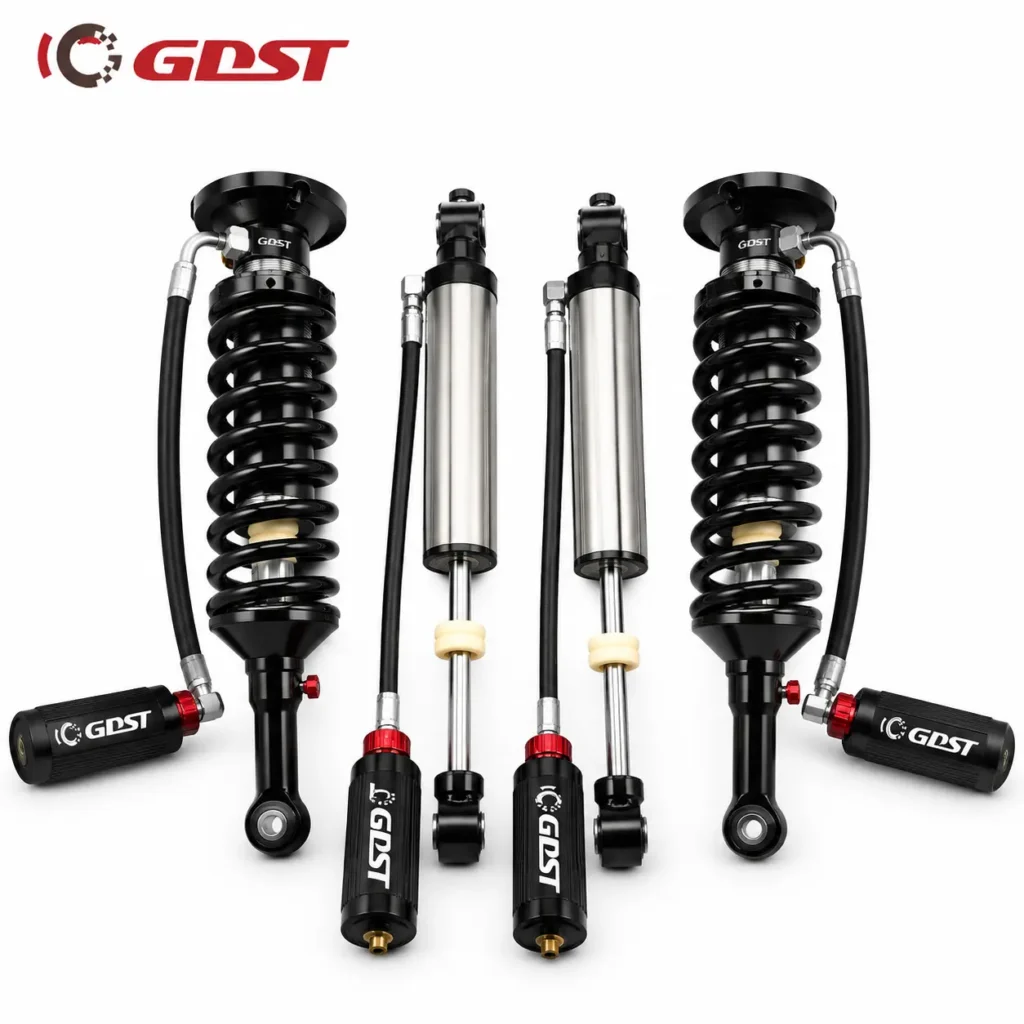
- MOQ
- 1set/model
- Price
- $300-$800
- Warranty
- 1 Year From Receipt of Goods
- Delivery Time
- 45-55 Days
- Customization
-
- Customized Logo
- Customized Packaging
- ODM/Sample Development
ISO9001 Certified
Fast Delivery
OEM/ODM
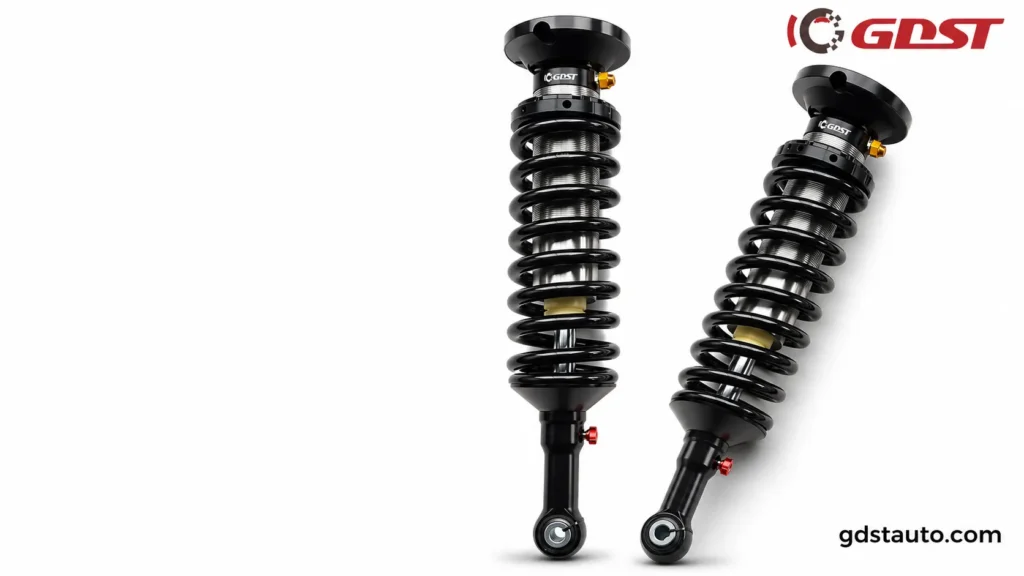
Wuhu GDST Auto Parts Co.,Ltd develops, manufactures, and supplies automotive shock absorbers for passenger cars, SUVs, pickups, and other vehicle applications. We support international distributors, wholesalers, and aftermarket brands with product sourcing, OE reference matching, and private-label cooperation.
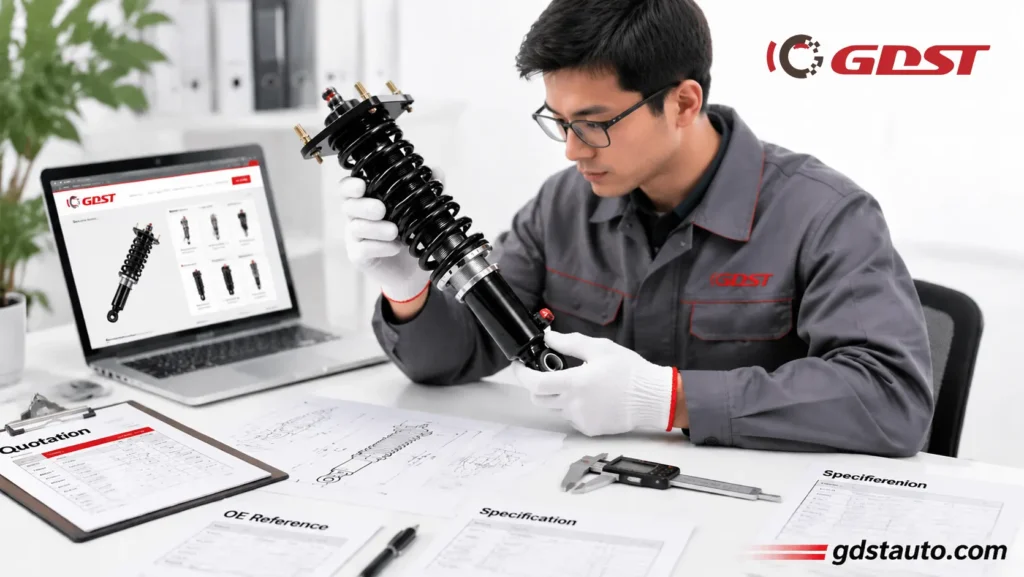
For adjustable shock absorber projects, our team can evaluate your OE references, technical drawings, product samples, and performance requirements to confirm product availability and development feasibility.
Key Advantages
- 2,000+ models across our existing shock absorber range
- Automotive shock absorber manufacturing and supply capabilities
- OE reference and vehicle application matching
- OEM branding and customized packaging
- Product performance and durability testing
- B2B sourcing support for international automotive parts buyers
| CAR MODEL | POSITION | YEAR | SUSPENSION TYPE | TUBE DIAMETER/ ROD DIAMETER(mm) | RAISE IN SIZE |
| HILUX
2WD |
FRONT | 2005+ | COIL SPRING | 67/22 | 0-2INCHES |
| REAR | LEAF | 67/22 | |||
| LAND CRUISER 60 | FRONT | 1986+ | LEAF | 67/22 | 0-2INCHES |
| REAR | LEAF | 67/22 | |||
| Lexus LX570 | FRONT | 2007+ | COIL SPRING | 67/22 | 0-2INCHES |
| REAR | COIL SPRING | 67/22 | |||
| VITARA | FRONT | 1988+ | COIL SPRING | 57/22 | 0-2INCHES |
| REAR | COIL SPRING | 57/22 | |||
| BT50 J97M | FRONT | 2006 to 2011 | TORSION BAR | 67/22 | 0-2INCHES |
| REAR | LEAF | 67/22 | |||
| MU-X | FRONT | 2013-07/2021 08/2021+ | COIL SPRING | 67/22 | 0-2INCHES |
| REAR | COIL SPRING | 67/22 |
Download GDST Shock Absorbers Catalog
What Are Adjustable Shock Absorbers?
Adjustable shock absorbers are automotive suspension dampers designed to allow specific suspension characteristics to be modified within a defined operating range.
Most automotive adjustable shock absorbers focus on damping adjustment, allowing users to change compression damping, rebound damping, or both according to driving conditions and suspension requirements.
Other related suspension products provide ride-height adjustment, additional load support, or electronic damping control. These functions involve different mechanisms and should not be confused with adjustable damping.
Compared with conventional fixed-damping shock absorbers, adjustable designs offer greater flexibility in suspension tuning. They are commonly considered for performance vehicles, off-road applications, and vehicles with specialized suspension requirements.
The available adjustment functions, range, and operating characteristics depend on the actual product design.
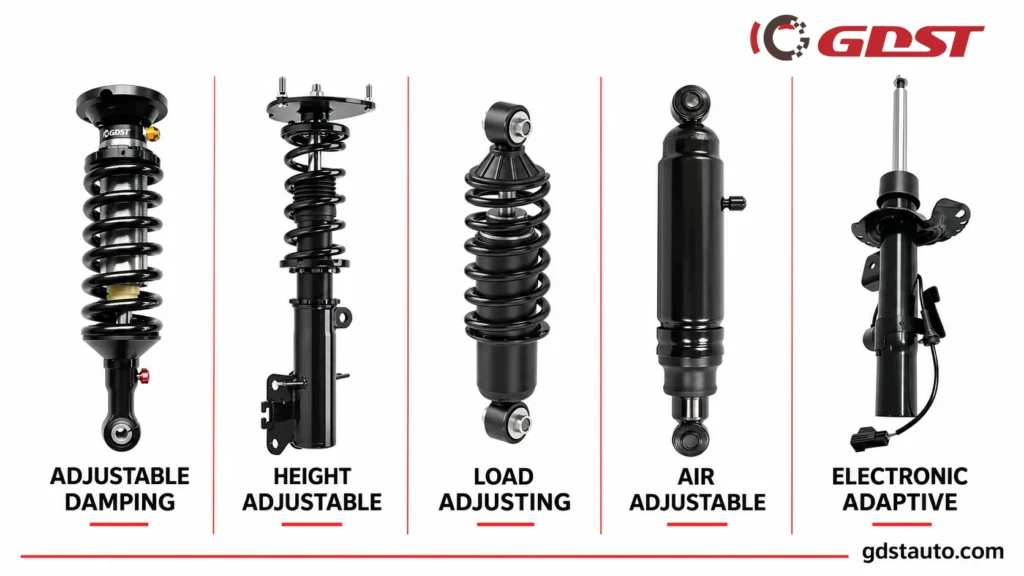
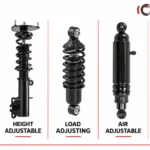
Types of Adjustable Shock Absorbers
Different adjustable shock absorbers are designed for specific suspension requirements. Understanding their functions helps buyers identify suitable products for their markets.
Adjustable Damping Shock Absorbers
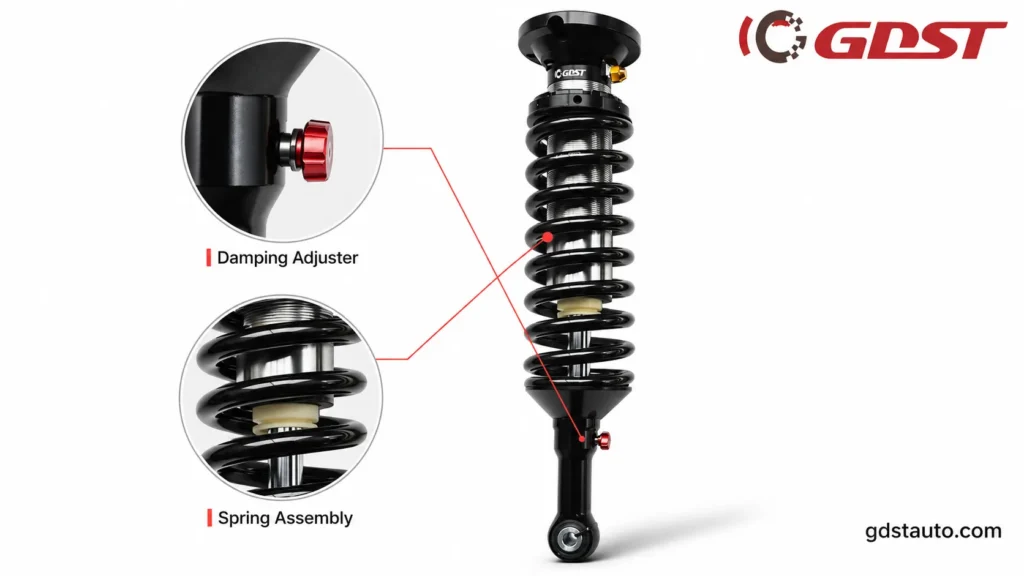
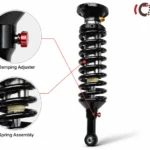
These shock absorbers allow users to modify damping force through an adjustment knob, valve, or other mechanism. Depending on the design, adjustment may control compression, rebound, or both.
They are commonly used in performance vehicles and off-road suspension systems where different damping settings may be required for changing road or driving conditions.
Height-Adjustable Coilover Shock Absorbers
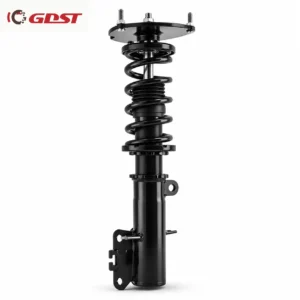
Coilover systems combine a shock absorber and coil spring into an integrated assembly. Depending on the design, threaded bodies or adjustable spring seats allow changes to suspension height.
Some full-length adjustable designs allow ride height to be changed independently of spring preload. Other designs primarily use spring-seat positioning to adjust the suspension setup.
A height-adjustable coilover does not necessarily provide adjustable compression or rebound damping.
Load-Adjusting Shock Absorbers
Load-adjusting shock absorbers are designed to provide additional suspension support and help reduce vehicle sag when carrying varying loads.
Some designs use auxiliary coil springs around the shock absorber, making them suitable for pickups, light trucks, and vehicles frequently used for towing or carrying cargo.
These products do not increase the vehicle’s manufacturer-rated payload capacity.
Air-Adjustable Shock Absorbers
Air-adjustable shock absorbers use an air chamber or air sleeve that can be inflated or deflated to change suspension support under different load conditions.
They are particularly relevant to towing vehicles and light trucks that regularly experience changing cargo or trailer loads.
Air-pressure adjustment should not be interpreted as hydraulic damping adjustment. The primary function of many air-assisted designs is load support and ride-height maintenance.
Electronic Adjustable Shock Absorbers
Electronic or adaptive shock absorbers use electronically controlled damping mechanisms to modify suspension response according to vehicle signals or selected driving modes.
These systems are commonly used in vehicles equipped with adaptive suspension technology. Compatibility with the original electronic control system, sensors, and connections must be verified before replacement.
Comparison of Adjustable Shock Absorber Types
| Product Type | Main Function | Typical Application |
| Adjustable Damping Shock | Changes compression and/or rebound damping | Performance and off-road vehicles |
| Height-Adjustable Coilover | Changes suspension ride height | Modified and performance vehicles |
| Load-Adjusting Shock | Provides additional suspension support | Pickups and light trucks |
| Air-Adjustable Shock | Adjusts air pressure and load support | Towing and load-carrying vehicles |
| Electronic Adjustable Shock | Controls damping electronically | Adaptive suspension vehicles |
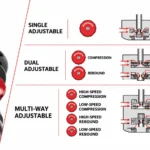
Adjustable Damping: Single, Dual and Multi-Way Options
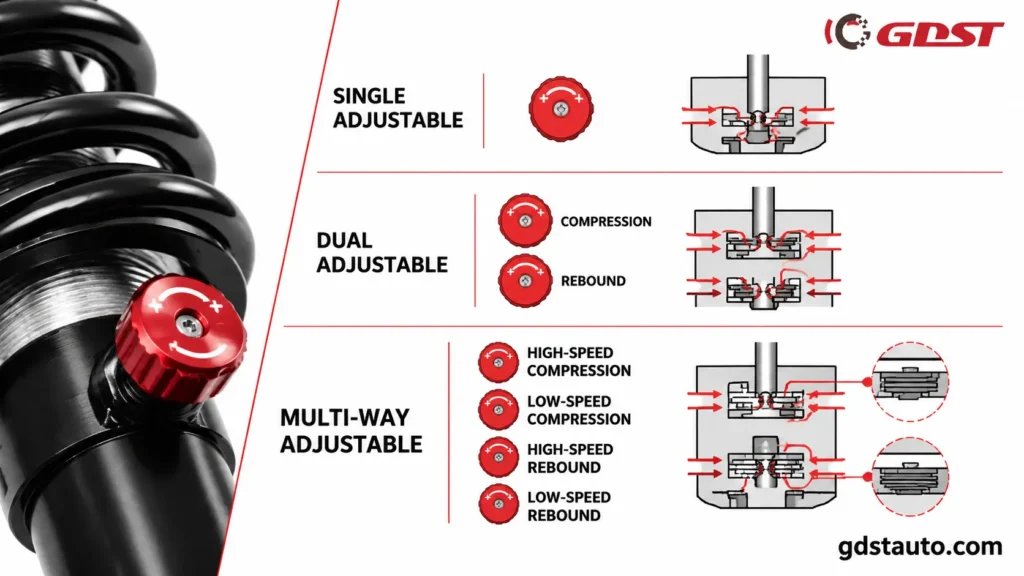
Adjustable damping shock absorbers are classified according to the number and function of their adjustment controls.
Single Adjustable Shock Absorbers
Single adjustable designs feature one primary adjustment control. Depending on the internal valve configuration, it may regulate compression damping, rebound damping, or a combined damping characteristic.
They offer a relatively straightforward approach to suspension tuning and are commonly associated with street-performance and aftermarket applications.
Dual Adjustable Shock Absorbers
Dual adjustable designs provide two separate adjustment controls. Many models allow independent compression and rebound adjustment, giving users greater control over suspension response.
The exact function of each adjuster depends on the manufacturer’s design and should be confirmed through technical documentation.
Multi-Way Adjustable Shock Absorbers
Multi-way adjustable shock absorbers provide multiple damping adjustment circuits. Advanced four-way designs may independently control:
- High-speed compression damping
- Low-speed compression damping
- High-speed rebound damping
- Low-speed rebound damping
High-speed and low-speed refer to shock absorber piston movement speed, not vehicle driving speed. These advanced systems are generally used in professional motorsports and specialized performance applications.
Comparison of Damping Adjustment Options
| Adjustment Type | Typical Configuration | Main Application |
| Single Adjustable | One adjustment control | Street performance |
| Dual Adjustable | Two adjustment controls | Performance and off-road |
| 3-Way Adjustable | Three adjustment controls | Advanced suspension tuning |
| 4-Way Adjustable | Four independent controls | Professional motorsports |
The actual adjustment functions vary between manufacturers. More adjustment controls do not automatically mean better performance. Damping characteristics, adjustment range, and vehicle compatibility are equally important.
Shock Absorber Construction and Design
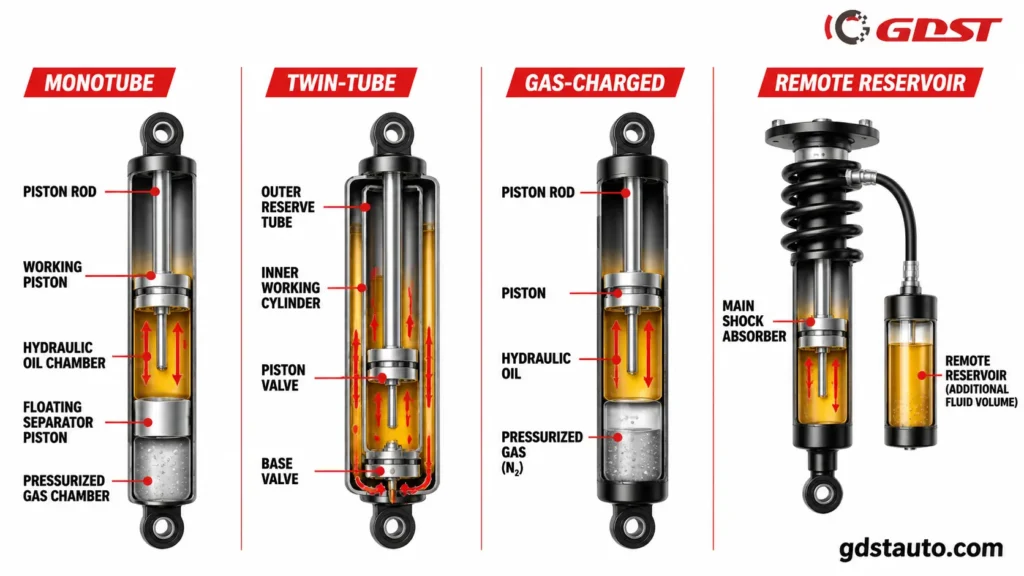
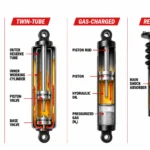
Shock absorber construction is different from damping adjustment capability. Monotube and twin-tube describe internal structures, while adjustable damping describes a functional feature.
Monotube Shock Absorbers
Monotube shock absorbers use a single main pressure tube with a working piston and a gas-oil separation arrangement. They are commonly used in standard and performance automotive suspension applications.
Twin-Tube Shock Absorbers
Twin-tube designs use an inner working cylinder and an outer reserve tube. They are widely used in passenger cars and aftermarket replacement applications.
Gas-Charged Shock Absorbers
Gas-charged designs use pressurized gas to help reduce oil aeration and cavitation under suitable operating conditions. Gas charging does not automatically mean the shock absorber has adjustable damping.
Remote Reservoir Shock Absorbers
Remote reservoir designs feature an external fluid reservoir connected to the main damper. Depending on the design, additional fluid volume can help manage heat during demanding operating conditions.
Some remote reservoir products include adjustable damping controls, but the reservoir itself does not provide damping adjustment.
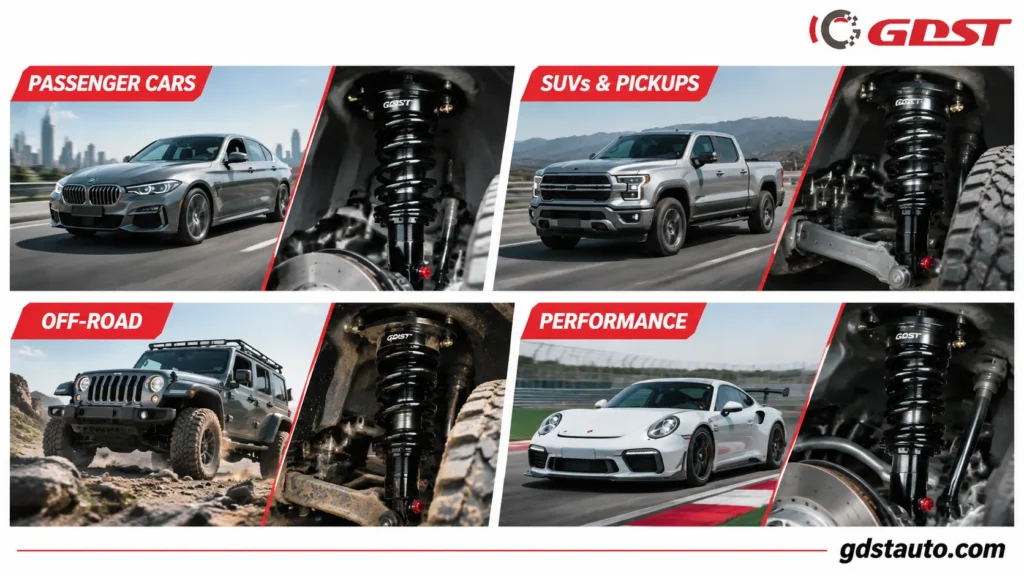
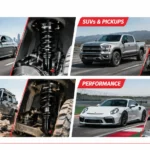
Applications of Adjustable Shock Absorbers
Adjustable shock absorbers serve different vehicle segments according to suspension design and operating requirements.
Passenger Cars
Adjustable damping systems can help fine-tune suspension response and handling characteristics. They are suitable for applications requiring different suspension settings for everyday driving or performance use.
SUVs and Pickups
SUVs and pickups may encounter changing road conditions and load requirements. Adjustable damping can provide additional suspension tuning flexibility, while load-adjusting or air-assisted designs may help reduce vehicle sag.
Off-Road Vehicles
Off-road driving exposes suspension components to changing terrain, larger impacts, and demanding suspension travel requirements. Adjustable damping systems can help users modify suspension response for different terrain conditions.
Performance and Motorsport Vehicles
Performance vehicles may require more precise control of compression, rebound, braking movement, and body roll. Single, dual, and multi-way adjustable shock absorbers provide different levels of suspension tuning flexibility.
The appropriate product depends on vehicle specifications, intended use, and the required adjustment functions.
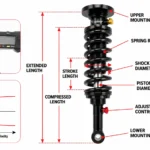
Adjustable Shock Absorber Specifications
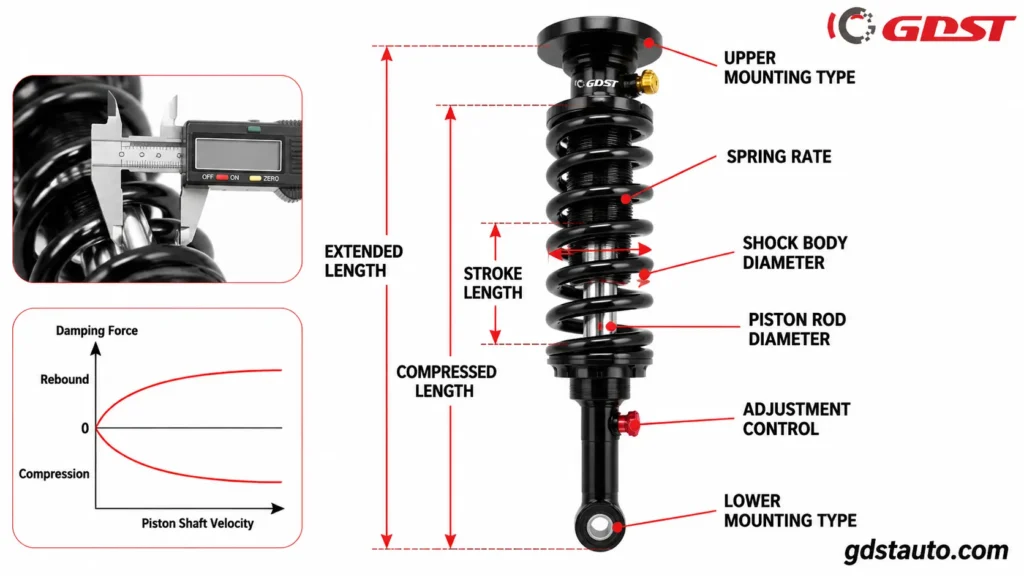
Selecting an adjustable shock absorber requires more than matching the vehicle make and model. Buyers should evaluate the adjustment mechanism, physical dimensions, mounting configuration, and damping characteristics.
Key Technical Specifications
| Specification | Description |
| Product Type | Monotube, Twin-Tube, Coilover, etc. |
| Adjustment Function | Compression, Rebound, Ride Height, or Air Pressure |
| Adjustment Range | Available adjustment positions or specified range |
| Damping Force | Compression and rebound force characteristics |
| Extended Length | Length at full extension |
| Compressed Length | Length at full compression |
| Stroke Length | Total working travel |
| Mounting Type | Eyelet, Stud, Fork, or other configurations |
| Body Diameter | Outer diameter of the shock absorber |
| Spring Rate | Spring stiffness for coilover applications |
| Reservoir Design | Internal, Piggyback, or Remote Reservoir |
Not every specification applies to every product. Exact values should be confirmed through technical drawings or product datasheets.
Damping Performance Verification
For adjustable damping products, damping force curves are important technical references. They show the relationship between damping force and piston or shaft velocity during compression and rebound.
Buyers evaluating adjustable products should consider:
- Compression and rebound damping force curves
- Damping force at specified shaft velocities
- Performance at different adjustment settings
- Available adjustment range and click positions
- Adjustment mechanism repeatability
- Test temperature and operating conditions
These details provide a more reliable basis for product comparison than adjustment levels alone.
Information Required for Product Matching
- OE number or original part number
- Vehicle make, model, year, and engine
- Front or rear application
- Required adjustment function
- Extended and compressed lengths
- Stroke length and mounting configuration
- Estimated order quantity
For customized projects, technical drawings and existing product samples can help improve matching accuracy.
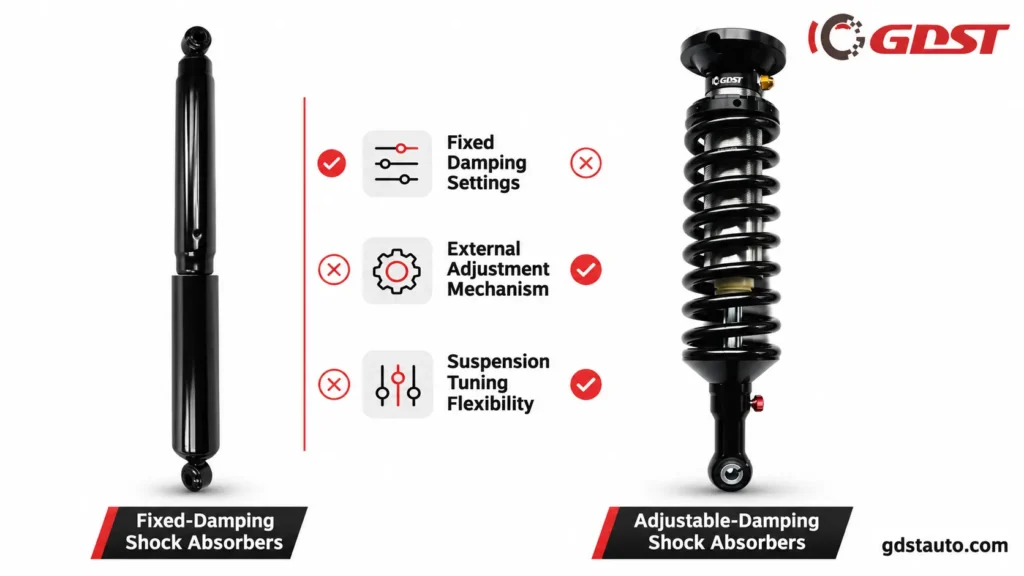
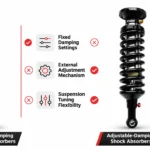
Adjustable vs. Fixed-Damping Shock Absorbers
Both adjustable and fixed-damping shock absorbers control suspension movement, but their adjustment capabilities are different.
| Comparison | Fixed-Damping Shock | Adjustable Damping Shock |
| Damping Settings | Predefined | Adjustable within a specified range |
| Adjustment Mechanism | No external manual adjustment | Knob, valve, or other mechanism |
| Suspension Tuning | Based on original design | Additional tuning flexibility |
| Typical Application | OE replacement and standard aftermarket | Performance and specialized applications |
Adjustable shock absorbers are not necessarily better for every vehicle. A correctly matched fixed-damping shock absorber may be more suitable for standard replacement applications, while adjustable products are useful when additional suspension tuning is required.
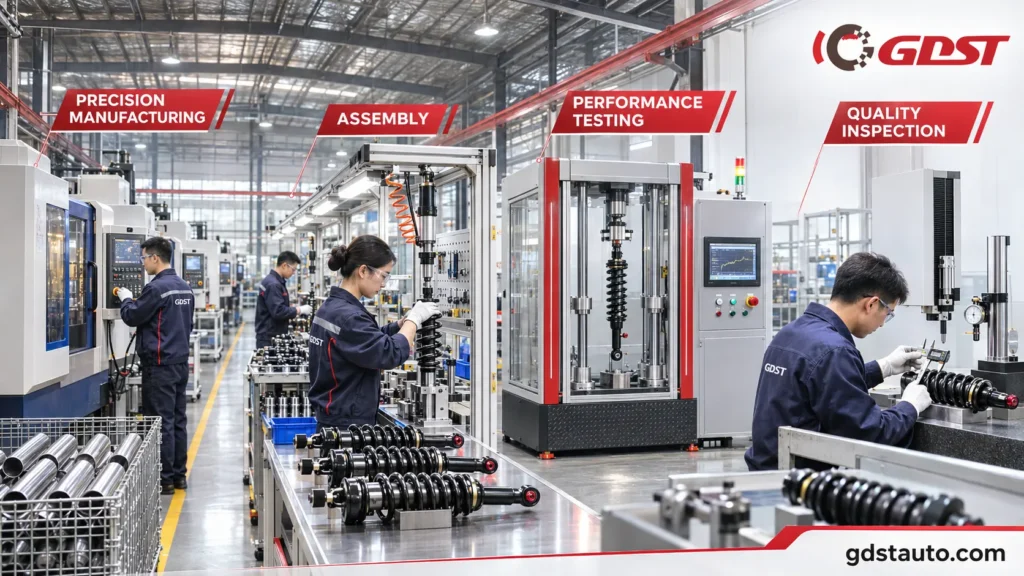
GDST Shock Absorber Manufacturing and Quality Control
GDST is a Chinese automotive parts supplier with established shock absorber manufacturing and supply capabilities.
Our existing shock absorber range includes more than 2,000 models covering Japanese, Korean, European, American, and other vehicle applications. We support international aftermarket distributors and automotive brands with product sourcing, OE reference matching, and private-label cooperation.
Manufacturing Capabilities
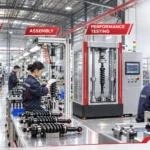
Our shock absorber production process includes precision component processing, ultrasonic cleaning, robotic welding, assembly, oil filling, applicable nitrogen charging, surface treatment, and final inspection.
These processes are managed according to the relevant product specifications and manufacturing requirements.
Quality Inspection and Testing
Our existing shock absorber quality-control program includes:
- Dimensional Inspection
- Material Composition Analysis
- MTS Performance Testing
- Compression and Rebound Testing
- Tensile Strength Testing
- Fatigue Durability Testing
- High and Low Temperature Testing
- Salt Spray Corrosion Testing
For adjustable shock absorber projects, additional validation should be defined for damping force at different adjustment settings, adjustment range, and repeatability.
The testing scope depends on the product configuration and agreed technical requirements.
OEM, ODM and Private Label Shock Absorber Solutions
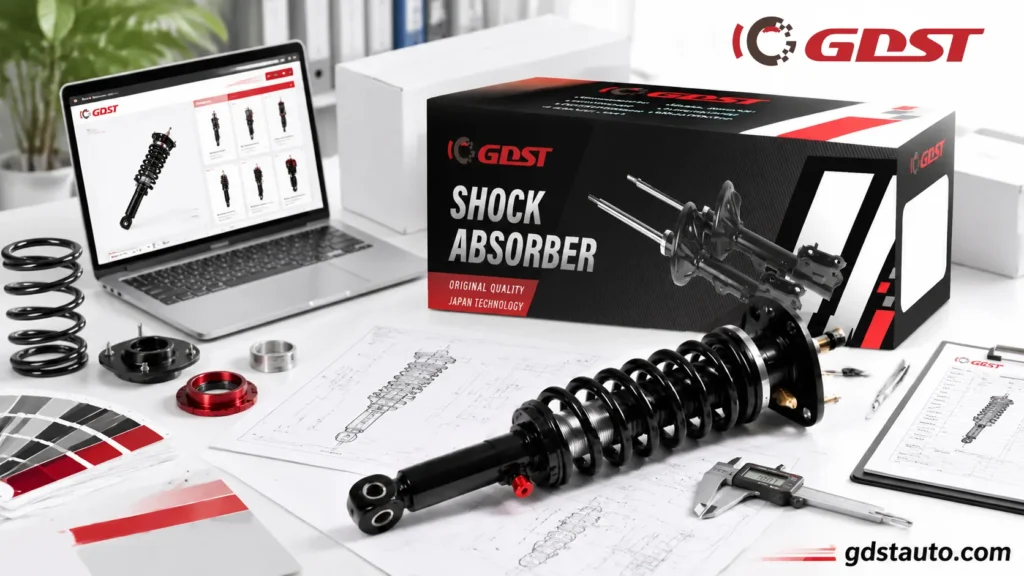
GDST supports automotive aftermarket distributors and brands with customized shock absorber sourcing and private-label cooperation.
Branding and Packaging
- Customized product logos and identification
- Private-label color boxes
- Customized master cartons and shipping marks
- Product labels and packaging artwork
Product Customization
- Product color and surface finish options
- OE reference matching
- Technical drawing and sample evaluation
- Customized product development subject to technical feasibility
For adjustable shock absorber projects, damping configurations, adjustment mechanisms, and performance requirements must be evaluated before quotation and production.
How to Source Adjustable Shock Absorbers from GDST
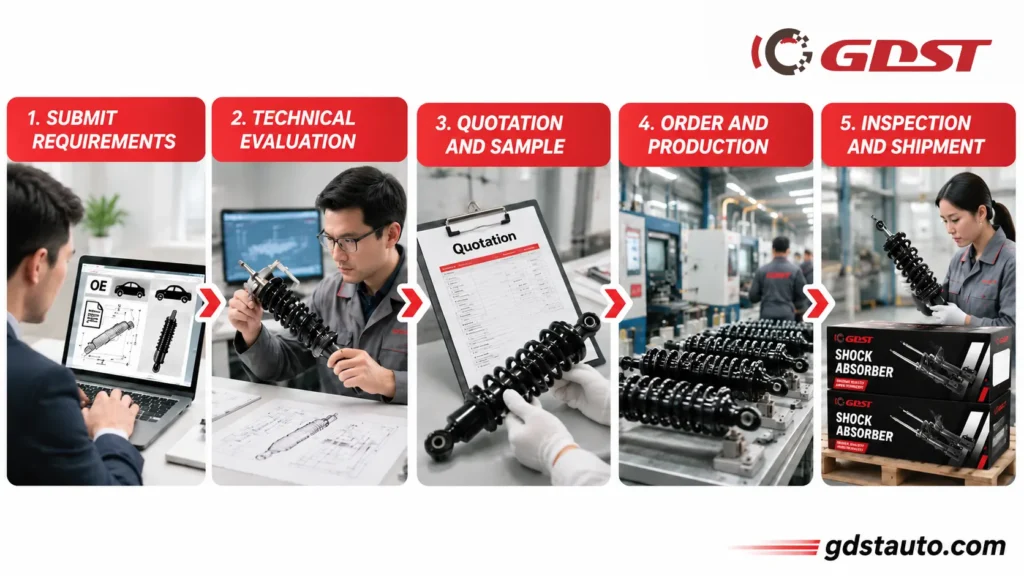
Submit Your Requirements
Provide your OE number, vehicle information, product photographs, technical drawings, or existing samples. Specify whether you need damping adjustment, ride-height adjustment, or load assistance.
Technical Evaluation and Quotation
Our team reviews the product application, dimensions, mounting configuration, and development feasibility before preparing a quotation.
Sample Approval and Production
After specifications and commercial terms are confirmed, sample evaluation and production arrangements can be discussed.
Quality Inspection and Shipment
Products undergo the agreed inspection procedures before export packaging and shipment.
Frequently Asked Questions
What is an adjustable shock absorber?
It is a suspension damper that allows specific damping or suspension characteristics to be changed through an adjustment mechanism.
Do all adjustable shock absorbers adjust compression and rebound?
No. Some adjust only compression or rebound, while others provide independent adjustment of both.
What is the difference between adjustable height and adjustable damping?
Height adjustment changes vehicle ride height, while damping adjustment changes the shock absorber’s resistance during compression or rebound.
Are all monotube shock absorbers adjustable?
No. Monotube describes the internal construction, not the damping adjustment capability.
Can adjustable shock absorbers fit any vehicle?
No. OE references, dimensions, mounting types, stroke, and suspension specifications must be verified.
Can GDST provide OEM and private-label shock absorbers?
Yes. GDST supports customized branding, packaging, and product development subject to technical and production feasibility.
What is the MOQ and lead time?
GDST’s standard shock absorber range lists an MOQ of 50 pieces per model and a typical lead time of 50 days. Customized projects require separate confirmation.
Does GDST provide warranty support?
The existing standard shock absorber program lists a one-year / 30,000 km warranty. Applicable terms and conditions should be confirmed for each order.
Related Products
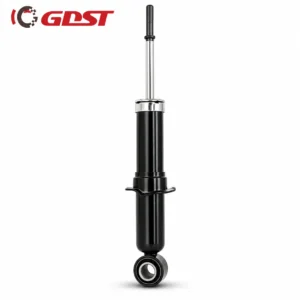
Explore more suspension and steering parts from GDST.
Quality Assurance
Every product undergoes rigorous testing and inspection to ensure reliability and performance
Material Inspection
Premium steel from certified suppliers with full traceability
Performance Testing
Fatigue, torque, and stress testing per OE standards
Dimensional Control
Tolerance control for precise OE fitment
Final Inspection
100% inspection before shipment