
Quick Answer
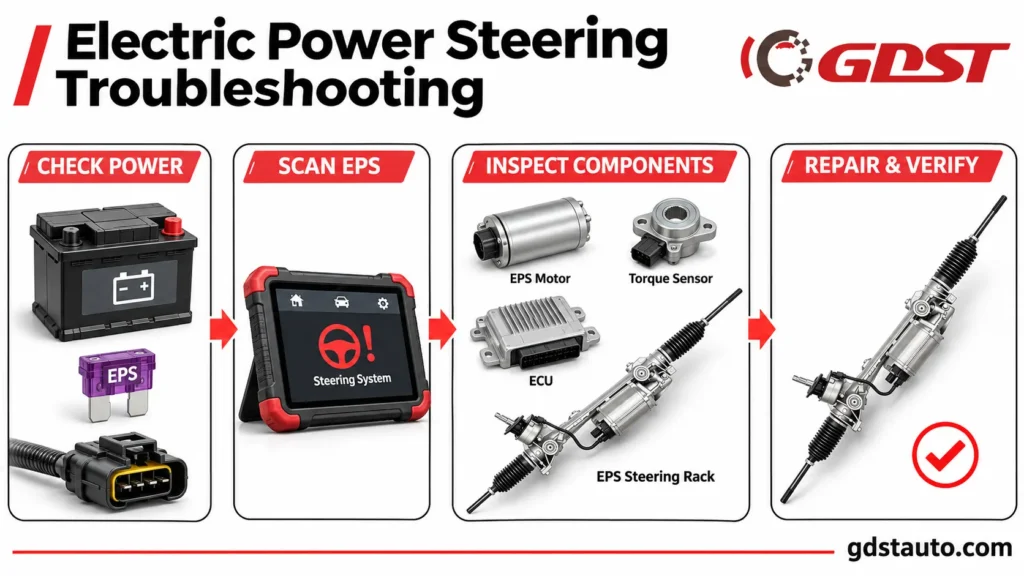
Electric power steering (EPS) problems are commonly caused by low battery voltage, blown fuses, damaged wiring, faulty sensors, motor failure, or a defective control module. To fix them, check the battery, fuses, and electrical connections, then scan the EPS system for fault codes. Inspect the motor, sensors, and steering rack to identify the actual failure. Depending on the diagnosis, repairs may involve wiring replacement, sensor calibration, motor repair, or steering rack replacement. Resetting EPS alone cannot fix underlying hardware faults.
How Does Electric Power Steering Work?

Electric Power Steering (EPS) uses an electric motor to provide steering assistance instead of a conventional engine-driven hydraulic pump. When the driver turns the steering wheel, sensors measure steering input and send signals to the EPS control module (ECU). The module calculates the required assistance and controls the electric motor to reduce steering effort.
The main EPS components include:
- Electric Motor: Generates additional steering torque.
- EPS Control Module (ECU): Processes sensor signals and controls motor operation.
- Torque Sensor: Measures the force applied to the steering wheel.
- Steering Angle Sensor: Provides steering position information where required.
- Wiring and Connectors: Supply electrical power and transmit signals.
- Steering Rack and Pinion: Transfer steering input to the wheels.
EPS systems generally use three configurations:
| EPS Type | Motor Location | Main Feature |
| Column-Assisted EPS (C-EPS) | Steering column | Compact design with motor assistance through the column |
| Pinion-Assisted EPS (P-EPS) | Steering pinion | Applies assistance through the pinion mechanism |
| Rack-Assisted EPS (R-EPS) | Steering rack | Applies assistance directly to the steering rack |
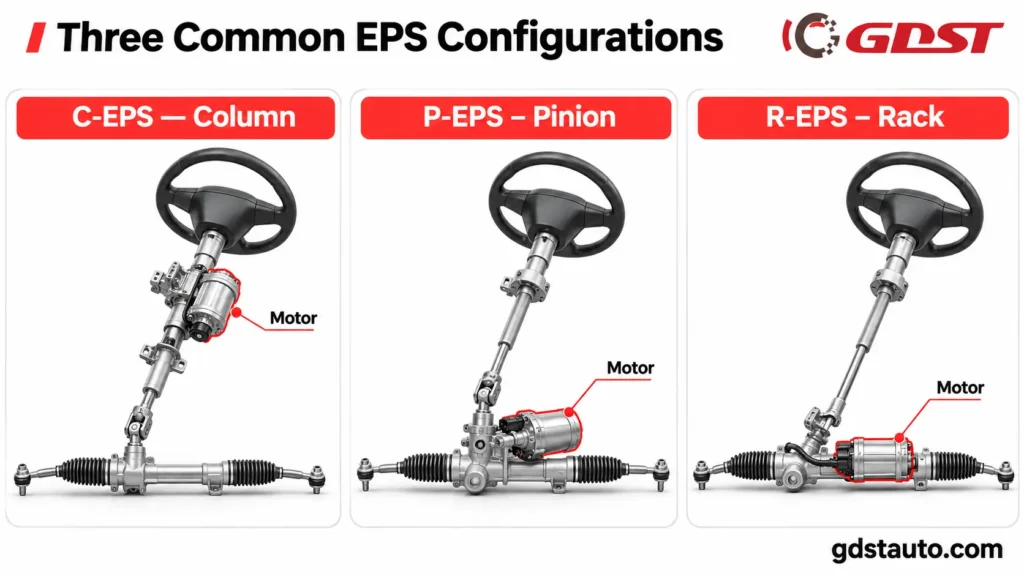
Understanding the EPS configuration is important because motor location, sensor arrangement, and repair procedures vary between designs.
Unlike conventional Hydraulic Power Steering (HPS), pure EPS systems do not require steering fluid, hydraulic pumps, or hydraulic hoses. However, Electro-Hydraulic Power Steering (EHPS) uses an electrically driven hydraulic pump and requires different diagnostic procedures.
What Are the Common Signs of Electric Power Steering Failure?
EPS problems can produce several noticeable symptoms. Recognizing them early helps identify potential faults before they develop into more serious steering problems.
Heavy Steering Wheel
A steering wheel that suddenly becomes difficult to turn may indicate reduced or lost electric assistance. Common causes include low battery voltage, a blown fuse, damaged wiring, motor failure, or an EPS control module malfunction.
EPS Warning Light
An EPS warning light indicates that the vehicle has detected a steering assistance system fault. Possible causes include sensor abnormalities, electrical supply problems, communication failures, or motor and control module issues. Diagnostic trouble codes are needed to identify the actual cause.
Intermittent Steering Assistance
If steering assistance works normally at some times but disappears at others, possible causes include loose connectors, corroded terminals, unstable voltage, overheating protection, or intermittent sensor signals.
Uneven or Jerky Steering
Inconsistent steering assistance may result from faulty torque sensor signals, incorrect calibration, motor control problems, or mechanical resistance inside the steering assembly.
Unusual Steering Noise
Grinding, clicking, knocking, or whining noises may originate from the EPS motor, internal gears, bearings, steering rack, tie rod ends, or suspension components. A mechanical inspection is necessary to locate the actual source.
Poor Steering Wheel Return
If the steering wheel does not return smoothly to center, possible causes include mechanical friction, incorrect wheel alignment, damaged steering components, or an EPS control issue.
What Causes Electric Power Steering Problems?

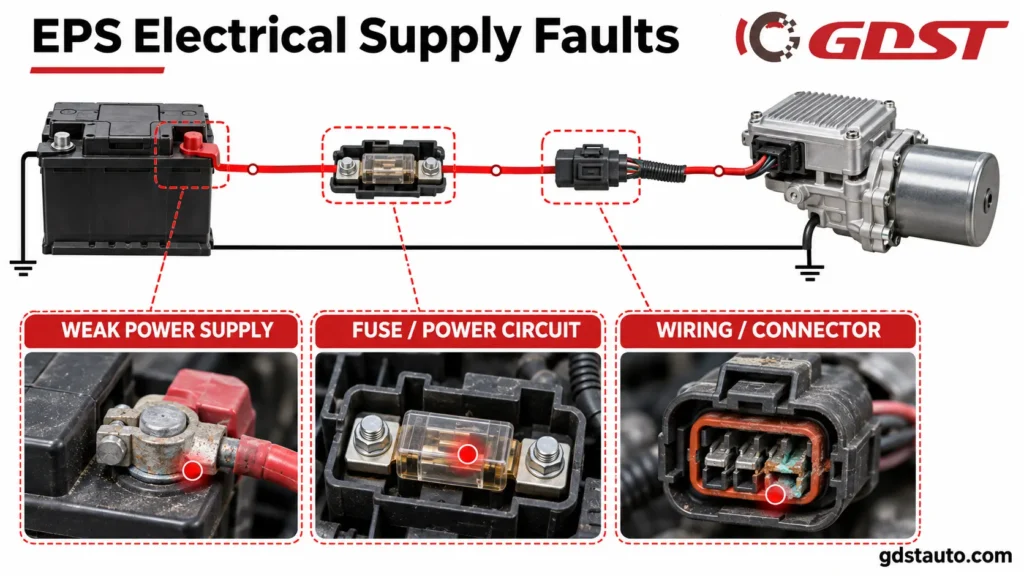
EPS failures generally fall into four categories: electrical supply problems, electronic component failures, mechanical damage, and software or communication faults.
- Weak Battery or Charging System Failure
EPS motors can require substantial electrical current, especially during low-speed steering. A weak battery, faulty alternator, loose battery terminal, or poor ground connection can interrupt normal EPS operation.
Low voltage may trigger warning lights, reduce steering assistance, or cause the control module to enter a protective mode.
- Blown EPS Fuse or Damaged Wiring
A blown fuse, damaged power cable, loose connector, or poor grounding connection can interrupt the electrical supply to the EPS motor or control module.
A repeatedly blown fuse may indicate a short circuit or excessive current draw. Replacing the fuse without investigating the underlying problem will not provide a reliable repair.
- Faulty Torque or Steering Angle Sensor
The torque sensor measures driver steering effort, while the steering angle sensor provides steering position information where required.
Incorrect or interrupted sensor signals can cause inconsistent steering assistance, warning lights, or system shutdown. Potential causes include internal sensor wear, wiring damage, poor connections, or incorrect calibration.
- Electric Motor Failure
The EPS motor generates steering assistance. Internal electrical damage, bearing wear, damaged windings, overheating, or motor drive faults can reduce or eliminate assistance.
Before replacing the motor, technicians should verify its electrical supply, ground, control signals, and mechanical load.
- EPS Control Module Failure
The EPS ECU processes sensor information and controls motor operation. Water intrusion, corrosion, unstable power supply, damaged electronic components, or software problems may affect its performance.
An EPS warning light alone is not sufficient evidence of ECU failure. Proper diagnostic testing is necessary.
- Mechanical Steering Rack Damage
Internal gear wear, excessive backlash, damaged bearings, a bent shaft, or mechanical binding can affect steering performance even when the electronic components operate normally.
Other steering and suspension parts, including tie rod ends, ball joints, and bushings, can also produce similar symptoms.
- Software and Communication Problems
Modern EPS systems communicate with other vehicle control modules and may rely on vehicle speed and stability control information.
Incorrect calibration, incompatible replacement components, communication errors, or software faults can interfere with steering assistance.
How to Diagnose Electric Power Steering Problems Step by Step
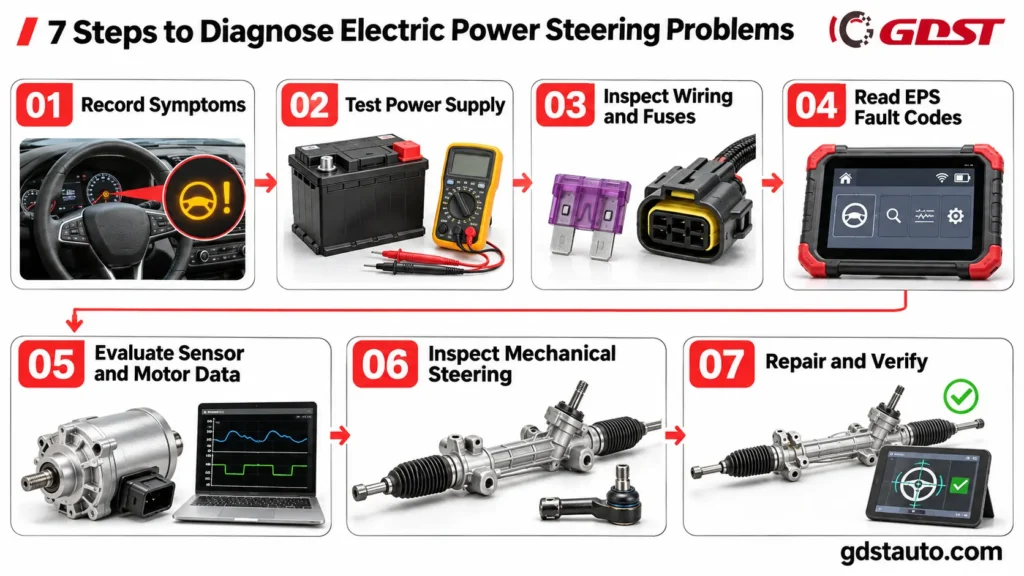
A systematic diagnostic process helps technicians identify the actual fault without unnecessarily replacing expensive components.
Check the Symptoms and Warning Lights
Record when the problem occurs, whether steering assistance is completely lost or intermittent, and whether unusual noises or warning lights appear.
Also check whether the vehicle recently experienced battery replacement, collision damage, water exposure, or steering system repairs.
Test the Battery and Charging System
Inspect battery terminals, grounding connections, battery condition, and charging system performance.
Use a suitable multimeter or battery tester and compare the results with vehicle manufacturer specifications. Voltage-drop testing may also be necessary to identify excessive resistance in the EPS power and ground circuits.
Inspect EPS Fuses, Wiring, and Connectors
Use the vehicle-specific fuse diagram to locate the relevant EPS protection circuits.
Inspect wiring and connectors for corrosion, moisture, loose terminals, broken wires, damaged insulation, and overheating.
If a fuse has blown, identify the cause before installing a replacement with the specified rating.
Read EPS Diagnostic Trouble Codes
Connect a diagnostic scanner that supports the vehicle’s EPS control module. A basic engine-only OBD-II scanner may not provide access to steering system fault codes.
Record stored and current DTCs before clearing them. Remember that a fault code identifies a detected problem, not necessarily the component that must be replaced.
Check Sensor Signals and Motor Operation
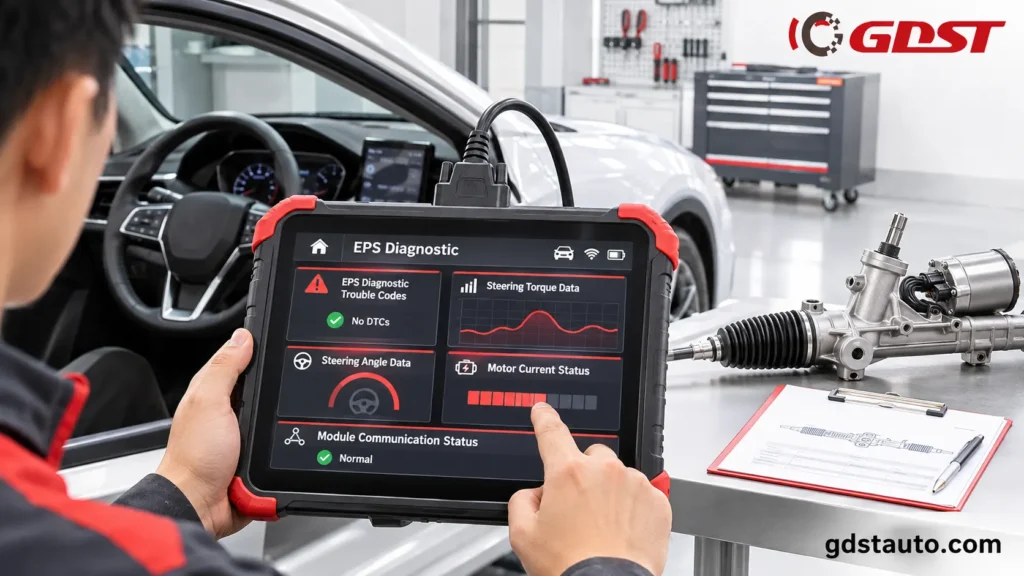
Use live diagnostic data to evaluate available torque sensor, steering angle, motor current, and vehicle speed information.
Abnormal readings may indicate sensor failure, wiring problems, incorrect calibration, or mechanical resistance.
If necessary, qualified technicians can use an oscilloscope or specialized EPS testing equipment to evaluate electrical signals and motor circuits.
Inspect the Steering Rack and Mechanical Components
If electrical testing does not identify the problem, inspect the steering rack, pinion, tie rod ends, steering column joints, ball joints, suspension bushings, and mounting points.
Mechanical binding, excessive play, or damaged components may require repair or replacement.
Complete Repairs and Verify Operation
After repairing the confirmed fault, perform any required coding, calibration, or initialization.
Clear relevant fault codes and verify steering assistance, warning light status, steering wheel centering, and system communication. Conduct a controlled road test only after confirming that the steering system is safe.
How to Fix Common Electric Power Steering Problems
The correct repair depends on the failed component. The following table summarizes common EPS problems and appropriate solutions.
| EPS Problem | Possible Cause | Recommended Repair |
| Heavy steering | Low voltage, fuse, motor failure | Test battery, fuse, and motor circuit |
| EPS warning light | Sensor, ECU, or communication fault | Read EPS-specific DTCs |
| Intermittent assistance | Loose connectors or damaged wiring | Repair electrical connections |
| Jerky steering | Sensor or calibration problem | Test live data and calibrate if required |
| Unusual noise | Rack, motor gears, bearings, or suspension | Locate and repair the defective component |
| Assistance stops after extended driving | Thermal protection or excessive motor load | Inspect temperature-related faults and mechanical resistance |
| EPS fails after rack replacement | Incorrect part or incomplete initialization | Verify compatibility and perform required calibration |
Repair Electrical Supply Problems
If the battery, alternator, terminals, or grounding connections are defective, repair or replace the affected components. Then verify stable electrical supply to the EPS system.
Replace Damaged Fuses and Wiring
Replace blown fuses only after checking for short circuits or excessive current draw. Damaged wiring, corroded terminals, and loose connectors should be repaired using appropriate automotive electrical repair procedures.
Replace Faulty Sensors
If testing confirms a defective torque or steering angle sensor, replace it with a compatible component. Some sensors are integrated into the steering column or rack and cannot be serviced separately. Perform required calibration after installation.
Repair or Replace the EPS Motor or ECU
A defective motor or control module may be repairable by a qualified specialist, depending on the vehicle design and component condition.
If the motor has internal damage or the ECU has severe corrosion or electronic failure, replacement may be necessary. Some replacement modules require vehicle-specific coding or programming.
Repair or Replace the Steering Rack
If internal rack gears, bearings, shafts, or integrated motor components are damaged, professional repair or complete assembly replacement may be required.
The decision depends on component availability, damage severity, and manufacturer specifications.
How to Reset Electric Power Steering

Resetting EPS may resolve certain temporary faults, but it cannot repair defective hardware or damaged electrical circuits.
Common procedures include:
- Ignition Cycle: Switching the ignition off and restarting the vehicle may allow the system to reinitialize after a temporary condition.
- Battery Disconnection: Some vehicles specify battery disconnection as part of a maintenance or initialization procedure. It is not a universal EPS reset method and may require other systems to be reinitialized.
- Diagnostic Code Clearing: An EPS-compatible scanner can clear stored codes after the underlying problem has been repaired.
- Sensor Calibration: Some vehicles require steering angle or torque sensor calibration after steering system repairs.
- Module Programming: Certain replacement steering racks or ECUs require coding, software configuration, or initialization.
Always follow the manufacturer’s repair procedure. If the warning light returns or steering assistance remains abnormal, further diagnosis is required.
Can You Drive with Electric Power Steering Not Working?
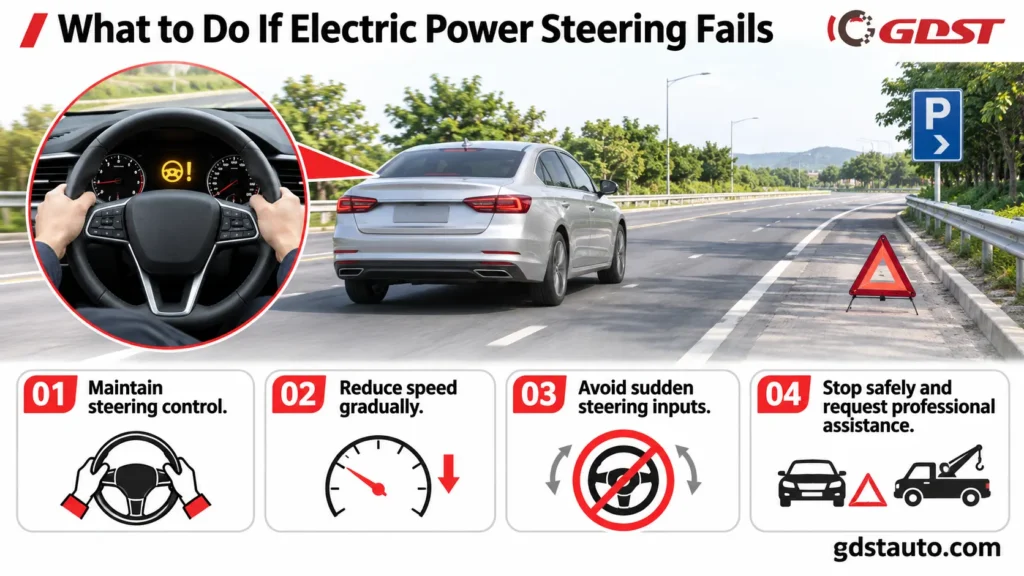
When EPS assistance fails, many conventional systems retain a mechanical connection between the steering wheel and road wheels. However, steering effort may increase significantly, particularly at low speeds.
This does not mean the vehicle is automatically safe to drive. The outcome depends on the vehicle design and the nature of the failure.
If steering assistance suddenly disappears or steering behavior becomes unpredictable:
- Keep both hands on the steering wheel.
- Avoid sudden steering movements.
- Reduce speed gradually when safe.
- Move to a safe stopping location.
- Arrange professional inspection or towing if necessary.
Do not attempt to diagnose intermittent EPS failure by repeatedly restarting the vehicle while driving. If mechanical binding or unexpected steering input occurs, do not continue driving.
When Should You Repair or Replace the EPS System?

Not every EPS failure requires complete steering rack replacement. The correct decision depends on the damaged component, system design, repairability, and component availability.
| Failure Condition | Recommended Action | Complete Rack Replacement |
| Loose or corroded connector | Repair electrical connection | Usually unnecessary |
| Weak battery or charging fault | Repair power supply | Unnecessary |
| Faulty external sensor | Replace and calibrate | Usually unnecessary |
| Defective EPS motor | Replace separately if supported | Depends on design |
| Failed EPS control module | Repair or replace and program | Depends on design |
| Internal rack wear | Rebuild or replace rack | Often considered |
| Bent shaft or damaged housing | Replace affected assembly | Usually necessary |
When sourcing a replacement EPS steering rack, confirm the vehicle make, model, production year, OE reference, steering configuration, connector type, mounting dimensions, and electronic compatibility.
Matching the correct application helps reduce incorrect orders and installation problems.
How Much Does It Cost to Fix Electric Power Steering Problems?
EPS repair costs vary according to the vehicle, failed component, labor requirements, and calibration needs.
A simple wiring repair may cost considerably less than replacing an integrated EPS steering rack.
The main cost factors include:
- Diagnostic labor and specialized equipment.
- Battery, fuse, wiring, and connector repairs.
- Sensor replacement.
- Electric motor or ECU replacement.
- Complete steering rack replacement.
- Wheel alignment, calibration, and programming.
Before approving a major replacement, request a diagnostic report identifying the confirmed fault, recommended repair, and required post-installation procedures.
How to Prevent Electric Power Steering Problems

Although pure EPS systems do not require hydraulic fluid replacement, their electrical and mechanical components still need proper maintenance.
Maintain Battery and Charging System Health
Inspect battery condition, terminals, charging performance, and grounding connections during routine maintenance.
Protect Electrical Connections
Check accessible connectors and wiring for corrosion, moisture intrusion, damaged insulation, and loose terminals, especially after flooding or repairs.
Avoid Prolonged Steering at Full Lock
Holding the steering wheel against its mechanical end stop for extended periods can increase system load. Follow the vehicle manufacturer’s operating recommendations.
Inspect Steering and Suspension Components
Regularly inspect the steering rack, tie rod ends, ball joints, suspension bushings, and mounting points to identify wear or mechanical resistance.
Address Warning Lights Promptly
Do not ignore EPS warning lights, intermittent assistance, or unusual steering behavior. Early diagnosis can prevent additional damage and unnecessary replacement.
Use Compatible Replacement Parts
Always confirm OE compatibility and follow the required installation, coding, and calibration procedures when replacing EPS components.
Frequently Asked Questions About Electric Power Steering Problems

Why is my electric power steering not working?
Common causes include a weak battery, blown fuse, damaged wiring, faulty torque sensor, defective motor, ECU failure, or mechanical steering rack damage. Read EPS fault codes and check electrical supply before replacing components.
Can a weak battery cause electric power steering problems?
Yes. Low battery voltage or charging system problems can interrupt EPS operation and trigger warning lights or reduced steering assistance.
Does electric power steering have a fuse?
Most EPS-equipped vehicles have electrical protection for the system. Fuse locations and ratings vary, so consult the vehicle-specific fuse diagram.
How do I reset my electric power steering?
Depending on the vehicle, resetting may involve an ignition cycle, diagnostic code clearing, sensor calibration, or module initialization. Follow the manufacturer’s procedure because resetting cannot repair defective components.
Can I drive with the EPS warning light on?
It depends on the underlying fault. If steering becomes heavy, unpredictable, or mechanically restricted, stop when safe and arrange professional inspection.
Why does my electric power steering work intermittently?
Possible causes include loose connectors, corroded terminals, unstable voltage, overheating protection, faulty sensors, or control module problems.
Can an electric power steering rack be repaired?
Some EPS racks can be professionally rebuilt if suitable replacement components are available and the damage is repairable. Severe shaft, housing, or integrated electronic damage may require replacement.
Why is my EPS warning light still on after replacing the steering rack?
Possible causes include an incompatible replacement part, wiring problems, incomplete coding, or missing sensor calibration. Read the fault codes and complete the required initialization procedures.
Is electric power steering better than hydraulic power steering?
EPS generally improves energy efficiency and reduces hydraulic maintenance requirements. However, it contains electronic components that require specialized diagnostic procedures when faults occur.
How often should electric power steering be inspected?
Pure EPS systems do not require hydraulic fluid replacement. However, the battery, charging system, wiring, steering rack, and suspension components should be inspected according to the vehicle manufacturer’s maintenance recommendations.
Diagnose Before Replacing EPS Components
Electric power steering problems can originate from electrical supply faults, damaged sensors, motor failures, control module issues, or mechanical steering rack damage.
The most effective repair approach is to identify the actual failure through systematic diagnosis rather than replacing the entire steering rack based on symptoms alone.
When replacement is necessary, accurate OE matching, compatible components, professional installation, and required calibration are essential for reliable steering performance.
