
Quick Answer
An automotive bushing is a flexible component, usually made of rubber or another elastomer, that connects suspension parts while allowing controlled movement and reducing vibration. A bearing supports moving components, typically allowing rotation with controlled friction. Suspension bushings mainly work through elastomer deformation, while rolling-element bearings use balls or rollers between raceways. Although both are used in automotive systems, they serve different purposes and are not interchangeable. When selecting replacements, check the OE reference, vehicle application, dimensions, and mounting design.
What Is an Automotive Bushing?

An automotive bushing is a flexible joint that connects suspension or chassis components while allowing controlled movement. Most suspension bushings consist of rubber or another elastomer bonded between inner and outer metal sleeves.
As the suspension moves, the rubber deforms to accommodate movement and absorb part of the vibration transmitted from the road. Its stiffness and shape also influence suspension geometry, handling, and ride comfort.
Common applications include control arms, stabilizer bars, trailing arms, and subframes.
What Is an Automotive Bearing?
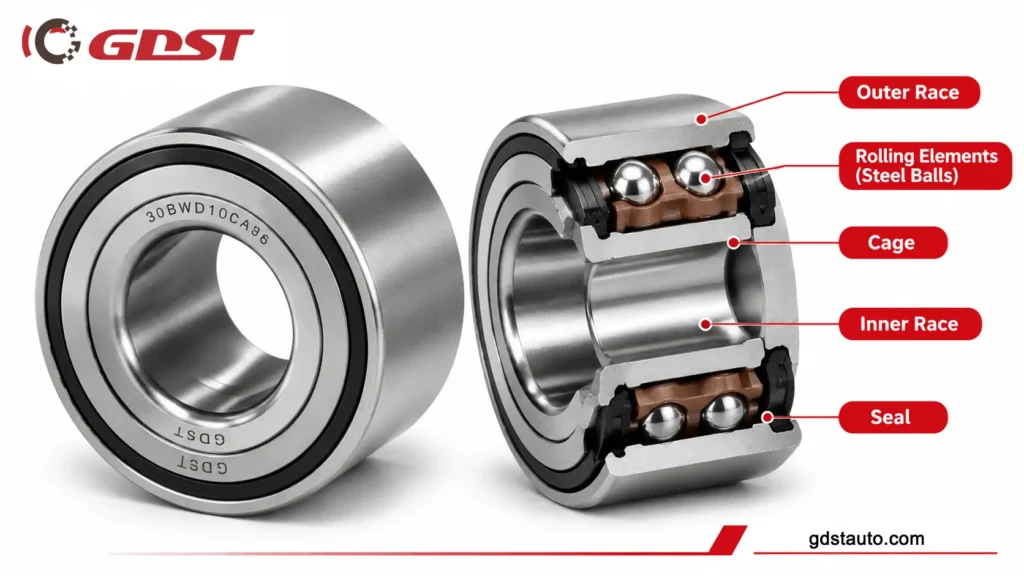
An automotive bearing supports moving components and allows controlled movement, most commonly rotation. Wheel bearings are a common example: they use balls or rollers between raceways to support the wheel hub as it rotates.
Bearings are also found in alternators, transmissions, water pumps, and other rotating assemblies. However, not all automotive bearings are rolling-element designs. Engine crankshaft and connecting rod bearings, for example, are typically plain bearings that operate with a lubricating oil film.
The correct bearing type depends on the component’s function, load, and operating conditions.
How Does an Automotive Suspension Bushing Work?
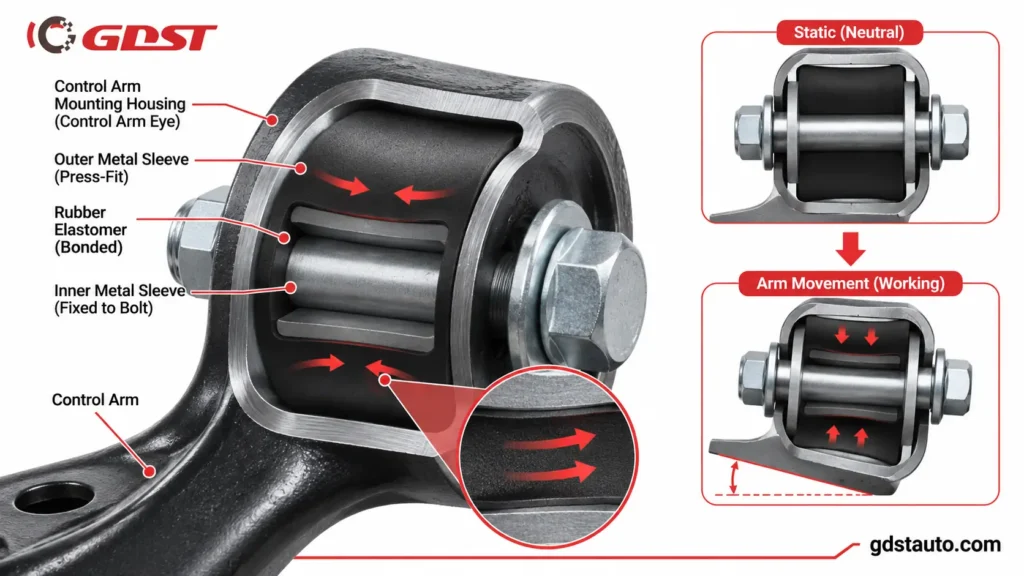
An automotive suspension bushing works by allowing controlled movement through the deformation of its elastomeric material.
Consider a lower control arm bushing. The outer sleeve is fitted into the control arm, while the inner sleeve is secured to a mounting bolt. When the wheel moves over uneven road surfaces, the control arm changes position relative to the vehicle body.
The rubber between the two sleeves deforms to accommodate this movement. Depending on the direction and magnitude of the applied force, it may experience compression, tension, and shear deformation.
This arrangement provides several functions:
- Allows controlled suspension movement.
- Helps maintain the intended relationship between suspension components.
- Absorbs and isolates part of the vibration transmitted from the road.
- Reduces direct metal-to-metal contact at the mounting joint.
- Contributes to the vehicle’s ride comfort and handling characteristics.
The amount of movement is not arbitrary. Suspension engineers design the bushing to provide different stiffness characteristics in different directions.
A bushing that is too soft may allow excessive suspension movement, while one that is too stiff may transmit more road vibration and impact into the vehicle body.
The correct balance depends on the bushing’s location, suspension geometry, vehicle weight, and intended driving characteristics.
How Does an Automotive Bearing Work?

An automotive rolling-element bearing supports rotation through contact between rolling elements and raceways.
In a typical wheel bearing, the inner and outer rings provide the running tracks for the balls or rollers. As the wheel rotates, the rolling elements move along these tracks and transfer loads between the rotating hub and the stationary mounting structure.
The bearing must maintain appropriate internal clearance or preload, depending on its design. It must also retain its lubricant and prevent contaminants such as water, dirt, and road debris from entering the rolling contact area.
Different bearing designs are selected according to the loads and operating conditions.
For example:
- Deep-groove ball bearings are commonly used in motors and accessory systems.
- Angular-contact ball bearings can support combined radial and axial loads.
- Tapered roller bearings are widely used in automotive wheel-end applications.
- Needle roller bearings are used where radial space is limited.
- Spherical roller bearings are found in certain heavy-duty rotating applications.
Unlike an elastomeric suspension bushing, a rolling-element bearing is primarily designed to support rotation rather than provide suspension compliance.
Automotive Bushings vs. Bearings: Key Differences
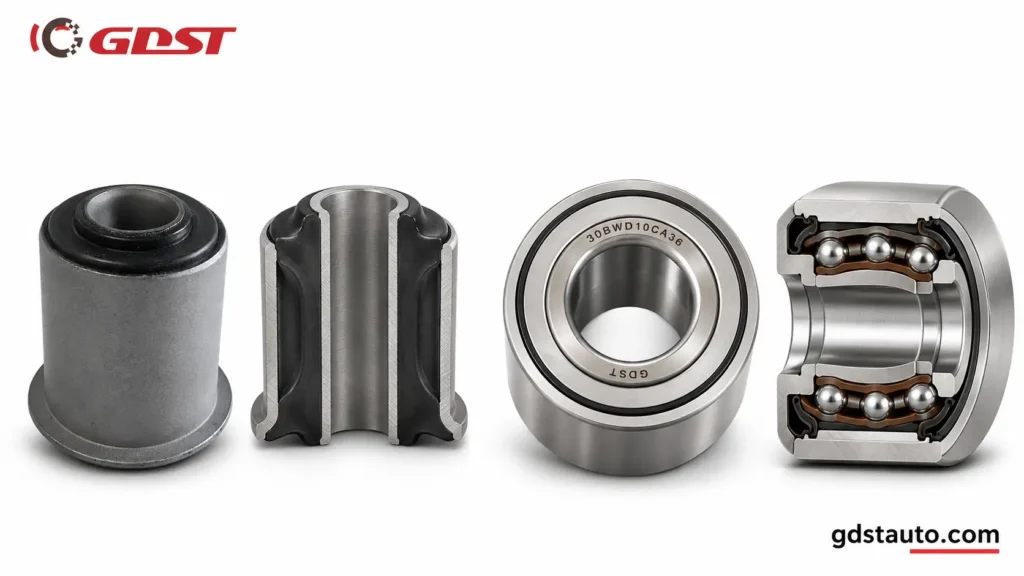
Automotive bushings and bearings both support mechanical connections, but their structures and intended functions are different.
| Comparison | Automotive Bushing | Automotive Rolling-Element Bearing |
| Main function | Connects components and allows controlled movement | Supports rotating components |
| Common construction | Rubber or elastomer, often bonded to metal sleeves | Inner ring, outer ring, balls or rollers |
| Movement | Primarily elastomer deformation in suspension applications | Rolling movement between raceways |
| Main design characteristic | Directional stiffness and damping | Load capacity, rotational accuracy, and fatigue performance |
| Vibration control | Helps isolate road and chassis vibration | Primarily supports rotation; not designed as a suspension isolator |
| Typical location | Control arms, stabilizer bars, trailing arms, subframes | Wheel hubs, strut mounts, alternators, transmissions |
| Material | Natural rubber, synthetic rubber, polyurethane, metal sleeves | Bearing steel, stainless steel, ceramics, cages, seals |
| Maintenance | Usually inspected and replaced when damaged or worn | Requires appropriate lubrication, sealing, and inspection |
| Common wear symptoms | Cracking, separation, deformation, excessive joint movement | Humming, grinding, rough rotation, excessive play |
| Replacement considerations | OE reference, dimensions, stiffness, mounting design | Bearing type, dimensions, load rating, fit, and sealing |
One important distinction is that an automotive rubber bushing is not simply a low-friction substitute for a rolling bearing.
Its purpose is to provide a controlled elastic connection. A rolling bearing, by comparison, is designed to support movement between mechanical parts while limiting friction and maintaining their relative position.
Where Are Automotive Bushings Used?
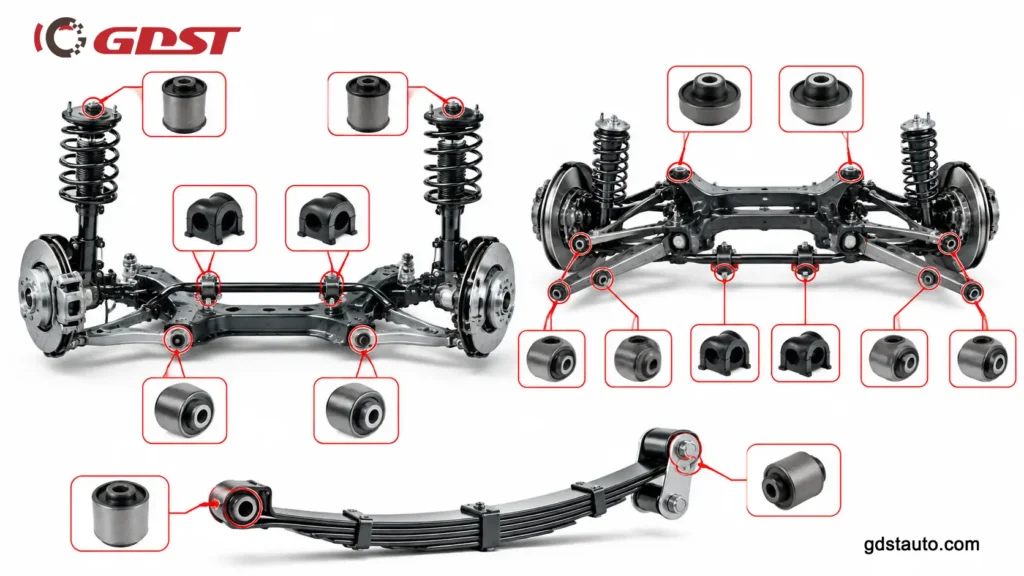
Automotive bushings are used in several parts of the suspension and chassis system. Their location and design depend on the vehicle’s suspension architecture.
Control Arm Bushings
Control arm bushings connect the control arm to the vehicle frame or subframe. They allow the arm to move as the suspension travels while helping control unwanted movement.
Both front and rear suspension systems may use control arm bushings, depending on the design.
Stabilizer Bar Bushings
Stabilizer bar bushings support the anti-roll bar where it attaches to the vehicle chassis or subframe.
They allow the bar to twist as the suspension moves while limiting unwanted movement at its mounting points. These bushings are often made from rubber or polyurethane and may use a split design for installation.
Trailing Arm Bushings
Trailing arm bushings connect the trailing arm to the vehicle structure. They accommodate suspension movement while controlling the arm’s position during acceleration, braking, and road impacts.
Their stiffness characteristics can influence rear suspension behavior and vehicle stability.
Subframe Bushings
Subframe bushings connect the suspension subframe to the vehicle body. They help isolate vibration and noise transmitted from the suspension assembly into the passenger compartment.
Their design can affect both structural movement and cabin comfort.
Leaf Spring Bushings
Leaf spring bushings are used at suspension mounting points, including spring eyes and certain shackle connections.
They allow the leaf spring assembly to move as the suspension compresses and rebounds while helping maintain its intended mounting position.
Strut Mount Rubber Insulators
Some suspension strut assemblies use rubber mounts or isolators to connect the strut to the vehicle body. These components help reduce vibration transmission and support the suspension assembly.
Depending on the suspension design, the strut mount may also incorporate a separate bearing to allow rotation during steering.
Common Types of Automotive Bushings
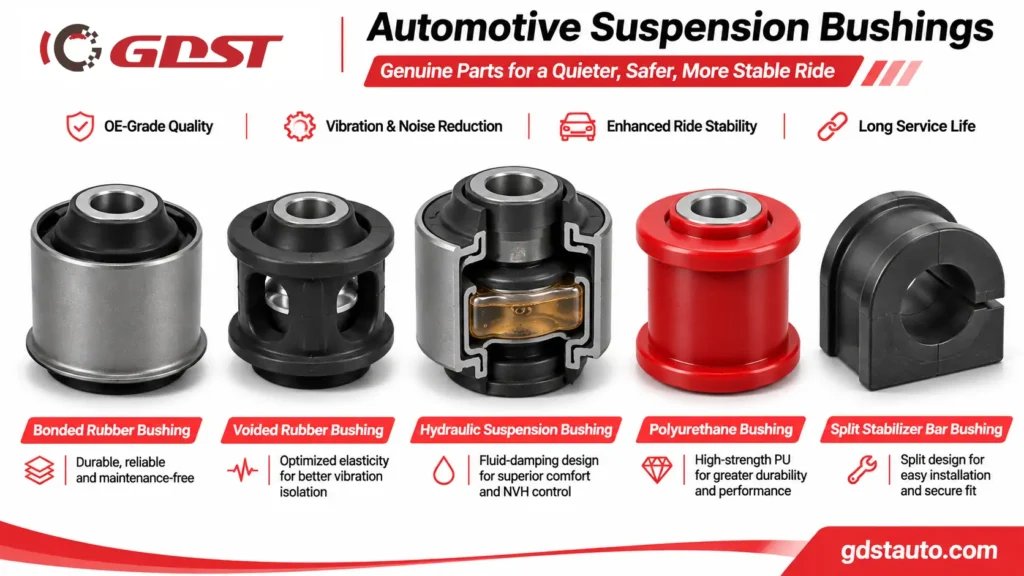
Automotive bushings come in different constructions to suit the movement, loading, and comfort requirements of individual suspension applications.
Bonded Rubber Bushings
These bushings use rubber bonded between inner and outer metal sleeves. They are widely used in control arms and other suspension connections.
The rubber provides flexibility and damping, while the metal sleeves provide mounting and structural support.
Voided Rubber Bushings
Voided bushings contain openings or specially shaped sections in the rubber element.
These features allow engineers to tune stiffness in different directions. The void arrangement can influence how the bushing responds to braking, cornering, acceleration, and vertical suspension movement.
Hydraulic Bushings
Some automotive suspension bushings contain fluid-filled chambers within their structure.
The fluid moves between chambers as the bushing deforms, creating additional damping characteristics. These designs are used in selected applications where more specific vibration isolation is required.
Polyurethane Bushings
Polyurethane bushings are used in certain aftermarket and performance applications.
Their stiffness and deformation characteristics differ from conventional rubber bushings, depending on material formulation, hardness, geometry, and design.
A polyurethane bushing is not automatically an upgrade for every vehicle. A change in bushing stiffness can affect suspension compliance, road-noise transmission, and ride comfort.
Non-Bonded or Split Bushings
Some automotive bushings are designed as separate components that fit around a shaft or stabilizer bar rather than using a bonded inner and outer sleeve arrangement.
Split stabilizer bar bushings are a common example. Their structure allows installation around the bar without removing the entire assembly.
Materials Used in Automotive Bushings
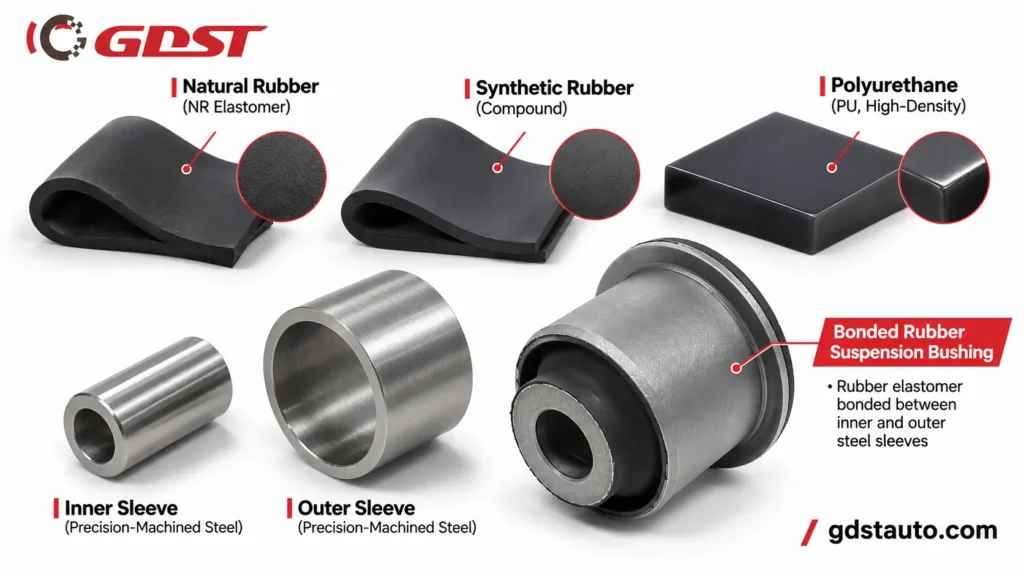
The material used in an automotive bushing affects its stiffness, elasticity, damping, durability, and resistance to environmental conditions.
Natural Rubber
Natural rubber is widely used in automotive suspension applications because of its elasticity, resilience, and ability to accommodate repeated deformation.
Its formulation can be adjusted to achieve different stiffness and damping characteristics.
Synthetic Rubber
Synthetic elastomers are used when particular temperature, aging, oil resistance, or environmental requirements need to be addressed.
The specific compound depends on the application and the expected operating conditions.
Polyurethane
Polyurethane is used in some replacement and performance-oriented bushings.
Its mechanical properties can be adjusted through formulation and hardness. Compared with conventional rubber designs, some polyurethane bushings provide less deformation under similar loads, although actual performance depends on geometry and material specification.
Metal Sleeves
Steel sleeves are commonly used in bonded suspension bushings.
They provide the mounting surfaces needed to secure the bushing to the control arm, subframe, or vehicle structure. Surface treatment and dimensional accuracy are important for proper installation and corrosion resistance.
The choice of bushing material should not be based on hardness alone. The intended suspension movement, stiffness requirements, temperature, environmental exposure, and compatibility with the mating components all need to be considered.
How Bushing Stiffness Affects Suspension Performance
Bushing stiffness is one of the most important characteristics in automotive suspension design.
It describes how much force is required to produce a certain amount of deformation. In a linear approximation, stiffness can be expressed as:
Stiffness = Force / Displacement
For automotive suspension bushings, three deformation directions are particularly important.
Radial Stiffness
Radial stiffness describes the resistance to movement perpendicular to the bushing’s centerline.
It helps control suspension movement under forces generated during cornering, braking, acceleration, and road impacts.
Axial Stiffness
Axial stiffness describes the resistance to movement along the bushing’s centerline.
It influences how the suspension connection responds to forces acting along the sleeve axis.
Torsional Stiffness
Torsional stiffness describes the resistance to relative rotation between the inner and outer sleeves.
It is particularly important in suspension designs where the bushing accommodates angular movement through rubber deformation.
The geometry and mechanical properties of the elastomer directly influence the bushing’s stiffness in each direction. Changes to the inner sleeve, outer sleeve, rubber dimensions, and material properties can alter its force-displacement characteristics. These factors must be considered together when designing a bushing for a particular suspension application. [1]
This explains why two bushings with similar external dimensions may not perform identically. Differences in rubber formulation, internal geometry, sleeve dimensions, and bonding structure can produce different force-displacement characteristics.
Frequency, Amplitude, and NVH Characteristics of Automotive Bushings
Automotive rubber bushings do not respond to every road input in exactly the same way.
Their dynamic properties can change with excitation frequency, displacement amplitude, temperature, and preload.
This is important because a vehicle suspension experiences a wide range of operating conditions. Small road irregularities, larger suspension movements, braking forces, and cornering loads produce different patterns of deformation.
Two characteristics are particularly relevant:
- Dynamic Stiffness:The relationship between the applied dynamic force and the resulting displacement.
- Loss Factor:A measure associated with the phase difference between force and displacement, reflecting energy dissipation during cyclic deformation.
Experimental measurements of carbon-black-filled rubber bushings have demonstrated that axial and radial dynamic stiffness depend on both excitation frequency and displacement amplitude. The material’s behavior also exhibits amplitude-dependent characteristics, meaning that its response cannot be fully described by a single static stiffness value. [2]
The same relationship can be observed in more detailed dynamic testing. In one experimental evaluation, rubber bushings were tested at displacement amplitudes of 0.2 mm, 0.4 mm, and 0.6 mm. Experimental data from 1–60 Hz was used to develop a model for predicting dynamic behavior at 61–100 Hz.
Under the specific test conditions, the prediction error was below 1% for dynamic stiffness and below 3% for the loss factor. [3]
These figures describe the accuracy of the prediction model under the tested conditions, not universal performance specifications for automotive bushings.
Together, these findings show why static stiffness alone cannot fully describe the behavior of a suspension bushing. Its response under real driving conditions depends on the applied movement and operating environment.
This is also why bushing design plays an important role in vehicle noise, vibration, and harshness (NVH) performance.
Automotive Bearings: Common Types and Applications
Although automotive bushings and bearings are often installed within the same general systems, their functions are different.
The following are common automotive bearing applications.
Wheel Bearings
Wheel bearings support the rotating wheel hub and allow it to turn relative to the stationary suspension or steering structure.
They are designed to handle the radial and axial forces generated during driving, braking, and cornering.
Strut Mount Bearings
Some MacPherson strut suspension systems use a bearing within the upper strut mount.
It allows the strut and spring assembly to rotate as the steering system turns. Not every strut mount uses the same bearing arrangement, so the correct design depends on the vehicle.
Alternator Bearings
Alternator bearings support the rotor shaft and allow it to rotate while the alternator generates electrical power.
Transmission Bearings
Transmission bearings support rotating shafts and gears inside the transmission assembly.
Their design depends on the load direction, rotational speed, available space, and transmission configuration.
Engine Bearings
Engine crankshaft and connecting rod bearings are important examples of automotive plain bearings.
They generally use bearing shells and a lubricating oil film to support rotating or oscillating engine components. They are not the same as suspension rubber bushings or wheel-hub rolling bearings.
This distinction is useful when comparing automotive components because the word bearing covers more than one mechanical design.
Are Automotive Bushings Better Than Bearings?
Neither automotive bushings nor bearings are universally better. They are designed to perform different jobs.
An automotive suspension bushing is suitable when a connection needs to accommodate controlled movement while providing flexibility, vibration isolation, and specific stiffness characteristics.
A rolling-element bearing is suitable when a component needs to rotate while carrying the required radial or axial loads.
For example, a lower control arm bushing allows controlled movement between the control arm and vehicle structure. A wheel bearing supports the wheel hub as it rotates.
Replacing one with the other would change the mechanical function of the assembly.
Even within the same component category, performance varies. A rubber suspension bushing designed for comfort may have different stiffness characteristics from one developed for a performance-oriented suspension system.
The correct choice depends on the original engineering requirements rather than a general assumption that one component is better.
Can an Automotive Bushing Replace a Bearing?
An automotive suspension bushing generally cannot replace a wheel bearing or another rolling-element bearing.
The two components have different structures and operating functions.
A wheel bearing must support rotation between the hub and its mounting structure. A suspension bushing must provide a controlled connection between components while accommodating movement through elastic deformation.
Similarly, a strut mount rubber insulator cannot automatically replace a strut mount bearing. If the original suspension design requires a bearing to allow steering rotation, the replacement must maintain that function.
There are also cases where automotive components are incorrectly identified because they have similar external shapes or are located close to each other.
Before selecting a replacement, confirm the OE reference, vehicle application, mounting arrangement, dimensions, and actual component function.
Common Signs of Worn Automotive Bushings
Suspension bushing wear can affect the way a vehicle feels and behaves on the road.
Common symptoms include:
Knocking or Clunking Noises
A worn or damaged bushing may allow excessive movement between connected suspension components. This can produce knocking or clunking sounds when driving over uneven surfaces.
Squeaking or Creaking
Rubber deterioration, friction at the mounting interface, or changes in the bushing’s condition may produce squeaking or creaking noises.
Excessive Suspension Movement
A damaged bushing may no longer control suspension movement as intended, allowing the connected arm or linkage to move beyond its normal range.
Uneven Tire Wear
Changes in suspension positioning can affect wheel alignment and contribute to uneven tire wear.
Changes in Steering or Handling
Worn control arm or other suspension bushings may contribute to steering instability, wandering, or changes in vehicle response.
Visible Rubber Damage
Cracking, tearing, deformation, or separation between the rubber and metal sleeves can indicate deterioration.
These symptoms are not exclusive to bushing failure. Ball joints, tie rod ends, shock absorbers, wheel bearings, and other suspension components can produce similar problems. A proper inspection is necessary before identifying the failed part.
Common Signs of Worn Automotive Bearings
Rolling-element bearing problems usually present differently from suspension bushing wear.
Common warning signs include:
- Humming or rumbling noises that change with vehicle speed.
- Grinding or roughness during rotation.
- Excessive play in the wheel hub or rotating assembly.
- Abnormal bearing temperature.
- Vibration associated with a rotating component.
For example, a worn wheel bearing may produce a humming or rumbling noise while driving. In some cases, the noise changes during cornering as the load on the bearing changes.
However, tire noise, brake problems, and other suspension faults can create similar symptoms.
Bearing diagnosis should therefore include appropriate inspection of the rotating assembly rather than relying on sound alone.
How to Choose the Correct Automotive Bushing or Bearing
Selecting the correct replacement requires more than matching the external appearance of the original component.
Start by confirming the vehicle application.
Important identification details include:
- Vehicle make and model.
- Model year.
- Engine or powertrain configuration, where relevant.
- Drivetrain, such as FWD, RWD, or AWD.
- Suspension type and configuration.
- OE part number or other original identification reference.
Next, check the component’s physical characteristics.
For automotive bushings, relevant details include:
- Inner and outer diameters.
- Overall length and sleeve dimensions.
- Mounting structure.
- Rubber or polyurethane construction.
- Internal void arrangement.
- Bonding and sleeve design.
- Required stiffness characteristics, where specified.
For automotive bearings, identification may require:
- Inner and outer diameters.
- Bearing width.
- Bearing type.
- Sealing arrangement.
- Load and speed requirements.
- Mounting and retention design.
- OE reference.
A similar-looking component is not necessarily interchangeable. Even small differences in sleeve length, internal geometry, mounting position, or stiffness can affect how a suspension bushing performs.
For this reason, OE matching and vehicle-specific verification are important parts of replacement selection.
Automotive Bushing Replacement and Installation Considerations
Correct installation is important for achieving the intended performance and service life of an automotive bushing.
Before installation, inspect the mating components for damage, corrosion, deformation, and excessive wear.
For press-fit bushings, confirm that the housing bore and bushing dimensions are appropriate. Incorrect installation methods can damage the outer sleeve or elastomer.
The installation position also matters. Some bushings have directional features, alignment marks, or void arrangements that must be positioned correctly.
For bonded rubber bushings, the final tightening procedure can affect the installed condition of the rubber. Depending on the vehicle manufacturer’s design, certain suspension fasteners may need to be tightened at the specified suspension position rather than with the suspension hanging freely.
Always follow the vehicle manufacturer’s service instructions and the replacement component manufacturer’s installation requirements.
After replacement, inspect the suspension assembly and check wheel alignment when required by the repair procedure.
Frequently Asked Questions About Automotive Bushings and Bearings
Are bushings and bearings the same thing?
No. Automotive suspension bushings generally provide flexible connections through elastomer deformation, while rolling-element bearings support rotating components through balls or rollers. The broader engineering term bearing can also include plain bearings.
Is a control arm bushing a bearing?
A conventional rubber control arm bushing is an elastomeric suspension joint rather than a rolling-element bearing. It allows controlled movement between the control arm and the vehicle structure while helping isolate vibration.
What is the difference between a wheel bearing and a control arm bushing?
A wheel bearing supports the rotating wheel hub, while a control arm bushing connects the control arm to the vehicle structure and accommodates suspension movement through elastic deformation.
Do automotive bushings rotate?
Some automotive bushings accommodate angular or rotational movement, but conventional bonded rubber suspension bushings generally achieve this through deformation of the elastomer rather than continuous sliding between metal surfaces.
Are polyurethane bushings better than rubber bushings?
Not necessarily. Polyurethane and rubber have different stiffness, damping, and deformation characteristics. The appropriate material depends on the vehicle’s suspension design, comfort requirements, handling targets, and intended application.
Can worn bushings affect wheel alignment?
Yes. Excessive movement in suspension bushings can change the position of connected suspension components and may affect wheel alignment, handling, and tire wear.
Do all strut mounts contain bearings?
No. Some suspension designs incorporate a strut mount bearing to allow rotation during steering, while others use different mounting arrangements. The correct configuration depends on the vehicle.
Understanding the Difference Between Automotive Bushings and Bearings
Automotive bushings and bearings both play important roles in vehicle operation, but their purposes should not be confused.
Suspension bushings are designed to connect components while allowing controlled movement through elastomer deformation. They help manage suspension stiffness, isolate vibration, and contribute to ride comfort and handling.
Automotive rolling-element bearings, on the other hand, support rotating components such as wheel hubs, shafts, and accessory assemblies. Their primary purpose is to carry loads while allowing controlled rotation.
The distinction becomes particularly important when selecting replacement parts. A control arm bushing, stabilizer bar bushing, strut mount bearing, and wheel bearing may all belong to the same general vehicle system, but they perform different mechanical functions.
The correct replacement should always match the original application, component design, mounting dimensions, and vehicle specifications. Similar appearance alone is not enough to establish compatibility.
Research References
[1] Rivas-Torres, J., Tudon-Martinez, J. C., Lozoya-Santos, J. D., Ramirez-Mendoza, R. A., & Spaggiari, A. (2019). Analytical Design and Optimization of an Automotive Rubber Bushing. Shock and Vibration, 2019, Article 1873958.
[2] García Tárrago, M. J., Kari, L., Viñolas, J., & Gil-Negrete, N. (2007). Frequency and Amplitude Dependence of the Axial and Radial Stiffness of Carbon-Black Filled Rubber Bushings. Polymer Testing, 26(5), 629–638.
[3] Li, G., Wu, L., Zhang, S., et al. (2022). Frequency Dependence Prediction and Parameter Identification of Rubber Bushing. Scientific Reports, 12, Article 863.
