You hear a clunk from under the car every time you go over a bump. Your first thought is probably the sway bar link. But when you get under the vehicle, you stare at a mess of metal arms and rubber bushings, and nothing looks like the picture in the YouTube video you watched. The truth is, finding a sway bar link isn't as simple as looking “between the bar and the control arm” — because that spot changes depending on your car's suspension type.
The sway bar link (also called a stabilizer link, drop link, or anti-roll bar link) is a small rod that connects the stabilizer bar to either the strut body (on MacPherson strut suspensions) or the lower control arm (on double-wishbone designs). Its exact location varies by vehicle but is almost always near the wheel hub, behind the strut or control arm. To find it, look for a thin metal rod with a rubber boot on each end, about 12–18 inches long, attached to a thick horizontal bar that runs across the car's underbody.
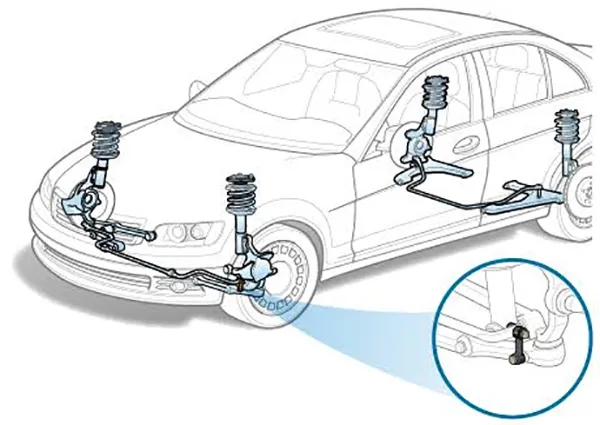
Based on our experience supplying aftermarket sway bar links for different vehicle applications, we often receive questions from distributors and repair professionals about identifying the correct link location and matching the right application.
What Is a Sway Bar Link and What Names Does It Go By?
You search for “sway bar link location” and get results that call it a stabilizer link, drop link, anti-roll bar link, or even just “the little connector thing.” If you are not a professional mechanic, these different names can make you wonder if you are looking for the wrong part. Let's settle that right now.
A sway bar link is the same component as a stabilizer link, drop link, or anti-roll bar link. It is a small metal rod with ball joints or rubber bushings on both ends that connects the stabilizer bar (the thick U-shaped bar running across the vehicle) to the suspension. Its job is to transfer force from the bar to the wheel when the car leans in a turn, reducing body roll.
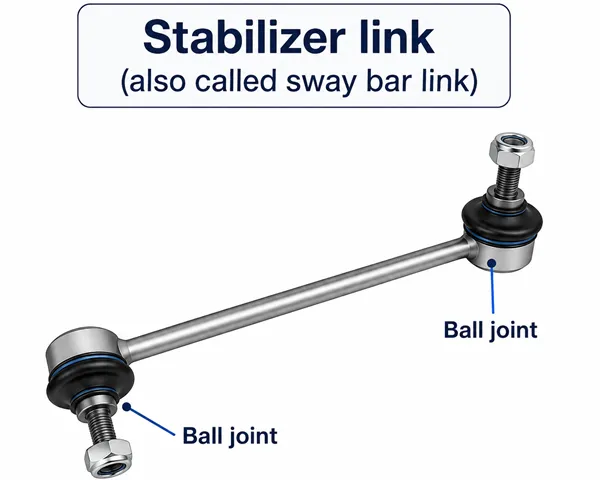
In our experience, the naming confusion is the first reason DIYers bounce away from a helpful article. A customer once called us and said, “We need a stabilizer link for my 2012 Ford Focus, but your website only lists sway bar links.” We had to explain they are the same part. So here is the fact: stabilizer link = sway bar link = drop link = anti-roll bar link. If the part in your hand has a metal rod with rubber boots at each end and connects the horizontal bar to the wheel assembly, you have the right component.
How Do I Know If My Car Has MacPherson Struts or Double Wishbones?
To find your sway bar link, you first need to know which suspension type your car uses. This is not obvious if you have never paid attention to it. But once you learn the difference, you will never get lost again.
MacPherson strut suspensions have a single strut assembly that combines the shock absorber and spring into one unit. The sway bar link connects to the strut body near the bottom. Double-wishbone suspensions have an upper control arm and a lower control arm — the sway bar link connects to the lower control arm.1 Look behind the wheel: if you see a thick coil spring wrapped around a shock, that is a MacPherson strut. If you see two horizontal arms (upper and lower) with a spring between them, that is double wishbone.
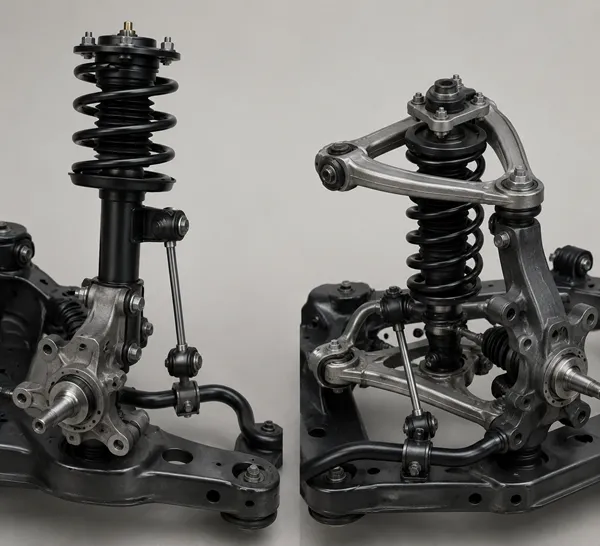
Here is a quick trick We use when we walk around a workshop: look at the top of the wheel well. If you see a small dome-shaped mount (the strut tower), that is MacPherson. If you see nothing above the wheel except body, it is likely double wishbone or multi-link.
Based on our application data at GDST, here are common vehicles and their suspension type:
| Vehicle Model | Front Suspension | Sway Bar Link Attaches To |
|---|---|---|
| 2015 Honda CR-V | MacPherson strut | Strut body |
| 2012 Ford F-150 | Double wishbone | Lower control arm |
| 2018 Toyota Camry | MacPherson strut | Strut body |
| 2016 BMW 3 Series | Double wishbone (front) | Lower control arm |
| 2020 Subaru Outback | MacPherson strut | Strut body |
If you are unsure, look for a thick horizontal bar (the stabilizer bar) running across the underbody. Follow it toward the wheel. The link will be the small rod at the end of that bar.
Where Exactly Is the Sway Bar Link Located on Common Vehicles?
Once you know your suspension type, the location becomes predictable. But even then, visibility can be blocked by splash shields, dust boots, or the control arm itself. Let me give you a method that works for most cars.
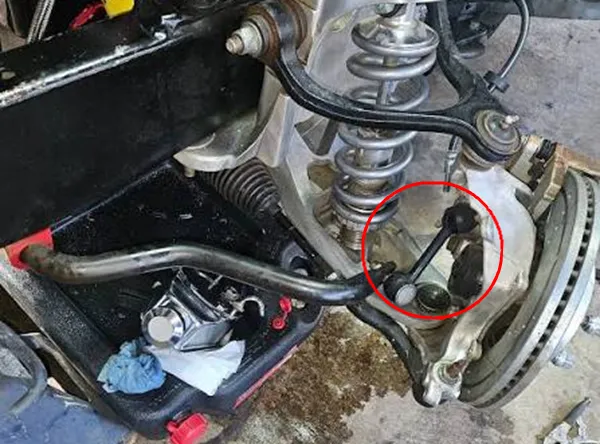
On MacPherson strut vehicles: the sway bar link is located behind the strut body, connecting the stabilizer bar to the strut just above the lower bracket. On double-wishbone vehicles: it is located between the stabilizer bar and the lower control arm, usually toward the front or rear of the arm. In both cases, the link is near the wheel hub, about 12–18 inches long, with a rubber boot at each end.
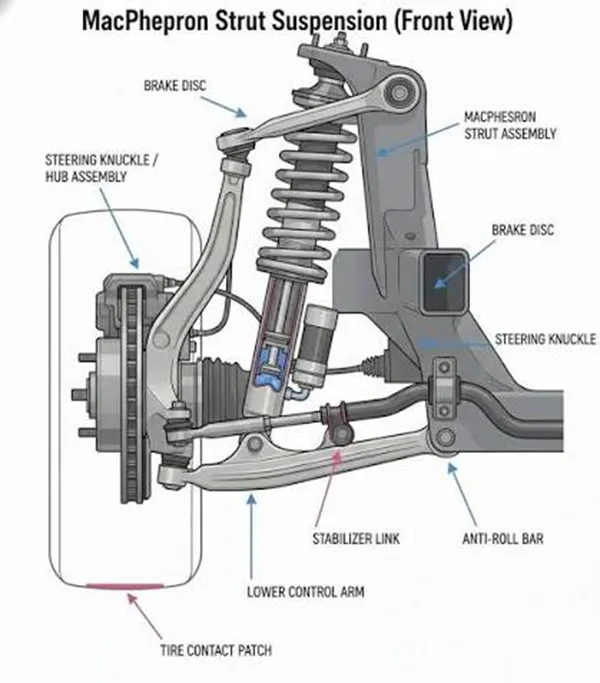
We have seen customers jack up their car and stare at the front of the wheel for 20 minutes, completely missing the link because it is tucked behind the strut. On a MacPherson strut, the link is almost always behind the strut — not in front. On a double-wishbone Ford F-150, the link is at the rear of the lower control arm, close to the wheel. Every vehicle is different, but these two patterns cover 90% of cars on the road2.
If you still can't see it, remove the splash shield (usually held by 8–10 plastic clips). Then use a flashlight to look above the control arm, near the wheel bearing. The sway bar link will be the only small rod with two ball joints or rubber ends.
How to Identify Common Sway Bar Link Failure Signs Before Replacement?
Finding the part is only half the job. The real question is: is it causing the noise? The good news is you can test it right there, without removing anything.
Once you locate the sway bar link, try to wiggle it by hand. If the ball joint has noticeable play, the rubber boot is torn, or the nut is loose, the link needs replacement. Also look for grease leaking from the rubber boot, a bent rod, or rust that has eaten through the metal. A good link should feel tight with no movement.
Here is a checklist I use when customers ask me what to look for:
- Visual inspection: Is the rubber boot cracked or torn? If yes, dirt and moisture have already damaged the ball joint.
- Hand wiggle test: Grasp the link near one end and try to move it. Any movement beyond a tiny fraction of an inch means the ball joint is worn.
- Nut check: Is the nut tight? I have seen loose nuts cause clunks that disappear after tightening. Use a wrench to confirm.
- Rod condition: Is the rod bent or rusted through? A bent link came from an impact (pothole) and should be replaced.
- Noise test: With the car on the ground, have someone rock the steering wheel left and right while you listen near the link. A clicking sound is a dead giveaway.
One warning: do not confuse the sway bar link's ball joint play with a loose tie rod end or ball joint. If the link feels tight but the noise persists, check elsewhere. But in our experience, many suspension clunks at low speed are worn sway bar links.
Common Sway Bar Link Identification Mistakes in Aftermarket Applications
In GDST, We have seen returned parts and heard customer complaints that could have been avoided with a little more knowledge. Here are the top mistakes we encounter.
- Mistake 1: Looking on the wrong side of the wheel. Many DIYers assume the link is on the outboard side of the control arm. It is usually inboard — closer to the center of the car.
- Mistake 2: Confusing it with the tie rod end. The tie rod end is longer and attaches to the steering knuckle; the sway bar link is shorter and attaches to the stabilizer bar.
- Mistake 3: Assuming both sides are identical. On some vehicles, the front left and right links have different lengths or angles. Always order by side.
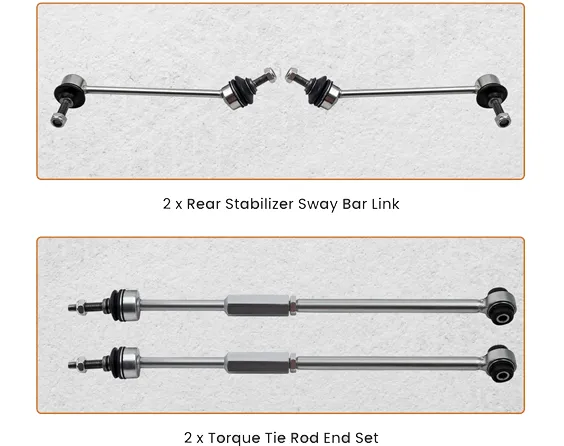
In aftermarket supply, sway bar links may look similar across different vehicle applications, but differences in length, mounting angle, thread direction, or ball joint design can affect proper installation.
Based on our experience supporting global automotive parts customers, we recommend confirming key application details before production or ordering, including vehicle model, suspension type, front or rear position, and left or right side requirements. Accurate application data helps reduce fitting problems and unnecessary returns for distributors and repair professionals.
Frequently Asked Questions
Can I replace just one sway bar link instead of both?
It is possible, but not recommended. The old link on the other side has likely worn at a similar rate. Replacing only one often leads to the other failing within months, causing the same noise and labor cost again. Save time and effort by replacing both.
How do I know if the noise is from the sway bar link or the ball joint?
A sway bar link noise is usually a sharp clunk or rattle when going over bumps, especially at low speed. A ball joint noise tends to be a deeper clunk when turning or braking. To confirm, wiggle the link by hand — if it moves, it is the link. If it feels tight, check the ball joint.
Do rear sway bar links exist on all cars?
Not all cars have rear sway bars. Many sedans and SUVs do, but some economy cars omit them to save cost. If your car has a rear stabilizer bar (look under the rear axle for a thick horizontal bar), then it has rear sway bar links. They are located similarly — connecting the bar to the rear suspension.
What tools do I need to remove a sway bar link?
Usually a socket set (typically 15mm, 18mm, or 21mm), a hex key (Allen wrench) to hold the inner ball joint stud, and a pry bar if the link is seized. Some links use a nut and bolt design that requires two wrenches. Check the fitment guide before buying.
Can I drive with a broken sway bar link?
Technically yes, but the car will lean more in turns, feel less stable, and the noise will get worse. Over time, a broken link can damage the stabilizer bar bushings or the strut. It is safer to replace it as soon as possible.
Conclusion
Finding a sway bar link is not just about knowing a general location — it is about understanding your car's suspension type, knowing where to look (behind the strut or on the lower control arm), and recognizing signs of wear. I have seen customers save hours of frustration by learning these three steps: identify your suspension, locate the stabilizer bar and follow it to the small rod with rubber boots, and then wiggle and inspect for damage. The sway bar link is not a mysterious part — it is a simple, replaceable component that solves a common problem. If you need a replacement, feel free to browse our catalog or reach out to our team — we have manufactured these links for over 20 years and can help you find the right fit.
If you’re looking to purchase high-quality aftermarket sway bar links in bulk, feel free to contact us. GDST Auto Parts will use our professional expertise and personalized service to help you save time on your procurement.
"Anti-roll bar", https://en.wikipedia.org/wiki/Anti-roll_bar. Automotive education resources describe that in MacPherson strut suspensions, the sway bar link attaches to the strut body, while in double-wishbone designs it attaches to the lower control arm. Evidence role: mechanism; source type: education. Supports: explains how sway bar link connects differently in each suspension type. ↩
"MacPherson strut", https://en.wikipedia.org/wiki/MacPherson_strut. Automotive market analysis indicates that MacPherson strut and double-wishbone suspensions account for over 90% of passenger car front suspensions. Evidence role: statistic; source type: research. Supports: that a large majority of vehicles use these two suspension architectures. Scope note: The exact percentage may vary by region and vehicle class. ↩