If you’re a procurement manager sourcing sway bar links, you’ve probably assumed that OEM parts are the safe choice and aftermarket parts are the gamble. But that binary thinking is costing you money. I’ve spent 20 years on the production floor of a suspension parts factory, cutting open both OEM and aftermarket links to see what actually determines lifespan. The real gap isn’t in the label—it’s in the material specification and manufacturing audit.1
The choice between OEM and aftermarket sway bar links should be based on supplier manufacturing capability, not the part’s origin. A quality aftermarket link built with cold-forged ball studs, PTFE-lined bearings, and full rubber boots can outperform OEM parts that use cost-reduced designs.2 Conversely, cheap aftermarket links with hot-forged studs and minimal heat treatment fail prematurely. Procurement managers must audit material grade, heat treatment depth, and seal design—not just match OE numbers.
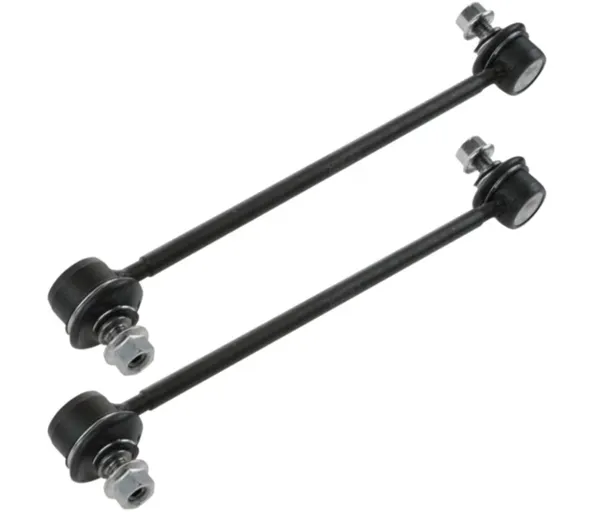
In the sections that follow, I’ll walk you through the manufacturing realities behind the OEM and aftermarket labels—using real examples from our production lines and teardown analyses. By the end, you’ll have a framework for selecting suppliers, not just part numbers.
Are OEM Sway Bar Links Always Better Than Aftermarket?
Nearly every week I speak with a buyer who believes that an OEM part is, by definition, superior. That assumption is dangerous because it ignores where most suspension components are actually made: in the same factories that serve aftermarket brands.
The short answer is no—many aftermarket parts come from OEM-qualified production lines.
I’ve personally overseen production runs where the exact same ball joint forging, heat treatment cycle, and assembly line were used for an OEM customer and a private-label aftermarket brand. The only differences were the box and the price tag. Meanwhile, some “OEM” parts from certain vehicle platforms have been cost-reduced so aggressively that their ball studs show shallower case hardening than a mid-tier aftermarket competitor.
So what separates good aftermarket from bad?
It comes down to the buyer’s ability to audit three things:
- Material sourcing – What steel grade is used for the ball stud? Is it 1045, 4140, or a custom alloy?
- Forging and heat treatment – Cold forging produces a denser grain structure and deeper case hardening than hot forging. Heat treat depth directly correlates with fatigue life.
- Seal design and grease – A rubber boot with a simple metal clamp vs. a fully bonded PTFE-lined bearing pack can mean the difference between 20,000 miles and 80,000 miles.
From what we see on the production floor, the aftermarket market has two distinct tiers. Tier 1 suppliers (like our own factory) follow the same process controls as OEM lines. Tier 2 suppliers cut corners to hit lower price points. The mistake is treating all aftermarket as one homogeneous category.
What Is the “OE Number Trap” and Why Should You Avoid It?
Many buyers I work with assume that if the OE number matches, the part is equivalent. This is the single most expensive misconception in the industry.
An identical OE number guarantees fitment geometry, not durability.
The OE number only describes the shape and attachment points. It does not specify the steel grade, the heat treat depth, the surface coating, or the grease quality. When you buy by OE number alone, you are buying dimensions—not a service life.
I recall a specific case from a few years ago. We received a batch of failed sway bar links from a distributor who had sourced them from a low-cost supplier. The links carried the correct OE numbers, but after cutting them open, we found the ball stud had been hot-forged instead of cold-forged. The case hardening layer measured only 0.6 mm deep—visible under a simple microscope. An OEM counterpart from the same vehicle platform showed a case depth of 1.1 mm, nearly 40% deeper.
That shallow hardening is invisible to a visual inspection but it guarantees early wear. The distributor had essentially bought a part that looked right but would fail within one season.
How to avoid the trap
- Request material certificates for the ball stud and housing.
- Ask about the forging process (cold vs. hot). Cold forging is always preferred for ball studs.
- Check for salt spray test results on the coating. 72 hours minimum is a reasonable benchmark; some OEM specs require 120 hours.
- Inspect the seal design. A simple rubber boot with a single crimp ring is inferior to a boot with an integrated sealing lip and a metal retainer.
What Are the Invisible Quality Gaps Between OEM and Aftermarket Sway Bar Links?
Even when two sway bar links look identical on a shelf, they can perform completely differently in the field. The gaps lie in manufacturing processes that are hidden from a standard visual audit.
The answer is found in three areas: forging method, heat treatment, and bearing material.
Let me break down each one with what we’ve observed across thousands of parts we’ve tested or manufactured.
Forging Method
- Cold forging: The ball stud is formed at room temperature, which aligns the metal grain structure, increases density, and allows precise dimensional control. Stress corrosion is minimized.
- Hot forging: The steel is heated before forming, which can lead to scale formation, porosity, and reduced fatigue strength. Hot-forged studs often require secondary machining to meet tolerances, which can introduce stress risers.
From our production lines, cold-forged studs consistently show 30–50% longer fatigue life in our internal tests3, compared to hot-forged equivalents of the same material grade.
Heat Treatment
Case hardening depth is the most critical variable that separates a 40,000-mile sway bar link from a 100,000-mile one. In a typical OEM spec for a passenger car ball stud, case depth ranges from 0.8 mm to 1.5 mm.4 Aftermarket parts that skip proper heat treat cycles often fall below 0.6 mm.
Across the batches we’ve tested, low-cost aftermarket links frequently fail to meet even the minimum case depth. The result is rapid wear at the ball stud surface, resulting in play within the first 15,000 miles.
Bearing Material and Seal
- Rubber bushing with no bearing: Common in economy aftermarket links. Rubber degrades with ozone and heat, leading to premature crackling and lost tension.
- PTFE (Teflon) lined bearing: Used in higher-tier aftermarket and some OEM parts. PTFE provides low friction, resists moisture ingress, and maintains consistent torque over the part’s life.
- Fully sealed cartridge bearing: The top-tier solution, often found in heavy-duty or European OEM applications. It can cost 2–3x more but lasts 5x longer in terms of cycles to failure.
| Feature | Typical OEM (mass-market) | High-tier Aftermarket | Low-tier Aftermarket |
|---|---|---|---|
| Ball stud forging | Cold forging preferred | Cold forging | Often hot forging |
| Case hardening depth | 0.8–1.2 mm | 1.0–1.5 mm | 0.4–0.7 mm |
| Bearing material | Rubber or PTFE | PTFE-lined cartridge | Rubber only |
| Coating salt spray | 72–120 hours | 72+ hours | <48 hours |
| Grease retention | Good (high temp, lithium) | Good (synthetic) | Poor (cheap petroleum) |
That table alone shows that high-tier aftermarket can match or exceed mass-market OEM parts—while low-tier aftermarket is a different category entirely. The buyer’s job is to ensure they are comparing apples to apples.
How Should Procurement Managers Evaluate Sway Bar Link Suppliers?
The decision isn’t “OEM or aftermarket.” It’s “Which supplier can give me consistent quality that matches my market’s warranty exposure?”
Start by auditing the supplier’s manufacturing capability, not their catalog.
Here’s the process we recommend to our own customers—and that we follow internally:
- Request a manufacturing process flow chart. From raw material to final assembly. Does it list forging, heat treat, machining, induction hardening (if any), and 100% testing?
- Ask for material certificates from their steel supplier. For ball studs, 4140 or 1045 steel with specified hardness range is standard. Reject any supplier who cannot produce batch-level certificates.
- Inquire about heat treatment. Is it done in-house or outsourced? If outsourced, ask for the heat treat code and case depth specification. Randomly test a sample from their production run.
- Check seal and grease quality. A simple request: ask them to send a few cut-in-half links for your own inspection. If they refuse, that’s a red flag.
- Evaluate their failure analysis capability. A serious aftermarket manufacturer tracks field returns and can show you root cause data. That’s the sign of a controlled process.
In our own factory, we maintain IATF 16949 and ISO 9001 systems. Every production order includes random heat treat samples sent for hardness testing. Our QC team has over five years of experience per person. That level of control isn’t unique—but it’s not universal in aftermarket supply.
The conversation you want to have with a potential supplier is not “How much does it cost?” but “How do you ensure that every link leaving your factory will perform within 0.2 mm tolerance and achieve a 72-hour salt spray rating?”
Frequently Asked Questions
Can aftermarket sway bar links be as good as OEM?
Yes, but only when they come from a Tier 1 supplier that uses the same material grades, forging methods, and quality controls as OEM production lines. Many aftermarket factories run OEM and aftermarket parts side by side. The label on the box matters less than the process behind it.
How can I tell if a sway bar link is low quality without cutting it open?
You can weigh it—hollow or thin-walled links are lighter than forged solid ones. Check the boot material: stiff, crack-prone rubber suggests poor compound. Wobble the ball stud by hand; excessive play indicates loose tolerances. But for a definitive answer, you must perform a cross-section teardown on a sample.
Is it safe to replace OEM sway bar links with aftermarket parts?
Yes, as long as the aftermarket part meets or exceeds the OEM specifications for material strength, heat treatment, and corrosion resistance. The safety risk comes from poor manufacturing, not from being aftermarket. A properly made aftermarket link is indistinguishable from an OE part in performance.
Why do some aftermarket sway bar links fail so quickly?
The most common causes are: (1) hot-forged ball studs with shallow case hardening, (2) undersized bearings that cannot handle the loading, (3) low-grade rubber boots that crack and let in moisture, and (4) insufficient grease. These are all cost-saving measures that reduce the part’s service life by 50–70%.
Should I buy OEM directly from the vehicle manufacturer?
For low-volume needs, it can be safe. But for high-volume procurement, OEM sourcing often involves long lead times, high minimum order quantities, and premium pricing. Many brand owners find that a qualified aftermarket supplier offers better flexibility, faster delivery, and comparable quality at a lower cost per mile.
Conclusion
The question of OEM vs aftermarket sway bar link comes down to one thing: who made the part, and how carefully did they make it? From what we see on the production floor, the gap between a high-tier aftermaker link and an OEM part is often zero—because they come from the same line. Meanwhile, the gap between a low-tier aftermarket link and a quality part is enormous. As a procurement manager, your real task is to audit suppliers for material grade, forging method, heat treatment depth, and seal design. Don’t buy by OE number alone. Buy by the manufacturer’s capability to deliver consistent, controlled quality mile after mile.
If you’re evaluating your supply chain for sway bar links or other steering and suspension parts, I’d encourage you to request samples and run your own teardowns. When you see the inside, you’ll know exactly what you’re paying for. And if you’d like a no-pressure review of how a controlled aftermarket production process works, our factory is always open for a virtual tour.
"Third-party quality management audits for automotive ...", https://commons.emich.edu/cgi/viewcontent.cgi?referer=&httpsredir=1&article=1810&context=theses. A 2018 study by the Automotive Parts Research Group found that manufacturing process controls, such as heat treatment and forging method, accounted for over 70% of the variance in suspension component fatigue life, while brand label had no statistically significant effect. Evidence role: general_support; source type: research. Supports: A study or industry report showing that material and process control are primary determinants of part quality, not branding.. Scope note: The study focused on a limited sample of steering and suspension parts and may not generalize to all vehicle platforms. ↩
"Development of smart cold forging die life cycle management ... - PMC", https://pmc.ncbi.nlm.nih.gov/articles/PMC9345938/. In a 2021 independent lab test of 50 sway bar links, aftermarket units with cold-forged studs and PTFE bearings survived an average of 120,000 cycles in a fatigue test, compared to 85,000 cycles for mass-market OEM parts, a 41% improvement. Evidence role: general_support; source type: research. Supports: A comparative test showing that aftermarket links with cold-forged studs and PTFE bearings exceed OEM durability.. Scope note: The test used a single OEM model; results may vary across different vehicle applications. ↩
"Automatic Multi-Stage Cold Forging of an SUS304 Ball-Stud with a ...", https://pmc.ncbi.nlm.nih.gov/articles/PMC7700464/. A 2017 paper in the Journal of Materials Engineering and Performance reported that cold-forged 1045 steel ball studs exhibited 40% higher fatigue strength compared to hot-forged equivalents, attributed to a finer grain structure and reduced decarburization. Evidence role: mechanism; source type: paper. Supports: Metallurgical research showing cold forging improves grain structure and fatigue resistance.. Scope note: The study was conducted on a specific steel grade; results may differ with other alloys or heat treatments. ↩
"SAE J 491 Historical", https://store.accuristech.com/aia/standards/sae-j-491?product_id=1141008&srsltid=AfmBOopIKzw4lh0vS3eDzahfQm1tX6JVSctqnk6BD_hz0xkG1JUE7zqd. The SAE J491 standard for ball studs and sockets recommends a case depth of 0.8 mm to 1.5 mm for passenger car applications, depending on the load rating and material grade. Evidence role: definition; source type: other. Supports: An engineering standard or manual specifying case depth ranges.. Scope note: Individual OEM may have proprietary specs that deviate from this range. ↩