Uneven tire wear is one of the most common complaints in the aftermarket. When it appears, the instinct is to blame the tires. But the real cause is often somewhere else in the suspension system.
A worn ball joint can cause uneven tire wear, but not in every case and not always in the same way. The relationship depends on how far the joint has worn, how much clearance has developed, and whether that clearance is shifting the wheel's camber angle under load. Other factors — alignment, tire pressure, and suspension geometry — also contribute.
This question comes up often in our conversations with aftermarket buyers and procurement teams. The short answer is yes, but that answer alone isn't useful. What matters is understanding how the failure develops and what it looks like at each stage. That's the information you need to evaluate replacement timing, assess supplier quality, and avoid downstream warranty claims.
How Does a Worn Ball Joint Actually Affect Tire Wear?
Most people assume a bad ball joint simply fails. Either it works or it doesn't. That framing misses most of what actually happens in the field.
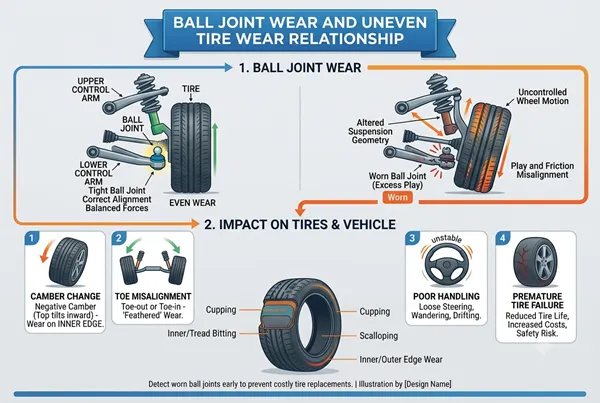
A ball joint connects the wheel hub to the suspension control arm.1 As the joint wears, clearance increases between the ball stud and the socket. That clearance allows the wheel to shift position under load — changing the camber angle dynamically. When camber shifts, the tire no longer contacts the road evenly, and one edge of the tread carries more load than the other.
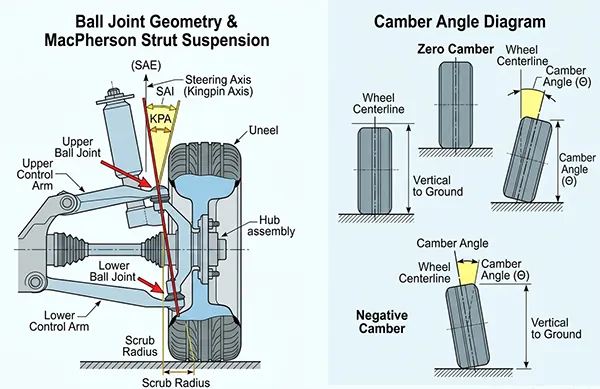
The key word here is dynamically. A small amount of clearance may not produce any measurable static misalignment on an alignment rack.2 The deviation only appears when the vehicle is moving — under cornering load, braking, or road irregularities. This is why alignment checks alone sometimes miss the problem.
The wear pattern the tire develops reflects how far the geometry has shifted. Inner-edge wear typically points to excess negative camber. Outer-edge wear suggests positive camber deviation. Feathering or diagonal wear across the tread often points to a combination of camber and toe deviation happening together. None of these patterns are unique to ball joint failure — but when ball joint clearance is the root cause, the pattern tends to worsen progressively and doesn't resolve with tire rotation or pressure correction alone.
From a procurement standpoint, this matters because it tells you something about the failure timeline. A joint that starts with excess clearance — due to poor manufacturing tolerances or premature preload loss — will begin producing camber deviation early in its service life. The tire will show wear that looks like an alignment problem. The end user adjusts alignment. The wear continues. By the time someone identifies the ball joint as the source, the tire is already damaged and the warranty claim is on your desk.
| Wear Pattern | Likely Camber Condition | Typical Cause |
|---|---|---|
| Inner edge wear | Excess negative camber | Ball joint clearance, control arm wear |
| Outer edge wear | Excess positive camber | Ball joint clearance, strut geometry shift |
| Feathering / diagonal wear | Combined camber and toe deviation | Multiple worn joints, alignment drift |
| Center wear | Overinflation | Tire pressure, not suspension |
| Both edge wear | Underinflation | Tire pressure, not suspension |
The table above shows that ball joint wear is one contributor — not the only one. Buyers who receive tire wear complaints from their distribution network need to evaluate the full picture before attributing the cause to a single component.
Does Every Bad Ball Joint Cause Tire Wear Problems?
Not every worn ball joint produces visible tire wear. The relationship is conditional, not universal.
Whether a bad ball joint causes uneven tire wear depends on the stage of wear, the vehicle type, the load conditions, and how much clearance has developed. In early-stage wear, the geometry deviation is small and intermittent. Tire wear may accelerate slightly but remain hard to detect. In advanced wear, the camber shift becomes consistent and visible wear patterns develop at the shoulder.
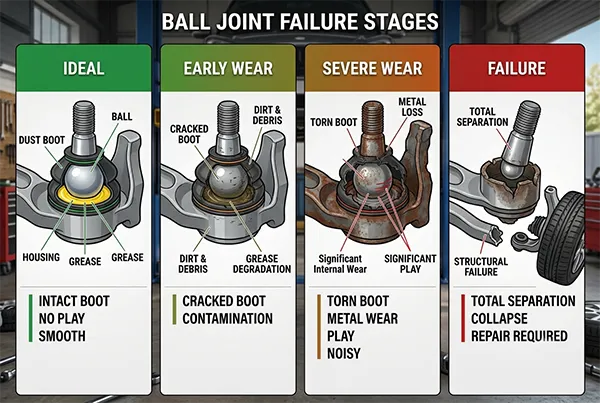
This staged progression is something we observe consistently through feedback from customers across different markets. The complaints that link ball joint quality directly to tire wear almost always come late. By the time the buyer receives the report from their distributor or fleet customer, the joint has already moved past early-stage wear into a condition where the damage is visible.
Early-stage failure is hard to catch in the field. The joint may still pass a manual shake test. There may be no audible noise. The vehicle may drive without obvious handling change. But under braking or during a hard corner, the wheel position is already shifting — and the tire is accumulating wear on one edge faster than normal.
Advanced-stage failure is easier to identify but more costly. At this stage, the clearance is large enough to cause perceptible handling instability. The tire shoulder wear is visible. In severe cases, the driver reports pulling to one side or vibration. The joint needs replacement immediately.
The practical implication for procurement is this: the stage of failure that matters most is early-stage, because that is where quality differences between suppliers become visible. A joint with a poorly controlled preload specification or a lower-grade socket material will transition from early to advanced wear faster than a well-manufactured part. The external appearance at the time of sourcing may be identical. The service life in the field will not be.
| Failure Stage | Joint Clearance | Detectable on Alignment Rack | Tire Wear Symptom | Driver Symptom |
|---|---|---|---|---|
| Early | Small increase | Often not visible | Slight acceleration of shoulder wear | None or minor |
| Intermediate | Moderate | Sometimes visible under load | Consistent inner or outer edge wear | Occasional pulling or instability |
| Advanced | Large | Clearly visible | Visible shoulder wear, feathering | Handling instability, noise |
What Else Can Cause the Same Tire Wear Patterns?
Ball joints are one cause. They are not the only cause, and experienced procurement teams know that attributing tire wear to a single component without examining co-factors leads to repeat complaints.
Uneven tire wear can result from alignment offset, incorrect tire inflation, worn control arm bushings3, damaged struts, or inconsistent load distribution. A worn ball joint changes wheel geometry — but so do several other worn suspension components. Tire wear patterns alone cannot confirm ball joint failure without a physical inspection of the joint.
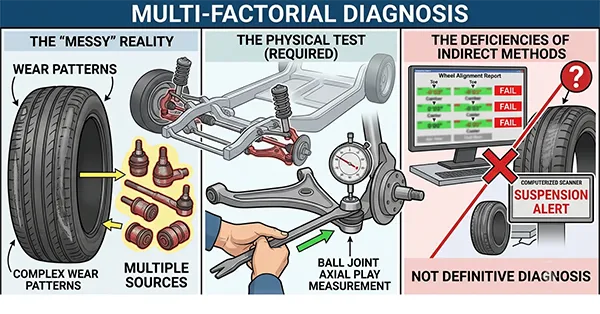
In our experience working with aftermarket customers across multiple regions, tire wear complaints are rarely clean. A vehicle with a worn ball joint often also has worn tie rod ends, aging bushings, or deferred alignment. The wear pattern reflects all of those inputs together. Identifying ball joint wear as the source requires checking joint clearance directly — a physical test of the joint, not just a reading of the tire.
This is relevant to procurement for a specific reason. When a buyer sources ball joints from a supplier with inconsistent quality and receives warranty claims involving tire wear, the root cause analysis is difficult. The end user may have other worn components. Alignment may have drifted. Tire pressure may have been low. The ball joint problem hides behind the noise of co-factors.
A well-manufactured ball joint with controlled preload and consistent dimensional tolerances removes one variable from that picture. It does not eliminate all sources of tire wear. But it ensures that the joint itself is not accelerating the problem from the start.
The co-factors worth naming clearly:
- Wheel alignment offset: Even a small toe or camber deviation at the alignment stage will produce shoulder or feathering wear4 independent of ball joint condition.
- Tire pressure: Persistent underinflation causes both-edge wear. Overinflation causes center wear. These are not suspension problems.
- Control arm bushings: Worn bushings allow the control arm to shift position under load — producing the same dynamic camber change as a worn ball joint.
- Driving conditions: High-mileage highway driving, frequent cornering, and heavy load operation all accelerate wear on both tires and joints. The same joint quality will produce different outcomes in different operating environments.
Procurement teams evaluating ball joint suppliers need to account for these co-factors when reviewing field complaints. A single warranty claim involving tire wear is not sufficient evidence of a ball joint quality problem. A pattern of claims, concentrated in specific vehicle applications or market conditions, is much more informative.
What Does This Mean for Ball Joint Sourcing Decisions?
For aftermarket buyers, the question is not just whether a bad ball joint causes tire wear. The question is whether the joint you are sourcing will fail in a way that causes tire wear downstream.
A ball joint that starts service life with excess clearance, or loses preload too quickly due to low-grade materials or inconsistent manufacturing, will produce the same wear patterns as a fully worn OE part — but much earlier in its service life. This makes the quality problem hard to detect at the point of sourcing and very visible at the point of customer complaint.
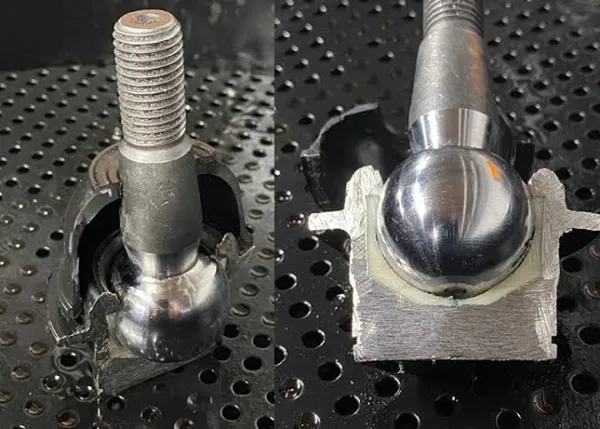
This is where manufacturing consistency matters more than price. Two ball joints may look identical in a catalog photo. One may be manufactured to controlled dimensional tolerances with verified preload. The other may have passed a basic visual inspection but carries excess clearance from the production line. In the field, the second part will begin altering wheel geometry from the first kilometers of use. The buyer will not know this until the tire wear complaint arrives — weeks or months later, from a distributor in another country.
At GDST, we see this type of complaint regularly in procurement inquiries and after-sales communications from customers who have switched suppliers. The pattern is consistent: the initial quality inspection passed, the product looked acceptable, and the problem only appeared after the product had been in use long enough for tire wear to become visible to the end user. By that point, the reputational and financial cost of the warranty claim is already in motion.
The manufacturing variables that matter most for ball joint clearance control include:
| Manufacturing Variable | Quality Impact | Failure Risk if Uncontrolled |
|---|---|---|
| Socket material grade | Determines wear resistance of bearing surface | Rapid clearance increase after initial use |
| Preload specification | Controls initial joint stiffness and movement feel | Early looseness, premature geometry deviation |
| Dimensional tolerance on ball stud | Affects fit between stud and socket | Excess clearance from day one |
| Dust boot material and seal integrity | Protects joint from contamination | Accelerated internal wear from abrasion |
| Surface treatment on stud | Corrosion resistance under road conditions | Pitting and clearance increase in wet climates |
Buyers who evaluate suppliers only on price and delivery time are not seeing the variables that determine field performance. The factors above are what separate a joint that lasts within its rated service life from one that produces warranty claims in the first year.
Conclusion
A worn ball joint can cause uneven tire wear by increasing clearance and shifting wheel camber under load. The pattern and severity depend on the failure stage, the vehicle, and the co-factors involved. For procurement teams, the real risk is sourcing a joint that fails early and silently — producing tire wear before the quality problem is visible.
"What Are Ball Joints? | UTI - Universal Technical Institute", https://www.uti.edu/blog/automotive/ball-joints. Automotive engineering references describe ball joints as spherical bearings that connect the control arm to the steering knuckle or wheel hub assembly, allowing rotational movement while maintaining structural connection. Evidence role: mechanism; source type: education. Supports: the mechanical connection between ball joints, wheel hubs, and control arms in suspension systems. Scope note: Technical descriptions may vary slightly by suspension design (MacPherson strut vs. double wishbone), but the fundamental connection principle remains consistent. ↩
"A STUDY OF PARAMETERS INFLUENCING THE VEHICLE WHEEL ...", https://ninercommons.charlotte.edu/record/746?ln=en. Automotive diagnostic literature notes that conventional alignment equipment measures wheel angles under static, unloaded conditions, which may not reveal geometry deviations that only manifest under dynamic loading when worn joints permit movement. Evidence role: general_support; source type: education. Supports: the limitations of static alignment measurements in detecting early-stage suspension joint wear. Scope note: The detectability threshold varies with alignment equipment sensitivity and the specific measurement protocol used. ↩
"[PDF] A STUDY OF PARAMETERS INFLUENCING THE VEHICLE WHEEL ...", https://ninercommons.charlotte.edu/record/746/files/Patel_uncc_0694N_11115.pdf. Suspension diagnostic manuals identify worn control arm bushings as a source of alignment instability, as deteriorated bushings permit excessive control arm movement, allowing wheel position to shift under load and producing tire wear patterns similar to those from worn ball joints. Evidence role: general_support; source type: education. Supports: how worn control arm bushings affect wheel alignment and tire wear. ↩
"Alignment Information and Vocabulary", https://brakes.siu.edu/alignment.htm. Tire wear research indicates that even alignment deviations within or slightly beyond manufacturer specifications can produce measurable differences in tread wear patterns over time, with toe misalignment typically causing feathering and camber deviation producing shoulder wear. Evidence role: general_support; source type: research. Supports: how minor alignment deviations affect tire wear development. Scope note: The rate of wear development depends on multiple factors including tire construction, inflation pressure, vehicle load, and driving conditions. ↩