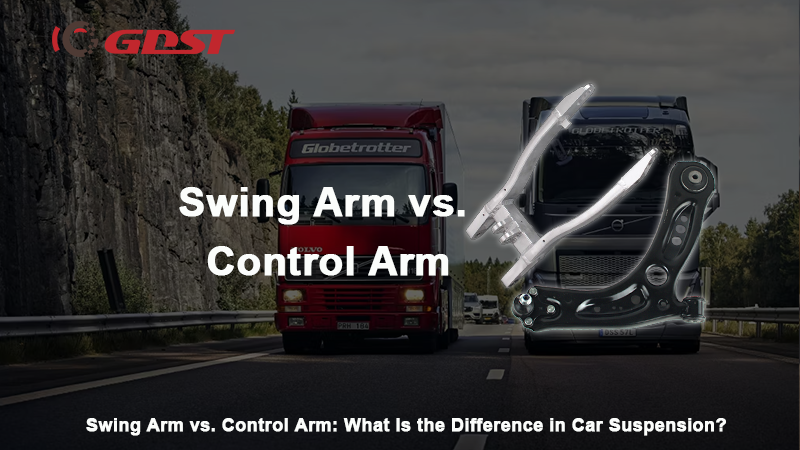
The core difference between a swing arm vs. control arm lies in their pivot axis and how they manage wheel travel. A control arm (often called an A-arm) typically uses multiple pivot points to manage lateral stability and vertical movement. In contrast, a swing arm suspension pivots on a single longitudinal or transverse axis, commonly seen in motorcycle rears and specific trailing arm vs. control arm car configurations. Understanding the role of the suspension swing arm is essential for maintaining vehicle alignment and handling precision.
Understanding the Swing Arm Suspension System
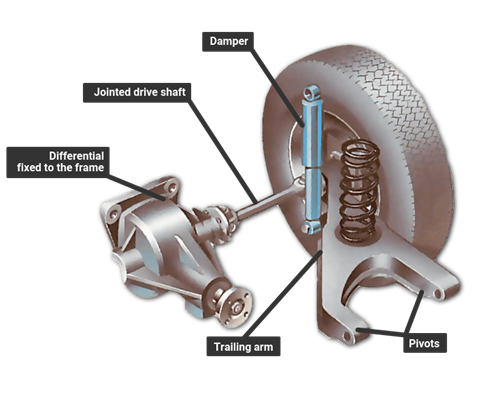
In the automotive world, the term suspension swing arm is frequently used interchangeably with “trailing arms,” especially when discussing rear-axle setups. A swing arm car design is valued for its mechanical simplicity and space-saving properties.
Unlike a complex multi-link setup, the swing arm suspension moves in a predictable arc. While this design is iconic in motorcycles, in cars, the swing arm car configuration helps maintain a consistent wheelbase during heavy acceleration. However, because it has fewer pivot points than a control arm, it requires high-quality bushings to prevent unwanted arm sway and vibration.
What Do They Have in Common?
Before diving into the swing arm vs. control arm differences, it is important to recognize that they share the same fundamental DNA within a suspension swing arm system. Both components are essential structural members designed to:
- Locate the Wheel: Both parts serve as the primary link between the wheel hub and the vehicle chassis.
- Support Body Weight: They provide a mounting point for springs or shocks to manage the vehicle’s load.
- Absorb Road Shock: Both rely on high-quality bushings to dampen vibrations and prevent metal-on-metal contact.
- Regulate Movement: They ensure the wheel travels in a controlled path, preventing unpredictable “shifting” during acceleration or braking.
Trailing Arm vs. Control Arm: Key Differences
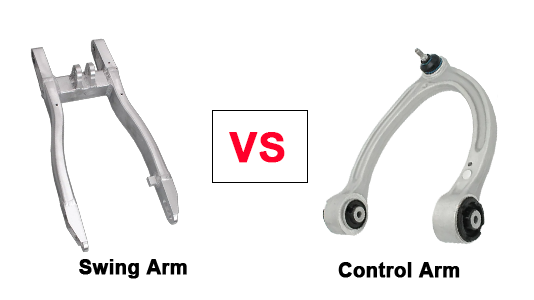
When enthusiasts debate trailing arm vs. control arm, they are usually comparing two different ways to handle road forces.
- Control Arm: Designed to manage lateral (side-to-side) forces. It keeps the wheel perpendicular to the road during turns.
- Trailing Arm (Swing Arm): Primarily manages longitudinal (front-to-back) forces. It “trails” the chassis, pulling the wheel behind a forward pivot point.
In many modern vehicles, a suspension swing arm works in tandem with a control arm to create a multi-link system. Understanding this control arm vs. trailing arm relationship is vital for diagnosing handling issues.
Table: Comparison of Swing Arm vs. Control Arm
| Feature | Swing Arm Suspension | Control Arm (A-Arm) |
| Pivot Axis | Single axis (Longitudinal) | Multiple points (Horizontal) |
| Movement Type | Up-and-down arc | Complex vertical travel |
| Primary Strength | Longitudinal load handling | Lateral stability & cornering |
| Common Use | Swing arm car rear axles | Front-end independent suspension |
Where Are They Located?
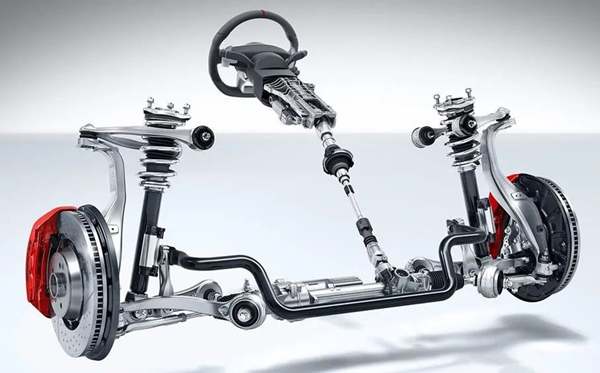
One of the easiest ways to identify a swing arm vs. control arm is by looking at its position under the vehicle:
- Control Arm Location: Usually found in the front suspension, connecting the steering knuckle to the frame. In independent rear suspensions, they may also be used to manage camber.
- Swing Arm (Trailing Arm) Location: Predominantly located at the rear axle. The pivot point is usually toward the front of the vehicle, with the arm reaching back to “trail” the wheel hub—hence the term swing arm car or trailing arm setup.
Signs of Failure: Bad Symptoms and Maintenance

Whether your vehicle uses a swing arm vs. control arm, the rubber bushings and joints are the first to fail. A worn suspension swing arm can lead to a “loose” feeling in the rear of the vehicle, while a bad control arm often causes steering wander.
Common signs of a failing arm sway stabilizer or arm include:
- Uneven Tire Wear: Often caused by a bent swing arm suspension.
- Clunking Noises: A classic symptom in the control arm vs. trailing arm connection points.
- Vibration: Felt through the chassis when suspension swing arm bushings dry rot.
If you suspect your front-end components are failing, it’s important to understand the financial side of repairs. You can consult our detailed guide on ‘lower control arm replacement costs and symptoms of failure’ to help you budget for a professional suspension overhaul.
Engineering Excellence: The GDST Advantage
At GDST Auto Parts, we understand that a swing arm car is only as reliable as its components. While some aftermarket parts might feel like an “evil swingarm” that ruins your alignment, our products are engineered for precision.
- Material Strength: Our suspension swing arm replacements are made from reinforced steel to handle high-stress loads.
- Precision Bushings: We use high-density rubber to eliminate the arm sway common in lower-quality parts.
- Custom Solutions: From standard replacements to specialized swingarm extension kit components, we provide factory-direct expertise.
FAQ For You
Is a swing arm the same as a trailing arm?
In the context of car suspension, yes. The suspension swing arm is a type of trailing arm that pivots to allow the wheel to move up and down.
Can a bad swing arm affect my alignment?
Absolutely. A bent swing arm vs. control arm will change the toe and camber of your wheels, leading to rapid tire wear and poor fuel economy.
Why choose GDST for suspension parts?
With 20 years of experience as a professional manufacturer in China, GDST provides the perfect balance of OEM quality and wholesale pricing for all control arm vs. trailing arm needs.