If you’ve been sourcing control arms for a while, you’ve probably faced this question more than once:
Should you go with OEM, or choose aftermarket?
At first, it seems like a simple comparison — OEM sounds more reliable, aftermarket sounds more affordable.
But once you start requesting quotes and dealing with suppliers, things quickly become less clear.
- Some aftermarket products perform just as well as OEM
- Some OEM-priced products don’t justify the cost
- Price differences don’t always reflect real quality differences
So the real question is not: “OEM vs aftermarket control arms: which one is better?”
But: “Which one is more suitable for your market and business model?”
If you’re also comparing supplier options, you may want to check our guide on Top 10 Control Arm Manufacturers in China.
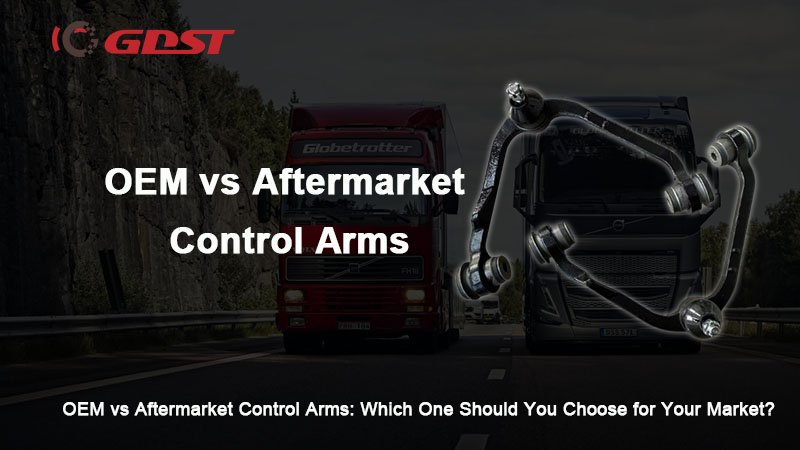
OEM vs Aftermarket Control Arms
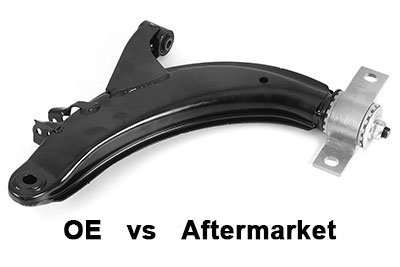
- OEM control arms offer more consistent quality and standardized specifications
- Aftermarket control arms offer more flexibility in pricing, configuration, and product range
👉 In practice:
- OEM is often preferred in markets that value stability and brand perception
- Aftermarket is widely used in price-sensitive and volume-driven markets
👉 The best choice depends on:
- your target customers
- your pricing strategy
- your positioning in the market
What OEM and Aftermarket Really Mean
Let’s keep this simple.
- OEM (Original Equipment Manufacturer)
→ produced according to original factory standards - Aftermarket
→ produced by third-party manufacturers, not tied to the original brand
Here’s the important part many people misunderstand:
👉 Aftermarket does not mean low quality
In reality:
- some aftermarket manufacturers produce very stable, high-quality products
- others focus purely on low cost
👉 The difference is not the category — it’s the supplier behind it
Key Differences That Actually Affect Your Business
Instead of looking at definitions, it’s more useful to focus on how OEM and aftermarket affect your day-to-day business.
Product Consistency

OEM products are generally:
- more standardized
- more consistent across batches
Aftermarket products:
- can vary significantly depending on the manufacturer
👉 This means:
- OEM reduces risk
- aftermarket requires better supplier selection
Price Range
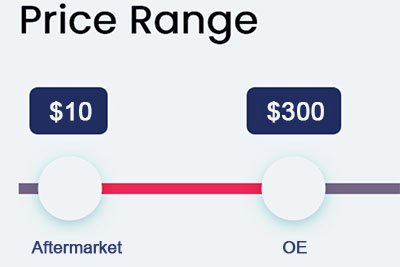
OEM products are usually:
- priced higher
- less flexible in negotiation
Aftermarket products:
- cover a wide price range
- can be adjusted based on configuration and quality
👉 This is why the aftermarket dominates in many export markets.
If you want a deeper breakdown, you can also refer to our Control Arm Price Guide.
Flexibility and Product Range
OEM:
- limited to original specifications
- less flexibility
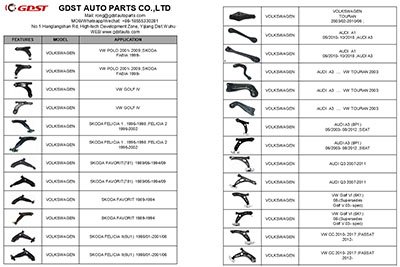
Aftermarket:
- wider OE coverage
- more options (different materials, configurations)
👉 This is especially useful if you:
- handle multiple vehicle models
- want to expand your product line
Branding and Market Positioning
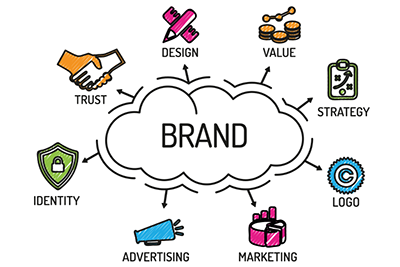
This is often overlooked, but very important.
OEM:
- easier to position as “high-end.”
- suitable for customers who value brand and reliability
Aftermarket:
- more suitable for private label
- better for building your own brand
👉 For distributors, the aftermarket often offers more long-term opportunities.
Which One Should You Choose Based on Your Market
There is no universal answer — but there is a practical way to decide.
If Your Market Is Price-Sensitive
👉 Go with aftermarket
Typical markets:
- developing regions
- highly competitive wholesale markets
Customers care more about:
- price
- availability
👉 The key is choosing a stable aftermarket supplier, not just the cheapest one.
If Your Market Focuses on Stability and Fewer Complaints
👉 Consider OEM or high-quality aftermarket
Typical scenarios:
- customers expect longer lifespan
- lower tolerance for defects
👉 In this case:
- consistency matters more than price
If You Are Building Your Own Brand
👉 Aftermarket is usually the better choice
Why:
- more flexibility in pricing
- easier to customize packaging and branding
- better control over your product line
👉 This is how many distributors grow from traders into brand owners.
Real Cost Difference: What Buyers Should Really Care About

Many buyers focus only on purchase price.
But experienced importers look at total cost of control arms.
What Actually Impacts Your Profit
- purchase cost
- return rate
- warranty cost
- customer satisfaction
👉 A cheaper product may:
- save money upfront
- but create more problems later
The Key Insight
👉 Lower price does not always mean lower cost
In many cases:
- slightly higher-quality products reduce complaints
- stable suppliers reduce operational stress
👉 Over time, this is what improves profitability.
Common Mistakes When Choosing Between OEM and Aftermarket
Assuming OEM Is Always Better
Not necessarily.
Some aftermarket manufacturers:
- match OEM quality
- offer better pricing
👉 The key is evaluation, not assumption.
Choosing Aftermarket Only Based on Price
This is one of the most common mistakes.
👉 Lowest price often means:
- lower material quality
- less consistency
Ignoring the Supplier Behind the Product
This is the biggest mistake.
👉 OEM vs aftermarket is not the real issue
👉 The real question is:
Who is producing the product?
A strong aftermarket supplier is often better than a weak OEM source.
How This Connects to Your Supplier Choice
At the end of the day, your decision should not stop at product type.
You still need to evaluate:
- supplier capability
- quality control
- consistency
👉 If you haven’t done this yet, refer to our guide on
How to Choose a Reliable Control Arm Manufacturer in China
Conclusion: There Is No “Better”, Only “More Suitable”
OEM and aftermarket are not competitors — they are tools.
👉 The right choice depends on:
- your market
- your customers
- your business strategy
Experienced buyers don’t ask:
“OEM vs Aftermarket Control Arms: Which one is better?”
They ask:
“Which one helps me run a more stable and profitable business?”
Get in Touch
If you’re currently deciding between OEM and aftermarket control arms, the right choice often depends on your specific market and product strategy.
If you’d like a second opinion or want to compare options based on real cases, feel free to reach out — sometimes a short discussion can save you a lot of trial and error.
Frequently Asked Questions
Not always. Some aftermarket manufacturers can match OEM quality, depending on their production standards.
Yes, if you work with a reliable supplier. Quality varies significantly between manufacturers.
Aftermarket is usually more suitable due to flexibility, pricing, and branding opportunities.
In many cases, yes — especially when produced by experienced manufacturers with good quality control.